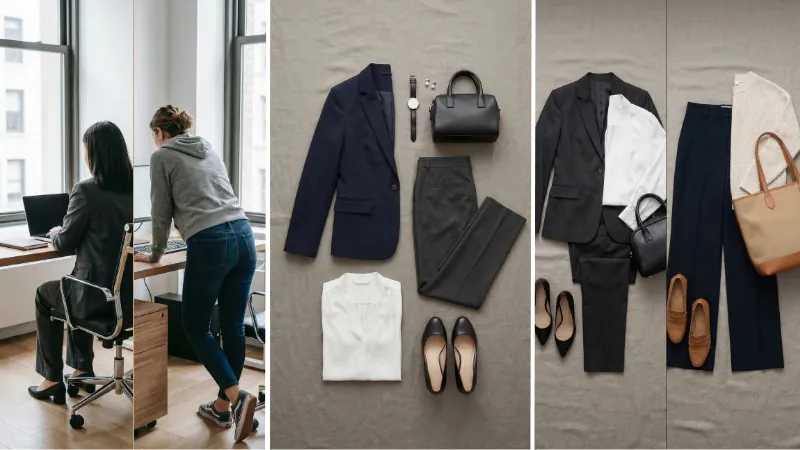
Business Dress Code for Women: Decoding the Unspoken HR Rules

Corporate handbooks defining the Business Dress Code for Women usually trigger severe morning paralysis. Watched seasoned executives freeze in front of their closets, attempting to translate vague HR terminology before surrendering to the exact same limp wool-blend separates. This constant hemline ambiguity and contradictory footwear protocol creates a bureaucratic textile maze.
Spent months mapping the unspoken rules of the corporate floor to dismantle this exact sartorial gridlock. Extracted the rigid structural requirements for every single tier, from boardroom formalities to open-plan Fridays. Built this definitive guide to the Business Dress Code for Women to eliminate your daily guesswork and establish a highly functional wardrobe matrix.
Dress Codes Decoded: What Every Level Actually Means
You’ve just accepted the offer. The contract says “business professional attire.” And you’re standing in your bedroom at 7am, genuinely unsure if that means a full suit or just no jeans.
This is not a personal failing. It’s a communication failure. Dress codes are written for legal coverage, not for clarity.
Here’s the thing most people miss: a dress code is not a fashion preference. It’s a signal system. It tells clients, colleagues, and the room what category of professional they’re dealing with before anyone opens their mouth. Understanding it that way changes how you approach it.
There are five levels of business attire for women, moving from most to least formal. They are not interchangeable.
- Business Formal — full suits, structured dresses with matching jackets, closed-toe heels. This is courtrooms, investment banking, C-suite presentations.
- Business Professional — suits or tailored separates, conservative colors, polished shoes. Law firms, corporate finance, formal client-facing roles.
- Business Casual — the level most offices claim to be. Trousers, blouses, blazers, clean flats. The ambiguity lives here.
- Smart Casual — structured but relaxed. Dark jeans are usually fine. Sneakers, sometimes. Tech companies, creative agencies, startups with funding.
- Casual — no real rules, within reason. Rare in client-facing environments.
Each level has a default setting. The problem is that the label rarely matches the reality.
| Dress Code Level | Definition | Typical Setting | Required | Forbidden |
|---|---|---|---|---|
| Business Formal | Highest standard. No exceptions, no interpretation. | Courtrooms, investment banking, formal hearings, government | Matched suit or formal dress with jacket, closed-toe heels or polished flats, neutral hosiery | Bare legs (in many settings), open-toe shoes, bold prints, any visible casual item |
| Business Professional | Polished, conservative, no ambiguity. Suits or structured separates. | Law firms, corporate finance, consulting, traditional client-facing roles | Tailored trousers or skirt, blazer or structured jacket, collared or conservative blouse, heels or clean leather flats | Denim, athletic wear, graphic tees, open-toe sandals, overly casual knits |
| Business Casual | Professional but relaxed. The most misread category in existence. | Open-plan offices, mid-size companies, most non-client-facing corporate roles | Tailored trousers or chinos, blouse or knit top, optional blazer, clean footwear | Ripped anything, graphic prints, athletic shoes, visible loungewear fabrics |
| Smart Casual | Intentional, put-together, but visibly relaxed. Think: neat, not stiff. | Tech companies, creative agencies, startups, internal team environments | Dark jeans acceptable, clean trainers sometimes fine, structured tops, layering pieces | Activewear, torn denim, anything that reads “I wasn’t planning to leave the house” |
| Casual | No enforced standard. Wear what you want, within basic decency. | Remote-first companies, fully internal teams, some creative fields | Nothing specific. Personal judgment applies. | Truly nothing enforced, but anything offensive or unsafe is still a problem |
My take: business dress code guidelines for women are always written by someone who doesn’t have to wear them every day, and that’s why they’re almost always useless in practice.
The HR Handbook vs. Office Reality

The handbook says “business casual.” You arrive on day one in tailored trousers and a blazer. Your manager is in jeans and a fleece. Someone from finance is in a hoodie. Nobody is wearing what the handbook described.
This happens constantly. And it matters, because dressing too formally in a casual office signals that you haven’t read the room. Dressing too casually in a professional one signals something worse.
The fastest way to calibrate in your first week: watch the senior women. Not the interns. Not the junior hires who are also figuring it out. The women who’ve been there five years and are still getting promoted. What they wear on a regular Tuesday is your baseline.
There’s a second layer to this. “Client-facing” and “back-office” are not the same dress code, even in the same company. If your role puts you in front of clients, external partners, or stakeholders, the unwritten rule is one level more formal than the internal team. Always. Nobody will tell you this explicitly.
- Client presentation day: add a blazer, swap the loafers for something with a heel or a cleaner sole
- Internal meeting day: the baseline is fine, comfort is acceptable
- No-meeting desk day: still not the day for the hoodie, but ease is allowed
The business attire distinction between women in business professional vs. business casual roles is not just about aesthetics. It’s about what your clothes communicate before your work does.
This won’t work if your company has recently been acquired, merged, or is in the middle of a culture overhaul. In those environments, the “senior women” signal is unreliable because norms are actively shifting and nobody agrees on what the new standard is. In that case, skip the observation game entirely. Email HR. Ask directly what the expected dress standard is for your role and team. It is not an embarrassing question. It is a practical one.
Blunt truth: most dress code confusion is actually anxiety in disguise. The clothes are solvable. The real problem is not wanting to get it wrong in a new environment. Reading the room is the skill. The clothes are just the output.
One more thing on the what is business professional attire question that nobody seems to answer plainly: it requires structure. That’s the physics of it. A blazer reads as professional because the shoulder construction holds a shape your body wouldn’t naturally create on its own. That shape signals formality. A soft knit, regardless of how expensive it is, doesn’t hold the same geometry and reads differently in a fluorescent-lit boardroom.
Business Professional Attire: The Full Item-by-Item Breakdown
You bought a blazer you love. Good fabric, good color, fits through the shoulder. Then you paired it with the wrong trousers and the whole outfit reads wrong — not obviously wrong, not unprofessional in a way you can name, but off in the way that interviewers notice before they know why.
That’s the problem with business professional. The gap between “looks okay” and “reads correctly” is small. But it’s not invisible.
First: yes, women can absolutely wear trousers in business professional settings. Full stop. The question isn’t the silhouette. It’s the execution. Tailored fit, pressed fabric, no cargo pockets, no stretch panels. Those are the actual rules.
Before the item breakdown, the non-negotiables:
- Full coordination is required. Separates that almost match are worse than separates that don’t try to match at all.
- No distracting prints. A subtle windowpane check is fine. A graphic floral is not.
- Closed-toe shoes. This is not a guideline. It’s the floor.
- Fabric needs structure. Knits, jersey, anything that drapes softly — those belong in business casual, not here.
My take: Business professional isn’t about spending more money. It’s about making fewer wrong choices. The checklist above eliminates most of them before you’ve touched your wardrobe.
| Item | What It Looks Like | Key Tips |
|---|---|---|
| Suit | Matched jacket and trouser or skirt in structured fabric — wool, ponte, or a wool blend. Navy, charcoal, black, or medium grey. | Jacket sleeves should end at the wrist bone. Trousers should break cleanly at the shoe. If either is off, the suit reads sloppy regardless of the price tag. |
| Blazer | Structured jacket worn as a separate. Only works here if the bottom is equally formal — matching suit trousers or a tailored skirt in a coordinated neutral. | Shoulder seam must sit at your actual shoulder. If it drops, the whole jacket falls wrong and no amount of good tailoring elsewhere fixes it. |
| Blouse / Shirt | A structured button-down or woven blouse. Silk, silk-look polyester, or a cotton poplin. Tucked in. | Neckline should be conservative — nothing lower than two fingers below the collarbone. Sleeves at least to the elbow. |
| Trousers | Tailored fit in a structured fabric. Pressed. No visible stretch. Flat front preferred. | Hem length matters. Too long and they bunch. Too short and the break disappears entirely. Both read unprofessional in different ways. |
| Skirt / Dress | Pencil skirt or A-line at or below the knee. Sheath dress with a jacket over it counts. | Hem at the knee or longer. If the skirt rides up when you sit, it’s the wrong length for this context. |
| Shoes | Closed-toe pumps, block heels, or pointed flats in black, nude, or dark brown leather. | No open toe. No platform. No sneakers of any kind, including leather ones. Scuffed shoes undermine an otherwise correct outfit faster than anything else. |
| Accessories | Minimal. Stud earrings, a watch, a structured bag. That’s a complete accessory set at this level. | Statement jewelry has its place. This isn’t it. The outfit is the point, not the earrings. |
Suits, Blazers & Coordinated Sets
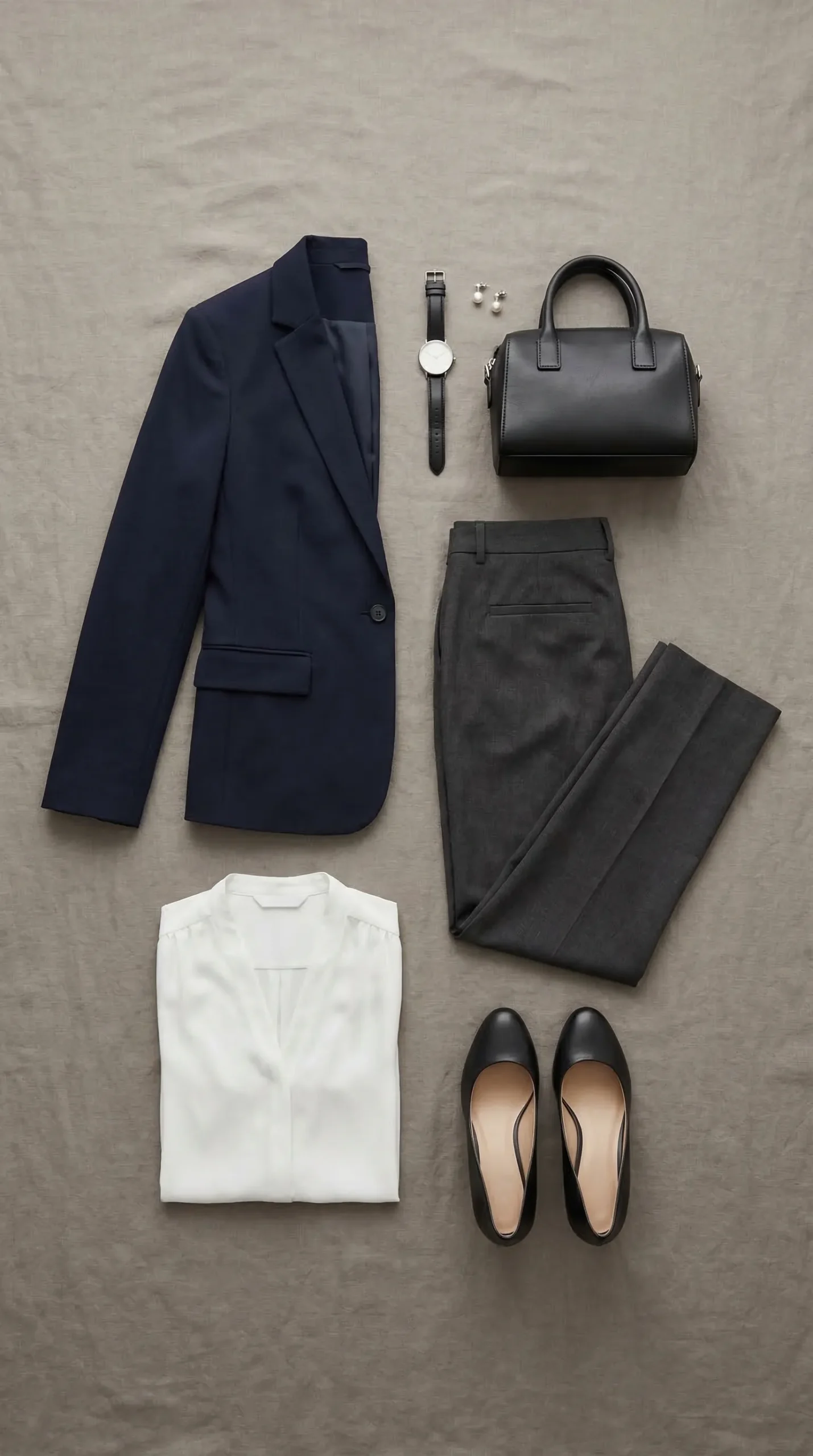
A matched suit means the jacket and trouser are cut from the same fabric bolt. Coordinated means they’re in the same color family but not identical. Both are acceptable in women’s business professional attire. The distinction matters because they communicate slightly different things to the room.
A matched suit is unambiguous. It reads as intentional. Coordinated separates can work just as well, but they require more precision — if the tones are even slightly off under fluorescent light, the whole look falls apart.
Fabric rules at this level are straightforward. Wool and structured wool blends are the standard. Ponte works if it has real body to it. Linen does not belong here. Neither do anything with visible texture variation or bright pattern.
Blunt truth: A perfectly tailored suit in the wrong size is not a tailored suit. It’s a size problem wearing good fabric. Poor fit undermines formality faster than any other variable because it signals that you didn’t notice — or didn’t care.
Color: navy, black, charcoal grey, and mid-grey cover 95% of business professional situations for women. Camel and soft taupe work in certain industries. Bright colors, deep jewel tones used as a base — those are style choices that may read correctly in some rooms and incorrectly in others. At the level of professional business attire for women, conservative is not a weakness. It’s strategy.
Trade-off: A matched suit is the most formally correct option and also the least flexible. You can’t split the pieces and wear them separately without the other half looking like a spare.
Tops, Blouses & Shirts
The top is where business professional gets undermined most often. Not with dramatic mistakes. With small ones. A jersey knit that looks structured on the hanger. A blouse that gaps at the button placket. A fabric that wrinkles by 11am.
What makes a top correct at this formality level is structure. Not stiffness — structure. A woven fabric holds its shape. A knit doesn’t, not under a jacket, not after three hours of sitting. That’s the difference.
- Button-down shirts in cotton poplin or a cotton blend: reliable, pressable, professional.
- Structured blouses in silk or silk-look polyester: slightly softer, still appropriate, harder to keep wrinkle-free.
- Shell tops in structured fabric worn under a matching blazer: works when the rest of the outfit is doing enough formal weight.
Neckline: no lower than two fingers below the collarbone. That’s a practical rule, not a moral one. It’s the line where business professional stops reading as business professional. Sleeves should reach at least to the elbow. Sleeveless is possible if the jacket stays on — but that’s a constraint worth knowing before you leave the house.
My take: Off-shoulder, cold-shoulder, or anything cut specifically to show shoulder skin does not belong in this category regardless of the fabric or the price.
Shoes & Accessories for Business Professional
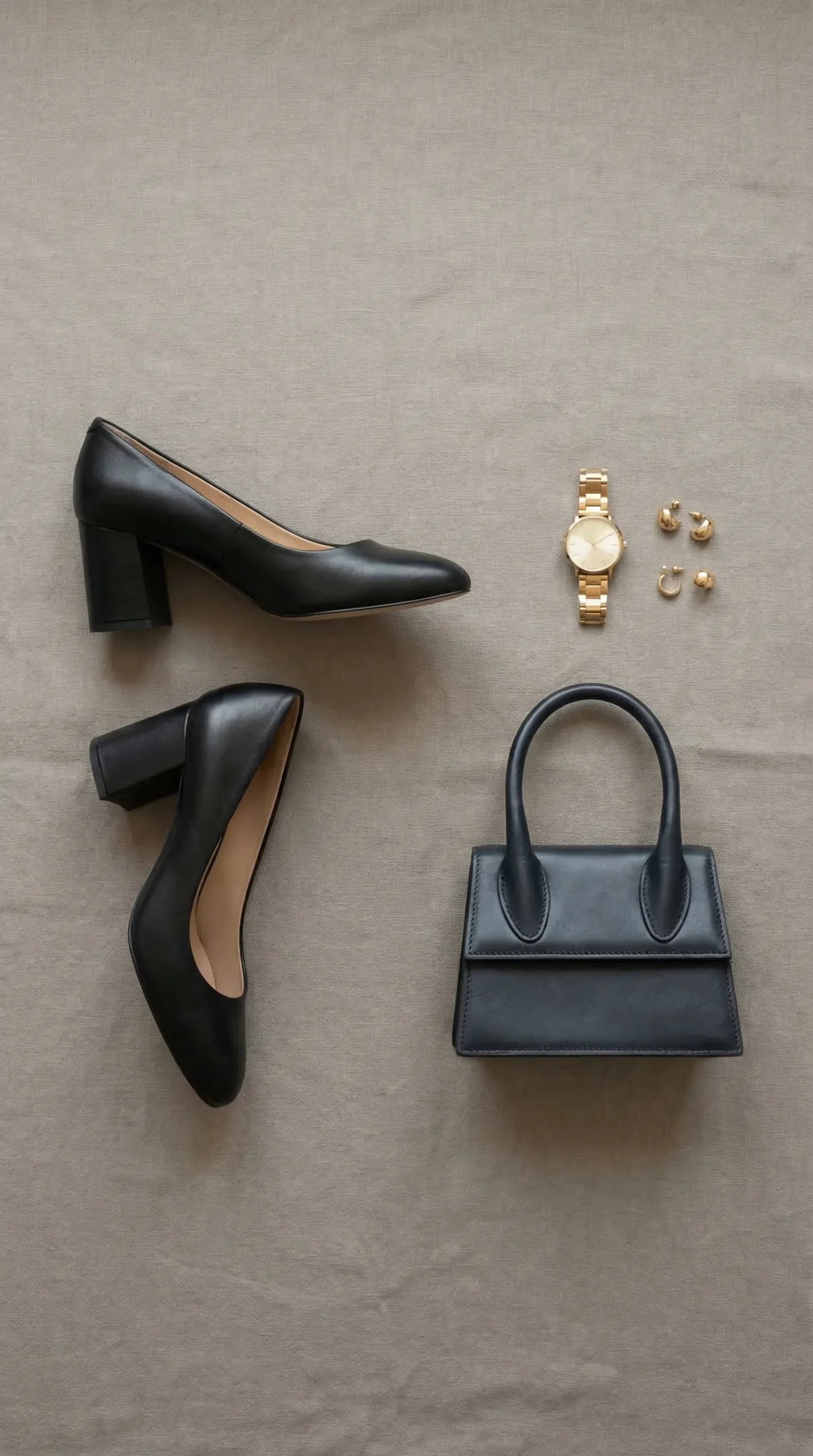
Closed-toe shoes are the requirement. Not a strong preference. The requirement. Business dress code standards for women at this level are clear on this, and they haven’t changed because sneakers got expensive.
What works: closed-toe pumps, block heels, pointed flats, low kitten heels. In black, dark brown, or nude. Leather or leather-look. Clean and unscuffed.
What doesn’t: open-toe anything, platform soles, mules, sandals, sneakers (leather or otherwise), and anything with a novelty detail — bow, metallic stud, cutout. Those details read as casual at this formality level regardless of how they’re styled.
On heel height: function over fashion is not a compromise here, it’s the correct framework. A 3-inch heel that you can’t walk steadily in creates a different problem than no heel at all. Business attire for women includes the way you move in it. A block heel at 2 inches covers every room this outfit needs to enter.
Trade-off: Pointed-toe flats are the most versatile closed-toe option at this level and also the most unforgiving in fit. Half a size off and you feel it by noon.
Accessories: the edit matters more than the individual pieces. Stud earrings or small hoops. A watch, if you wear one. A structured bag — not a tote, not a backpack, not a cross-body with a logo the size of your hand. That’s a complete set. Nothing needs to be added to it.
Statement necklaces, stacked bangles, earrings that move visibly when you turn your head — all of those shift the attention off the outfit and onto the jewelry. At this level, that’s not what the accessories are for.
Blunt truth: A scuffed shoe ruins a correct outfit more reliably than a wrong shoe in good condition. Polish them or replace them.
Business Casual Attire: What Works, What Crosses the Line
She pulls on dark jeans and a blazer. Feels good. Walks into a room of tailored trousers and structured blouses and immediately knows she read it wrong.
That moment is not about being underdressed. It is about miscalibration. And it happens because business casual is one of those dress codes that sounds self-explanatory until you are standing in front of your closet at 7 AM with no idea what actually qualifies.
Here is the short version: business casual means polished separates, not a full suit. No tie. No matching jacket-and-trouser set required. But also not jeans-and-a-tee because technically both are separate items.
The business attire women navigate at this level sits in the middle ground between boardroom and weekend. Structure is still present. Fit still matters. The difference is that a blazer can replace a suit jacket, trousers can replace a full suit, and a dress does not need to be formal to work.
Blunt truth: Most women do not struggle with being overdressed for business casual. They struggle with underdressing and calling it relaxed.
What does not belong, specifically:
- Ripped, distressed, or faded denim in any wash
- Graphic tees, slogan tees, anything with a band name or logo
- Athletic wear — leggings, track pants, zip-up hoodies, running shoes
- Flip-flops, slides, or anything open-toed and completely flat unless the office explicitly runs casual
- Visible undergarments, including bra straps worn as an intentional detail
- Very short hemlines (more than two inches above the knee in most professional settings)
- Sheer tops worn without a substantial layer underneath
Those are the lines. Crossing one does not ruin a career. But it does register, and usually at the wrong moment.
| Category | Acceptable for Business Casual | Leave It at Home |
|---|---|---|
| Tops | Silk or woven blouses, structured knit tops, tailored button-downs, fine-gauge sweaters | Graphic tees, logo tees, cropped tops, sheer blouses without a layer, tank tops worn alone |
| Bottoms | Tailored trousers, ponte pants, dark non-distressed denim (paired correctly), A-line or pencil skirts at or below the knee | Ripped or faded jeans, leggings, athletic shorts, mini skirts, anything with a drawstring waist |
| Dresses | Sheath dresses, wrap dresses in structured fabric, shirt dresses, midi dresses with defined waistlines | Sundresses, strapless dresses, bodycon styles, slip dresses worn as outerwear |
| Layers | Blazers, structured cardigans, tailored jackets, longline vests in woven fabric | Zip-up hoodies, oversized fleece, denim jackets in casual washes, puffer vests as a top layer indoors |
| Shoes | Low-heeled pumps, loafers, block-heeled sandals, leather or leather-look ankle boots, clean leather flats | Running shoes, flip-flops, heavily distressed boots, platform sneakers, anything with visible athletic branding |
The Jeans Question
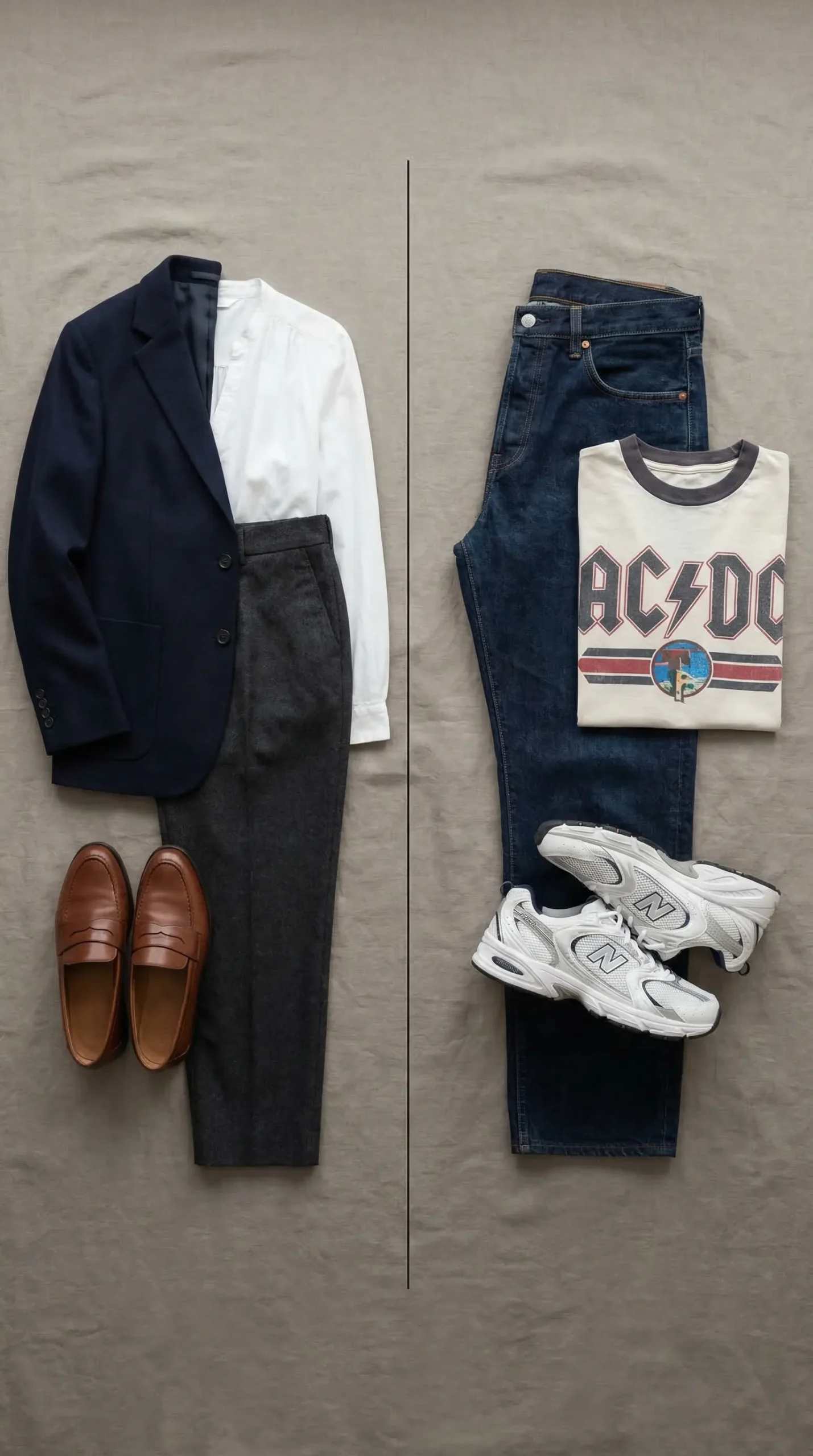
Dark jeans can work. That is the honest answer. But two conditions have to be met, and both matter equally.
First: the fabric. Dark-wash denim in a structured, non-stretch twill reads more formal than a soft, jersey-feel denim because it holds its shape through a full day. When denim goes limp at the knee or pulls at the thigh by 2 PM, it reads casual regardless of the color.
Second: the pairing. Dark jeans under a structured blazer, with a blouse and a low heel, can read as modern business attire. The same dark jeans with a tucked-in tee and white sneakers do not — even if the tee is expensive.
The business dress code women are navigating in most mid-level corporate environments does not automatically disqualify jeans. It disqualifies jeans that look like jeans.
My take: If you are reaching for jeans on a day when you have a meeting, do the pairing honestly. Would the outfit read as polished if you swapped the jeans for trousers? If yes, the jeans are probably fine. If the whole look falls apart without the trouser swap, stay with the trousers.
Trade-off: Dark denim is less versatile than it looks. It holds up well under artificial light but can read too casual in natural light-heavy spaces like glass-walled conference rooms. That is a real limitation worth knowing.
Business Casual for Plus Size Women
Most fit advice assumes a straight-size body. The instructions are the same — structure, proportion, tailoring — but the execution looks different, and that gap is real.
The core issue for business casual plus size women is not finding clothes that fit. It is finding clothes that are both structured enough for the office and cut for a curvier frame without compromising on either.
Proportions are the actual framework here. Not rules about what to “hide.” Proportions.
A wrap dress is a good example. It works on many body types because the wrap construction creates a defined waistline without relying on a fixed seam. But to keep it office-appropriate as a piece of business attire for women at any size, the fabric needs to stay structured. Jersey wrap dresses in thin fabric tend to cling through the hip and pull at the chest over the course of a day. A ponte or thick woven wrap holds its shape.
- Structured knit fabrics (ponte, scuba, thick jersey) hold shape without adding bulk and require less tailoring than woven fabrics
- Straight-leg or wide-leg trousers with a mid-to-high rise are more forgiving than slim cuts because they do not compress the hip or thigh
- Blazers with a defined shoulder and a single button closure create clean vertical lines without requiring a belt or cinched waist
- A-line skirts at or below the knee work across most proportions because the shape moves with the body rather than against it
For business professional attire plus size women, the same logic applies as it does at any size: fit at the widest point first, then tailor from there. A jacket that pulls across the back or a trouser that gaps at the waist is a fit problem, not a style problem.
When shopping, the criteria to look for are: a back vent or kick pleat in skirts and structured dresses (so the fabric moves when you walk rather than pulling tight), full lining in trousers and skirts (unlined fabric shifts throughout the day and bunches in ways lined fabric does not), and a shoulder seam that sits at the actual shoulder rather than dropping past it.
My take: Plus size business professional attire fails most women not because good options don’t exist, but because sizing inconsistency across brands is genuinely worse in extended sizes. Buy the fit, not the size on the label. Trying things on or ordering multiple sizes is not a personal failing — it is an accurate response to a real problem in how these clothes are made.
The goal with any of this — business attire women plus size or otherwise — is clothes that do not require management during the workday. No tugging. No adjusting. No checking in bathroom mirrors. That is the standard worth buying toward.
Smart Casual & Casual Friday: Navigating the Gray Area
It’s Friday. The Slack message says “dress down today.” And you’re standing in front of your wardrobe at 7:15am with absolutely no idea what that means.
Does it mean your good dark jeans and a silk blouse? Does it mean the colleagues who work from home in hoodies are finally showing up in their natural habitat? You don’t know. That uncertainty is the problem.
Smart casual is not business casual with less effort. It’s a separate register entirely. The rules shift. But they don’t disappear.
What “Smart” Still Means, Even on a Relaxed Day
The word “smart” is doing real work in that phrase. It means structure. Not a suit jacket necessarily, but something that holds its shape — a knit with a clean neckline, a shirt that isn’t a t-shirt, trousers that aren’t tracksuit-adjacent.
What relaxes in smart casual: formality of fabric, strictness of palette, the need for a full coordinated set. What doesn’t relax: fit, condition of your clothes, whether the outfit looks considered.
- A cashmere or fine-knit crew neck reads smart. A slouchy sweatshirt doesn’t, even an expensive one.
- Dark, well-fitted jeans can work. Faded ones with fraying hem don’t — regardless of the brand.
- Clean leather trainers or sleek flats are fine. Your actual running shoes stay home.
- Linen, jersey, ponte — all acceptable fabrics. But they need to be unwrinkled and well-cut.
The through-line is intentionality. Smart casual looks chosen. Casual Friday gone wrong looks like you gave up.
My take: smart casual is harder to dress for than business casual, because the guardrails are further apart and the margin for misjudgment is wider.
Casual Friday: What “Casual” Actually Means at Work
Casual Friday in a professional context is not the same as casual on a Saturday. That distinction matters more than most people acknowledge.
Weekend casual means comfort is the priority. Professional casual means you still work in an office and an unexpected client could walk in at noon. The business dress code for women doesn’t evaporate on Fridays — it softens.
| Item | Friday-Appropriate | Too Far |
|---|---|---|
| Jeans | Dark, clean, no visible wear or distressing | Faded, ripped, or heavily washed |
| Trainers | Clean leather or minimal sneakers in white/neutral | Running shoes, chunky gym trainers, anything with visible sweat |
| Tops | Knit, fine jersey, structured blouse worn untucked | Logo tees, oversized sweatshirts, anything with a hood |
| Layers | Unstructured blazer, fine-knit cardigan, shirt jacket | Puffer vest, zip-up fleece, anything designed for outdoors |
| Dresses/Skirts | Midi length, clean cut, minimal print | Very short hemlines, sundress silhouettes, anything beachwear-adjacent |
The Friday Trap Nobody Warns You About
The most common Casual Friday mistake isn’t wearing something inappropriate. It’s wearing something that works fine at 9am — and then an unscheduled client drops by at 2pm.
Business attire for women gets discussed mostly in terms of formal occasions. But the real test is what you’re wearing when something unexpected happens. That’s when the Friday tracksuit moment becomes a problem.
Blunt truth: over-casualing on a Friday doesn’t just affect how clients see you — it affects how you carry yourself in that meeting. You know you’re underdressed, and it shows in how you sit down.
The fix is simple. Keep a blazer at the desk. One that doesn’t need to match your outfit perfectly — a dark navy, a camel, a black. Something that adds structure fast.
Quick-Pivot Outfit
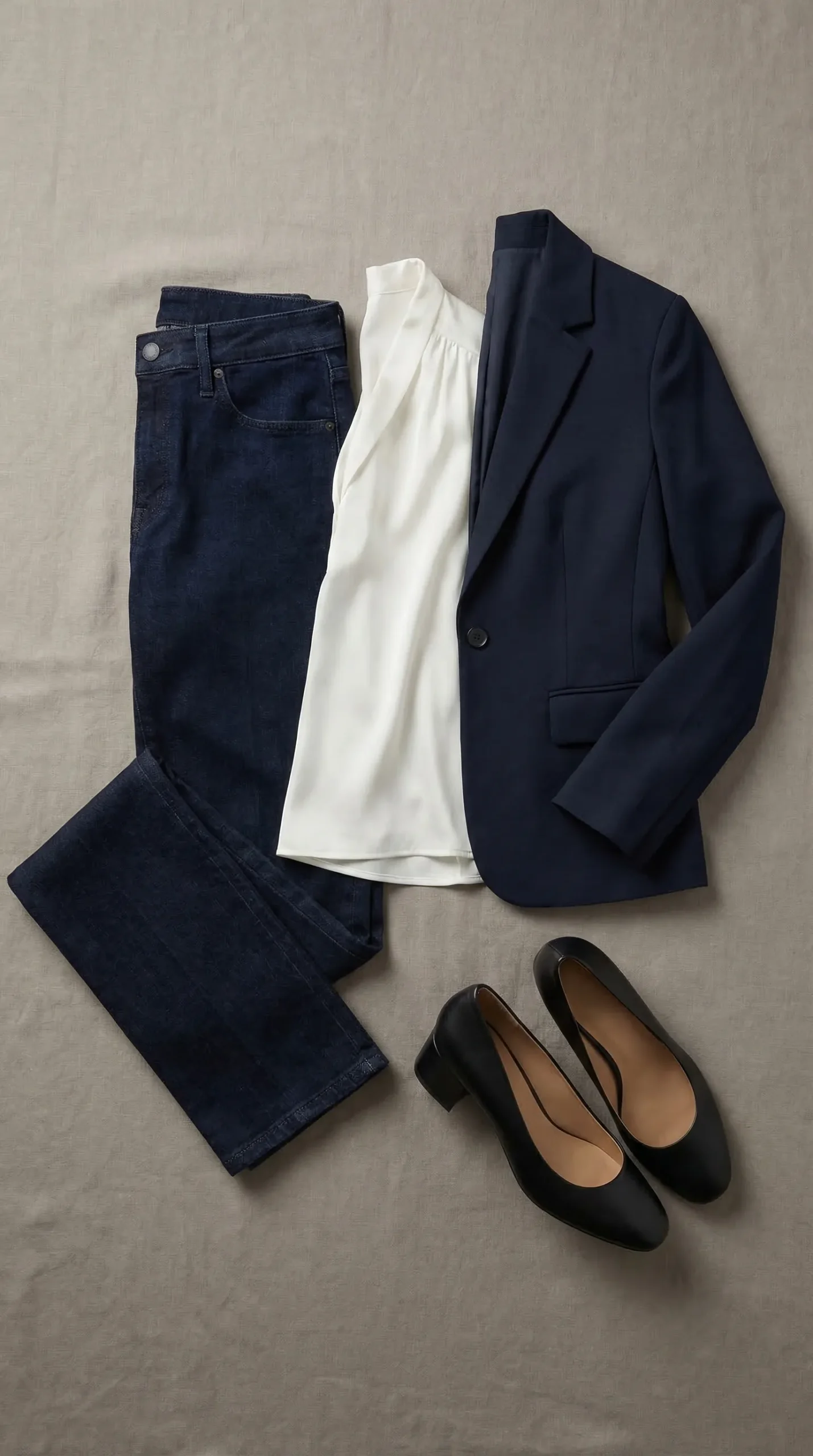
A smart casual outfit that can pivot to business casual in under a minute is the actual goal for any casual workday. You’re not trying to dress for a board meeting. You’re trying to not be caught off-guard.
The formula: one polished base (blouse, fine knit, or clean dark jeans with a structured top) plus one upgrade item kept nearby. That upgrade item is almost always the blazer.
- Dark jeans + silk blouse + blazer over the chair = smart casual that becomes business casual in one move
- Wide-leg trousers + fine knit + loafers = smart casual that needs nothing added
- Clean midi skirt + plain fine-jersey top = reads more dressed-up than it feels
The blazer-at-the-desk strategy works because it requires zero planning in the morning. You dress for the Friday you’re probably having. The blazer handles the Friday you might suddenly be having.
Trade-off: keeping a blazer at your desk means it will eventually look like a blazer that lives at your desk. Rotate it home for steaming every couple of weeks or the crumple starts to show.
Dressing for a casual workday without a clear policy is essentially a calibration exercise. Watch what the people one level above you wear on Fridays. Not to copy them exactly — but to understand the unspoken ceiling in your specific office.
Your Core Wardrobe Staples: The Pieces That Do All the Work
Sunday night. You’re standing in front of a full closet laying out three “maybe” outfits on the bed. None of them feel right. By Monday morning you’re wearing the fourth option — the safe one — because you ran out of time to think.
That’s not a shopping problem. That’s a system problem.
The fix is the 3-3-3 rule: three bottoms, three tops, three shoes that all mix and match with each other. Nine pieces. Twenty-seven possible combinations. Every item earns its place because it works with everything else in the set — not just one or two things.
For a professional wardrobe specifically, the 3-3-3 works because the constraints are actually helpful. You’re not building a full fashion wardrobe. You’re building a uniform with variations. That’s easier, not harder.
My take: most women own far more clothes than they need and far fewer outfits than they think they do. Those are two different problems, and the 3-3-3 solves the second one.
Why Fabric Is the Whole Game
You can buy a beautifully cut trouser and ruin it by choosing the wrong fabric for how you actually live. If you commute on a train and sit in meetings for six hours, wrinkle-resistance is not a luxury. It’s structural.
Wool blends (typically 60/40 or 70/30 wool-polyester) hold their shape across a full day in a way that pure cotton or linen simply don’t. Merino specifically breathes well enough for all-day sitting without trapping heat the way synthetic-heavy fabrics do. Polyester alone is fine for structure but tends to hold body heat and show sweat under harsh office lighting. Worth knowing before you buy.
Trade-off: natural fibers like wool and silk perform better and age better, but they require more care. You’re looking at dry cleaning or careful hand washing. If that’s not your life, a quality wool-poly blend is a reasonable middle ground.
The Core Pieces, Mapped Out
| Item | Recommended Color / Pattern | Fit Guideline | Fabric to Look For |
|---|---|---|---|
| Blazer | Navy, charcoal, or camel. No pattern for your first one. | Shoulder seam sits at the shoulder. Not inside it, not past it. Sleeves hit the wrist bone. | Wool blend or ponte. Ponte for lower maintenance; wool for sharper structure. |
| Tailored Trousers | Black or charcoal first. Mid-grey second. Save navy for later. | High-rise. Actually high-rise, not the kind that claims to be. Hem grazes the top of the shoe. | Wool-poly blend (60/40 or higher wool content). Wrinkle-resistant stretch options work for commuters. |
| Blouse / Fitted Top | White, ivory, or pale blue. One in a neutral print if you want range. | Sits cleanly at the hip. Nothing pulling across the chest or gaping at the button. | Silk, silk-blend, or quality polyester that doesn’t look cheap under fluorescent light. |
| Sheath Dress | Solid dark colour. Black is the obvious choice for good reason. | Hem at or just below the knee. Enough room through the hips to walk without pulling. | Ponte or crepe. Both hold their shape through a full day and don’t wrinkle badly in a chair. |
| Knit Top / Fine-Gauge Sweater | Camel, grey, or cream. These layer without adding visual weight. | Close-fitting but not tight. Sits neatly under a blazer without bunching at the arms. | Merino wool or cashmere blend. Pilling starts with cheaper knits — the cost-per-wear math changes fast. |
| Ankle-Length Trousers | Neutral or subtle pattern. Checks work here if the rest of the outfit is solid. | Straight or slightly tapered. Cropped hem should be intentional — not full-length trousers that were never hemmed. | Stretch-wool blend or cotton-blend with some structure. Avoid anything that goes limp after four hours of sitting. |
Care Is Not Optional
A wrinkled blazer undoes a strong outfit. Not slightly. Completely. The blazer is the piece that signals “put-together” — when it’s creased, it reads as careless, and the whole look drops a register.
Same goes for pilling on a knit. A fine-gauge sweater with pills at the elbows doesn’t look “worn in.” It looks like you stopped paying attention. A fabric shaver is a two-minute fix that costs almost nothing. Worth keeping one at your desk.
- Steam, don’t iron, structured pieces where possible. Irons flatten the fabric in ways that change how it hangs.
- Hang trousers immediately after wearing. Folding them over a chair puts a crease through the thigh.
- Wash knits inside out in cold water, or hand wash. Heat is what causes pilling and shrinkage — not wear.
- Dry-clean wool blazers infrequently. Over-cleaning breaks down the fibers. Spot-treat when you can.
Blunt truth: how you care for women’s professional business attire matters more than how much you spend on it. A €90 blazer that’s steamed and stored properly looks sharper after two years than a €300 one that gets crammed into a bag every morning.
Seasonal Adaptations: Winter and Summer
The office in August is a specific problem. The building is air-conditioned to a temperature that would be reasonable in November. Outside it’s 32 degrees and you walked six blocks from the train. So you’re either sweating at 8:45am or shivering in a meeting at 11.
Neither is comfortable. Both affect how you look and how you feel. It’s worth having a plan.
Summer: The Fabric and Layer Problem
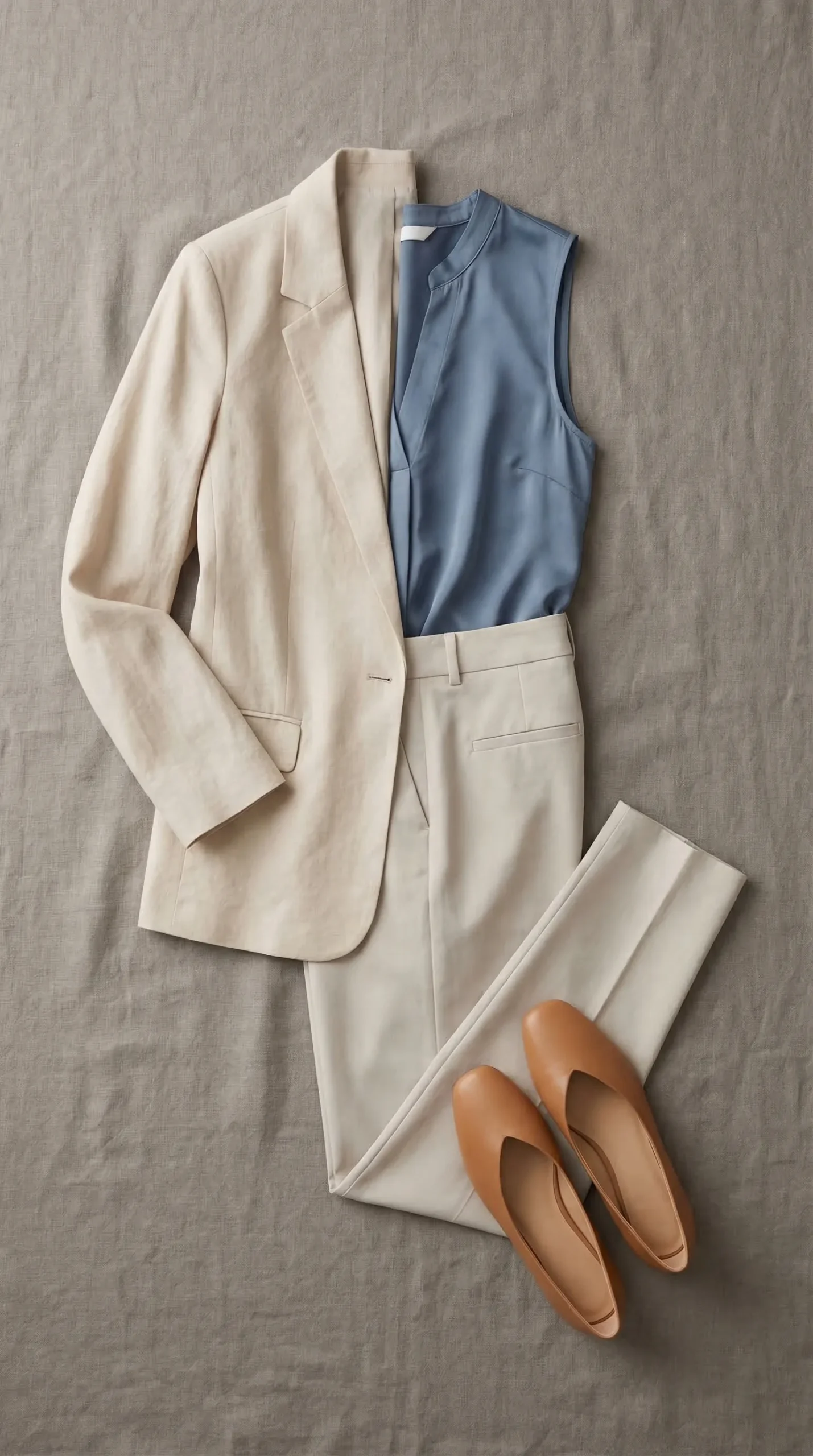
For women’s business attire in summer, the real enemy isn’t heat. It’s the swing between outdoor heat and indoor air conditioning. Dressing for one means being wrong for the other by 10am.
The answer is thin layers, not fewer layers. A sleeveless blouse under a lightweight blazer in a breathable fabric (linen-blend, unlined cotton, or silk) means you can remove the blazer outside and put it back on before walking into a meeting. The silhouette stays appropriate either way.
- Avoid synthetic-heavy fabrics in summer. Polyester traps body heat and shows sweat under harsh light. If you’re sitting in a meeting for three hours, this matters.
- Linen is fine for client-facing roles with a relaxed dress code. It will wrinkle. That’s not negotiable. If wrinkles bother you, go for a linen-cotton blend — slightly more structure, slightly less visual chaos by afternoon.
- Sleeve length stays at cap-sleeve or longer in most offices. Sleeveless is acceptable in some environments; read the room before defaulting to it.
- Light colours reflect heat but show sweat more visibly. Soft mid-tones — dusty blue, warm taupe, sage — are easier to wear through a full summer day.
Trade-off: linen looks composed for the first hour. After that it creases, especially across the lap if you’ve been sitting. For a morning of desk work it’s fine. For a full day with afternoon client meetings, plan accordingly.
Winter: Layering That Stays Professional
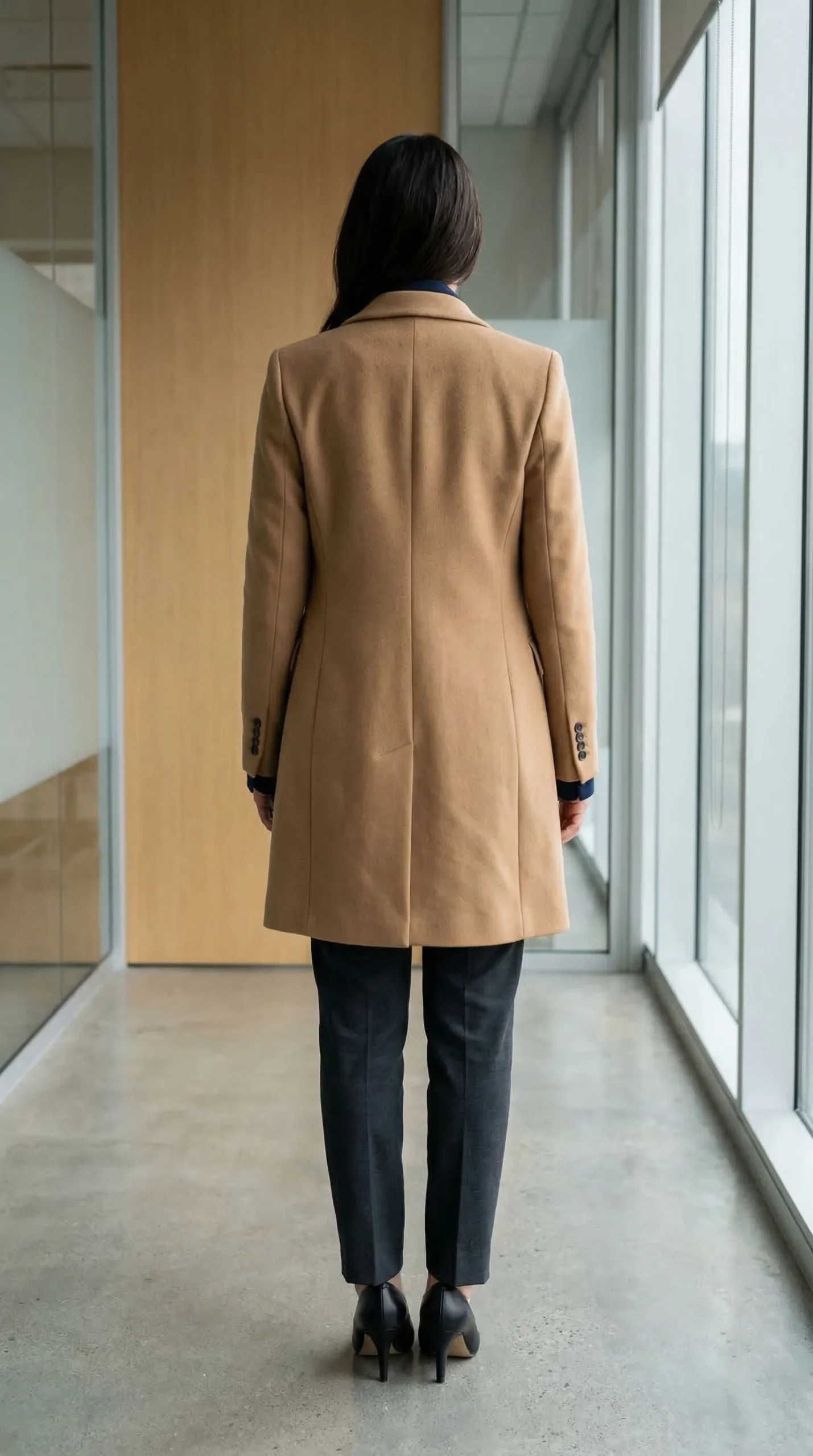
Business dress for women in winter has one core challenge: the coat. Specifically, the gap between what looks good over a suit and what actually keeps you warm on a January commute.
A structured wool or cashmere overcoat in a dark neutral (black, camel, charcoal) is the one piece of winter outerwear that does both. It fits cleanly over a blazer without bunching at the shoulders. It reads as professional when you walk into a building. And a decent one lasts a decade if you treat it properly.
- Puffer coats don’t work over tailored clothing. The volume at the shoulders distorts the silhouette underneath. Fine for a casual day; wrong for business professional attire in winter.
- Thermal layers work under fitted tops. A thin merino base layer adds warmth without changing how an outfit looks. This is the most practical solution for cold offices or long commutes.
- Knitwear thickness matters. A fine-gauge merino sits under a blazer cleanly. A chunky knit adds bulk at the shoulders and arms — which usually reads as less polished in structured office environments.
- Boot height is a real silhouette decision. Knee-high boots under trousers are invisible and work well. Under a skirt or dress, the hem length determines whether the look is office-appropriate or not.
For business attire in winter, the structured overcoat is the one investment worth making before anything else in the seasonal wardrobe. Everything else can be adapted. The coat you wear walking in the door is seen before anything else you’re wearing.
Trendy professional clothes cycle in and out of relevance. A well-cut coat in a classic colour does not.
Outfit Formulas for Every Real-Life Scenario
It is 7am Tuesday. You have a client meeting at 10 and a casual team lunch at 1. You are standing in your bedroom holding a blazer in one hand and a knit sweater in the other and you genuinely cannot decide.
Not because you don’t own enough clothes. Because you have too many decisions before coffee and none of them come with a clear answer.
This section is not about inspiration. It is about shortcuts. Repeatable formulas you can run on autopilot so the blazer-or-sweater question stops eating your mornings.
The fail-safe formula, if you need one that covers almost every office scenario: one neutral bottom, one structured top, one layer. That is it. The layer is doing the heavy lifting. It is what signals intentionality without requiring you to overthink the rest.
- Neutral bottom: charcoal, black, camel, navy — nothing that needs a matching partner
- Structured top: a blouse, a fitted knit with some body, a button-down with a clean collar
- Layer: blazer, tailored cardigan, or a longline vest with structure — not a hoodie, not a drapey open-front cardigan that reads like you grabbed it on the way out
If the individual pieces feel unclear, the earlier chapters on business professional attire for women and business casual attire cover what qualifies. That groundwork is already laid. Here, we are just applying it.
My take: The formula works because it removes the variable that causes most morning paralysis, which is wondering whether the outfit reads as “trying too hard” or “not trying at all.” A structured layer solves both at once.
Interview and High-Stakes Meeting Outfits
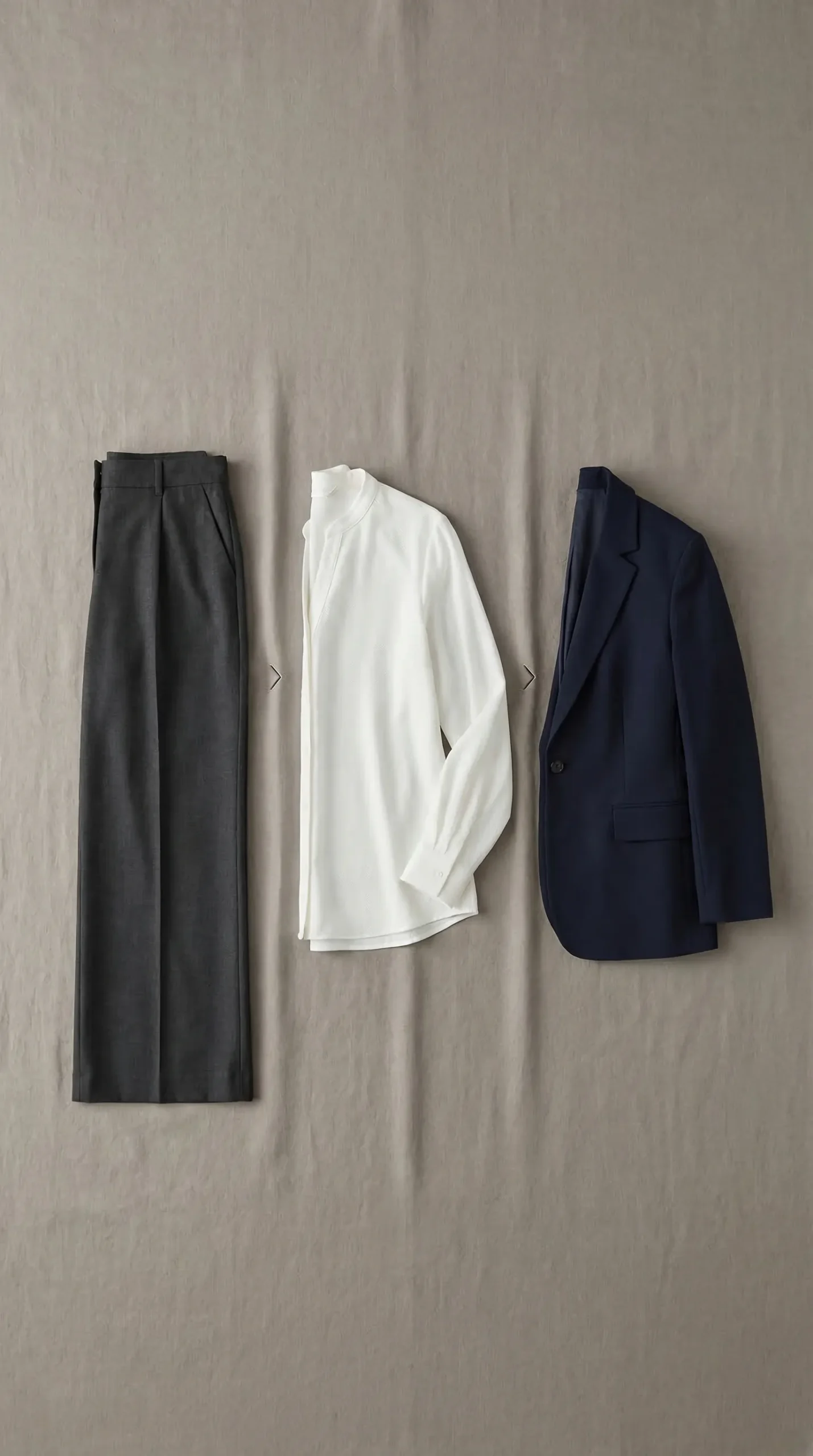
One formula. Tailored trouser, blouse, blazer, low heel. That combination will not embarrass you in any professional context where women’s business attire is expected to signal competence from the moment you walk in.
The pieces matter less than the fit and the fabric weight. A blazer with soft, unstructured shoulders reads casual regardless of the color. A trouser that pulls at the hip looks like the wrong size. Both are problems you want to solve before the interview, not during it.
Industry culture shifts the formality level significantly. A law firm interview and a Series B startup interview are not the same room.
- Finance, law, consulting: The full formula, executed in dark neutrals. No visible prints. No statement jewelry. Clean bag. This is not the moment for personality.
- Tech, creative, media: The formula still applies, but you can substitute the blazer for a structured knit layer, swap the trouser for a tailored midi skirt, and bring one considered piece — a interesting shoe, a minimal sculptural earring — that shows you have a point of view.
The formula breaks down when the company culture is genuinely, structurally casual. Some teams wear hoodies to every meeting, including external ones. Showing up in a full blazer-and-trouser setup to that interview does not signal competence — it signals that you did not do your research.
Look at the company’s social media, their team page, their LinkedIn posts. If every photo is a sea of athleisure and quarter-zips, adjust. You want to be one level above their daily standard, not three.
Trade-off: Dressing down for a casual-culture interview feels risky. It is. But overdressing in a context where formality reads as out-of-touch carries its own risk. Pick the smaller mismatch and accept it.
Client Meetings, Networking and Visible Moments
A regular office day and a day with external visibility are not the same thing. The gap between them is not about buying new clothes. It is about which version of your existing wardrobe you reach for.
On a standard internal day, professional women’s business attire can afford to be quieter. The trouser that is slightly more relaxed. The knit that requires less maintenance. That is fine.
On a day with external visibility, the formula tightens. Specifically:
- The bottom should be your most structured option in its category — the trouser with a proper crease, the skirt with clean seam lines, not the jersey version you bought because it was comfortable
- Shoes close-toe. Heel or a serious flat. Nothing that introduces a casual note when the rest of the outfit is working hard
- One accessory that reads as deliberate — a watch, a simple necklace with visible quality, a structured bag — not a collection of things, just one that lands
The shoe and bag combination is where intentionality reads most clearly to an external audience. People in professional contexts notice a structured bag and a clean shoe before they notice your blouse. That is not a style observation. It is just how visual processing works at first glance.
Blunt truth: You can upgrade a fairly basic outfit for a networking event with a single good shoe. The inverse is also true — a great outfit gets quietly undermined by a bag that looks like it has been through a commute for two years.
For networking specifically, you want one piece that gives someone something to say. A textured blazer. An interesting shoe. Not a statement, just a conversation hook. Small rooms reward it.
Industry-Specific Variations
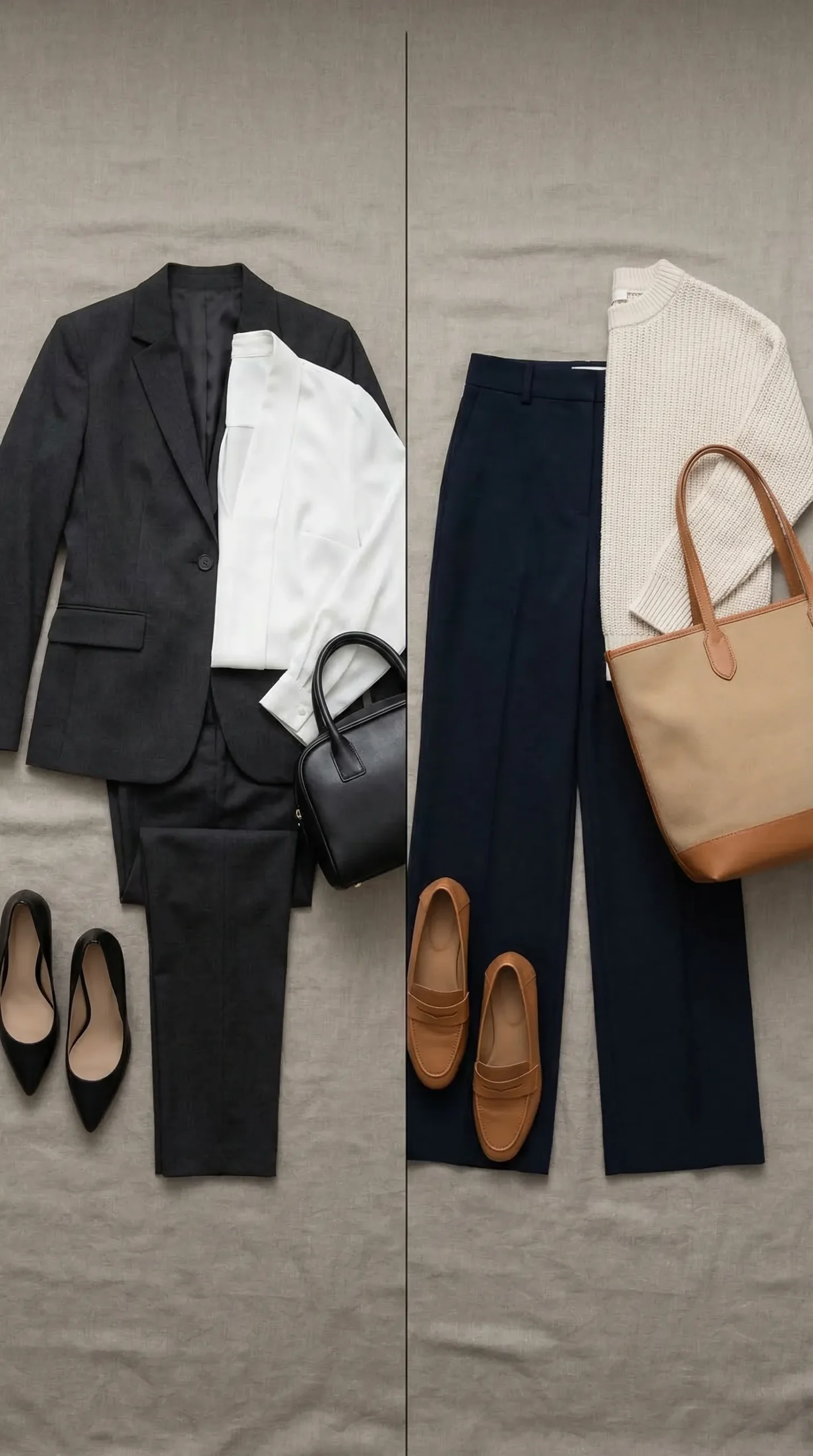
The trap most people fall into is dressing for the industry stereotype rather than the specific company. Finance is formal — yes, broadly. But a fintech startup with 40 employees operates differently than a private equity firm in a building with a doorman. Same sector. Not the same dress code.
The table below gives you a starting-point calibration across four industries. Use it as a compass, not a prescription.
| Industry | Baseline Expectation | What to Anchor On | Watch Out For |
|---|---|---|---|
| Finance and Law | Strictest. Structured suiting, dark neutrals, minimal prints. The full spectrum of business professional attire for women applies here. | Tailored trouser or pencil skirt, blazer with real shoulder definition, closed-toe low heel | Relaxed fabrics (jersey, ponte), open-toe shoes, anything that reads as “almost formal” |
| Consulting and Corporate Services | High, but with slightly more flex. Client-facing days skew formal. Internal days can relax one level. | The neutral-bottom, structured-top, blazer-layer formula works reliably across most scenarios | Assuming internal-day standards apply on a client site visit. They don’t. |
| Tech | Variable. Ranges from smart casual to jeans-and-a-hoodie depending on company stage and culture. Rarely requires formal suiting. | Tailored trousers or a clean dark jean, structured knit or blouse, minimal layer. Polish without formality. | Overcorrecting into full suiting for a company where the founding team wears trainers to board meetings |
| Creative, Media and Marketing | Most relaxed on formality. Point of view matters more here than structure. Personality in clothing is often a professional signal, not a liability. | One considered piece — a print, an interesting cut, a textured layer — alongside cleaner basics. Cohesion still matters. | Assuming “relaxed industry” means you can stop thinking about fit and fabric quality. You still cannot. |
The way to locate yourself on this spectrum is not to Google your industry’s dress code. It is to look at the people one level above you in your specific company. Not the CEO on a panel. The people in the meetings you want to be in.
Their wardrobe is your calibration point. Not the industry average, and not the most formal version of what your sector is theoretically capable of requiring.
My take: Most women in creative and tech industries undershoot on fabric quality and overshoot on trend. The ratio that actually reads as credible is the opposite.
The stereotype trap works in both directions. Assuming Finance means you must wear a full suit every day can leave you overdressed and uncomfortable in a firm that moved to business casual three years ago. Assuming Tech means anything goes can leave you the least-polished person in a room full of people who actually thought about what they put on.
Dress for the room you are in, not the category it belongs to.
Fit, Grooming & the Mistakes That Quietly Undercut Everything
The outfit is technically correct. Blazer, trousers, closed-toe shoes. Everything is there. And yet something about the way it sits makes her look like she borrowed it from someone else.
This is the fit problem. Not a style problem. Not a budget problem. Fit.
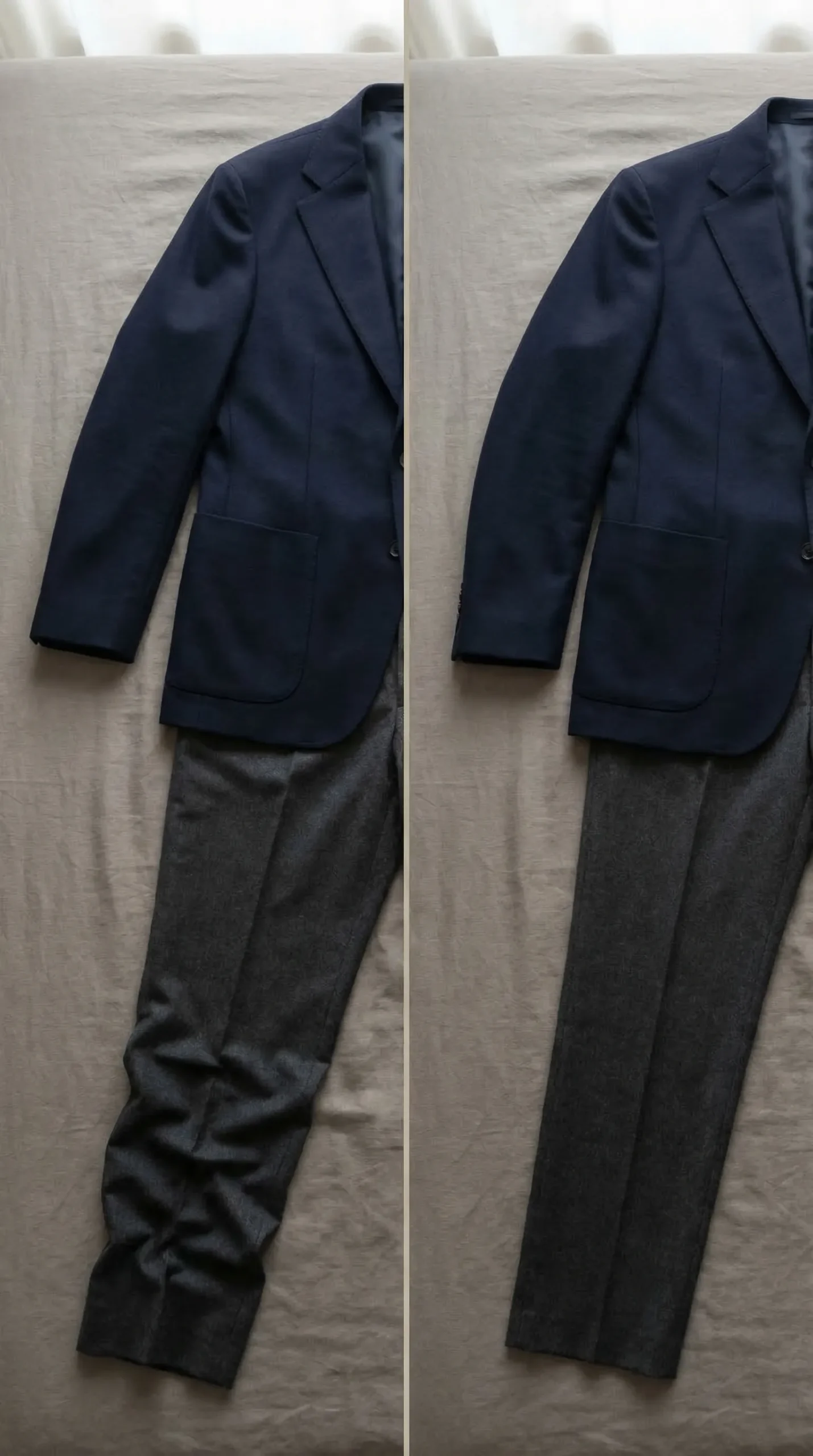
A $400 blazer with shoulders that drop half an inch past the joint reads as sloppy. A $60 blouse that skims the body cleanly reads as intentional. The price tag does not do the work. The tailor does. Or the hour you spent trying things on before buying them.
Fit is the single highest-impact variable in professional business attire for women. Full stop. You can dress for a business professional attire environment in modest pieces and look polished. You can dress in expensive pieces that don’t fit and look like you’re playing a role you haven’t grown into yet.
My take: most women underestimate how much a single alteration changes a garment. A hem. A taken-in side seam. That’s often all it takes.
| Recommended Actions & Items | Common Pitfalls |
|---|---|
| Get trousers hemmed to sit at the top of the shoe, not bunching at the ankle | Wearing full-length trousers unhemmed — they pool, they drag, they read as an afterthought |
| Check blazer shoulder seam: it should sit exactly at the edge of the shoulder joint | Dropping shoulder seams — this is the fastest way to look like the jacket doesn’t belong to you |
| Keep nails clean and at a consistent length — polish is optional, chipping is not | Chipped or overgrown nails in a client-facing role — small detail, outsized impression |
| Press or steam fabric before wearing — especially wool, linen, and ponte blends | Wearing creased trousers or a wrinkled blouse, which signals you’re not paying attention |
| Choose one statement piece per outfit — a bag, a shoe, a structured necklace | Over-accessorizing: stacked bracelets plus statement earrings plus a printed scarf compete with each other |
| Keep shoe heel height proportionate to the setting — a 2-inch block heel reads as polished across most offices | Wearing a 4-inch stiletto to a casual business casual environment, or flat athletic sneakers to a business professional one |
| Match your bag to the formality of the meeting, not just the outfit | Bringing a canvas tote to a boardroom — fine for a Thursday at your desk, not for a client presentation |
| Wear a bra that is invisible under the garment — seamless, skin-tone, or structured enough not to show | Visible colored straps or band lines under a fitted blouse at business professional level — it pulls focus |
Grooming Is a Professional Signal, Not an Aesthetic Judgment
Grooming is not about looking a certain way. It is about consistency. Intentionality. The signal it sends is: I knew what I was walking into today.
Pressed fabric, clean shoes, hair that is visibly styled rather than visibly not — these things do not require money or time. They require the decision to do them.
Clean shoes matter more than most people factor in. Scuffed leather or visibly dirty soles read as careless in rooms where polish (of all kinds) is expected. Wipe them down. It takes ninety seconds.
Blunt truth: grooming is where modern female business attire breaks down most often, and it has nothing to do with the clothes themselves.
The Mistakes That Are Specific and Common
Visible bra straps at business professional level. Still happening. Frequently. A seamless bra or a convertible style that can go racerback eliminates this entirely. Not complicated.
Heel height calibrated to the wrong environment. There is a real difference between business casual for women and business professional attire when it comes to shoes. In a casual office, a clean flat or a low block heel is completely appropriate. In a formal client environment, it reads as underdressed. Know which room you’re in.
Over-accessorizing at the professional end of the spectrum. The instinct to add one more thing is usually wrong. A structured watch, a simple ring, one earring style. That’s a complete picture. The fifth accessory does not add personality. It adds noise.
Trade-off: stripping back your accessories to look more polished can feel like you’re stripping back yourself. And in some workplaces, a little more personality in what you wear is not only acceptable but expected. The trick is reading the room, not defaulting to minimalism out of anxiety.
Where Personal Style Has Room to Breathe
The distinction between business professional attire and business casual is partly about formality. But it’s also about range. Business casual, by definition, gives you more.
Color is one place to take that room. A deep burgundy trouser reads as polished in a business casual context. A printed blouse in a restrained pattern — small check, fine stripe, subtle floral — works if the rest of the outfit is structured.
For plus size business casual dressing specifically: the fit principles above apply exactly the same way. The body type changes nothing about what makes a silhouette look intentional. A well-fitted wide-leg trouser in a heavier fabric, hemmed correctly, is a strong foundation for any size.
Personality lives in the details. A bag in an unexpected color. A shoe with a slight edge to it. A single piece of jewelry that is not conventional. These things are entirely compatible with looking professional. They just cannot all happen at once.
The baseline has to hold first. Once it does, the rest is yours.
FAQ
What is the 3-3-3 rule for clothing?
Three colors. Three pieces. Three minutes to get dressed. The 3-3-3 rule is a formula for building outfits that read as intentional without requiring much thought in the morning.
For the full breakdown of how it applies to a work wardrobe, go to Your Core Wardrobe Staples.
What are the 5 levels of business attire?
From most formal to least: business formal, business professional, business casual, smart casual, casual. Each one has a different ceiling and a different floor.
The comparison table with specific item examples is in Dress Codes Decoded.
What is not acceptable for business casual?
Anything that belongs at the gym, the beach, or a Saturday farmer’s market. That means athletic shoes (the ones you actually work out in), graphic tees, ripped denim, and anything sheer without a layer over it.
The full item-by-item breakdown is in Business Casual Attire.
Can women wear pants in business attire?
Yes. Always have been able to. The requirement is fit and fabric — tailored through the hip and thigh, no pulling at the seam, and a material with enough structure to hold its shape past noon.
For specifics on trouser cuts and fabrics that meet the standard, see Business Professional Attire.