Polished 15+ Executive Outfit Looks That Inspire

Every executive woman knows the drill. You find a suit that fits, but the fabric wrinkles by noon. Or the blazer that commands respect in a boardroom looks stiff on a morning flight. The usual advice—wear a pantsuit in navy or black—misses the real challenge: an executive outfit that works for your body, your industry, and your back-to-back calendar. You don’t need more options. You need better ones—pieces that signal authority without sacrificing comfort, that travel without disintegrating, and that actually exist in your size.
For a deeper look at the building blocks of executive style, start here. Then pair it with a focused pantsuit strategy to cover the most common power look.
21 Executive Outfit Formulas That Cover Every Workday Scenario
An Executive Outfit isn’t one uniform—it’s a toolkit. The real women I’ve watched ascend corner offices don’t rely on a single “power suit.” They rotate strategies silently, deploying specific pieces for the boardroom, the creative brainstorm, the 7 p.m. dinner that isn’t really a dinner. Below, I’ve grouped 21 real-deal combinations by the challenge they solve, from high-stakes meetings to off-duty days where you’re still the most capable person in the room.
For High-Stakes Days
When the calendar says “present to the board” or “close the deal,” these formulas deliver authority without looking like you raided a costume shop. Each piece is chosen for fit, fabric, and the quiet signal it sends.
The Cream Coat Command

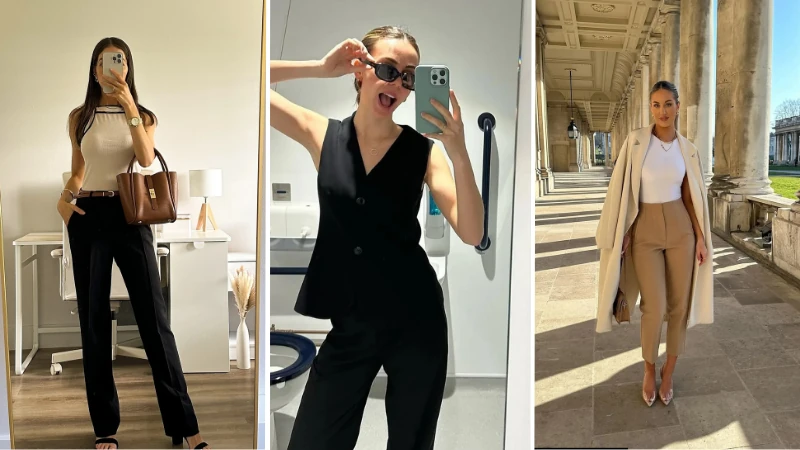
An oversized cream wool-blend coat anchors this look, thrown over a crisp white jersey bodysuit and tan tailored cotton-blend trousers. Pointed-toe PVC heels add modern transparency that keeps the outfit from feeling heavy. A tan leather bag and simple gold necklace tie it together. When wearing a coat as a statement piece, keep the layers underneath slim—a bulky sweater under an already oversized coat will swallow your frame and dilute the sharp line.
The Grey-on-Grey Power Separates

A grey-and-white striped button-down hangs relaxed over dark grey wool-blend trousers—a gentle deconstruction of the suit. A slim black belt and structured black handbag add rigor. Black sunglasses and minimal gold jewelry complete the formula. The palette is muted but the message is clear: competent, not trying too hard. For an instant upgrade, have the shirt cuffs tailored to end just past your wrist bone—that precise inch of exposed skin reads as meticulous, not accidental.
The Preppy Power Knit

A relaxed fine-knit white top paired with light blue cotton-blend trousers feels fresh but serious. The knotted silk neck scarf in brown and white adds a non-verbal cue of attention to detail. Brown leather belt and tan pebbled shoulder bag anchor the palette. Gold-plated earrings catch the light just enough. Resist the urge to match your scarf to your bag—contrast like this brown-and-tan mix reads as selected, not overly coordinated.
The Cardigan-As-Blazer Strategy

A regular-knit white cardigan over a slim white cotton tee softens the authority of tailored grey wool-blend trousers without diluting it. Dark brown suede mary janes and matching leather belt and bag keep the outfit from veering casual. Gold accessories—a watch and simple earrings—reinforce polish. This is the executive version of cozy: the cardigan’s fabric must hold its shape, never sag by noon. A cardigan works as a blazer substitute only when its shoulder seams hit exactly at your natural shoulder; anything droopy reads as off-duty, not executive.
The All-Black Power Suit

A tailored black wool-blend blazer with sharp shoulders meets wide-leg trousers in the same fabric—a true power suit. A slim black belt defines the waist, and a small black leather bag disappears into the look. Rectangular black sunglasses add mystery. Add a silk shell in champagne or midnight blue at the neckline to introduce depth without interrupting the monochrome. When wearing all black, texture becomes your communicator: the wool’s subtle grain and the bag’s matte leather differentiate the pieces so you don’t look like a solid block of nothing. A pantsuit this sharp isn’t about blending in; it’s about being the reference point.
The Halter Authority Move

A white ribbed-knit halter top tucks into black wide-leg wool trousers, creating a long, uninterrupted line. A brown structured handbag and slim brown belt introduce warmth, while black strappy sandals keep the bottom light. A gold watch is the finishing detail. This silhouette bypasses the blazer entirely, using the halter’s high neck and the trouser’s sharp front crease to structure the upper body. To avoid a too-bare effect in conservative environments, add a lightweight cashmere scarf draped around the shoulders—it bridges the formality gap.
The Monochrome Red Power Set

A tailored red crepe waistcoat and matching wide-leg trousers create a head-turning monochrome statement. Black accessories—oversized acetate sunglasses and a leather handbag—ground the look, while layered gold jewelry keeps it from feeling costumey. This is for the negotiation where you need to own the room before you say a word. Monochromatic dressing works because it elongates the body, but only if the shades match exactly; a half-shade-off red blazer reads as a failed attempt. The corporate statement suit in red is a confident flex.
The Polo and Denim Reimagined

A slim dark brown knit polo replaces the standard button-down, paired with crisp white wide-leg denim trousers. A dark brown waist belt cinches, while black pointed-toe heels and a black top-handle bag add formality. Gold jewelry ensures the look feels intentional, not like a weekend afterthought. This is a masterstroke for warm-weather client meetings. White denim in an executive context must be rigid, not stretch—any hint of thigh pulling undercuts the polish instantly.
The Column of Black Softness

by @mint_label_
A relaxed black silk button-down flows into a slim-fit black wool-blend maxi skirt, creating one continuous dark line. A slim black leather belt defines the waist, and a black suede top-handle bag adds texture—the kind of accessory that never kills the outfit. Strappy black sandals offer a bareness that feels intentional, not casual. A silver cuff bracelet breaks the monochrome. When wearing a maxi skirt to work, the hem must clear the floor by one inch; anything longer drags and telegraphs that you didn’t plan for standing or stairs.
The Tonal Neutral Suit

by @mint_label_
A tailored brown wool-blend blazer over relaxed beige trousers and a slim white jersey top plays the tonal game brilliantly. No bag, no loud accessories—just a silver watch. The simplicity is the luxury. This is the uniform of the minimalist executive: quiet, but impossible to ignore. A tonal suit only lands when the fabrics share a similar weight; a heavy wool blazer with thin cotton trousers will look mismatched and cheap. Business formal doesn’t require a black suit; it requires precision, and this delivers.
The Tweed-Texture Authority

A black tweed jacket with subtle black-on-black texture replaces the standard smooth blazer, worn over black wide-leg crepe trousers. Slim black suede heels and a small black crossbody bag keep the silhouette sleek. Black acetate sunglasses add a shield of mystery. The outfit relies on surface interest to avoid flatness. Tweed adds instant gravitas, but only if it’s fully lined—unlined tweed can look rustic and out of place in a boardroom.
For Flexible Dress Codes
For offices where the dress code is a shrug, these outfits thread the needle: enough structure to say you mean business, enough ease to fit the culture. They work for creative firms, business-casual environments, and days when you set the tone.
The Three-Piece Light

by @demelza_may
A tailored black crepe waistcoat, worn solo over nothing but skin and a gold necklace, pairs with relaxed black crepe trousers. The open arms show confidence, but the structure keeps it professional. Black acetate sunglasses finish the look. This is the corporate outfit distilled to its boldest elements, perfect for fashion-adjacent industries. The armhole of the waistcoat is critical—too low and you’ll flash side bra; if in doubt, have a tailor raise it half an inch.
The Textured Tweed and Satin Mix

A white tweed jacket with subtle flecks sits over a tan slim-fit knit turtleneck, while a bronze bias-cut satin skirt catches the light. Pearl earrings and a simple gold ring are the only jewelry needed—the fabric combo does the heavy lifting. This outfit reads as a modern heiress, not a caricature. Pairing a heavy tweed jacket with a liquid skirt creates a tension that photographs well and signals taste; just avoid a shiny bag that competes with the satin.
The Androgynous Tie Formula

by @mint_label_
A relaxed white cotton button-down, sleeves rolled once, paired with a slim black silk necktie and black high-waisted crepe trousers. Black fitted leather boots ground the look with a hint of edge. It’s borrowed-from-the-boys but tailored to a feminine frame. If you wear a tie, skip the necklace—one focal point at the neck is enough. A collarbone-length pendant will compete with the tie’s knot and create visual noise.
The Sweater-as-Accessory Trick

A black turtleneck and black crepe trouser base becomes a canvas for a cream-and-navy knit sweater casually draped over the shoulders. A slim black belt adds definition. The gold phone case (yes, it counts as an accessory) brings warmth. This is the uniform of an editor-in-chief on a busy day. The draping sweater works only if it’s a fine-gauge knit that doesn’t bulk up the shoulders—chunky cable knits look like you’re carrying a blanket, not an accessory.
The Blazer-Jeans Hybrid

by @mint_label_
An oversized black blazer slouches perfectly over a white button-down with a cream silk tie—a subversive twist on the schoolboy look. Light blue straight-leg jeans anchor the outfit in reality, while black pointed-toe suede heels pull it back to executive territory. A silver watch keeps time. The tie is the power move here, but it must be silk and cut slim—a polyester tie reads as costume, not confidence. Blazer outfits with denim live or die by the wash; stick to a clean dark wash or a true rigid light blue.
The Color-Block Blue Formula

A blue button-down in classic cotton tucks neatly into navy wide-leg crepe trousers. A black belt, top-handle bag, and patent pointed-toe flats unify the dark accessories. Cat-eye sunglasses add a retro polish. The palette is serious but not somber—a reliable framework for days that start with a desk meeting and end at a gallery opening. The button-down’s collar should stand up on its own; if it collapses, use magnetic collar stays to keep it crisp all day.
The Monochrome Suit with Sneakers

A bright green oversized blazer and matching wide-leg trousers cut a bold silhouette, softened by a simple white cotton-blend top. White mesh-and-leather sneakers—box-fresh and perfectly clean—bring the authority level down just enough for a creative-director office. Gold necklace and earrings catch the eye. A matching suit with sneakers only works as a deliberate choice when the suit fabric is crisp and the sneakers are pristine; worn-out trainers will collapse the whole outfit into lazy territory.
For the Off-Duty Power Move
Even when the occasion says casual, you’re still the executive. These outfits hold onto polish while letting you breathe—for travel days, creative workshops, or the networking coffee that isn’t really casual.
The All-Black Leather Edge

A relaxed black leather coat dominates this look, layered over a slim black knit top and tailored black polyester shorts. Black opaque tights and black leather shoes extend the line. A black belt and small black bag dissolve into the whole. It’s one dark, gleaming column. Leather for daytime requires judicious editing—make it the only statement and keep everything else absolutely simple, or you’ll look like you’re headed to a club, not a creative meeting.
The Waistcoat Over White

by @mint_label_
A white cotton button-down, sleeves rolled, is layered under a black wool-blend waistcoat, with black flared crepe trousers adding a 1970s ease. Silver rings and small silver hoop earrings are the only metal. This is a classy alternative to the standard suit that says “I know fashion, but I’m not a slave to trends.” Flares can quickly overwhelm your frame—make sure the trouser hem just brushes the floor with your chosen shoe height, otherwise the proportions will look accidental.
The Denim-and-Loafer Uniform

A blue cotton button-down, untucked and easy, meets black straight-leg denim. Black leather loafers and a black shoulder bag keep it grounded, while gold necklaces and earrings add a sharp gleam. This is what you wear when the calendar says “internal strategy day” but your title still says CEO. Loafers for executives should have a slight heel—a stacked leather 1-inch is ideal—and a pointed or almond toe; rounded ballet flats will soften the look too much. Networking events that claim “casual” are code for this exact level of polish.
Reading the Room: Dress Codes No One Spells Out
The real difference between “business formal” and “boardroom attire”: It’s not about skirt vs. pants. Formal implies an external audience—clients, shareholders, regulators—where your clothing must align with institutional hierarchy. Boardroom attire is more tribal: you’re signaling membership to the inner circle. In practice, boardroom leans slightly softer and more personal, like a knit blazer over a silk shell rather than a full matched suit. Miss the distinction and you read as either stiff or careless.
Geography dictates details: Wall Street requires high color saturation—deep navy, charcoal, even a rich burgundy—and closed-toe pumps no matter the season. Silicon Valley’s C-suite actually judges a pressed blazer as try-hard; a perfectly draped ponte-knit jacket with dark jeans is the power move. Dallas oil and gas expects sleeve-length coverage year-round and a precise heel height between 2 and 3.5 inches. Before you travel, scan the company’s LinkedIn photo galleries and press-event images—not to copy, but to read the unspoken hem-length and color-saturation rules.
Out-dressing your boss is a social risk most guides ignore: When your outfit reads as significantly more expensive or more formal than your leader’s, it can unintentionally signal ambition that overshadows team cohesion. The fix isn’t to dress down but to shift textures—swap a structured worsted-wool blazer for an unlined knit jacket in the same color family. You stay polished while dialing down the armor.
Client-facing vs. internal days: One column dress, one topper. For a morning board presentation, wear a structured black shift with a menswear-inspired blazer and pumps. By 4 p.m., remove the blazer, add a thin metal belt at the waist and switch to lower-block-heel mules for an internal strategy session. You’ve kept the backbone of the outfit but shed the formality for approachability.
“Polished casual” is not a trap: It means expensive fabric, relaxed silhouette. A fluid wide-leg trouser in wool crepe paired with a fine-gauge merino tunic and a pointed-toe flat reads as intentional and expensive without a single stiff seam. Skip anything with elastic cuffs, raw edges, or visible logos—those are the tells that get you marked as a visitor in the executive wing. This exact formula works for networking event outfits when the dress code feels ambiguous.
Surviving 16-Hour Days Without a Wrinkled Mess
The fabric matrix that saves you: High-twist wool blends labeled “travel weave” or “tropical weight,” mid-weight ponte knit with at least 18% elastane, and triacetate dresses resist crushing at the desk-chair pressure points—lower back, elbows, back of thighs. Pure linen and cheap viscose are the enemy; they’ll wrinkle before your first coffee. Triacetate is the insider’s pick because it sheds creases with body heat alone. Pack it in a carry-on and it emerges board-ready.
Accessory-refresh method at 6 p.m.: At your desk, swap a silk neckerchief tucked inside the collar for a longer draped scarf with a subtle sheen. Switch a thin leather belt for a chain-link metal belt that catches evening light. Add a structured necklace—not a pendant, but a collar-length piece with geometric weight. These three changes transform a morning suit into an outfit that holds its own at a work conference outing without a full wardrobe change. Keep all three in a slim pouch in your tote.
The 48-hour business trip capsule: Most guides overpack. I’d argue eight pieces is plenty if you pick fabrics that don’t betray you. Pack: one dark ponte-knit blazer, one triacetate shift dress, two trousers (one crepe, one ponte), three shells (silk blend, fine-gauge knit, charmeuse), one pair of pointed-toe pumps, one pair of low-heeled ankle boots. That yields four distinct executive combinations and fits in a weekender. Shoe logic: the boots handle travel days and post-dinner walks; the pumps cover everything else. No sneakers—even in airport lounges, a sleek flat reads more commanding.
Desk-drawer emergency kit specifics: Keep a Tide instant stain pen for coffee splashes on silk (dab, never rub). For deodorant marks on wool, a dry microfiber cloth lifts the residue without wearing the fibers. A fallen hem gets hidden with double-sided fashion tape—no sewing needed. A tiny spray bottle of vodka spritzed and patted refreshes a musty blazer between meetings. This kit lives in a small zipper bag and costs under $20.
Your morning routine is silently aging your clothes: Heat-styling-tool spatter can singe synthetic fibers on contact; hold a towel over your outfit while spraying hairspray. Perfume applied directly to fabric yellows light-colored collars over time—spray your skin, let it dry, then dress. Body lotion with mineral oil seeps into cuff edges and attracts dirt; give it five full minutes to absorb before putting on any long-sleeved piece. These three habits triple the wearable life of your blouses.
The Power Details That Make People Trust You Instantly
Necklines do psychological work: Notched lapels and a slight V-neckline frame your face and project linear, decisive energy—this shape dominates in politics and law for a reason. Jewel necks and soft cowls read warmer but diffuse authority; save them for one-on-one mentoring sessions, not cross-table negotiations. The most underrated signal: a shawl-collar blazer in a non-black neutral, which combines open body language with tailored structure.
Color negotiates before you speak: Charcoal signals impartiality and deep competence. Navy says trustworthy but modern. Deep teal is the stealth power color—it’s unexpected enough that you register as confident without intimidating. Most guides recommend black as the complete power color. I’d argue charcoal is more versatile and less defensive, because it reads as authoritative without making you seem unapproachable in closed-door meetings. All-black can feel armored; save the full black suit for formal events. A flash of red—a single pump, a lip, a slim leather belt—works tactically when you need to redirect attention, like during a Q&A where you want to control focus.
Texture broadcasts status louder than a logo: A heavyweight wool crepe trouser or a hammered silk top telegraphs substance because the eye reads density before cut. Ponte knit with a matte finish says “I understand fabrication,” while shiny polyester reads as junior no matter the tailoring. In certain rooms, a limp fabric will silently demote you before you deliver a single point. If you want to signal quiet luxury without a label, pick a piece in brushed cotton-silk blend or a subtle ottoman weave.
The single alteration that changes your entire silhouette: Shoulder-seam placement must sit exactly at the edge of your acromion. Even half an inch too far inward makes your frame look narrow and uncertain. Sleeve length should end precisely at your wrist bone; too long suggests borrowed clothes, too short reads as afterthought. These two points are what your audience’s eye judges before you open your mouth. Find a tailor who alters from the shoulder, not just the hem—it’s a classy business outfits fundamental.
Heel height and toe shape as unspoken signals: A squared-off block heel of 40 to 60 millimeters projects straightforward dependability—you look grounded and ready to move. A slim kitten heel under 50 millimeters reads high-status yet approachable; it’s the footwear equivalent of a fine watch. Avoid stilettos in daytime settings: they clatter, sink into grass, and paradoxically shorten your visual height. Rounded-toe ballet flats, unless sharply structured, tend to collapse your posture and read as off-duty, not executive.
The Cost-Per-Wear Formula That Saves You Thousands
Real lifetime cost flips the price tag logic: A $500 blazer worn twice a week for 300 days over three years lands at $1.67 per wear. Three $150 blazers that pill after 12 wears each cost $12.50 per wear and you still end up with nothing. The math only works if you actually wear the piece that frequently, so start tracking from day one. Keep a simple note in your phone or a paper tag pinned to each garment. Most articles push cost-per-wear as a reason to buy luxury. I’d argue the real discipline is admitting when a $500 item won’t cross the 50-wear mark—don’t buy it.
Investment versus fluid split: Pour your budget into structured blazers, tailored wool trousers, classic pointed-toe pumps, and a quality watch with a metal bracelet. These objects anchor your entire closet. Shells, soft blouses, midi dresses with season-specific colors, and trend-driven skirts work better at mid-range prices—they’ll get laundered harder and fade in relevance faster. A $35 cotton-elastane shell in a core neutral actually outlasts a $150 silk one if you’re traveling hard. The split is about wear frequency, not prestige.
Second-hand goldmines exist if you authenticate: The RealReal, Vestiaire Collective, and well-selected local consignment stores reliably carry C-suite staple brands at 60-80% off retail. Search for specific fabric content—filter by “wool,” “silk,” “triacetate”—rather than designer name. Authenticate anything with a logo-engraved button or hardware through the platform’s in-house process. A pre-owned St. John knit blazer or Theory trouser with tags still attached often costs less than a new fast-fashion “suit” that will disintegrate in a season. Building a executive outfit wardrobe this way saves thousands over five years.
Dry cleaning is a slow depreciation machine: The chemicals break down natural fibers and fade dyes with every cycle. Steaming between wears reactivates the finish and kills bacteria. Spot-treat stains immediately with cold water and clear soap; save full dry cleaning for twice a season at most. Fold structured blazers in acid-free tissue, never hang them on wire hangers that stretch shoulders. These home-care tactics triple the lifespan of your suits and dresses without any new purchases.
The five-year wardrobe calendar ends panic-buying: Map your upcoming roles, likely travel seasons, and major presentations. Plan a blazer purchase in July before the fall collections sell out. Replace worn trousers in January when post-holiday sales hit. Allocate one “fluid trend” piece per year—a skirt shape, a color accent—that refreshes your existing core without starting over. This intentional sequence eliminates duplicates and remorse, and it aligns your spending with your actual business attire needs.
The 10-Point Executive Wardrobe Audit: Know What’s Missing Before You Shop Again
The Reverse-Hanger Inventory: Turn every hanger in your closet backward at the start of the month. When you wear an item, re-hang it facing the normal direction.
After four weeks, the backward hangers spell out the truth: you’re likely wearing under half your clothes. Most women discover the pieces they ignore aren’t aspirational treasures—they’re just wrong in fit or fabric, and holding onto them delays buying what actually works.
The 7×7 Grid Mapping: Draw a grid with days of the week as rows and your recurring meeting types as columns—client calls, internal reviews, after-hours networking.
Plot which office outfits you can actually construct for each square. The empty boxes don’t collect around the big events you’ve already rehearsed; they cluster on the ordinary “polished casual” Tuesdays that no one ever discusses. That’s your real shopping list.
The Seasonless-Switch Principle: Identify four core items that traverse three seasons with layered adjustments.
A seasonless wool blazer, a silk shell, a stable midi knit skirt, and pointed-toe flats cover fall, winter, and spring with small garment tweaks. If an item only works in one season, it’s costing you closet space most of the year.
The Cost-Per-Wear Calculation: For every piece you own, divide the purchase price by the number of times you’ve worn it.
That $45 impulse blouse worn twice clocks in at over $22 per wear. A $400 structured blazer worn three times a week every fall and spring? Pennies. When you run the numbers, the high-ticket item is often the frugal choice, and the “steal” is the waste.
The Duplicate Detector: Pull every item within a single category—all your black trousers, all your white button-downs—and lay them on your bed in a row.
You’ll see the near-clones immediately. If three pairs do the exact same job, keep only the one with the best fit and fabric. The freed space makes room for a genuine gap, like a quality mid-weight knit you actually need for transitional days.
FAQ
Can I wear a dress to an executive interview without looking junior?
Yes, if it’s a structured shift or wrap dress in a substantial fabric like wool crepe or ponte. Avoid ruffles, loud prints, and hemlines that hover above the knee. Anchor the look with a tailored blazer and closed-toe pumps—that combination signals serious intent, not party-ready.
What if my Executive Outfit feels too masculine and erases my personal style?
Inject femininity through fabric, not silhouette. A silk shell under a sharp blazer, a watch with a distinctive face, or a curved block heel inserts your point of view without softening your authority. One antique brooch or a scarf knot at the neck pulls the register from “boardroom clone” to unmistakably you.
How do I dress as a young executive when people assume I’m the intern?
Make fit, fabric, and finish your armor. Pieces that are impeccably tailored in quality textiles—wool suiting, silk, ponte—with zero pilling, lint, or scuffed shoes, project a woman who invests in herself. Steer clear of high-street trends and fast-fashion finishes; they read as temporary, not tenure-track, and your corporate wardrobe should speak before you do.
Are open-toed shoes ever acceptable in an executive environment?
In conservative sectors, no. Even in creative fields, only if the rest of the outfit is sharply tailored and the event is explicitly casual. Pointed-toe slingbacks or sculptural flats give you the lightness of an open toe without the gamble—and they read as intentional across far more contexts.
I hate heels—can I still convey executive authority?
Yes. Pointed-toe flats, leather loafers with a sharp toe, or low block-heeled mules all project polish. The secret is an un-scuffed, structural toe shape; rounded ballet flats collapse your posture and read as off-duty, not office-ready.
How many actual pieces make a functional Executive Outfit capsule?
A working core: 2 blazers, 3 trousers, 5 tops (shells and shirts), 2 pairs of pumps or flats, and 1 structured dress. That’s 13 pieces that generate over two dozen distinct combinations when mixed strategically—it’s the business formal math most women ignore because they over-buy isolation pieces instead of connectors.
Can I wear pantsuits even if everyone else in leadership wears dresses?
Yes. A flawless pantsuit in a soft color like dove gray or sand commands respect without a whisper of apology. To soften the contrast, choose a fabric with fluid drape and add a silk scarf or a distinctive belt—your pantsuit should be about fit, not fitting in.