Stylish 10+ Career Day Outfits to Steal the Spotlight

Most career day advice splits into two useless camps: too vague to act on (“wear a suit”) or so aspirational it ignores your real body and your real industry. Career Day Outfits aren’t one-size-fits-all — they’re personal. You want to walk into that room looking polished without looking like someone else, and the gap between those two things is where the stress lives. You don’t need another generic checklist. Professional outfit ideas for career day only work when they respect your proportions and your field. Your feet get a vote too.
Most career fairs sit somewhere in the business casual gray zone, so start there when the invite says nothing helpful. And a career day is really a networking event with a nametag, so the instincts behind networking event outfits carry over well.
18 Career Day Outfits That Work For Every Industry
Most search results for “what to wear to a career fair” stop at wear a suit — which helps no one who’s weighing creative fields against corporate ones. These professional outfit ideas for career day cover the full spectrum of business casual career day looks, from structured blazers that command a room to soft separates that let your portfolio do the talking. Each look comes with a specific tweak that keeps you comfortable enough to stay present, not just pass through. Because the right outfit isn’t the one that looks best in a mirror — it’s the one you forget you’re wearing during the conversation.
The Structured Blazer Edit
If your target company leans traditional — or you’d rather let your outfit recede so your resume can talk — a structured blazer with tailored bottoms is the safest bet. These six looks take the classic formula and give it life through texture, proportion, and one deliberate unexpected element. A good blazer fit starts with the shoulders; the rest can be tweaked with tailoring.
The Houndstooth-and-Satin Clash

This look bets on texture contrast to do the work that loud colors usually perform. An oversized black-and-white houndstooth blazer tops a slim black crew-neck tee, then drops into a black satin midi skirt that moves as you walk. Black pointed-toe pumps and a leather tote keep it business-ready; the gold belt and pendant necklace break the monochrome without shouting. If your blazer is borrowed or thrifted and the sleeves land past your wrist, fold the cuff once and secure it with double-stick tape — it shifts the whole proportion from ‘drowning’ to ‘deliberate.’ This outfit works for industries where visual taste matters as much as words, from publishing to marketing.
The Tweed Blazer Reset

A cream plaid tweed blazer over a white ribbed knit and navy trousers reads classic without feeling like an uniform. White leather mule loafers swap the expected pump for something that’s easier to pace a hall in, and the black leather tote anchors the look in reality — you can fit a water bottle and a resume folder without bulging. Tweed picks up lint and hair faster than smooth wools, so pack a travel lint roller in your bag and use it after you check in, not before you leave home. The gold pendant necklace catches light without distracting, making this a go-to for women targeting roles where authority and approachability need equal airtime.
The Black Blazer, Relaxed

This is the outfit that says you understand modern workwear rules: a black blazer and black trousers keep the structural bones, while clean white sneakers signal you’re not stuck in an old playbook. The white blouse underneath softens the contrast, and an ID lanyard — usually a hassle — becomes a casual accessory here. Wait until you’re one block from the venue before swapping your commute shoes for these sneakers; even slight sole dirt can knock the polish off an otherwise crisp look. For a career fair where the dress code is ambiguous, this split between formal and casual hits the sweet spot that avoids both overdressing and underdressing.
Black and White, With Gold Bonding

by @hajargmal
A black blazer with sharp shoulders meets high-waisted white wide-leg trousers for a look that stretches your silhouette without trying. The black leather belt and quilted shoulder bag with gold chain add structure points, while a simple white tank top keeps the torso quiet. Gold bracelet and ring echo the bag’s hardware — enough to catch an eye, not enough to jangle with every handshake. If wide-leg trousers are new for you, do a sit-down test in front of a mirror: the hem should hover half an inch above the floor when you’re seated, or you’ll spend the fair managing your cuffs instead of chatting. This works for interviews that hover between creative and corporate.
The Head-to-Toe Brown

Warm brown registers as confident without the aggression of black. A tailored brown blazer and matching wide-leg trousers wrap over a simple white long-sleeve top, while gold hoop earrings and a necklace bring light to the neckline. The white paper bag — yes, paper — is a counterintuitive choice that adds texture and tells recruiters you’re not afraid to deviate from the leather-everything script. When building a monochrome set from separate pieces, check the fabrics in daylight; brown has a tendency to read purple or green under fluorescents if the dye lots don’t match. Brown on brown feels fresh for media, education, or any industry where warmth is an asset.
The Boxy Grey Suit

An oversized grey blazer and matching wide-leg trousers turn a full suit into a fashion statement that still plays by career-fair rules. White sneakers — crisp, not scuffed — strip the formality so you look less ‘boardroom’ and more ‘connected to reality.’ A white t-shirt under the blazer keeps it simple, while a black handbag and oversized sunglasses create a memory point. When wearing an oversized suit, make sure the shoulder seam hits roughly at or just past your natural shoulder — any further, and you’ll look like you’re playing dress-up in someone else’s closet. This is ideal for creative directors, design firms, or anyone who wants to signal that they lead teams, not just follow them.
Blazer Meets Casual Cool
Career fairs aren’t always suit-and-tie affairs. For creative agencies, tech companies, or casual-forward workplaces, a blazer over jeans or a twist on the classic top says you understand their culture. The key: keep one piece impeccably tailored so the whole look reads ‘professional’ not ‘popped in after brunch.’ Check the networking event dress codes if you’re unsure how far to push the casual line.
The Navy Pinstripe Over Denim

An oversized navy pinstripe double-breasted blazer anchors light wash high-waisted straight-leg jeans — a combination that draws the eye up, then down, in a good way. A light blue striped button-up shirt and dark blue bra top create layered depth without bulk, while dark grey pointed-toe flats and a taupe Birkin-style handbag add quiet luxury cues. The pinstripe-on-stripe clash works because the scales are different; if both patterns were the same size, your torso would start to vibrate. Roll the blazer sleeves once to show shirt cuffs, and you’ve got a look that reads ‘I researched your company culture’ without saying a word.
The Grey-on-Black Split

by @hajargmal
A grey blazer over a black turtleneck creates a clean column of color, broken only by a black leather belt with a gold buckle. Black straight-leg jeans maintain the line, while a brown leather tote bag adds a warm counterpoint that keeps the outfit from feeling cold. Black pointed-toe heels lift the silhouette, but you could swap for a block heel if the venue requires hours on concrete. When pairing a structured blazer with jeans, check the jacket length against the rise of the denim: high-waisted jeans plus a cropped blazer cuts you at the awkward point, while a longer blazer elongates. This is a reliable formula for career-changers who need to look seasoned, not entry-level.
The Dark Brown Blazer Formula

by @hajargmal
A dark brown wool blazer paired with light wash wide-leg jeans creates a contrast that reads as deliberate — not like you lost your trousers. A light blue pinstriped button-down shirt lightens the mood, and dark brown pointed-toe heels tie back to the blazer for a considered finish. The small brown clutch keeps lines clean. With light denim, always wear a darker shoe — white or nude heels with this palette would cut your visual line at the ankle and make you look shorter. This outfit feels right for a career fair at an architecture firm, design studio, or anywhere where taste and precision are the unspoken criteria for getting hired.
The Model-Off-Duty Career Fair

A black blazer, white graphic t-shirt, and black slim-fit trousers hit the sweet spot between ‘I know what a P&L is’ and ‘I’ll fit in at your team drinks.’ White Adidas Superstar sneakers seal the casual pact, while a black belt with a gold GG buckle whispers that you know the difference between a trend and an investment. Gold watch and stud earrings add just enough polish. The graphic tee is the wildcard here: pick one with a design that’s abstract, text-free, or small — anything else will distract recruiters as they try to read your shirt instead of your resume. For media, tech, or any industry where personality is a plus, this is your armor.
The Full Suit Statement
When the invite says ‘formal attire’ or you’re aiming for a conservative industry like law or finance, a full suit is non-negotiable. But suit doesn’t mean boring. These three outfits show how a business professional matching set can have personality while still passing the door test.
The All-Red Entrance

by @katie_gear
A tailored red blazer and matching pencil skirt make no apologies — and that’s the point. The white ruffled blouse adds a feminine note without dulling the impact, while red high heels and a red handbag continue the monochrome commitment. Bright red in a conservative setting reads as leadership if the fit is exact; if the blazer pulls at the buttons or the skirt rides up, the same color reads as costume. This is for the woman who already knows she belongs in the room and wants her clothes to say ‘I’m the future of your organization, not just a candidate.’ Wear it to finance or law career fairs if you have the confidence to hold eye contact — because everyone will look.
The Pinstripe Vest Suit

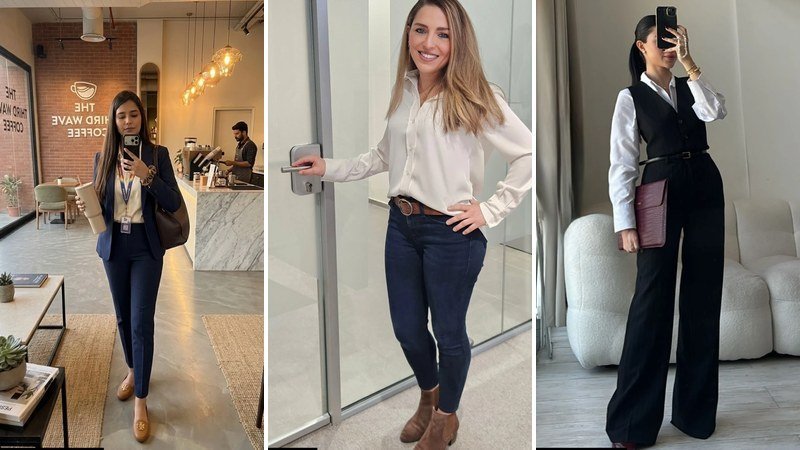
A black pinstripe vest worn as a top over a white button-down shirt, paired with matching black pinstripe trousers, creates a three-piece effect without the jacket bulk. Burgundy leather loafers and a matching laptop sleeve thread color through the look, while gold bracelet, pearl ring, and stud earrings add a feminine counterweight. The vest must button smoothly with no gaping at the chest — if it pulls, size up and have the sides taken in; a tailor can fix the fit, but no amount of confidence fixes a strained button. This outfit says you understand the details that power clients notice: matchy-matchy without being boring, formal without being frozen. Best for law or consulting where sartorial precision signals analytical precision.
The Modern Navy Suit

A monochromatic navy blue blazer and tailored trousers, split by a classic cream button-down shirt, form the foundation of a look that’s both fresh and familiar. Tan leather loafers keep the foot at ease, while a brown leather tote bag brings warm contrast to the cool navy. A lanyard with an ID card signals that you’re already envisioning yourself on the team. Before the fair, hang the suit in a steamy bathroom for ten minutes — it releases tiny packing wrinkles without the risk of a hot iron scorching the wool. This outfit is a safe harbor for anyone pivoting into a traditional field, from government to healthcare administration, where you need to telegraph reliability before you’ve proven it.
Polished Without the Blazer
Not every polished career day outfit needs a blazer. For women who run hot, forgot their dry-cleaning, or simply prefer a softer silhouette, a well-chosen sweater, shirt, or cardigan can carry the same weight. The trick is in the details — fabric, fit, and the accessories that whisper ‘I belong here.’ Look at internship outfit guides for more non-blazer inspiration that still reads as professional.
The Turtleneck-and-Trouser Uniform

A black turtleneck sweater tucked into high-waisted grey wide-leg trousers is the definition of ‘I have nothing to prove.’ No logos, no loud accessories — just good fabric and a silhouette that moves. This look relies on the weight of the materials: a fine-gauge sweater that doesn’t cling, trousers that hold their shape without starch. The tuck is everything here — use a thin leather belt hidden inside the waistband to prevent the sweater from untucking when you reach for a brochure; a safety pin can work in a pinch. For career fairs in luxury, art, or policy, it signals that you speak softly and do your homework.
The Burgundy Cardigan Overlay

by @yeona.id
A burgundy collared cardigan buttoned over a white button-down shirt feels like an academic’s take on a blazer — softer, smarter, and infinitely more huggable should a recruiter turn out to be friendly. Black wide-leg trousers and black pointed-toe heels ground the palette, while a grey leather handbag and silver laptop case add practical polish. When layering a button-down under a cardigan, starch the shirt collar so it stands up straight — a limp collar buried under the cardigan neckline will make the whole outfit read as laundry pile. This works for career day at universities, nonprofits, or anywhere where intellectual warmth trumps corporate chill.
The Black Shirt, Brown Trousers

A black button-down shirt tucked into high-waisted dark brown trousers creates a column of contrast that reads as intentional — not like you mixed up your separates. A tan leather belt breaks the zone, and a silver wristwatch adds a professional edge. The ID card lanyard, often a nuisance, becomes a credential badge here. The shirt buttons should end just at your waistband; if the shirt is longer, you’ll get a fabric poof when you sit, which distorts the clean line in an instant. Swap in a tote if your materials are heavier than a folder, and you’re ready for education, research, or any setting where you want to look like a thinker who can also execute.
The Button-Down and Skinny Jeans

by @sev_ci
A crisp white button-down shirt tucked into dark indigo skinny jeans shows you know the business-casual boundary line and know how to walk it. Brown leather belt and brown suede ankle boots keep the look grounded, while small gold hoop earrings and a delicate necklace reflect the light without catching on lanyards. For conservative industries, ensure your jeans are truly dark indigo with no whiskering or fading — otherwise, you cross from ‘professional’ to ‘weekend’ before you’ve shaken hands. This is a strong pick for career fairs where the recruiters are only a few years older than you and you need to look like a peer, not a student.
The Collared Sweatshirt, Crisp Denim

A beige collared sweatshirt over a white t-shirt, paired with white cropped wide-leg jeans, takes the concept of ‘smart-casual’ and pushes it into ‘I know exactly how casual this room allows.’ Brown and white sneakers with a brown and black bucket bag tie the look together, while a simple necklace adds a thought-through detail. Spray your sneakers with a fabric protector the night before — career fairs have spilled coffee and muddy entrance mats, and a stain on the toe box is the first thing a recruiter’s eye will snag. This is your armor for startup fairs, creative agencies, or any place where a suit would make you the anomaly.
What No One Tells You About Career Day Dress Codes
Reading the room before you arrive: Don’t trust the career page photos. Scroll a company’s Instagram or TikTok for candid shots of actual employees at desks, in meetings, or grabbing coffee. If you see a lot of dark jeans and knit blazers in tagged posts, that’s the real dress code — not the stock-image suit on their “About Us” page.
The “one step up” rule that varies by industry: The idea is to dress one notch above what you’d wear on the job. In finance, that often means a full suit when daily wear is a blazer and trousers. In tech, one step up from a hoodie might land at dark jeans and a tailored blazer. Map it to your own field so you look intentional, not clueless. For more on navigating the blurry line between polish and practicality, business casual rules for women can help you decode the gray area.
The accessory signals you’re already sending: A structured tote reads more senior than a backpack. A crossbody can look frantic or student-like during a handshake. Swap in a bag with clean lines, and lose any dangling charms or keychains. It takes five minutes to make your accessories say “I’m ready to work here,” not “I just ran out of class.”
When “overdressed” actually hurts you: Most guides say overdressed is safer than underdressed. I’d argue that’s outdated. Showing up in a full pantsuit at a startup known for hoodies can create subtle social friction — you seem unaware of the culture, which matters in early conversations. The better move: wear one structured piece, like a blazer, and pair it with a simple tee and clean sneakers if that reflects the office. If you’re unsure, check out interview tips for women that cover how to read a room before you even walk in.
The Comfort Mistakes That Ruin Career Day Confidence
Sweat-proofing without sacrificing style: Look for fabrics labeled “cooling,” “moisture-wicking,” or blends with TENCEL™ lyocell or merino wool. A thin, breathable camisole under your blouse can catch sweat before it shows, especially under the arms. Avoid 100% polyester satin; it traps heat and highlights damp spots the moment adrenaline hits.
The shoe trial women always skip: The conventional take is to break in shoes by wearing them around the house. The better move is to test them on the exact surfaces you’ll encounter. Walk up and down stairs, across polished lobby floors, and over outdoor brick or concrete 48 hours before. If they slip or pinch on stairs, you’ll be limping by the second recruiter table. For options that don’t sacrifice comfort, shoes for work outfits that actually last the day are worth a look.
Bras and straps: the hidden killers: A racerback bra with a boatneck top is fine until you reach for a résumé and the strap pops into view. Test every handshake movement in your outfit at home. For strapless or tricky silhouettes, use fashion tape along the neckline and shoulder seams — it stays put even through a full day of standing and sitting.
Layering for unpredictable AC and outdoor walkways: A packable knit blazer or a lightweight merino cardigan stashed in your bag solves the shiver problem without adding bulk. It’s easier to slip on and off than a full jacket, and it doesn’t wrinkle in your tote. Better than shivering through your pitch in a sleeveless shell because the conference room feels like a freezer.
How Your Career Day Outfits Change The Way You’re Heard
The fit factor that alters perceived competence: A sleeve that hits precisely at your wrist bone projects more authority than one you’ve rolled. If you’re between sizes, use fashion tape to temporarily hem cuffs or pant hems so they don’t bunch. Recruiters notice the silhouette before the label, and a clean line suggests precision without a word.
Color psychology that works across industries: Red in a conservative setting can read as combative; in a creative field, it signals energy. If you want a neutral more memorable than black, try a deep navy, charcoal with a faint pinstripe, or even a saturated forest green — it’s polished but not sleepy. A blazer in one of these shades anchors the look without blending into a sea of black suits.
The “conversation starter” piece you can control: A single intentional item — a vintage silk scarf, a handmade ring, a lapel pin — gives a recruiter an easy opening: “That scarf is beautiful, where’s it from?” Place it near your face or on your bag handle so it sparks the conversation you want, not a distraction.
Posture and the illusion your clothes create: Certain necklines, like a bateau or a slight V, subconsciously pull your shoulders back and open your chest. Structured blazers with a defined shoulder seam and a single button closure make you stand straighter without thinking. For more on building that effect into your look, blazer outfits that frame your posture can become a quiet confidence tool.
The Virtual Career Day Rules No One Talks About
Colors that don’t strobe or wash you out on camera: Bright white can flare, and tiny stripes or checks can create a moiré pattern that distracts recruiters. Stick to solid mid-tone blues, soft greens, or heather grays. Test your top on a video call with a friend using the same lighting you’ll have at the event — if it flickers or washes you out, swap it.
Why you still need to style your bottom half: Research on embodied cognition shows that dressing from the waist down anchors your vocal confidence, even on camera. You don’t need a full suit, but swap pajama pants for a pair of pull-on knit trousers that feel as soft as pajamas. It tricks your brain into “meeting mode,” and your tone shifts accordingly.
Lighting and background interactions with your outfit: A busy floral print can disappear into a bookshelf, and a dark blazer against a dark wall makes you a floating head. Run a pre-call test with a friend where they see exactly what the recruiter will see. Adjust your background or your top until your silhouette is distinct and your face is the focal point. For more on prepping your virtual presence, zoom interview tips can help you dial in the details.
The tech-run mirror test: Your phone’s front camera at 8 a.m. in bedroom light looks nothing like your laptop camera at noon with a window behind you. Check your outfit at the exact time and spot you’ll be sitting, using the same device and lighting position. This catches washed-out colors, awkward shadows, or a collar that looks crumpled in lower resolution — all fixable before you log on.
Your 10‑Minute Pre‑Career Day Outfit Check
Lint roll in daylight: Roll your entire outfit near a window—not just the chest, but the back and the underside of sleeves.
Bathroom light lies. The lint you miss indoors will glow under the fluorescent panels at a career fair. Hold the fabric taut and roll downward in one direction; back-and-forth rubbing packs the fuzz deeper instead of lifting it.
Zipper test: Zip and unzip every zipper three separate times, including bag and boot closures.
A sticky trouser fly halfway through the day kills momentum. Run a wax candle stub or a strip of wax paper along the teeth if there’s even a hint of resistance—it takes fifteen seconds and saves you from a locked zipper after a nervous bathroom visit.
Shoe soles: Flip each shoe and scrape off the price tag remnants, hair, and tiny pebbles lodged in the tread.
One small stone can change your gait from assured to limping within the first aisle. Also wipe the interior footbed with a damp cloth if you’ve gone barefoot while breaking them in; odour is invisible but lingers closer than you think when you cross your legs.
Emergency kit stow: Tuck double-stick tape, a safety pin, a blister bandage, and a single stain wipe somewhere invisible inside your bag.
Transfer them into a small mint tin so they don’t rattle every time you reach for your résumé. The stain wipe is non-negotiable—coffee splashes happen, and recruiters will remember the splatter before they remember your qualifications.
Cross-check with your handshake: Lift your right arm as if handing over your résumé and watch what shifts.
This motion exposes a sleeve that rides up to reveal a bra strap, a cuff that cuts into your wrist, or a blazer that pulls tight across the upper back. Fix stretched seams with a strip of fashion tape, and if a button gapes over your bust, swap to a sleeveless shell underneath instead of fighting the closure all day.
FAQ
Can I wear the same outfit to multiple career day events?
Yes—and you should if it makes you feel steady and sharp. Swap one visible piece each time: a blouse, a scarf, or a pair of earrings. The work conference outfit formulas I use rely on the same logic: no one tracks your clothes, but you’ll feel the difference between a rerun and a refresh.
What if I realize my outfit is wrong once I’m there?
Fix the physical discomfort first. Duck into a restroom, ditch the layer that’s bothering you, or switch your bag to the other shoulder. Do not mention your outfit to anyone—apologising out loud signals that you’re distracted. Straighten your posture, walk back in, and open with a question about the company. Recruiters remember how you made them feel, not what you wore.
Do tattoos or piercings matter?
Most industries today don’t penalise a visible tattoo or a small nose ring, but conservative fields like law or finance can still lean covered. If you’re uncertain, choose sleeves or a higher neckline rather than piling on concealer. Confidence about your choices leaves a stronger impression than apologetic hiding, so whatever you show, own it and don’t fidget.
Are heels ever appropriate for a career day?
Only if you genuinely reach for them during an eight-hour day on hard floors. The limping woman at a career fair is a cliché for a reason—it tanks your posture and your presence. A low block heel, a sleek pointed flat, or a stacked kitten heel reads far more composed. If you wear heels anyway, test them on the exact concrete or polished tile of the venue and stash a pair of foldable flats in your bag.
Is it okay to wear a dress without tights?
It can be, if the hem skims at or below the knee and the fabric doesn’t cling when you sweat. For conservative environments, sheer nude tights add a layer of polish that stops you from second-guessing; for casual fields, bare legs with a crisp closed-toe shoe look modern and intentional. When in doubt, the tights will cost you nothing in style and settle the question entirely.
What if I’m plus-size and nothing seems to fit the “professional” look?
The gap isn’t your body—it’s the rack. Start with a blazer that fits your shoulders (tailor sleeves and waist after) and build outward. Eloquii, Universal Standard, and M.M.LaFleur’s extended sizing prove career polish exists at every size. Ponte knit blazers skim without adding bulk, and one bold saturated colour elongates the silhouette instantly.
How do I look professional without spending a lot of money?
Rent a single statement jacket, thrift for wool or heavy crepe blends, or borrow from a friend whose fit you trust—then spend the real money on tailoring. Even a twenty-dollar blazer looks intentional once the sleeves hit your wrist bone. My internship outfit advice goes deeper on building a full look under a hundred dollars, and the same shortcuts apply here.