Comfortable 15+ Work Outfits With Flats You’ll Love

If your search for work outfits with flats starts with a quiet doubt—wondering if going flat means looking less polished, less senior—you’re not alone. The problem isn’t the shoe. It’s that most professional inspiration is built around heels, leaving you to figure out the proportions and polish on your own. A flat shoe doesn’t lack authority. It lacks the wrong silhouette around it. When you fix the hem, the toe shape, and the vertical line, the shoe stops being a compromise and starts being a deliberate choice.
If you’re building a footwear foundation from scratch, start with a solid set of office shoe options that actually hold up. And if you’ve ever felt the need to justify why you choose comfort, this reflection on wearing comfortable shoes without apologizing will feel familiar.
20 Work Outfits with Flats That Command Respect
The sea of heels in workwear inspiration isn’t just annoying—it’s gaslighting you into believing a shoe determines your competence. Not anymore. These 20 work outfits with flats are built from real dressing formulas that work whether you’re presenting to a board, negotiating a raise, or just trying to get through a 10-hour day without limping home. They use the exact pieces you likely already own: blazers, trousers, knits, and the right flat. The difference is in the details—hem lengths, toe shapes, and a few proportion rules most women learn the hard way. Here’s how to do it without sacrificing an ounce of authority.
The Boardroom-Ready Flat
These five outfits are built for conservative dress codes, client-facing meetings, and days when you need to look like you’ve already got the promotion. The common thread: impeccable fit, neutral palettes with a single anchor color, and flats that refuse to apologize for not being heels. This is where you learn that a pointed toe and a sharp blazer do more for your presence than any stiletto could.
The Black Tee, Beige Trousers Formula

A black heavyweight cotton tee tucked into beige wide-leg trousers is a lesson in proportion: the soft volume below is balanced by a close-to-body top. Black leather flats, a thin black belt, and a structured black handbag pull the look together without a blazer. Gold accessories—a simple watch, small earrings—add a controlled gleam. The wide trouser hem should just skim the top of your flat, not pool on the ground; if it drags, you’ve lost the line. This no-jacket outfit borrows the precision of classic work outfits but feels completely current, especially in warmer months when you’d rather not layer.
Cream Shell, Black Trousers, Pointed Flats

Cream sleeveless shell in a substantial crepe holds its shape through a full day of meetings. Black tailored trousers with a straight leg cut a crisp silhouette. The beige pointed-toe flats are the stealth weapon here: the toe mimics the elongating line of a heel without the pitch, and the neutral tone blends with your skin to extend the leg. A chunky gold bracelet at the wrist is the only accessory you need. Avoid a shell that’s too thin—if you can see the outline of your bra, the entire look loses its professional edge. This combination works for formal offices and handles a standing desk without complaint.
White Blazer, Black Velvet Trousers

A relaxed white tweed blazer over black wide-leg velvet trousers sounds risky, but the texture contrast makes it arresting. Black ballet flats with a standard toe keep the look grounded and avoid the costume-y feel of a heeled pump with velvet. A black handbag and minimal gold jewelry finish it. The velvet trouser hem should end just above the floor when you stand barefoot, so with flats it hovers a half-inch off the ground—you want a slight break, not a puddle. This look nods to traditional business attire but refuses to be stuffy. Perfect for evening work events or board meetings that run late.
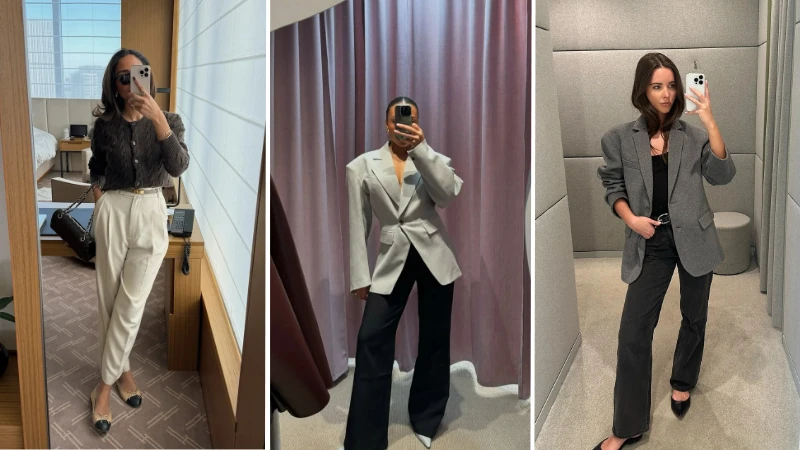
Dark Knit, Cream Trousers, Two-Tone Flats

by @cocobeautea
A dark brown cardigan—fine-gauge, buttons closed or open depending on the mood—paired with cream tailored trousers creates a lengthened line that reads taller than it is. Beige-and-black two-tone ballet flats add a quiet visual hook without breaking the neutral palette. A taupe belt and black shoulder bag keep the accents subtle. If you’re wearing a cardigan this fitted, a front-crease trouser is non-negotiable: the sharp crease offsets the softness and stops the outfit from veering into loungewear. This works for a formal office where you want to look approachable yet authoritative, especially on days when a blazer feels like armor you don’t need.
The Tailored Suit, Pointed Flat Alternative

by @havanattan
A light grey structured wool blazer and black wide-leg crepe trousers form the backbone of a power suit. Instead of the expected white heels, we’re swapping in white pointed-toe flats—same sharp silhouette, no elevation. The white shoe against the black trouser creates a deliberate focal point that travels upward, so the eye registers the vertical line. Small gold earrings are the only jewelry needed. Make sure the trouser hem is taken up slightly: a flat requires a shorter break than a heel, otherwise the fabric stacks and cuts the leg off at the ankle. This outfit says you’re in charge, not your footwear.
The Daily Power Uniform
Not every workday calls for a full suit, but you still need to look like you tried—and more importantly, like you’re in charge. These business-casual combos mix textures, loose-and-structured proportions, and flats that hold their own. They’re the outfits you’ll reach for when the dress-code memo says “smart casual” but your calendar says “three back-to-backs and a lunch meeting.”
The Oversized Knit and White Denim

by @renaciuki
A beige oversized sweater with white straight-leg denim hits the smart-casual sweet spot. The sweater’s volume asks for a slender bottom, so straight legs—not skinny, not wide—keep the line clean. Black ballet flats with a low vamp expose enough instep to prevent the leg from looking cut off. A black shoulder bag coordinates without competing. Pay attention to the denim’s hem: it should end right at your ankle bone, no higher; a cropped cut with flats often hits too high and widens the ankle visually. This is a Monday-morning no-think outfit that still looks intentional, especially if you’ve absorbed the unspoken rules of business casual for women.
White Tee, Dark Wool Trousers, White Flats

by @amyfuchsia
A white relaxed tee tucked into dark brown wide-leg wool-blend trousers feels impossibly expensive with the right flat. White pointed-toe mesh flats reflect light and keep the look airy, while the dark trouser anchors. Gold accessories—bracelet, earrings—add a luxe touch. A void a too-sheer white tee; a substantial cotton hides bra lines and reads as polished, not pajama. The key to making wide trousers work with flats is ensuring the hem just grazes the ground when you’re still; if it drags, the outfit drags with it. This is the outfit you wear when you need to look like you have your life together, even if your inbox says otherwise.
The Brown Blazer, Black Trousers, Ballet Flats

by @_katiepeake
An oversized brown wool-blend blazer thrown over a white tee and black straight-leg trousers is a masterclass in easy authority. Beige ballet flats add a soft neutral that keeps the look from becoming too stark. A tan tote and slim black belt define the waist without cinching. The trouser break for ballet flats should be minimal—enough fabric to touch the foot when standing, but not so much that it folds over the shoe. It’s the kind of reliable combination you’ll find in any well-edited corporate wardrobe. If you’ve been avoiding blazers with flats because you thought it would look bottom-heavy, this combination disproves it. The blazer’s shoulder structure balances the flat’s low profile.
Layered V-Neck Over Button-Down

by @amyfuchsia
A beige V-neck sweater layered over a white button-down shirt with olive green wide-leg trousers is the kind of outfit that says you read the manual on quiet luxury and then wrote your own. Cream woven slip-on flats keep the silhouette light, and a dark brown suede tote adds texture. Avoid a clunky collar—the button-down’s points should lie flat inside the sweater’s V, or the whole thing looks rumpled. This combination thrives in smart-casual offices and handles temperature swings well because you can shed the sweater. The trousers should have a slight crop but still cover the top of the flat; a too-short length with these proportions creates a visual stop.
White Button-Down, Wide Beige Trousers

by @missy_elz
A relaxed linen button-down in white paired with beige wide-leg cotton-blend trousers is a summer work uniform that doesn’t wilt. Black flats (true to size, not too snug—your feet will swell by afternoon) ground the light tones. A black leather belt and oversized black tote match, and a gold watch adds a detail. Roll the sleeves twice to expose the wrist; it breaks the uniform feel and makes the shirt look like a choice, not a requirement. When the heat climbs, swapping in a thoughtful flat is a lesson from smart shoe selection. This outfit relies on the trousers’ drape: they should fall from the widest part of your hip and not cling.
The Creative Executive
If your office leans creative or you’ve got the leeway to push business casual into less traditional territory, these looks are for you. Blazers with jeans, tonal layering, and the kind of casual polish that reads as confident, not sloppy. The flats here walk a line between structure and ease—loafers, ballet flats, and one sleek loafer that could pass for a dress shoe.
Black Blazer, Off-White Jeans, Ballet Flats

by @amybethvdl
A black oversized blazer over a white tee and off-white straight-leg jeans is a French-chic departure that reads entirely professional when the denim is pristine and the fit is sharp. Beige ballet flats soften the black-and-white contrast, and a cream shoulder bag ties in the warm neutral. Resist the urge to cuff the jeans; a clean hem that grazes the top of the flat is more elongating than a rolled edge that chops the leg. This outfit thrives in creative agencies, tech offices, and any workplace where “no denim” isn’t in the handbook. It’s the kind of look that makes people ask where you bought your blazer, not why you’re wearing jeans.
Grey Blazer, All-Black Underneath

A grey oversized wool-blend blazer over a black slim-fit top and black straight-leg jeans creates a continuous dark column from shoulder to toe, which is exactly what you want with flat shoes. Black leather flats with a slightly squared toe keep the look modern. A black belt with a matte buckle disappears into the outfit. Shiny buckles or logo hardware on the belt will cut the vertical line and draw the eye downward—stick to low-contrast accents. This is business casual done right: it feels easy because the color palette does the heavy lifting. Add a swipe of red lipstick if you want the full effect, but the outfit doesn’t need it.
Grey Trousers, Brown Loafers, Soft Tones

A light grey blazer and matching tailored trousers feel serene when paired with a dark brown slim tee. Brown leather loafers and a matching belt anchor the look, while a tan handbag lifts it. The loafer should be a shade lighter or warmer than the trousers to avoid a blocky foot; true brown against light grey works, but black would be too stark. This outfit is quiet but not boring—the tonal play is intentional. If you’re prone to falling into the all-neutral trap, this is your proof that neutrals can have depth when you mix temperatures. Perfect for client meetings where you want to look competent without intimidating.
Beige Blazer, Cream Trousers, Ballet Flats

by @indybamra
A beige oversized blazer open over a black top and cream straight-leg trousers is a lesson in line. Beige ballet flats echo the blazer, while a black handbag and gold bracelet provide contrast. Push the blazer sleeves up to just below the elbow—this small adjustment makes the oversized cut look intentional, not borrowed. The key with cream trousers and flats is opacity: choose a heavier cotton blend that doesn’t show every pocket outline. When the fabric holds its shape, the flat shoe becomes an afterthought, not a compromise. This outfit can go from desk to dinner by adding a bolder earring.
Cream Blazer, Layered Button-Down, Light Denim

by @missy_elz
A cream blazer over a white button-down and white t-shirt is an advanced layering move that stops just short of overkill. Light blue straight-leg jeans and black ballet flats keep it fresh. A black handbag and black belt tie the pieces together. If the layering starts to feel bulky at the shoulder, swap the t-shirt for a tissue-weight merino; otherwise you’ll look inflated. This outfit works because the colors are harmonious: cream, white, light blue. No single piece shouts. It’s a modern take on business casual outfits that proves you can layer three tops and still look streamlined. Reserve this for days when the office air conditioning is set to arctic.
The Soft Power Edit
Authority doesn’t always mean shoulder pads and sharp lapels. These five outfits embody the approachable yet completely capable side of professional dressing. Cardigans, soft knits, midi dresses, and wide-leg trousers—all paired with flats that keep the look grounded. There’s no artifice here, just quietly powerful pieces that work when you need to lead with warmth instead of armor.
Brown Tee, Patterned Trousers, Black Flats

A relaxed brown cotton tee tucked into brown-and-black patterned wide-leg trousers offers a subtle graphic punch without a print that overwhelms. Black leather flats with a slight patent sheen upgrade the tee. A slim black belt and black shoulder bag tie in the dark tones, while gold earrings catch the light. Patent leather flats require a clean line; scuffing is more visible, so keep a buffing cloth in your desk drawer. If you’ve shied away from patterned trousers with flats, note that the wide leg creates a long line that compensates for the flat sole. The pattern draws the eye down and through, not stopping at the foot.
Grey Midi Dress, Pointed Black Flats

A grey slim-fit linen-blend midi dress gets its authority from a sharp shoulder and a clean line. Black pointed-toe leather flats add the structure the soft fabric needs. A structured black tote and a chunky gold ring complete the look. A midi dress with flats can make the legs appear shorter; a side slit or a hem that ends at the narrow part of the calf (just below the widest point) prevents the stump effect. This is an one-piece solution for mornings when you have five minutes to dress. It works in creative offices and casual corporate environments alike, and the linen blend means you look composed even when it’s sweltering.
Red Knit Top, Black Trousers, Ballet Flats

A red sleeveless knit top, half-tucked into black wide-leg trousers, does the heavy lifting of a full-color outfit with just one piece. Black ballet flats and black sunglasses continue the streak of black, while a gold bracelet adds a metallic ping. A half-tuck gives shape without the fuss of a belt, but make sure the fabric isn’t too thick—a chunky knit in a half-tuck creates an odd bulge at the hip. This is a perfect Friday outfit: the red signals you’re not fading into the carpet, and the black trousers ground the statement. Pair with tidy hair (a low bun) to keep the look professional.
White Cardigan, Grey Trousers, Red Patent Flats

A white cardigan buttoned over grey wide-leg wool trousers is a template for soft authority. Red patent ballet flats shock the neutral palette awake. A black handbag and gold jewelry keep the outfit from feeling like a holiday ensemble. Patent red flats skew more “power lunch” than “holiday party” when the rest of the outfit stays monochrome; let the shoes be the only bright color. The trousers should have a pressed crease and a hem that just kisses the floor when you’re standing; with flats, that might mean a trip to the tailor for a quarter-inch adjustment. This is the kind of outfit that makes walking into a meeting feel like entering a room you already own.
Beige Blazer, Black Trousers, Minimal Loafers

by @ernestanavi
A beige relaxed blazer over a black thin top and black straight crepe trousers creates a column of dark under a light shell—a classic shape that works with any flat. Black leather loafers with a sleek, unadorned toe echo the trousers. A beige shoulder bag mirrors the blazer. Lug-soled loafers would disrupt the clean line; go for a low-profile sole so the shoe glides rather than clomps. This outfit handles the sitting-to-standing problem without any trouser-bunching at the knee, which is its own kind of win. It’s the uniform of a woman who’s made peace with her flats and figured out that the secret is never the shoe—it’s the hem.
Why Most Work Outfits with Flats Fail Before You Even Leave the House
The invisible proportion trap: Flats shorten the visual leg line, and the most common culprit is a broken hem. Pants that are too long puddle at the ankle and swallow your shoe; pants cropped too short cut the leg at its widest point, making you look shorter. For ballet flats, the hem should end no more than 1/4 inch above the floor—barely a sliver of light. With loafers, aim for a slight break right at the ankle bone, no pooling. Oxfords handle a slightly longer hem that hits the top of the vamp. Most women hem their trousers for heels and then switch shoes, not realizing they’ve lost the vertical line. You’ll hear that ankle-length pants are always safe with flats. That advice misses that your ankle bone height isn’t universal—measure from the floor up, not from the knee down. Get that wrong, and the length breaks everything.
Toe shape psychology: The silhouette of your flat sends an unspoken message. A round toe reads as approachable, but it can veer into juvenile or cutesy—especially with a bow or ballet detail. At a performance review, your shoes should say you’ll make the hard call, not host a tea party. An almond or pointed toe signals decisiveness and extends the leg line further. It’s not about brand; it’s the geometry. When you need to command a room, skip the circle and pick the angle.
The “oversized everything” misunderstanding: Many women compensate for flats by wearing baggy trousers or an oversized blazer, thinking volume balances the flat shoe. It doesn’t. It drowns your frame and erases the waistline, making you look shorter and less authoritative. The counter-intuitive rule: a closer-to-body fit on bottom creates a longer, leaner vertical line with flats. Slim ankle pants or a straight-leg trouser that hugs your hip and thigh elongates more than a wide leg that swallows your foot. Keep one clean line from hip to toe.
One non-negotiable detail: Add a sharp-shouldered blazer. The structure at the shoulders pulls the eye up and creates a vertical frame that instantly compensates for the missing heel lift. It’s the single garment tweak that tells the room you chose those flats deliberately, not because you gave up. A strong belt or a precise pant cuff hitting exactly at the ankle bone does the same job, but the blazer is the fastest fix.
The Silent Podiatrist in the Room: What Your Flats Are Really Doing to Your Body
The hidden hazard of ballet flats: Most women ditch heels to escape foot pain, but flimsy, unsupported ballet flats can cause plantar fasciitis, metatarsalgia, and Achilles issues over time. A podiatrist would tell you a completely flat, thin-soled shoe is almost as problematic as a stiletto because it offers zero arch support and encourages overpronation. That paper-thin sole transfers every sidewalk shock straight to your knees and lower back. You’ve traded one problem for another.
The “French girl” myth vs. your foot anatomy: The chic Parisian flat is held up as the ideal, but those wafer-thin soles on hard city pavement are biomechanical nightmares. You can love the look, but your body doesn’t care about Instagram. Hard surfaces plus zero cushion equal joint stress. A work flat for eight hours needs more than aesthetic credibility—it needs a sole with some density and a footbed that doesn’t collapse by lunch.
The standing-desk reality check: If you stand for hours at a sit-stand desk or in a lab, a flat that requires constant micro-toe-gripping to stay on destroys concentration and causes chronic foot fatigue by afternoon. Try the “twist and fold” test: grab your flat by the heel and toe, twist it, then try to fold it in half. If it bends easily, it’s not supporting you. This is a sitting-to-standing problem most office wear advice skips—your shoe must work when you’re vertical, not just when you’re posed at your desk.
An inflammation insight most skip: Your feet swell over a workday. Shoes that fit perfectly at 8 a.m. can be painfully tight by 2 p.m. Buy flats with a thumb’s width of space at the toe and, ideally, an adjustable closure across the instep. This isn’t about vanity sizing; it’s about lasting a full day without cutting off circulation. I’ve talked about choosing comfortable shoes without apology, but the real priority is support that holds up through that afternoon swell.
Office Politics in Flat Shoes: How to Command a Room Without an Extra Two Inches
Height and perceived competence: The bias is real: taller individuals are rated as more leader-like. But you can offset that with vertical-body-language tactics, not just clothing tricks. When standing, keep your elbows slightly away from your body—it expands your silhouette and signals confidence. Chin parallel to the floor, not tilted up or down. At a conference table, sit with your chair pulled in and forearms resting on the table; avoid tucking your elbows defensively. Your physical presence speaks before you open your mouth.
The sound factor no one talks about: Heels make a sharp, announcing sound when entering a room. Flats are silent. But you can create the same acoustic presence with a deliberate pause. When you enter a meeting, stop for two seconds just inside the doorway, plant both feet firmly, and let your eyes scan the room. It’s a visual and spatial statement that replaces the missing click. Executive presence coaches teach this because authority is about being seen, not just heard.
The “likeability” conundrum in male-dominated industries: In fields like finance or law, a woman in flats can be coded as “too casual” by some colleagues, while a man in flat oxfords is seen as traditional. The conventional take says you need heels to be taken seriously. That misses the psychological impact of deliberate presence. If a remark comes, a calm reply works: “I need to be on my feet for the next eight hours without distraction—these are my performance shoes.” It reframes the choice as practical and professional, not a concession.
The commuting authority shift: Many women change into heels at the office, creating a mental split between “the woman who walks” and “the woman who works.” Stepping off the train or out of the car in polished flats already signals readiness and a lack of fuss. You’re not the person who needs to switch shoes to feel official—you’re the person who arrived prepared. That reframes flats as a deliberate, powerful choice, not a second-best option.
The Unseen Economics of Work Flats: When to Splurge and When to Skimp
The false economy of $40 flats: A cheap flat that scuffs and loses shape after two months ends up costing more than a well-made pair. Do the math: $40 every three months for three years is $480. A $250 resoleable leather flat, resoled once in that time for $50, totals $300—and still looks presentable. You’re not saving money; you’re just spreading it across multiple failures. The hidden cost includes emergency replacements when a sole separates at lunch. I’d argue that’s a far more expensive habit than buying one good pair of work shoes up front.
The resoleable revolution: Most women don’t realize that flats with leather soles and Goodyear-welt construction can be resoled several times, lasting a decade or more. Cemented synthetic soles wear out and land in a landfill within a season. A cobbler can replace a leather sole for a fraction of the cost of a new pair. This is an environmental and economic win—but you have to know to look for a stitched, not glued, sole.
The mid-range “support trap”: Flats priced between $80 and $150 often look supportive with thick-looking insoles, but that foam compresses to paper-thin within weeks. They offer neither the longevity of a premium shoe nor the true orthotic benefit of a specialized comfort brand. To spot a durable insole, press your thumb firmly into the footbed. If it springs back instantly, it’s low-density foam that will flatten. A dense, slow-recovery material—one that takes a second to rebound—will actually hold up.
The real risk of repeat buying: Many women own five or six pairs of slightly uncomfortable, slightly worn black flats, but never purchase the one pair that would solve the problem. The behavioral trap is believing the next cheap pair will be better. Break it with an one-in, one-out quality rule: for every new flat you bring in, retire an uncomfortable one. Over time, you stop accepting even small discomforts—and you stop the mental load of constant shopping.
The 5-Minute Out-the-Door Mirror Check for Flats
The Hem Check: Your pants should never puddle on the floor or crop at the widest part of your calf.
Pants puddling over flats ruins the whole proportion instantly. For ballet flats, the hem should just kiss the top of your foot without breaking; for loafers, let it hover half an inch above the ground. Stand sideways and look—if fabric bunches at the ankle, you’ve lost the line.
The Vertical Line Check: Find one unbroken visual line from shoulder to toe.
A long cardigan, a monochrome column, or a front trouser seam does the job. Without it, flats make your body read as separate blocks. The non-obvious fix: unbutton your blazer to reveal a single-color top that matches your pants, creating a continuous streak of color.
The Foot Exposure Check: If you see too much bare instep, the line breaks.
A deeply cut vamp on a ballet flat shows skin that chops your leg visually. Add a sheer ankle sock in a shade close to your skin tone, or choose a shoe with a higher vamp. This one tweak turns a “commuter shoe” into a deliberate choice.
The Silhouette Check: From the side, a completely flat sole can flatten your arch optically.
Add even a half-inch block heel—often built into the shoe without screaming “heel”—to restore a subtle arch line. If your side view looks like a straight plank, your shoe is working against you. A slight pitch lengthens your stance without sacrificing comfort.
The Polish Check: Scuffed toes are an authority killer.
A dry washcloth buffs out light scuffs on leather in seconds—keep one in your desk. If the toe cap is worn through to suede or the leather is shredded, retire them. No one trusts a presentation from someone whose shoes look like they’ve been kicked under every desk.
FAQ
Will wearing flats to a job interview put me at a disadvantage?
Only if the rest of your presence is tentative. A crisp suit with pointed-toe flats and strong eye contact reads as more competent than a nervous candidate wobbling in stilettos. If you’re still worried, choose a low block heel under 1.5 inches—but never a shoe that makes you unsteady on your feet.
Can I wear ballet flats with a pencil skirt without looking like a secretary from 2005?
Yes, if the skirt hits exactly at the knee or just below and the toe is sharply pointed or almond-shaped—never round. The 2005 look came from a round-toe, paper-thin ballerina paired with an A-line. Update with a high-waisted pencil skirt, a subtle side slit, and a flat that has a structured sole and low-cut vamp.
Are flat knee-high boots office-appropriate?
Absolutely. A sleek, un-slouched riding boot with tailored trousers tucked in can project more authority than many pumps in fall and winter. The key is polished leather, not distressed, and a shaft that hugs your calf—wear them with a midi dress or slim trousers as part of your classic work outfits.
Do I have to wear orthotic-looking clogs if I have plantar fasciitis?
No. Many modern flats have removable insoles that hide custom orthotics perfectly. Look for a deep heel cup and a toe box wide enough to accept your insert—the outside can be as sleek as any fashion flat. A podiatrist’s solution doesn’t have to announce itself to the room.
What color flats are the most versatile for a corporate job?
A tone that matches your skin depth—nude for you—elongates your leg and disappears. After that, matte black and deep cordovan cover 90% of business wardrobes. Skip metallics and brights for everyday; they narrow your pairing options and read as casual before lunchtime.
Is it unprofessional if my toes show in flat sandals at work?
In most traditional offices, yes—open-toe shoes still fall into a gray area. Even in business casual, stick to a slingback or peep-toe flat that shows only a sliver of toe. When in doubt, closed-toe always reads as more deliberate; check your business dress code if you’re unsure.