Chic 10+ Shift Dress Outfit Ideas for Every Occasion

A Shift Dress Outfit search returns thousands of images—sleek models on clean backgrounds—but none of them tell you what happens when you actually sit down in that dress. The fabric bunches, the hem creeps up, and suddenly that relaxed look feels anything but. The problem isn’t you; it’s that most styling advice skips fit, fabric, and occasion. Real shift dress styling tips start with how the dress hangs on your body, not how it hangs on a hanger. That’s what this is about: understanding how to wear a shift dress so it actually flatters you.
If you’ve ever wondered why a shift dress feels off, often it’s the hem. Read more about how hemline length changes your silhouette. And if you’re aiming for the office, check the rules on business casual for women to avoid guesswork.
17 Shift Dress Outfit Formulas That Actually Flatter
Most shift dress outfit galleries show you a photo and leave you staring at a boxy silhouette wondering what went wrong. These 17 combinations don’t just pair items—they solve the real problems: looking shapeless, feeling dated, or landing in a setting where the dress code quietly judges you. I’ve grouped them by the style strategy each one uses, so you can steal the formula that fits your day. No aspirational fluff, just wearable answers.
The Minimal Edit
Minimal doesn’t mean boring. These shift dress outfits use clean lines and a strictly edited color palette to make the shape the statement. If you’ve ever felt swallowed by fabric, here’s the antidote.
The Layered Slip Shift

by @ohmboutique
A black slip dress gets structure when you layer it over a crisp white button-down. Add a tan leather belt at the waist—the belt creates a hourglass anchor without disrupting the shift silhouette—and finish with beige knee-high boots and layered gold necklaces. The oversized cotton shirt underneath adds coverage without bulk, so you keep the clean lines of the dress without bareness. Wear this for a gallery visit or a coffee catch-up where you want an edge.
The Boho Cotton Shift

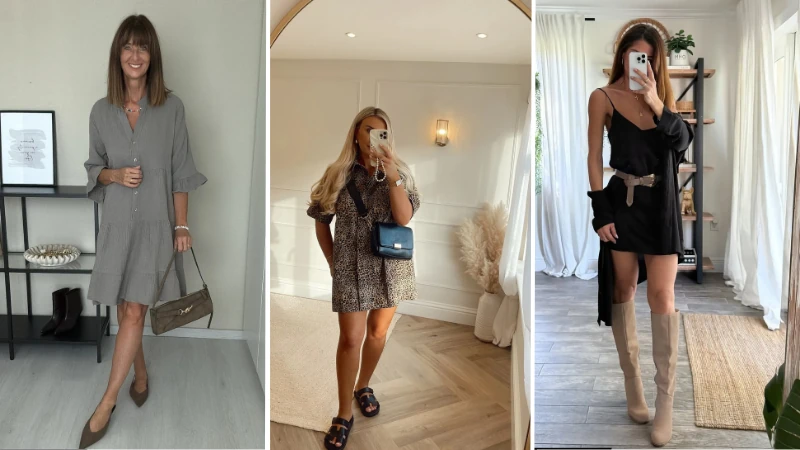
A grey crinkled-cotton shirt dress needs just a few grounding pieces to avoid looking like sleepwear. Pointed-toe brown suede flats extend the leg line, while a structured brown shoulder bag adds polish. If your shift dress fabric is thin, always wear a half-slip—it prevents cling and keeps the shape smooth. A multicolor beaded necklace and pearl bracelets bring boho character without overpowering the subtle texture of the dress. This works for a daytime market run or casual lunch.
The Sock-and-Loafer Shift

A pale-yellow cotton shirt dress leans preppy when you pair it with black loafers and crisp white socks. Black sunglasses and a black shoulder bag keep the accessories monochrome and polished. Make sure your socks are pulled taut—any slouching around the ankle cheapens the clean-girl effect. This outfit reads smart casual without trying too hard. It’s built for a city walk, a museum date, or a low-key work event where you need to look present but comfortable.
The Minimal Midi Knit

A cream midi knit shift dress is the blank canvas. Leopard-print slide sandals add a single jolt of pattern, while a grey smartwatch and black phone case stay in the background. The key with a midi hem is placement: it should hit at the narrowest part of your leg, usually just above the ankle or mid-shin, to avoid cutting you off at the widest calf point. This outfit is relaxed enough for a WFH day but intentional enough for a quick grocery run. The knit moves with you, so you’ll never feel restricted.
The Preppy Polish
The preppy aesthetic takes the shift dress from slouchy to sharp. A few key ladylike additions—like a sweater vest or loafer—instantly define the waist and add structure. These four looks prove you can be prim and still comfortable.
The Vest-Waist Trick

by @ohmboutique
A white shirt dress becomes instantly less boxy when you slide a black sweater vest over it. The vest acts like a corset without the squeeze, creating a visual waistline. Beige knee-high boots and a beige crossbody bag elongate the lower half. Choose a vest with a deep V-neck to continue the vertical line of the shirt collar—anything too high will cut your neck short. Gold jewelry reflects light up top. This formula works for fall coffee dates and casual office days where you want an extra layer.
The Striped Sailor Shift

by @ootd.diana
A blue-and-white striped cotton shirt dress leans into coastal prep. Leave the collar open, add a single gold necklace, and carry a white shoulder bag to echo the pattern. Lightly crinkled stripes hide wrinkles—if your dress arrives from a suitcase, a quick steam is all it needs. This is the uniform for a brunch with a view or a day exploring a new city. The cotton breathes, and the shift shape never restricts, so you’ll stay comfortable.
The City-Stroll Stalwart

A blue-and-white striped shirt dress meets tan slouchy suede knee-high boots for an urban look. A brown handbag and simple gold necklace tie the brown tones together. Slouchy boots work here because they mirror the dress’s relaxed cut—if the boots were stiff, your outfit would look top-heavy. This combination handles a day of pavement pounding. Add a trench coat when the temperature dips and you’ve got a full transitional look.
The Sweater-and-Jacket Equation

by @ohmboutique
A cream sweater dress gets structure when you layer a light-wash denim jacket over it—keep the jacket unbuttoned to create a long vertical line. Beige knee-high boots and a tan shoulder bag extend the neutral palette. When you sit down, the knit will mould to your body; stand up and it should spring back—if it stays stretched, the fabric weight is wrong for a shift. For an evening version, swap the denim jacket for a black blazer and add heeled booties. This look transitions from casual day to dinner with a quick jacket change.
Denim and Western Edge
Denim shift dresses can read too casual or too costume-y. The trick lies in the boots and the proportions. These three looks keep the Western references subtle, modern, and wearable for real life.
The Polished Denim Shift

by @ohmboutique
A medium-wash denim shirt dress with beige knee-high boots instantly reads Western-tinged but not theme-park. A taupe structured handbag and delicate gold necklaces add refinement. Make sure the denim has enough weight to hang straight—a thin, clingy denim will bunch at the hip and ruin the masculine-feminine balance. This look works for a brunch date or a casual networking event where you want to appear approachable but put-together. Cuff the sleeves for extra nonchalance.
The Denim Mini Shift

by @ohmboutique
A medium-wash denim mini dress gets a leg-lengthening assist from cream knee-high leather boots. Stacked gold jewelry and a white accessory (a hair clip or phone case) lighten the mood. Test the length sitting down—the hem should not creep above mid-thigh, or you’ll spend the day adjusting. This outfit is for casual outings where you want to feel a little flirty without sacrificing ease. The denim’s structure holds the shift shape, so no bunching at the waist.
The Dark Denim Standby

A dark-blue denim shirt dress is the blank canvas for tan fitted knee-high boots and gold rings. A cream phone case adds a subtle bright spot. When your boots fit snugly at the calf, the dress fabric will glide over them instead of catching—test with a few strides before leaving the house. This outfit leans more cowboy than coastal, but the sleek boot keeps it from veering into costume. Wear it for a weekend hangout or a concert.
The 9-to-5 Comfort Code
Whether you’re teaching, presenting, or just need a work dress that works as hard as you do, these shift dress combinations prioritize breathability and movement—without sacrificing style. They work for classrooms, casual offices, and any setting where you spend hours on your feet.
The Sage Sport Shift

A sage-green babydoll shift dress in soft jersey feels like a T-shirt but looks intentional. White high-top sneakers and an orange smartwatch strap inject a sporty pop. Since the dress has no built-in shape, the structured sneakers anchor the outfit and stop it from reading as maternity wear. White hoop earrings tie the whole look together. This is the uniform for a teacher who moves constantly—squatting, reaching, speed-walking between classes—while still looking polished.
The Denim Duty Dress

by @ah.teachess
A medium-wash denim shift dress gets a practical edge with tan platform cork sandals and a silver lanyard for your ID. Gold jewelry softens the functional pieces. If your school or office dress code prohibits sleeveless, check the armhole depth before purchase—the cut should sit snugly enough to hide your bra but loose enough to let you raise your arm to write on a board. This outfit balances utility and approachable style, so you feel confident during parent meetings or hallway supervision.
The Cool Linen Shift

A white-and-tan linen-blend shirt dress stays crisp through a school day. White leather sneakers match the dress’s light tones, while a pink smartwatch strap and silver earrings add discreet color. Linen wrinkles fast—choose a blend with at least 30% synthetic fiber to resist deep creases by 10 a.m. This breathable combination works for warm-weather classrooms or a creative office. Tuck a silk scarf into your bag for a quick neckline refresh before a meeting.
The Sleeveless Sage Staple

A sage-green sleeveless jersey shift dress is a warm-weather workhorse. White platform sandals keep the look airy, and a multicolor lanyard doubles as a playful accessory. If you wear a lanyard daily, choose one with a breakaway clasp to prevent it from snagging the delicate jersey edge. Gold stacked bracelets and a white smartwatch complete the look. This works for a classroom, a library assistant shift, or any indoor job where air conditioning isn’t guaranteed.
Bold Statements
When the shift dress itself carries the look—through print, color, or setting—the support acts need to stay quiet. These two outfits show how to let the dress do the heavy lifting while you remain in control.
The Animal Print Shift

by @mrshanbrown
A brown animal-print shirt dress is a statement on its own. Pair it with black slide sandals and a black crossbody bag to ground the pattern. A gold watch and a white faux-pearl phone charm add feminine detail without competing. Avoid adding a bulky layer like a puffer vest—the print already has enough visual weight; anything extra will overwhelm the shift’s clean line. This is a lunch or shopping look that turns the dress into the main event.
The Coastal White Shift

by @clemnzi
A white linen shift dress is the essence of Mediterranean vacation. Black cat-eye sunglasses, layered gold jewelry, and a beige straw tote bag play up the seaside vibe. Linen can be sheer—wear a nude slip underneath, never white, so there’s no harsh outline in bright sunlight. For a beach wedding, this dress keeps you cool while looking ceremony-appropriate. Or wear it for a travel day or a resort dinner when you want to feel easily polished.
The Silent Fit Signals That Make or Break a Shift Dress
Shoulder slope truth: The seam must end exactly at the shoulder bone edge—one centimeter off and the whole dress hangs wrong. If it droops even slightly down your arm, the dress widens your frame instantly. No amount of accessorizing fixes a collapsed shoulder line.
Armhole depth matter: Most guides obsess over the hem, but I’d argue armhole depth is the real dealbreaker—because a too-deep armscye flashes your bra every time you lift a coffee cup. A properly cut armhole sits high and snug under the armpit, letting you move without the dress riding up. Test it in the fitting room by reaching forward as if grabbing a door handle.
Bust apex alignment: The dart point should aim at the fullest part of your bust, not above it—this one detail stops the “tent” look cold. When the dart is too high, the fabric buckles and billows. A well-placed apex dart creates a slight curve that skims without clinging, exactly what a work dress needs to read polished.
Hem‑line‑of‑sight physics: The eye reads the hem as the widest point; an above‑knee hem widens, a midi telegraphed by heavy fabric adds pounds. Choose the break point deliberately. On petite frames, a hem that hits just above the knee creates a continuous vertical line, which keeps proportions balanced without visual bulk.
Fabric weight is the real shaper: Lighter silks skim, mid‑weight crepe holds its own shape, heavy tweed adds bulk—knowing this replaces shapewear. A crepe shift dress hangs straight without hugging, while a silk one drapes softly over curves. Pick the weight for the silhouette you want, not the one the tag promises.
Why Your Shift Dress Looks Dated: 2025’s Unspoken Fabric and Cut Rules
The stiffness outdated: A shift that stands away from the body with too much interfacing reads 2010. You’ll recognize it by the way the dress holds its shape on the hanger, as if starched. Modern versions use darts, a subtle side slit, or a fluid sandwashed finish that moves with you, creating shape without structure.
Lining tells the decade: Visible synthetic lining peeking out at the hem is a dead giveaway. A hybrid silk‑rayon lining breathes and lies flat, no static. Unlined dresses aren’t automatically cheap, but if the fabric is thin, they cling and crease in ways that age the whole look by lunchtime—something a shirt dress outfit rarely suffers because of its built‑in structure.
The neckline era indicator: Bateau necks read classic; deep‑V reads evening; mock‑neck reads youthful. Knowing which your dress has tells you what scenarios it slots into without guessing. If you find a shift with an arched jewel neckline, it likely dates to early‑2010s sweetheart shapes—and will fight any modern jacket you pair it with.
Prints that trap you in time: A scattered bird print feels twee; a geometric black‑and‑white block print is 2025. Scale matters more than motif: larger patterns expand the visual field, making you look wider; smaller, tighter repeats recede. For a test, stand six feet from a mirror; if the print blurs into a single color mass, it’s safe.
Back zip vs. exposed zipper: An exposed chunky back zip cheapens the look instantly. A concealed invisible zip or seamless side closure upgrades the garment’s perceived value and keeps the silhouette clean. You can often spot the difference before trying it on—if the zipper teeth glint under store lighting, leave it on the rack.
The Social Contracts of Wearing a Shift Dress to Work—What HR Won’t Tell You
Power vs. approachable: A sleeveless shift in a boardroom communicates confidence only if the armhole is tight; a floppy cut signals unpreparedness. The same dress with a knit blazer from a black blazer outfits guide becomes leadership‑ready. Look for a blazer that hits at the hip—it won’t fight the shift’s straight lines.
The 2‑inch knee rule for offices: In most corporate environments, the hem must be no more than 2 inches above the knee when seated. Test by sitting in front of a mirror—if you’re pulling the fabric down, it’s too short for authority. This is exactly the kind of detail I unpack in the sitting‑to‑standing problem, where a standing‑perfect length fails the moment you take a chair.
Color carries hierarchy: You’ll hear that black is universally safe. The better move in a conservative office is navy—it reads authoritative without the severity that can age you, and it transitions seamlessly from a morning meeting to a work dinner outfit with just a jewelry swap. Charcoal does the same job for cooler skin tones, projecting steadiness over trendiness.
The cleavage‑neckline paradox: A crew neckline may make a large bust look heavier; a soft V‑neck is the balancing act that shows collarbone without distracting. The sweet spot is a V that drops no more than three inches below the collarbone hollow—any deeper and it becomes event‑specific. Test it with the bra you’ll actually wear; a different cup shape changes the whole neckline.
The “who made it” factor: In some offices, wearing a dress visibly from a fast‑fashion label sends a different signal than an unbranded but well‑tailored piece. Remove branded jacquard tags with a seam ripper, and swap out cheap self‑covered buttons for simple metal ones. The result is a dress that reads “custom” to anyone who glances at the details.
The Only Shift Dress Outfit Rule That Solves the Hemline Panic
The 3‑inch rule decoded: The most flattering length for any body is where the hem falls exactly 3 inches above the knee or 3 inches below—in‑between lengths visually cut the leg at its widest calf point. I break down why this matters in the length that breaks everything, where a single hem miscalculation can throw off your entire silhouette.
Heel‑height illusion test: A 3‑inch stiletto makes the same dress look 1.5 inches shorter than a flat sneaker. When in doubt, pair the dress with the shoe you’ll actually wear to gauge true length perception. If you’re building a midi skirt outfit lesson into your wardrobe, you already know that heel height and hem length are a single variable, not two.
The “walk test” nobody talks about: Take three strides in the dress; if the fabric catches between your thighs, the cut is too tight in the hip and will ride up all day. Shift dresses shouldn’t grip. This test reveals more about a dress than any mirror session—because a dress that walks well wears well, period.
Tights as a hem visual equalizer: Opaque black tights actually recede from view, making a shorter shift look longer. Semi‑sheer nude tights draw the eye to the exact hem—use this tactically. For an important presentation, the opaque tight trick adds instant length without changing the dress, making it a stealth layering tool.
The occasion‑length translator: For brunch, err 2 inches above knee; for a networking event, stick to just above knee with a block heel; for evening, a longer midi with a slit keeps it refined. This is the exact thinking behind a well‑assembled brunch outfit, where the hemline sets the entire tone before you add a single accessory.
The Shift Dress Fitting Room Checklist You’ll Wish You Had Sooner (Bonus)
Shoulder seam check: The seam must end exactly at the edge of your shoulder bone—no drooping, no sliding inward.
If that seam drifts even a centimeter down your arm, the entire dress hangs from the wrong anchor point, pulling the neckline tight and bunching fabric under your arm. Stand with arms relaxed; the seam should sit perpendicular to the floor, not angled toward your neck.
Dart alignment: The dart point must aim at the fullest part of your bust—think nipple-level, not collarbone.
A dart that releases too high creates a tent effect because the fabric flares above your natural apex instead of shaping around it. Check in a mirror straight-on: if the tip lands anywhere north of your bust curve, it’s fighting your body.
Side seam straightness: The side seam should hang vertically from underarm to hem, like a plumb line—no curving forward or backward.
A seam that bends signals the hip or bust is pulling, which means the cut is too narrow. Take three steps in the fitting room; a straight seam won’t twist or rotate around your body as you move.
Back neck gape: When you hunch slightly forward—like reading a text—there should be no more than an one-finger space between the back neckband and your skin.
Gaping here means the shoulder slope isn’t cut deeply enough for your frame. That gap exposes bra bands and makes the dress look borrowed. Test it in your actual phone-scrolling posture, not standing at attention.
Motion hem: Walk, sit, cross your legs—the hem must return to its original spot without tugging or riding up.
A shift dress should skim, not grip. If the hem creeps upward when you sit, the hip cut is too tight and you’ll fight it all day. The fabric should float back into place as you stand, no different than managing the sitting-to-standing problem in other tailored pieces.
FAQ
Can I wear a shift dress if I have a belly?
Yes—choose a shift with a slight A‑line cut or an empire seam that floats away from the midsection instead of skimming it. Avoid heavy knits that pool around the stomach; a structured crepe or a silk with a subtle drape will glide past without clinging.
What shoes keep a shift dress from looking frumpy?
A pointed‑toe flat or low block heel instantly lengthens the leg and sharpens the silhouette. Chunky round‑toe ballet flats truncate your line, so reach for a sleek almond‑toe pump or a minimalist heeled sandal instead.
How do I stop my shift dress from riding up when I sit down?
Look for a dress with a hidden hem weight or a blind‑stitched hem—those tiny details stop the fabric from creeping. If yours lacks both, apply anti‑static spray to tights and the inner hem, and wear a half‑slip underneath. Most important: the hip cut must be roomy enough to allow movement, or you’ll face the sitting-to-standing problem every time you settle into a chair.
Is the shift dress still in style for 2025?
Absolutely—the silhouette has shifted toward softer tailoring, architectural necklines, and below‑knee midi lengths. The modern version often includes asymmetric seaming, roll‑up sleeves, or a detachable contrast collar, which keeps the shape fresh without losing its ease.
Can I wear a shift dress to a wedding?
Yes, in a luxe fabric like silk jacquard or heavy crepe. The same constraints that apply to wedding guest outfits hold here: avoid anything that reads white or champagne on camera flash, keep the hem modest, and skip anything you’d wear to a baby shower.
What bra do I actually wear with a sleeveless shift dress?
A strapless balconette bra gives support without peeking out, provided the armhole is cut high and snug. If you need more hold, a bustier with clear convertible straps works—just test the armhole clearance first so no strap edge shows.
How do I make a shift dress look expensive when it’s not?
Swap the factory buttons for metal or tortoiseshell versions, and remove any visible brand tag from the back. Press every seam before wearing—crisp edges signal care, and a steamed hemline reads far more expensive than any logo ever will.