Corporate Core Outfits: Chic Office Style Ideas

Your employee handbook calls it “business casual,” and those two words have caused more morning anxiety than any deadline. Corporate core outfits — the polished, practical looks that survive both the commute and the 3 p.m. slump — should fix that. But most office outfit ideas online skip the real office entirely. They sell boardroom drama and matching sets that cost a week’s pay, never answering what to wear on a normal Tuesday. You don’t need more inspiration. You need professional wardrobe pieces that hold up and make you look intentional, not costumed.
Most dress codes fail because they’re vague. The business casual rules for the gray area give you the missing details. From there, the corporate core outfit ideas I’ve collected turn those rules into looks you can repeat.
18 Corporate Core Outfits That Work Beyond the Pinterest Board
The algorithm keeps serving you boardroom fantasies: women in stilettos crossing empty cobblestone streets, not a coffee stain in sight. You live in a reality of packed subways, aggressive air conditioning, and a dress code no one writes down. These 18 outfits skip the costume. Each one uses real pieces—machine-washable trousers, blazers that let you raise your arm, shoes that survive a block walk. No gimmicks. Just formulas you can repeat, pulled from the actual rules your office expects but never states.
The Neutral Authority Builders
Grey, black, charcoal—these aren’t boring defaults. They’re the bones of a wardrobe that never reads like you tried too hard. The trick is texture and cut, not color—and a fit audit that’s ruthless about sleeve and leg lines.
The Unfussy Button-Down Reset

A relaxed white button-down stays untucked over charcoal wide-leg trousers. The cotton has enough weight to skim, not cling. A slim black belt anchors the waist, while an oversized black leather handbag and dark sunglasses add street-level distance. When a shirt gapes at the bust, a single hidden snap sewn between buttons fixes it for ten dollars—tailoring, not trash. The gold watch is the only shine here, and it’s enough. This is the outfit for days you need to look like you didn’t try, but you did, carefully, because the monitoring of details is what keeps the whole thing from tipping into sloppy.
The Relaxed Grey Blazer Uniform

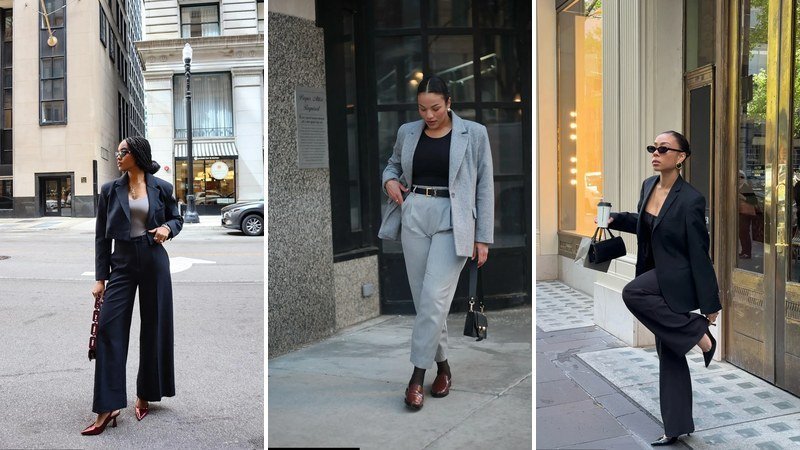
A grey wool-blend blazer with a dropped shoulder lands over black slim trousers. Underneath, a fine black jersey top is tucked flat—because any skin gap between layers reads like a mistake, not a style choice. Brown leather loafers pull the eye down and ground the whole look without adding height. Throw a full-size lint roller in your desk drawer; nothing deflates a grey blazer faster than visible fluff. A structured black handbag and slim belt complete the frame. This isn’t about inspiration; it’s a repeatable equation that fires up when your morning brain is still buffering, and it consistently outruns the decision fatigue that drains your closet.
The Oversized Grey Power Layer

A dark grey wool-blend blazer, cut oversized, stands as the only structured piece. Under it, a white slim-fit top and black tailored trousers do the quiet work. The blazer’s volume says you know the rules and you’re choosing which to use. If an oversized blazer drowns your frame, have the sleeves shortened to show a sliver of wrist—the alteration costs less than a lunch meeting and returns a decade of authority. A beige phone case is the accidental accessory; keep it clean because a grimy case reads as a misplaced priority. This outfit needs no bag to sell it, just a steady stride and no apologies for taking up space.
The Charcoal Column

Matching charcoal tones from blazer to wide-leg trousers create an unbroken vertical line—an immediate height cheat. The black jersey top dissolves into the shadows, and a slim black belt marks the waist without interrupting. Matching sets in the same tone need varied textures or they fall flat; here, the wool blazer’s grain against the smooth trousers does the work. A black leather handbag and sunglasses add polish, while minimal gold jewelry lifts the face. This is the smart-casual answer for days when you need to look taller, leaner, and a little untouchable, though the fabric choice means you nod through a fabric check first.
The Boot-Forward Blazer

by @iamginiee
A grey oversized blazer layers over a white ribbed tank—barely visible but essential for the neckline. Grey wide-leg trousers extend the line, while brown pointed-toe boots add interest below. Calf-hair boots demand a waterproofing spray before their first wear; a single rainy commute destroys the texture and leaves a patchy mess. A black slim belt and gold bracelets finish without fuss. This outfit straddles gallery opening and board presentation, depending on your lipstick and your posture. It’s for the days you want to signal you see fashion but you’re not its servant, a distinction that separates the watched from the followers.
The Color Confidence Coders
Color in the corporate space is a tool, not decoration. A single bold point—burgundy, navy, red—pulls the eye and lands the message before you speak. These outfits use color to anchor, not distract, sidestepping the neutral trap that can wash out your authority.
The Burgundy Tote as Hero

by @olgali.ber
A grey relaxed blazer and black slim trousers are the foundation. But the oversized burgundy tote shifts the whole field. It draws the eye and tells a story: you know one powerful accessory beats ten timid ones. If you carry a statement bag, keep the rest of your silhouette low-drama; competing focal points create visual noise that reads anxious. Black heels and a slim belt maintain the clean line, while dark sunglasses provide the final layer of polish. This works for street-to-meeting days when your tote needs to hold more than a phone, and a wrong bag would reset the formality to zero in seconds.
The Red Pump Rule

by @havanattan
A white halter top—structured, not spaghetti thin—tucks into navy wide-leg trousers. Red patent pumps and a matching red shoulder bag ignite it. This isn’t about loudness; it’s about precision. Red shoes in the office need a matte or patent finish, never suede; suede reads evening and shows scuffs like a confession under overhead lights. Tortoise-shell eyewear and a gold watch break the boldness with classic texture. You wear this when you need to walk into a room and own the first three seconds without saying a syllable. The navy ground keeps it corporate, so the red reads as a deliberate choice rather than a cry for attention.
The Waistcoat Remix

by @romillanh
A navy oversized blazer covers a matching waistcoat, both in wool-blend. Grey straight-leg trousers break the blue, so it’s not a costume. A three-piece look doesn’t require the matching pant; a well-chosen contrasting bottom here keeps it from reading cosplay and grounds you in the contemporary office. Gold earrings and a brown tote bag introduce warmth without softening the command. This formula is for high-stakes days when you need to look like you’ve been doing this for years, even if your internal monologue says otherwise. It stretches between business formal and boardroom edge with no seam showing, and it flatters a straight posture.
The Chocolate Suit Shift

Brown tailored blazer and matching wide-leg trousers give you an alternative to grey that reads warmer, not weaker. A black jersey top and waist belt quiet the volume, while a structured black handbag and cat-eye sunglasses keep it modern. A brown suit in heavyweight crepe or wool-blend avoids the “UPS uniform” trap smoothly; the fabric body matters more than the color, and a cheap lightweight version screams discount. This is your move for days when black feels too severe but you need full authority. It travels well, photographs well, and doesn’t scream for attention, all while signaling stability over trendiness.
The Navy Bodysuit Base

A structured navy blazer and wide-leg trousers sit over a grey form-fitting bodysuit. The bodysuit eliminates the retuck ritual—a silent de-stressor for long days when bathroom breaks are a strategy, not a luxury. Burgundy pointed-toe heels and a small burgundy handbag inject color at the extremes. A bodysuit in jersey with a low back or hidden snap won’t line-show through trousers; test with your phone flashlight against the fabric in the dressing room. A gold necklace and black sunglasses add finish without crowding. This outfit handles four-hour meetings and sudden dinner invites without a bathroom reconfiguration, and the color pop signals you’re not in mourning for your free time.
The Dark Navy High-Waist Edit

Dark navy structured blazer and high-waisted wool-blend trousers create a long, uninterrupted line. A grey bodysuit underneath keeps the focus on the outer structure. Burgundy patent heels and a matching small handbag replay the color story. High-waisted trousers with a side zip sit flatter under bodysuits than front-zip styles; check the fastening before you commit, because a front bulge under knits is a silent panic trigger. A gold mid-length necklace and oval sunglasses add the final layer. This variation of the navy formula feels sharper, more vertical, and slightly more formal—use it for days you need to stand tall in a crowded room where your height biases perceptions of competence.
The One-Piece Statements
Sometimes the outfit hinges on one unexpected item—a maxi skirt instead of trousers, a corset top, a linen set, a necktie. These looks prove that “corporate” is a gesture, not an uniform checklist, and that you can borrow from any playbook as long as you control the details.
The Maxi Skirt Evening Crossover

A black slim-fit knit top meets a grey maxi skirt in suiting fabric. The length says elegance, the fabric says you’re still billable. Black pointed-toe heels extend the line, and a large black tote bag carries everything without apology. A maxi skirt in suiting fabric holds a crease better than jersey; one quick iron at the hem is the difference between deliberate and defeated at the end of the day. A delicate gold necklace draws the eye up. This outfit transitions from a full-day internal review to a low-lit restaurant without needing an Uber home to change, and a hem that breaks the proportion here would steal all the power back.
The Linen Three-Piece Set

A light blue linen-blend blazer, vest, and straight-leg trousers read as a single quiet statement. White pointed-toe heels break the monochrome and lift the hem. Linen wrinkles on intention, not on accident; sit with legs uncrossed and stand during phone calls to keep the back smooth through your afternoon of back-to-backs. A black structured shoulder bag and layered gold necklace add sharpness to the soft palette. This is a summer corporate formula that says you understand climate without sacrificing clarity. It works for walk-and-talk meetings or terrace lunches where denim is the enemy, but it requires a quick steam before leaving the house.
The Corset-Under-Blazer Move

by @havanattan
All black, but not all quiet: a fitted corset top under a relaxed wool blazer redefines the torso line without showing skin. Wide-leg trousers in matching fabric continue the column. A corset top in corporate coding must have substantial fabric coverage—no lingerie lace, no boning visible through the back—or it undercuts the room’s focus and invites the wrong kind of memo. Black pointed-toe pumps, a black handbag, and oval sunglasses complete the monochrome. Gold earrings are the only break. This is for the woman who knows her competence is louder than any whispered commentary on her silhouette, and she’s correct about that.
The Necktie Neutralizes Nothing

by @heb.aashour
A white relaxed button-down and a black silk necktie—loosely knotted—do what most corporate gear avoids: they borrow traditionally masculine coding and redirect it. Black wide-leg wool trousers anchor the experiment. A necktie in a slim width, not skinny, reads as intentional; anything under two inches wide can tip into costume territory and make you look like a theater kid, not a VP. Dark brown pumps and a matching suede handbag bring texture and warmth without diluting the impact. A gold bracelet is the sole accessory. This outfit says you can navigate any unspoken rule because you’ve already memorized them all, and you’re choosing which ones to break today.
The Soft Power Shift
Minimalist doesn’t mean sterile. These outfits use lighter tones, flat shoes, or fluid fabrics to signal control without rigidity. They work when you need to listen as much as you lead, and they survive the desk-to-door transition without a wrinkle or a fidget.
The Turtleneck Trousers Clean Room

A slim black turtleneck folds into black wide-leg wool blend trousers, sealed with a brown leather belt. The line is uncompromisingly vertical. Brown pointed-toe heels and a brown tote bag echo the belt, pulling warmth into the monochrome. A black turtleneck in a fine-gauge knit avoids bulk under arms; stay away from chunky cables if you’re layering under blazers or standing in heated rooms, because the overheating will show on your face before the knit does. A silver necklace and gold watch coexist—mixed metals are allowed when the rest is this restrained. This is the outfit for formal days when you want to whisper, not announce, your status.
The Sneakers-Are-Allowed Pivot

A grey oversized blazer and wide-leg grey trousers are the uniform backbone. A white tank—slim, not sheer—keeps the midriff brief. The pivot: black and white sneakers, absolutely pristine, signal you chose comfort without dropping formality. All-white or monochrome leather sneakers only; visible mesh or scuffs read “gym bag,” and that’s a memo you don’t want to send to a director waiting for the elevator. A black shoulder bag and gold jewelry add polish up top. This is Monday commuting energy wrapped in a look that says you know the sneaker rulebook well enough to color outside a single line, and you scrubbed the soles before you walked in.
The Light Grey Formal Fade

by @amybethvdl
A light grey tailored blazer sits against black wide-leg crepe trousers. The contrast is stark and intentional, drawing a clean line at the hip. A structured black handbag and rectangular black sunglasses add weight to the silhouette. Crepe trousers with a high polyester percentage can melt under high heat; dry on cool or hang them flat after washing to keep the shape, because a warped crepe is unrevivable. This outfit has no tricks, no distractions. It works for external client meetings, presentations, and any day where your appearance needs to do half the arguing for you. The simplicity is the power, and the fabric’s drape sells the rest before you open your mouth.
Decoding the Unwritten Office Dress Code
The formality ladder is never in the handbook: Forget the HR PDF. Watch what the women in senior roles wear on client-facing days versus internal team meetings. That visible gradient—from sharp blazers to relaxed knits—is the real dress code. The gap between business casual expectations and formal requirements can often be observed in how they handle Fridays; follow their lead, not the policy’s vague language.
Use the one‑notch rule for your first 90 days: Most career guides tell you to “dress for the job you want.” I’d argue that’s a trap. Instead, dress exactly one notch above the daily average you observe, then ease back once people recognize your competence. It signals respect without making you look like you misread the room.
Shoes and bags broadcast your cultural fluency instantly: A pristine structured tote and clean, intentional shoes tell colleagues you understand polish, even in a laid‑back office. The bag you carry can either anchor an outfit or silently downgrade it. Scuffed heels or a slouchy tote scream “I didn’t plan this,” and that judgment sticks.
On‑camera dress codes count as much as in‑person ones: In hybrid roles, watch what leadership women wear on video calls. A top that reads “nightclub” or pajama will undercut your authority before you speak. The screen crops everything; a structured neckline and a solid color that doesn’t blur keep the focus on your words.
Don’t test a trend before a woman you admire tries it first: Let the office’s unofficial style leaders—the ones who always look current but never costume‑like—validate a look. Whether it’s wide‑leg leather or an oversized vest, wait until you see it on someone respected. If she can pull it off, you can too. If she skips it, there’s probably a reason.
The Unspoken Rules Women Actually Face in Corporate Attire
The warmth line between bossy and approachable is real: Head‑to‑toe black can read “unapproachable,” while all‑over pastels or soft florals risk being filed under “nice but not tough.” A strategic pop of saturated color—forest, burgundy, or teal—splits the difference. You come across as capable and human, not a caricature. The all‑neutral trap can accidentally make you fade into the background; one intentional color injects presence.
Fit is a proxy for self‑possession: Most advice tells you to “wear what makes you confident.” I’d argue confidence follows fit. Clothes that gape at the bust, pull at the hips, or sag at the seat telegraph that you’re not in control of your details—and people unconsciously assign the same judgment to your work. Get even your mid‑range pieces tailored. A quick fit audit can reveal where your wardrobe is silently letting you down.
Fidgety clothes whisper “anxious”: If you’re constantly tugging a wrap tie, straightening a slipping strap, or silencing jangling bangles, you break your own authoritative stillness. Corporate power is quiet and settled. Pick pieces that stay put on their own—no adjusting required.
Age‑based equilibrium matters, whether it’s fair or not: Younger women often need an extra dose of structural authority: a crisper shoulder, a meticulously tucked shirt. Tenured women earn the right to intentionally relax one element—a softened neckline, a lower heel—without losing respect. Read the room, and borrow authority from cut rather than print.
The midriff window is a test you don’t want to fail: Even a thumb‑width sliver of skin between a cropped cardigan and trousers can silently cap your perceived credibility in many offices. Err on the side of forever‑tucked and layered. If you’re unsure, stand sideways in a mirror and reach up: if anything separates, it’s a no.
How to Spot Quality in Corporate core outfits
Read the fabric before you read the tag: Natural fibers with a touch of elastane (2–5%) hold their shape and breathe. Pure cheap polyester shines unflatteringly under office fluorescents and traps heat—you’ll look wilted before lunch. A fabric check takes ten seconds and saves you money: look for the handfeel and weight, not just the brand name.
Unlined trousers and blazers are a false economy: Lining prevents saggy knees, uncomfortable cling, and weird draping. A half‑lined blazer where only the sleeves lack lining is a clear corner‑cut—you’ll pay in sweatiness and a shorter garment life. Always check inside before you buy.
“Dry‑clean only” is a hidden tax: If you can’t feasibly machine‑wash (gentle, cold, hang dry) at least 60% of your core workwear pieces, you’ll build a laundry logistics nightmare that eats your budget and your time. Look for heavyweight crepe, machine‑washable wool blends, or high‑end ponte. The tag rarely lies; don’t romanticize a piece that demands constant professional care.
Use the sit‑bend‑twist fabric memory test: Grab a handful of the garment in the store, squeeze for three seconds, release. If the resulting crinkles linger, that’s exactly how you’ll look after a meeting. Put it back. The sitting‑to‑standing problem starts with the fabric’s memory, not just the cut.
Details that betray longevity: Stitching that waves (tension problems), buttons that already feel loose, zippers that aren’t YKK—these small fails mean the garment will disintegrate at the salary you need to earn to buy it. Flip the piece inside out and inspect seams before you hand over your card.
Staying Comfortable Through a 10-Hour Workday
Build a shoe‑camouflage system: Commuting in heels is a myth. Wear chunky‑heeled or block‑heeled loafers with a gel insole for walking, keep pointed flats or a sleek low heel at your desk for meetings, and no one will know you’re not a footwear martyr. A pair of loafers styled for the office can do double duty, especially if the silhouette is sharp. Rotate your desk backup shoes seasonally so they don’t become dust‑collectors.
Merino wool base layers are your secret weapon: Worn under a silk shell or crisp cotton shirt, they regulate temperature, resist odors, and smooth lumps. They solve the deadly “office AC vs. overheated meeting room” swing without bulk. One lightweight merino tank lasts for days and packs flat, making it a non‑negotiable for any hybrid or long‑day schedule.
Do the real‑world sit test before you buy any bottom: Sit, cross your legs, then lean forward to type. If the waistband rolls, gaps at the back, or digs into your stomach, it’s an instant fail that will ruin your focus by 2 p.m. The same proportion issues that break a look when you stand up start with how the garment behaves when you sit. Test it or regret it.
Ban static cling with permanent intent: An anti‑static spray (or a silk slip) under skirts and dresses fitted over tights stops the embarrassing ride‑up. This is not a minor detail; it’s a dignity preserver. Keep a travel‑size bottle in your desk drawer and a lint roller next to it—you’ll never panic at a restroom mirror again.
Underthings you cannot afford to get wrong: Invisible panties (seamless, skin‑tone matched to you—not white) and a t‑shirt bra that truly disappears under silks and thin knits are non‑negotiable. Visible panty lines and strap peek‑aboo undercut every ounce of your hard‑won polish. Invest in a couple of sets that you reserve just for work days; they’re the foundation that holds the entire outfit together.
Build Your 3‑Minute Corporate Outfit Equation
The Equation: Commit to the four‑piece formula: 1 Base + 1 Top + 1 Third Piece + 1 Shoe.
Base means a tailored trouser, wide‑leg crepe pant, or clean‑front midi skirt. Top is a fine‑gauge knit shell, a silk‑feeling button‑down, or a fitted turtleneck. The Third Piece is the non‑optional transformational layer—a long knit blazer, a non‑matching relaxed vest, or a belted cardigan. Shoe is a low block heel, a loafer, or a sleek minimalist white sneaker where the culture genuinely permits it. This is how you convert a pile of separate items into professional wardrobe pieces that read as a deliberate outfit, not a frantic grab.
Rotate Only Three to Four Per Category: Own a tight edit, not a sprawling closet.
Three bases, four tops, three third pieces, and two shoe silhouettes give you over 80 combinations. Every single one will appear intentional because the third piece does the heavy lifting of tying the look together. The women in your office who always seem pulled together are almost certainly using this same system—they just haven’t handed you the blueprint. Stop buying one‑off “outfits” and start buying pieces that multiply each other.
Signature Color Across Bases and Third Pieces: Let your bottoms and layers share one uniting hue, then keep tops neutral.
Choose a workhorse shade like oxblood, navy, or forest. When your trousers and jacket or vest anchor in that single color family, any ivory shell or black turtleneck you drop under it looks pre‑planned. This is how you create Corporate core outfits that feel like a capsule wardrobe without the sterile matching‑set vibe. Nobody will register it as a formula—they’ll just think you have exceptional taste.
The Third Piece Is Never a Blazer If That Makes You Feel Like a Costume: Use a knit, a vest, or a cropped jacket that moves with you.
A structured wool blazer can read stiff in an already‑casual office. A longline cashmere cardigan belted at the waist or a tailored crepe vest does the same anchoring work without signaling “I’m interviewing elsewhere.” The test: if you forget you’re wearing it within a hour, it’s the right third piece. If you catch yourself rolling your shoulders or tugging the lapels, swap it for something that breathes.
Shoes Finish the Equation—And They’re the Easiest Detail to Get Wrong: Choose one polished flat and one low block heel that you’ve already walked two miles in.
A pristine loafer or a streamlined sneaker in all‑white leather works across the entire formula. If you feel like you’re sacrificing polish with a flat, the problem isn’t the heel height—it’s the condition of the shoe. Scuffed toes or worn‑down soles immediately drop your whole equation from “business casual attire for women done right” to “I gave up.” Keep loafers that actually support you at arm’s reach and you’ll never derail an outfit for comfort again.
FAQ
I’m afraid I look like I’m trying too hard. How do I know?
You know because people pause when you walk in, or you hear “You’re so dressed up!” far more than once a month. Swap one sharp piece—replace a structured blazer with a soft knit jacket, or switch pointed heels for a refined loafer—and watch if the comments stop. The goal is to look like you respected the room, not like you arrived from a different one.
Will I look like everyone else’s copy if I follow a formula?
No. The women who appear most distinct in your office all use formulas; they just vary texture and proportion. Your signature lipstick, a single piece of meaningful jewelry, or a watch with a story makes any combination yours. Uniformity vanishes the moment you stop thinking about the clothes and start moving through your day.
Is it embarrassing to repeat outfits frequently?
Only if your pieces are so unremarkable that people notice the repetition instead of you. High‑quality neutrals that fit impeccably are invisible in the best way—nobody will track a well‑cut navy trouser. If someone does comment, say, “This piece earns its closet space,” and they’ll file you under “woman who knows what works.”
What if my outfit feels fine in the mirror but wrong by lunch?
That’s a fabric, cut, or undergarment failure you can catch. Before you commit to wearing or buying anything, do the sit‑bend‑twist test in front of a mirror: sit, cross your legs, lean forward to type. If the waistband rolls, gaps, or binds, it will sabotage your focus by 2 p.m. Also, duck into the restroom at 10 a.m. for a strategic re‑tuck and a quick lint‑roller pass—it resets everything.
I got a comment about my clothes from a colleague—how do I handle it without being defensive?
Reply with neutral curiosity: “Oh, what made you notice?” That returns the awkwardness to them. You never owe an explanation, an apology, or a self‑deprecating joke. If it’s a compliment, a simple “Thank you, I felt strong in it today” closes the topic with warmth and finality.
Are sneakers ever truly okay in a corporate setting?
Yes, in many contemporary offices, but only one specific type: all‑white leather or monochrome suede, kept box‑fresh, paired with crisp trousers and a structured top that signals intent, not laziness. Scuffs, mesh panels, or anything that’s seen a treadmill tell the room you got lost on the way to the gym. Treat them as a strategic choice, not a concession.
How do I avoid my clothes smelling from a long commute or day?
Merino wool knits resist odor naturally, so start your base layer there. For everything else, never re‑wear a polyester blouse without airing it out completely—synthetic fabrics trap body odor and release it the moment you warm up again. Keep a travel‑size fabric refresher in your drawer and use it before you start your morning, not after the fact.