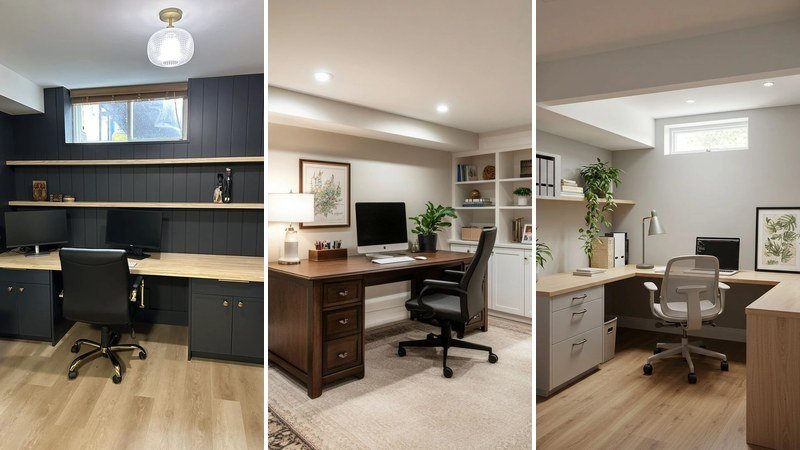
Cozy 10+ Basement Office Ideas for a Warm, Focused Vibe

Every basement office starts with the same sensory reality: the air sits cooler and the light never quite rises. The concrete floor sends a chill up through your shoes no matter the season. You can paint and rearrange all you like, but working eight hours a day underground asks something different from a room upstairs. It asks for a space that fights the gloom instead of accepting it. Converting a basement to office space doesn’t have to mean demolition or a builder’s quote. The right lighting and a clever layout carry most of the weight.
The same light fixes that make a bright home office feel open are the ones a basement needs most. And when the floor plan is tight, the advice for a small space home office applies just as well.
14 Basement Office Ideas That Turn the Underground into a Proper Room
A basement office rarely gives you an easy starting point. Low ceilings, cold concrete, and just one tiny window make most furniture choices feel wrong before you’ve even begun. The rooms ahead take those constraints seriously and work with them. No major construction. Just smart furniture placement, light that fights the shadows, and colour that does more than cover the wall.
Work With What You’ve Got
These offices start from what the basement already offers, letting brick walls and exposed joists set the tone.
Brick and Beam Corner Nook

by Pinterest
Exposed brick, an unfinished ceiling, and a small window set the scene for this rustic office. A wooden L shaped desk sits in the corner beside a black mesh chair, flanked by wall mounted wooden shelves stuffed with books. A LED strip tucked under the shelves adds a warm glow that claws back some height from the dark ceiling. Mounting lights beneath shelving, not overhead, stops the ceiling from feeling like it’s pressing down. The terracotta bricks bring their own natural warmth, so you need less artificial colour to make the room feel inhabited.
String Lights and Patina

by Pinterest
This basement office captures serious charm with exposed joists, brick walls, and string lights draped across the ceiling. A wooden desk with hairpin legs sits on a patterned rug, a leather chair at its side. Hanging plants and a vintage trunk used as a side table make the space feel collected, not cold. String lights should be your main decorative glow, but keep a focused desk lamp within reach for crisp task work. The small window brings just enough daylight, while the brick walls create a cozy basement nook that feels intentional.
Low Ceiling, Tall Shelves

by Pinterest
A low ceiling and exposed pipes don’t have to mean a cramped office—here warm beige walls and two tall wooden bookshelves draw the eye upward just enough. The wooden desk stays humble against the wall, paired with a black leather chair on a patterned rug that adds softness underfoot. In low ceiling rooms, place your tallest furniture along the perimeter, not near the desk, so your immediate workspace feels open. A snake plant and trailing pothos add life without needing much light, and a table lamp delivers a cosy golden focus zone.
Light Tricks That Lift the Ceiling
Small windows and recessed fixtures can do more than you think with the right placement.
Grid Ceiling, Double the Light

by Pinterest
A wood panelled ceiling with a grid pattern gives this basement office an architectural lift that draws the eye upward. Two white desks form a generous central workspace, each with its own lamp, while a patterned area rug anchors the zone. The dark concrete block accent wall adds texture without swallowing light, and a whiteboard on the left keeps notes from becoming clutter. Pointing task lamps toward the ceiling—not the desk—bounces light off the white surface and softens shadows on your face during video calls. Recessed ceiling lights maintain an even ambient glow, making the room feel consistently bright.
Minimal Oak, Maximum Calm

by Pinterest
A serious study in restraint, this office uses a long light oak desk and floating shelves to keep the floor clear and the eye travelling. A high rectangular window draws daylight deep into the room, while recessed ceiling lights fill in the gaps without hanging low. A grey office chair and beige walls stick to a calm, no shout palette that makes the small footprint feel larger. Keep the area behind your monitor empty or neutral—a cluttered wall cuts your visual field and makes the room feel half its size. Abstract art on the side wall adds a personal note without stealing attention from the screen.
Light Oak, High Window

by Pinterest
Light grey walls and a floor in a light oak tone brighten this basement workspace, while a L shaped desk tucks into the corner to save square footage. Floating shelves hold books and a framed botanical print, keeping the desktop free for a laptop and monitor. The high horizontal window works harder than you’d think, casting a wide band of daylight across the wall—a bright office setup doesn’t need a wall of glass. Paint the wall opposite the window a pale colour to reflect light deeper into the room; dark colours near the glass soak it up before it can travel.
Storage That Knows Its Place
Built in shelving and cabinets turn a cavern into a command centre, hiding the chaos without adding bulk.
The Wall of White Shelving

by Pinterest
Wall to wall built in white shelving behind the desk turns an entire wall into storage, with cabinets below and open display space above. The wooden desk sits on a light coloured area rug, facing a black office chair, while a table lamp casts a warm pool of light for after hours tasks. A framed botanical print and a potted plant keep the white storage from feeling sterile. Load bottom shelves with baskets or boxes to hide office clutter, and reserve upper shelves for books and decor—it draws the eye up and makes the room seem taller. You can keep the surface clear with smart desk organisation that puts everything within reach.
Moody Panel with Gold Glow

by Pinterest
A charcoal grey painted panel accent wall sets a moody tone, but the long oak desk and floating shelves keep the workspace light and functional. Two monitors sit above a desktop that stretches across two base cabinets, giving you plenty of room for papers. The black chair with gold legs adds a hint of polish, while a single glass pendant fixture centred above provides ambient light without a harsh glare. On dark walls, use matte paint to reduce screen reflections—glossy finishes bounce light right into your eyes. A small rectangular window above the shelves supplies a soft daylight accent.
Under Stair Command Centre

by Pinterest
Carved out from the dead space under a staircase, this office uses a white corner desk and upper built in shelves to create a surprisingly functional nook. Beige carpet and neutral walls keep the zone from feeling like a closet, while a high rectangular window pulls daylight in from above. A mesh office chair and compact white drawers complete the setup without crowding the stair traffic. For under stair spaces, paint the sloped wall the same colour as the ceiling—it blurs the hard angle and stops the room from feeling like a wedge.
Sculpted Wood and LED Warmth

by Pinterest
Built in wooden cabinetry wraps around this workspace, tucking the desk into a niche beside a staircase. Warm oak tones keep the look traditional and calm, matched with a beige ergonomic chair. Recessed ceiling lights and warm LED strips inside the shelving provide layered illumination that’s gentle on the eyes during long stretches. Install shelf lighting with a dimmer—full brightness for cleaning, low glow for focused work—so you can shift the mood without adding lamps. A computer monitor and table lamp sit on the desk, with a textured grey plaster wall adding subtle depth beside the stairs.
Colour That Outsmarts the Dark
Dark walls aren’t the enemy. These rooms prove that deep hues, wood tones, and a pop of colour make a basement feel deliberate.
Dark Slat Wall, No Distractions

by Pinterest
A floor to ceiling dark accent wall made of vertical wood slats becomes the hero of this office, absorbing visual clutter and pulling all attention to the screen. The L shaped walnut desk and Herman Miller Aeron chair sit in a charcoal and forest green palette, kept sharp by a black metal shelving unit and pegboard wall organiser. Three framed black and white photographs hang above the monitor, and a LED screen bar casts clean light directly onto the keyboard. Mount a screen bar instead of a traditional desk lamp to keep the dark accent wall dramatic while still seeing what you’re typing.
Orange Velvet on Brick

by Pinterest
A burnt orange velvet chair steals the show against an exposed brick wall, turning this dual zone office into a space you genuinely want to spend time in. Built in white shelving wraps the brick, keeping books and decor within arm’s reach, while a brass desk lamp and vase of sunflowers add warmth to the desk area. A patterned rug in orange and grey ties the two zones—a reading nook and a workstation—together without a physical divider. Pair bold upholstery with raw brick to soften the industrial edge; the contrast does more for the room than any single colour ever could.
Sage Green Study Den

by Pinterest
Dark sage green walls and a drop ceiling challenge the usual bright basement advice, but the result is a cosy, studious retreat. A dark wooden desk holds two monitors, and a black leather chair with wooden armrests sits on a richly patterned rug that brings red and navy into the mix. A metal shelving unit and black filing cabinet keep supplies tidy, while a snake plant on top adds a live note. In a dark painted room, use a rug with at least three colours—it stops the floor from becoming a black hole that swallows the rest of the design.
Shiplap and Double Leather

by Pinterest
Dark grey shiplap lining the long wall creates a stunning backdrop for a L shaped wooden desk set up for two. Two tan leather chairs and two gold desk lamps balance the dark wall with warm, reflective surfaces. Floating shelves display plants, books, and a record stand, while a flat screen television mounted in the centre makes the space practical for work and occasional breaks. When setting up a dual desk, orient both chairs toward the same wall rather than face to face—it maintains the office feel and keeps the room from turning into a meeting room. A patterned area rug grounds the zone.
Lighting a Basement Office: How to Fake a Window (and Fool Your Eyes)
Most guides tell you to add more bulbs. I’d argue the direction of light matters more than the quantity, because light fired upward creates perceived height that a brighter downward fixture never will.
Three-layer lighting with a basement twist: Ambient light must fire upward—wall sconces aimed at the ceiling or uplight floor fixtures widen the perceived height by washing the surface above you. Task lighting on the desk prevents glare on your screen, while accent lights behind the monitor or furniture erode the shadow pockets that make a room feel smaller than it actually is. Skip any one layer and the corners close in.
The 5000K colour temperature trick: LED panel lights calibrated to 5000K mimic noon daylight. Place one vertically behind a sheer curtain or frosted panel at eye level and your brain reads it as a window. It signals daytime, which fights the fatigue that creeps in after hour three of working below grade. This single move changes how the room feels more than any furniture piece ever could—it’s the difference between a bright home office and a storage room with a desk in it.
Why a single overhead fixture is the enemy: A lone ceiling light casts harsh shadows directly onto your screen and face while leaving every corner dark. Visually, it compresses the room by roughly 20 percent. Swap it for three to four distributed sources, even if they are plug-in floor lamps and clip lights. The room breathes differently when light comes from multiple heights.
Floor lamp behind the monitor: A slim arc lamp positioned behind your screen washes the wall with light, extending your visual field beyond the desk. It balances the contrast between a bright monitor and a dark wall, which reduces eye strain over long hours. This is an optometry trick few home décor articles mention, and it costs nothing beyond the lamp you might already own.
How to Arrange a Basement Office So It Never Feels Cramped
The way you place the desk determines whether the room holds you or closes in on you. Basements tend toward awkward proportions—long and narrow, or square with low ceilings—and a desk pushed against the wrong wall locks those proportions in place.
Diagonal desk placement for maximum sightline: Angle the desk to face the room’s longest diagonal axis instead of a wall. A fifteen to twenty degree rotation tricks your peripheral vision into reading more depth. In a ten-by-ten room, this makes the space read closer to twelve-by-twelve. For a long, narrow basement, float the desk near the centre and angle it toward the far corner—the diagonal becomes your longest uninterrupted view.
Float the desk—even in a basement: Pull furniture twelve to eighteen inches away from the walls. The negative space behind you reads as breathing room. A desk shoved against a concrete wall anchors the claustrophobia. Place a narrow console or sofa table behind you to reinforce the island effect, especially in a square room where floating the desk creates a natural walkway around it. This is one of the simplest home office ideas for small spaces that translates perfectly below ground.
Low ceiling adaptation: In a basement with headroom under seven feet, every vertical inch counts. Keep the desk visually low—a slim profile with hairpin legs works better than a chunky executive desk. Mount shelves above the desk but keep them shallow and painted the wall colour so they recede rather than advance. The horizontal line of a floating shelf set at five feet draws the eye across, not up, which stops you from noticing exactly where the ceiling drops.
The three-foot chair clearance rule: Measure from the edge of your desk to the nearest obstacle. Anything less than thirty-six inches forces you to squeeze sideways when you stand up, and your body registers that tightness every single time. If space is brutally tight, swap to a narrower desk—twenty inches deep instead of the standard twenty-four—to preserve that clearance. The room feels larger when you can move through it without touching anything.
Define the zone with a rug: A rug anchors the visual footprint of the office, but its real job is separating work from storage in an open basement. Extend it at least two feet beyond the desk on all sides. A rug that stops at the desk legs makes the setup look temporary and apologetic. On bare concrete, a properly sized rug reads as deliberate and grounded.
Keep the area behind the monitor clutter-free: This is your vertical sightline terminus. If you see boxes or exposed pipes, your brain reads the space as smaller than it is. A simple curtain rod with a neutral drape hung twelve inches behind the desk creates an instant wall that reads as distance rather than a dead end. You are not hiding the basement—you are giving your eyes somewhere to rest.
The One Thing About Basement Floors That Changes Everything
You feel a basement floor through your feet before you notice it anywhere else. Concrete does not simply read as cold—it actively pulls heat from your body, and that physical sensation colours how you experience the entire room.
Concrete is a heat-sucker: A bare or painted concrete floor wicks body heat roughly seven times faster than wood. At the same air temperature, you feel colder standing on concrete, and you will crank the thermostat trying to compensate. A thermal break underfoot is not a luxury—it is the difference between a workspace you occupy and one you endure.
A vapour barrier this thin makes all the difference: Even if the slab feels dry to the touch, a six-mil polyethylene sheet laid under any flooring blocks rising moisture vapour. Without it, that vapour condenses into a perpetual damp-chill microclimate. Skip this step and your rug padding becomes a mould incubator within two humid summers. The plastic costs pennies per square foot and takes twenty minutes to roll out.
Interlocking foam tiles—the unexpected hero: Before laying an area rug, snap together half-inch EVA foam tiles across the floor. They insulate, cushion your joints during long standing stretches, and create an air gap that lets the slab breathe. At roughly one dollar per square foot, it is the cheapest upgrade in any basement office that no one talks about. The tiles weigh almost nothing and cut with an utility knife—you can finish the whole floor in an afternoon.
Carpet tiles can betray you: They are the go-to for DIY basement floors, but if indoor humidity spikes above sixty percent—common in basements during summer—the fibre backing traps moisture at the adhesive layer. Within eighteen months, you smell mildew every time you drop something on the floor. Test before committing: tape a two-foot square of plastic sheeting to the slab for twenty-four hours. If condensation forms underneath, you need a full vapour solution before any soft flooring touches that concrete.
Where to Find Second-Hand Office Furniture That Doesn’t Look Sad
The conventional take is to furnish a basement office with cheap flat-pack pieces. That misses how poorly particleboard handles humidity—one damp July and the edges swell like a sponge. Used solid furniture, chosen carefully, outlasts new MDF by decades below grade.
Seek glass and metal over solid wood at first: Used glass desks with powder-coated steel frames appear regularly on Facebook Marketplace for under a hundred and fifty dollars. They are immune to basement humidity, easy to sanitise, and reflect light in a way that enlarges the space. Wood can warp if the piece spent years in a damp garage before you found it. Glass tells you immediately whether it survived storage intact.
The one thing you must buy new: an ergonomic chair. Upholstered second-hand chairs can harbour dust mites, dormant mould spores, and foam that flattened years ago—you notice it on day one of an eight-hour sit. A new mesh-back chair under three hundred dollars is the piece where skipping the thrift hunt pays back directly in spine health. This is not the place to save money.
How to rescue a wooden desk without regret: If you fall for a solid maple thrift find, seal all six sides—including the underside and drawer interiors—with two coats of moisture-resistant polyurethane. Unfinished wood in a basement swells like a sponge, making drawers stick shut forever after the first rainy season. Take the extra hour to seal what no one sees. Your future self, opening a drawer smoothly in August, will thank you.
Smell before you buy: If a wood piece even faintly smells musty inside the drawers, microscopic fungal hyphae are already woven into the grain. No amount of sanding, primer, or wishful thinking removes it. Pass on it. The smell is not old-wood charm—it is a biohazard for a windowless space where you spend forty hours a week.
Why used solid beats new particleboard: A forty-year-old solid oak desk from Habitat ReStore costs less than a flat-pack MDF copy, but more importantly, particleboard off-gasses formaldehyde and swells irreversibly at basement humidity levels. Used solid wood, properly sealed, lasts decades. MDF lasts until the first damp July. That old desk is not just cheaper—it is the smarter material choice for below-grade air, and it pairs well with the kind of cozy home office aesthetic that makes a basement feel intentional rather than makeshift.
The 3-Minute Monthly Check That Keeps Your Basement Office Healthy
A damp basement office never feels like a bright home office, no matter how many lamps you plug in. Below-grade rooms fight physics every day—hidden moisture, stale air, temperature swings. Ignore them and the room quietly undoes every decorating effort. A three-minute monthly routine stops that. Function over trend: a room that grows mould behind the file cabinet isn’t fixed by a gallery wall.
Hygrometer Habit: At the start of each month, glance at the $10 digital hygrometer on your desk. If the average reading stayed above 60 percent for more than two days in a row, run the dehumidifier now.
Mould spores germinate in 24 to 48 hours above that line—you won’t see them yet, but that faint “basement smell” next month is the colony letting you know it arrived. Keep the range between 40 and 50 percent and you protect paper, electronics, and your sinuses all at once.
Baseboard Touch: Run your palm along the lower twelve inches of every wall, especially where drywall meets the slab. Cool and slippery means rising damp is wicking through the concrete behind the baseboard.
Tap the seam gently with your knuckle. A hollow thud often means moisture has already softened the adhesive or gypsum core. Catch that early and a bead of silicone at the floor gap buys you months, even years, before replacement becomes inevitable.
Baking Soda Swap: Once a month, set a fresh shallow dish of baking soda on the floor in the corner farthest from the door. When you swap it, check the texture.
If the powder has turned from fluffy to a single hard clump, invisible vapour is rising through the slab—even if the concrete feels bone-dry. That clump tells you a vapour barrier is overdue under whatever flooring you have, and a dehumidifier alone won’t stop it forever.
Quick-Seal Scan: Hold the back of your hand near pipe penetrations, utility windows, and anywhere wires poke through the rim joist. Cool, sticky air means outdoor humidity is sneaking in.
A gap the width of a pencil can dump several litres of damp air into the room every day. Thirty seconds of copper mesh stuffed in first, then expanding foam, seals it for years. Do the same along the window sash edges—if the felt has flattened, self-adhesive foam tape costs less than a coffee and cuts the draft you feel at your ankles.
Dry-Day Flush: Pick one afternoon each month when the outdoor dew point is below 50°F (weather apps show it). Open the basement window or door, point a box fan blowing in, and let it run for ten minutes.
That’s a full air exchange. It pushes out the CO₂ and VOC buildup that make the room feel tired by 3 p.m., without importing enough moisture to worry about. In shoulder seasons you might get two or three opportunities a month—take them all.
FAQ
Will working in a basement office actually make me depressed?
Only if the space starves your eyes of what they need. Full-spectrum LEDs calibrated near 5000K and a faux-window panel behind a sheer curtain signal daytime to your brain just as effectively as a real window—thousands of women work productively below grade when those cues are in place. The risk isn’t the subsurface location; it’s ignoring those light signals for months while the room stays dim.
How do I keep bugs and spiders out of my basement office?
Dust a thin line of food-grade diatomaceous earth along baseboards and behind furniture—it slices up insect exoskeletons without off-gassing chemicals you’d breathe all day. Pair it with a plug-in ultrasonic repellent tuned for camel crickets and silverfish, the two most common basement crawlers. Then seal every utility gap: copper mesh stuffed into the hole first, a squirt of expanding foam over it—bugs chew through foam alone but not the metal.
Is it safe to have electronics in a basement?
Yes, as long as the relative humidity stays under 55 percent. Above that, temperature swings can cause condensation on circuit boards overnight, leading to corrosion and sudden failures. Plug your computer and monitor into a surge protector with a built-in line conditioner, and never place a tower directly on the concrete floor—a simple wooden riser allows enough air circulation to prevent internal condensation when the machine heats up.
What’s the cheapest way to finish my basement office without drywall?
Paint the slab with a moisture-locking epoxy, and create walls by wrapping rigid foam insulation boards in inexpensive canvas—these fabric panels absorb sound and hide ugly foundation walls without framing or permits. Clip-on track lighting plugged into existing outlets eliminates electrical work, while interlocking foam tiles under a large area rug insulate the floor and define the zone. A whole-room transformation with a clean, minimalist office feel often lands under $800.
How do I soundproof my basement office from upstairs noise?
Add mass overhead: mass-loaded vinyl sheets stapled between floor joists are the quickest DIY fix, followed by acoustic caulk in every joist gap and around light fixtures. On your side, a thick rug with a dense felt underlay absorbs footfall noise, and a white-noise machine on the desk masks voices and TV bleed. For impact noise like stomping there’s no silent miracle, but sealing the path and adding a large bookshelf directly under the noisiest spot upstairs breaks the sound transmission enough to make calls possible.
Do these lighting and layout strategies change if my basement office is in a small nook, an open rec room, or a laundry area?
Small nook: Mount the desk on the wall to float the floor, and push light upward with a slim floor lamp behind the monitor. A mirror opposite the light source doubles the perceived depth instantly.
Open rec room: Define your zone with a rug that extends at least two feet past the desk on all sides, and hang a curtain rod with a light drape behind your chair—it creates a soft “wall” without closing you in. This lets the rest of the room feel separate even when it shares the same floor.
Laundry area: Seal off moisture first: a dehumidifier permanently set to 45 percent is non-negotiable. Upgrade electronics on a high shelf, not just off the floor. Use washable braided rugs instead of deep-pile ones—spinning vibrations throw lint and dust, and you’ll want a floor covering you can toss in the machine monthly.