Bold 5+ Ceo Office Design Looks for Power Players

Walk into any room labelled Ceo Office Design and you’ll see the same formula: a vast desk and a leather chair. It’s aspirational, but it doesn’t help anyone whose workspace doubles as the guest bedroom. The real question is how to borrow that executive home office confidence without the corporate stage. Size is not the answer. It comes down to a smarter layout and a chair that fits your life. Materials should be honest, not precious, because they face daily use. Skip the marble credenza and the wet bar. Those belong to rooms you’ll never have.
If square metres are tight, this compact workspace guide handles the practical side of fitting a proper desk into a corner. And since authority lives in detail, executive presence finishes the job.
14 Ceo Office Design Moves That Actually Work at Home
Most “ceo office design” imagery online feels like it was built for a glass tower — acres of marble, lighting grids you’d need an electrician to install, and not a single cable in sight. Real home offices have to handle video calls at noon and homework at five, all inside one room. I pulled together 14 spaces that translate that executive polish into something livable. They work because each one gets one big thing right: the light, the materials, the layout — details you can copy without a construction crew.
Dark, Dramatic, and Doable
Some offices ask for attention the moment you open the door. These four rooms work with darkness, not against it, using deep tones and controlled lighting to create a sense of authority that never feels corporate.
Symmetry That Commands the Room

This executive home office goes straight to the point: a large dark wood desk centred in front of a feature wall that’s part vertical timber slats, part quilted black panel. Two tall wall sconces sit at exactly the right height — eye level — so they illuminate faces, not floors. Flanking bookshelves with integrated LED strips turn rows of binders and books into a backdrop that glows rather than shouts. The dark polished marble floor could easily feel cold, but the warm cove lighting above softens it. If you install sconces behind your desk, position them 150 to 160 centimetres from the floor — any lower and they cast unflattering shadows that age you on camera. This kind of lighting control is what gives the room its executive presence, even over a video call.
The Green-Shelved Executive Office

by @_mebelito_
An oval desk in dark wood sits centred against a wall that pairs dark panelling with open shelving painted in a deep emerald green. The green isn’t a random accent — it breaks the brown and black palette with just enough life without reading casual. Two upholstered guest chairs sit opposite, ready for a conversation, while a white marble floor keeps the otherwise weighty room from sinking. Vertical accent lights tucked into the shelving bring a soft glow that doesn’t compete with the desk lamp. Oval desks take up more visual space than rectangular ones of the same length; in a smaller room, choose an oval shape to create the illusion of generosity without adding bulk.
The High-Rise Office, Grounded at Home

The first thing you notice here is the view, but the second thing is how the dark slatted ceiling and geometric pendant light keep the room feeling intentional, not like it’s just showing off the skyline. A large dark desk faces the window, flanked by leather chairs and built-in shelves with gold accents that catch the city light without being shiny. Dark marble floors ground the space, and the overall palette stays in charcoal and slate grey. When your desk faces a window, position your monitor so natural light hits you at a 45-degree angle; straight-on light washes out your screen, while light from behind you creates glare headaches by noon.
The Map-and-Leather Study

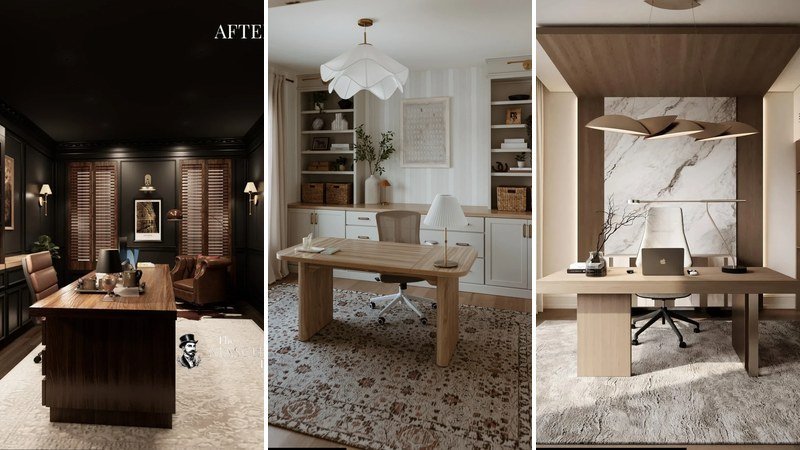
Charcoal walls, a dark desk, and a leather chair — this room knows exactly what it is. The desk sits on a light patterned rug, which stops the floor from disappearing into the dark palette. A framed map takes centre stage between two wooden shutters, while a built-in shelving unit to the left doubles as a bar. The leather armchair and brass wall sconces add enough texture that the room feels warm, not moody. Dark walls in a home office absorb ambient light, so you’ll need at least two lighting sources at different heights — say, a floor lamp and a desk lamp — to keep the room from feeling like a tunnel by late afternoon. This kind of cosy, collected atmosphere would work just as well in a basement office where natural light is scarce.
Quiet Luxury in Neutrals
The most effective luxury home office designs don’t scream. They use materials that age well — wood with real grain, leather that softens, stone with natural variation — and keep the palette restrained. These four rooms understand that the hardest-working pieces are the quietest.
The Light-Washed Library Wall

by @_mebelito_
A dark walnut desk faces a floor-to-ceiling bookshelf that’s divided by vertical timbers and bathed in warm backlighting. The effect is like a softly lit gallery, with the textured marble-look wall behind the shelves adding depth without distracting. A cream-toned swivel chair keeps the scene light, while a framed print on the left wall breaks the symmetry just enough to feel human. Blinds filter the daylight so it never hits the screen directly. Backlighting works best when it’s dimmable — even a small LED strip with a remote can take a bookshelf from harsh to inviting in seconds. If you enjoy this kind of unfussy calm, you might like my minimalist office notes.
The Marble-Top Workspace

by @_mebelito_
A white marble desktop with a wooden side base anchors this executive zone, pairing well with a tan leather chair. Behind the desk, vertical light strips on a paneled wall draw the eye upward, while a tall glass-fronted bookshelf adds sophistication without collecting dust. A decanter and a single glass sit on the desk — an element that feels personal, not just decorative. The patterned rug underfoot introduces a soft geometry that stops the room from reading too formal. Glass-fronted cabinets are brilliant for showcasing books and objects, but line the back with a neutral fabric if you don’t want the contents on full display.
The Pendant-Defined Office Zone

This layout uses a floor-to-ceiling shelving unit as both storage and architecture. The mix of walnut wood and textured grey panels keeps the wall from feeling like a block of furniture. A linear pendant light hangs directly above the desk, marking the work zone in a room that could otherwise feel undefined. Flowering branches in a vase add height and softness — a simple trick that costs little. When choosing a pendant light for your desk, measure so the bottom sits about 75 to 90 centimetres above the work surface; any lower and it creates a visual barrier between you and anyone entering the room.
The Paneled Wall Office

by @susana_cervantes_interiorista
Instead of a traditional backsplash, this office uses a slab of marble framed in dark wood to create a backdrop that feels permanent and considered. The desk, a solid piece of timber, faces the panel so the material does the talking, not the decoration. A sculptural pendant light hangs above, its shape echoed in the curve of the small vase on the desk. Built-in shelving on the right balances the composition. Marble panels mounted behind a desk are heavy and need proper fixing into the wall; always hire a professional installer, because a poorly secured stone can crack or pull away over time.
Fresh and Light-Filled
A bright home office doesn’t have to mean stark. These three spaces use pale woods, crisp whites, and just enough softness to make the room feel like a sanctuary, not a surgery.
The Office with Its Own Lounge

by @_mebelito_
A desk with a white marble base and natural wood top sits against a wall of vertical metal shelving, but the real luxury is the seating. Off to the side, a grey sofa and a comfortable armchair with a round side table create a separate lounge zone — perfect for reading or a different kind of thinking. This is one of my favourite home office layout ideas because it gives you two distinct zones without needing a bigger room. The large window with wooden blinds casts filtered light across the light-coloured rug, so the whole room feels open. If you add a sofa to your office, choose a fabric that doesn’t pill and keep it at least a metre from the desk, or the work zone starts to feel like a waiting room. For more ways to keep a room feeling light and functional, look at these bright home office examples.
The Bright White and Gold Room

by @cleyatelier
White built-in shelving stretches across the wall behind the desk, filled with books, objets, and a large glass vase of white hydrangeas. The gold legs of the desk and a matching gold chandelier catch the light without shouting, while the white upholstered chair stays visually light. A patterned rug in soft beige anchors the zone, and the city view through floor-to-ceiling windows brings the outside in. Fresh flowers are a luxury, but a single statement vase of hydrangeas or branches costs less than a new lamp and changes the room’s energy the moment you walk in. The overall simplicity nods to Scandinavian home office principles — clean lines, natural light, and nothing unnecessary.
The Striped and Serene Workspace

Vertical striped wallpaper in cream and taupe gives this room a subtle lift, while a light oak desk sits in front of a wall of built-in shelving. Woven baskets on the lower shelves hide the clutter, and a white pendant light above keeps the silhouette airy. A patterned area rug defines the workspace without boxing it in, and light-coloured curtains soften the window. A desk lamp with a fabric shade sits on one side, waiting for the afternoon. Striped wallpaper in a north-facing room can look dull under cool light; always test a sample against your actual wall for a full day before committing. The result feels more like a cozy home office that just happens to run like a boardroom.
A Place That’s Yours
The most memorable offices have fingerprints. These three spaces don’t hide the person behind the screen — they let art, books, and plants do the talking while the furniture stays serious.
The Art-Led Executive Corner

by @aleksandratrocewicz_interiors
A dark wood desk anchors the centre of this room, with a cognac leather chair and a floor-to-ceiling glass-fronted bookshelf to the right. The left wall hosts a large abstract black-and-white print, which immediately gives the room an identity beyond just work. Dark wooden floors and white walls with decorative moulding keep the contrast crisp. A vase of white flowers and a small table lamp on the desk add softness. Large-scale artwork in a home office works best when it’s hung at the same height as your seated eyeline, not centred on the wall — this connects the art to your view, not a visitor’s. It is a look that falls somewhere between gallery and study, much like the spaces I feature in my minimalist office guide.
The Compact and Selected Study

In a smaller room, every piece has to earn its keep. Here, a dark wood desk sits against the wall, topped with a laptop, desk lamp, and a few decorative books. Above the desk, a large abstract painting gets its own wall-mounted picture light — a detail that makes the whole room feel considered. In the foreground, an upholstered armchair and a glass-topped side table create a second spot to sit without crowding the floor. A patterned rug ties the two zones together. Picture lights aren’t just for galleries; mount one above your desk art at the top of the frame, and it will cast a warm, even wash that doubles as ambient light in the evening. For more ways to make a small footprint work hard, look at these small-space office ideas.
The Botanical Executive Desk

A white curved desk — almost sculptural — sits in front of a wall of illuminated glass-fronted cabinets. The black ceiling and horizontal blinds could feel stark, but the hanging circular light fixture filled with trailing plants softens every edge. More potted plants line the windowsill, turning the office into a functioning green corner. A mesh office chair keeps the look light and practical. Plants in an office improve air quality, but if you place them directly on the desk surface, use a tray underneath to protect against water rings on these delicate finishes. A curved desk like this is also clever in an awkward nook, not unlike a well-chosen corner desk.
Positioning Power — Why Desk Placement Matters More Than Your Chair
Command position clarity: The classic command position doesn’t just mean facing the door. It also means avoiding window glare that hits your screen and washes you out on camera. Angle the desk so daylight falls to your side, not directly behind or in front of you. In a living room corner, this might mean pulling the desk a few degrees off the wall so you face the entry point without squinting.
Rug defined zones: In an open plan, run a rug perpendicular to the main walkway, right under your chair. That line creates a psychological boundary nobody crosses accidentally. Your executive home office zone stays intact even when it shares space with the sofa and the children’s toy basket.
Float the desk: Pull it away from the wall by just 12 inches. Instantly the furniture reads more substantial and the room breathes. I’ve seen a small spare room transformed with a floating desk and a low console behind it, hiding cables and adding depth. The “waiting room” effect vanishes, and the space feels like a proper suite.
Break symmetry: Most guides tell you to centre the desk on a wall. I’d break that rule, because a slight offset paired with an oversized lamp or a leaning artwork on one side signals a designer’s hand. Perfect symmetry makes a room look like a hotel business centre; asymmetry says you’re in charge of the layout, not following a floor plan.
Scale tricks: Even in a bedroom corner, placing a tall plant or a floor lamp at the edge of your desk zone visually corrals the area. That vertical element anchors your authority better than a door, giving the tiny corner a sense of purpose and enclosure without physical walls.
Lasting Luxury — The Materials That Signal Authority Without Monthly Maintenance
Forget high gloss: Lacquer finishes photograph well but amplify every smudge and scratch in daily use. A matte or satin wood desk holds its dignity without polishing. In an minimalist home office that works hard, you touch the surface dozens of times a day, so a finish that forgives fingerprints is the real luxury.
Leather that ages well: Full grain leather on a chair armrest or desk pad develops a deep patina over years. Bonded leather, the cheaper option, cracks within two seasons. I’d pick a chair with full grain seating because it looks richer with age, not poorer. It’s one material where spending more upfront seriously lengthens the lifespan.
One raw edge piece: A single slab of live edge wood as a floating shelf or a petite desk return grounds the entire room. The organic variation reads as bespoke, never mass produced. In a bedroom corner turned luxury home office, that one element signals substance without crowding the limited floor space.
Switch to brushed metals: Brushed brass, bronze, or gunmetal on lamps and drawer pulls catches light softly and hides tiny scratches. Polished chrome, found on many affordable pieces, dates a room fast and screams budget. When I see a shiny chrome base, I swap in brushed hardware, because that single edit lifts the mood without any other change.
Spot the veneer trick: Engineered veneer can look convincing until humidity hits. In a steamy bathroom office nook, it peels quickly. Run a finger along the edge; if it feels plastic, not wood, pass. Real wood veneer edges show a barely visible thickness, a sign it will survive years, not seasons. In a rental, that quiet material choice saves you from replacing furniture every lease term.
Ceo Office Design Lighting Secrets That Make You Look Like a Leader on Zoom
The colour temperature sweet spot: Aim for 3000K to 3500K bulbs in your task light. Warmer than that makes skin look tired on camera; cooler feels sterile. This narrow range flatters your complexion and keeps you alert, exactly what you need in a room where you make decisions and show up on screen.
Your personal three point lighting: Place a soft key light at a 45 degree angle to your face, a dimmer fill light near your monitor, and a small lamp behind you grazing the wall. Suddenly, you’re not a flat figure on screen. It’s one of the most overlooked home office layout ideas because it costs almost nothing but transforms your video presence from amateur to authoritative.
Why overhead lights fail: A single ceiling fixture casts harsh downward shadows that underline your eyes and highlight every textured wall imperfection. During a video call, that’s your worst enemy. Swap the overhead light for layered sources at eye level and lower. In a bedroom office, abandoning the central light for wall sconces either side of the desk changes the entire atmosphere.
Wall sconces free your desk: Mount swing arm sconces on the wall flanking your monitor. They deliver even, flattering light and reclaim valuable desk surface for your notebook and coffee. In a rental, plug in sconces with cord covers painted to match your wall work without permanent changes. This adapts well to tiny corners in a living room or entryway, anywhere you need concentrated light without clutter.
Hidden LED magic: Line the inside of open shelving or a glass front cabinet with warm LED tape. The indirect glow makes objects sparkle like a gallery display, convincing anyone on the other side of the screen that you’re working from a considered space, not a cluttered side table. It’s the kind of bright home office detail that feels easily premium and requires zero daily fussing.
The Conscientious Corner Suite — How to Source High‑Impact Decor Without the Environmental Guilt
Refinish a vintage desk: Desks from the 1960s to 80s often hide solid walnut under orange hued stain. A weekend stripping and oiling reveals dramatic grain no new flat pack can touch. In a compact home office, a narrow vintage desk with slim legs keeps the room airy while offering the substance of real wood. It’s a smarter move than buying something generic that off gases in your space.
Upcycle with conviction: That heavy old piece from a thrift shop transforms with matte black milk paint and raw brass pulls. Suddenly, it reads CEO bespoke, not garage sale leftover. I’ve watched friends take a battered mahogany credenza and turn it into the most confident piece in the room for under a hundred dollars.
Vintage desk accessories: Seek out brass pen cups, trays, and inkwells from estate sales. They carry a weight and patina you can’t fake with new brass reproductions. A solid brass letter opener or a small marble paperweight adds instant gravitas without a single plastic part. These pieces also keep clutter intentional, a well organised desk surface that reads as executive, not messy.
Verify eco claims: When a brand flaunts “eco friendly,” look past the leaf symbol. Search for third party certifications like Greenguard Gold or FSC. Without them, it’s just marketing. You’re building a long term room, so a chair or desk with certification also ensures it won’t off gas harmful chemicals in your home, a quiet health protective move you’ll appreciate every day.
Choose furniture with a future: Pick an office chair with a lifetime mechanism guarantee and upholstery you can replace in a decade. Reupholstering a quality frame keeps it out of landfill and lets you update the fabric when your style shifts. This longevity mindset is the complete luxury home office move, because you never have to think about the chair again, yet it always feels current.
Quick Audit: 5 Signs Your Home Office Feels More Cubicle Than Corner Suite
Exposed wires snaking across the floor: Conceal every cable you can see.
A single cord trailing across an otherwise polished floor reads as unfinished, no matter how expensive the desk. Use a slim cable raceway painted to match your wall colour so it disappears completely, or install a floor grommet through the rug to channel wires out of sight. The room will instantly feel more intentional.
All furniture at the exact same height: Break the horizon line.
When every surface sits at an uniform 75cm, the room feels flat and monotonous. Introduce a tall floor lamp that reaches at least 145cm, a cascading plant on a pedestal, or a leaning floor mirror that stretches toward the ceiling. A single vertical element tricks the eye into seeing depth and turns a static layout into a layered composition.
A tiny, flimsy desk lamp: Swap it for a task light with physical weight.
A plastic student lamp shortens the room’s visual age to a dormitory. Choose a fixture with a heavy brass or marble base and a linen shade — the weight communicates substance before you switch it on, and the warm diffused glow flatters skin and wood tones the way no exposed bulb ever could. This one change recalibrates the entire room’s authority.
Bare walls except for a single framed poster: Add one oversized textile or a series of small framed works.
A lone poster feels like a waiting room placeholder. One large woven wall hanging, an indigo textile mounted on a simple rod, or three botanical prints in matching frames absorbs sound, softens the room, and draws the eye upward. Scale matters more than quantity — go large or go home.
Zero personal artefacts: Place one object that only you could own.
Executive presence does not mean sterile. A piece of raw amethyst you found on a walk, a letterpress card from a favourite artist, or a ceramic bowl you shaped in a workshop — these tell anyone who enters that the room belongs to a person, not a corporation. And they build your executive presence more quietly than any catalogue accessory ever will.
FAQ
Can I create a CEO-inspired office in a small bedroom corner?
Absolutely. A compact space forces ruthless editing, which often results in a stronger look — focus on one commanding desk, one eye-level light source, and let every other piece earn its place. For more strategies that work with tight dimensions, these home office ideas for small spaces show how to pull it off without clutter.
Do I need a window view to achieve a true CEO office design?
Not at all. Place a large mirror on the wall opposite your main light source to double the brightness and create the illusion of depth. Many powerful home offices are interior rooms made grand with layered ambient and task lighting — a windowless room can feel more cocooning and focused.
Is CEO office design inherently too masculine for my home?
No. Today’s executive aesthetic is about confidence, not gender. Incorporate velvet upholstery on an accent chair, a curve-front desk, or a palette of blush, charcoal, and brass — softness can be just as authoritative as sharp edges.
How can I make my existing furniture look expensive without replacing everything?
Swap plastic and black painted hardware for unlacquered brass knobs — they develop a natural patina and catch light softly. Then paint the desk in a high-quality satin finish and add one luxury textile, like a wool rug, to lift every piece around it.
Will painting my small home office a dark colour ruin the effect?
Only if the lighting stays poor. With a warm key light, a bias light behind your monitor, and a soft wall sconce, a deep navy or charcoal recedes the walls, making the room feel larger and more enveloping — perfect for intense focus.
What’s the first single thing I should change to move toward executive status?
Your seating. A high-back chair with an upholstered seat in a calm neutral tone alters your posture and the room’s energy immediately. It signals that this is a place for decisions, not a temporary workstation.
Is it possible to have a CEO office design in a rental without permanent changes?
Yes. Use tension-mounted curtain rods for drapes, plug-in wall sconces that require no wiring, large-scale art leaned against the wall, and a substantial area rug to define the zone. All can move with you and upgrade even a beige-box rental.
Does the CEO office approach work differently if my workspace is in the bedroom, the living room, or a kitchen nook?
Bedroom: Keep the desk away from the bed’s sightline so you can mentally switch off at the end of the day. A folding screen or a tall plant creates a soft division and stops work from invading your rest.
Living room: Anchor the desk with a rug that defines the zone, and face the seat outward — not into a sofa — so you feel like the room’s conductor, not its afterthought. A console table behind the chair adds depth and a subtle boundary.
Kitchen nook: Choose a slim floating shelf as a standing-height desk station for quick tasks; keep the surface clear of cooking clutter, and use a small, warm task light to separate the “work” moment from the “meal” moment.