Classy 5+ Japandi Office Ideas for a Zen Workspace

A Japandi office is easy to get wrong. Strip it back too far and you get a white room that feels calm for four minutes and hollow after that. Fill it with everything that helps you work and you get noise that competes with your attention. Real calm comes from an earthy palette of oak and clay, with natural light doing the rest of the work. Home office organization stays behind the scenes: it keeps surfaces clear without stripping the room of character.
Japandi pairs Japanese restraint with Scandinavian warmth. The Scandinavian home office is the closest cousin, and cozy home office styling shows how softness keeps a minimal room from feeling cold.
13 Japandi Office Tweaks That Change Everything
A few deliberate moves can turn a restless workspace into the calmest room in your home. These 13 ideas work whether you have a whole room to yourself or just a corner by the window. Pick the ones that fit your space and start there.
When the Room Is All Yours
A dedicated office room gives you freedom to think about the wall you face and the light you sit beside. These seven layouts use proportion, storage, and a touch of darkness to anchor a full room.
The Sage Wall That Holds Stillness

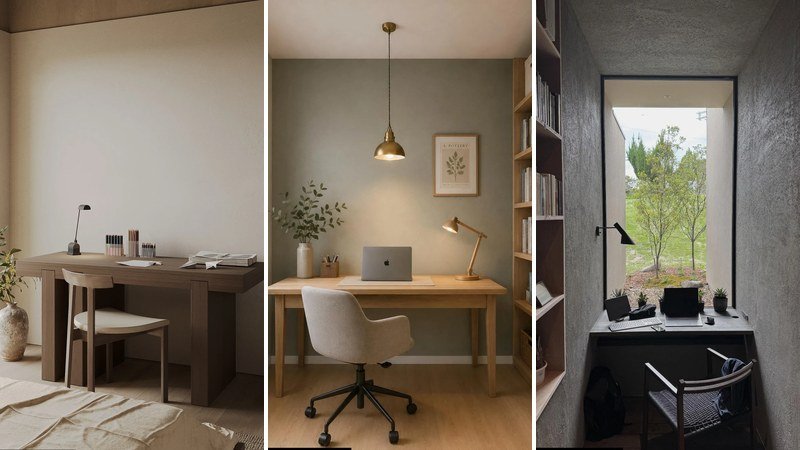
Against a sage green wall, a simple wooden desk takes centre stage. A tall oak bookshelf to the right holds books, woven bins, and a plant—displayed, not crammed. A brass pendant hangs above, its warm light pulling the room together. Keep shelves shallow—under 12 inches—so they don’t encroach on the floor. On the desk, a wood lamp, ceramic vase, and pencil holder keep things within reach but out of the way. The light oak, brushed brass, and linen chair pad feel calm and collected. A side window brings soft daylight, while the task lamp adds focus when needed. For a similar sense of intentional calm, how Scandinavian home office setups handle light wood can point the way. The sage wall adds just enough colour to ground the room without ever feeling busy.
The Curved Desk That Opens the Room

A light wood desk flows seamlessly from the wall, its surface curving around the corner as if carved from a single piece. A white circular table extends from one end, resting on a large stone planter that holds a small tree. Opt for a desk that mounts directly to the wall—no legs—to visually open floor space in a small room. Behind, walls are finished in smooth light beige plaster, illuminated by soft cove lighting that runs along the ceiling edge. The light bounces off the matte surface without glare, making the whole room feel larger. A beige office chair on castors tucks neatly under the curve, while a separate fabric chair waits to the side for reading. The stone planter adds weight and texture, grounding the light wood. It’s a layout that moves your eye in a gentle arc, and because the desk leaves the centre open, the room breathes.
The Dark Wall That Defines the Zone

This room leans into a deep espresso brown wall, then wraps it in warm oak. An open-frame shelving unit floats above a suspended desk, so the storage never feels heavy. A wooden chair with a leather seat sits on a textured grey rug, while a dark ceramic vase holds a leafy plant near the window. When you paint a wall dark, choose open shelving rather than closed cabinets—the light passes through and prevents the wall from closing in. Dark curtains frame the window, but natural light still catches the oak grain. Objects on the shelves are placed with breathing room to let the dark background work. The rug warms the floor and absorbs sound. It’s a workspace that wraps around you, not a blank box.
The Window Office That Faces the Trees

In a narrow room painted soft charcoal, a long light-oak desk runs along the right wall, and a matching tall bookshelf lines the left. The chair sits in the centre, facing a large window that frames a view of leafy trees. Position your desk so you never face a wall head-on—angle it toward a window or door to keep the space feeling open. A spherical pendant hangs overhead, its warm glow pooling on the desk. A small table lamp provides task light without harsh shadows, and a potted plant on the windowsill blurs the line between indoors and out. The matching wood tones tie the room together, while the dark walls recede, making the outside view the focal point. When you walk in, your eye travels straight to the light at the end—and that’s exactly where your attention should be.
The Warm Wall of Shelving and Light

A pale oak desk and matching armchair sit against a wall outfitted with slim wooden shelves. The shelves display a carefully edited collection of books, small ceramic vases, and a trailing plant—each object spaced to let the warm wooden panelling show through. A globe pendant hangs low to the left, its light pooling near a large potted plant that adds height and life. When you mount shelves at eye level, group objects in threes with breathing room between them—it reads as intentional rather than cluttered. The desk surface stays largely open, with only a table lamp, an open book, and a laptop. Because the walls and shelving share the same light oak tone, the room feels wrapped in a single, quiet material. Soft ambient light from the pendant and a small task lamp keeps the workspace gentle.
Dark Slats and a Quiet Desk

Behind a simple light-wood desk, a wall of dark vertical slats adds rhythm and depth. The slim wooden shelves mounted directly over the slats hold a few books and a ceramic vessel, while a large abstract painting hangs to the side, pulling the dark tone across the wall. A dark accent wall behind your monitor stops your eyes from wandering and keeps you focused on the screen. A small spherical lamp on the desk casts a warm pool, and a black vase with a leafy stem sits in the corner. Sheer curtains diffuse the light from the window, softening the whole scene. The tray on the desk keeps odds and ends contained, so the surface feels open. The slat wall does the heavy lifting, turning what could be a blank backdrop into something you want to sit in front of.
The Desk That Moves With You

This setup proves a height-adjustable desk can hold its own in a Japandi room. The black frame contrasts gently with the light oak top, while a cream upholstered chair and gold base add softness. A massive window dressed in sheer white curtains floods the space with diffuse light, and a digital clock on the desk sits quietly among the monitor and microphone. Choose a desk with a slim motor if you want to avoid an industrial look; the black frame here reads more like a line than a machine. To the right, a tall artificial plant in a black vase stands against a sage-green wall accented by vertical wood slats. The slatted panel lends texture and makes the whole corner feel intentional. A clear floor mat protects the floor without interrupting the visual flow. Everything has a place, and because the desk lifts and lowers, your posture—and your focus—stays strong.
When Every Inch Counts
No dedicated room? No problem. These six compact workspaces use vertical space, light, and a few well-chosen materials to carve a calm office out of a sliver of your home.
A White Desk That Holds Its Own

by @_laurahome
A crisp white desk against a plain wall sets the stage. It has a built-in monitor stand and tiny drawers—enough to hide the small stuff that usually wanders. Above, white floating shelves hold wooden boxes and a few books, their light oak accents the only warmth besides the cream chair. When you use open shelves above a desk, keep only daily items; store the rest behind a cabinet so the eye can rest. The bouclé chair softens the hard surfaces, and the wooden armrests tie into the shelf boxes. A large desk mat gives a soft landing for keyboard and mouse, and a ceramic coffee cup sits nearby. The monitor displays a green scene that echoes the calm. The monitor stand and tiny drawers do what a bulky organiser never could—they disappear. For more ways to keep a surface bare, desk organisation ideas that lean on vertical storage can help.
The Bedroom Desk That Doesn’t Shout

Tucked into the corner of a bedroom, a dark walnut desk and matching chair create a quiet zone without stealing the room’s calm. A tall textured ceramic vase anchors the left side, its leafy plant drawing the eye up and away from the bed linens. Use a plant with strong vertical lines—like a dracaena or snake plant—to set the workspace apart without a physical divider. On the desk, a small black lamp, a stack of papers, and a cup of pencils keep the surface functional but restrained. The warm beige walls and light wood floor let the dark desk feel grounding rather than heavy. No screens dominate; it’s a place for handwritten notes and thinking. It’s a lesson in how little a workspace really needs—a truth many minimalist office setups prove.
A Floating Shelf Corner That Disappears

A white metal desk sits against a window wall, with two slim light-wood floating shelves mounted above. The shelves hold a small lamp, a reed diffuser, camera lenses, and a few tiny plants—objects that feel personal without becoming a display. Mount shelves 20 inches above the desk so you have room to work but can still reach what you need without stretching. A trailing plant hangs near the window, its vines softening the edge where the wall meets the outside. On the desk, a laptop in a wooden stand lifts the screen to eye level, and a couple of potted succulents add green without needing much care. The light that streams in keeps the corner fresh; if you have a sunny spot, this bright home office approach amplifies it. Because the shelves float, the wall seems taller, and the floor stays open.
The Rattan Chair That Steals the Show

by @flowbylara
In this corner, a simple wooden desk stays low and calm, while a woven rattan chair brings texture and a handcrafted feel. Above the desk, a large, colourful abstract print breaks the neutrality—and it’s the only thing that does. Hang a single oversized piece of art behind the workspace instead of a gallery wall; it draws the eye up and makes the corner feel intentional. To the right, a tall white chest of drawers hides practical storage, its plain surface keeping the focus on the art and plant. A trailing plant near the window adds movement, and a candle flickers quietly beside the laptop. The rattan chair and candle bring a layer of softness that makes the corner feel like a cosy home office without any extra pillows. It’s a corner that feels like a room, because every object has a job—and a reason to be there.
The Alcove Desk That Faces the Day

Cocooned in a narrow alcove, a built-in wooden desk faces a floor-to-ceiling window. The view of trees and grass becomes a living screen that changes with the light. To the left, a tall open shelving unit in light oak holds books and small objects, its vertical lines echoing the window frame. When your desk faces a window, angle the screen slightly and use a matte display to reduce glare—natural light should lift your mood, not wash out your work. The concrete-finish walls add an industrial edge, but the woven chair and tiny succulents on the desk soften it. A black wall-mounted lamp pivots for task light after dark. Because the desk is built into the walls, there’s no visible clutter of legs or cords. The whole setup feels like a secret room that exists only for focus. If your alcove is even tighter, some small-space home office tricks can help you trim the footprint without losing the view.
The Corner Office With Its Own Wall

A light oak floating desk against a warm beige wall faces a square window that frames a patch of green. To the left, a vertical wooden partition rises from the floor to just above the desk, creating a soft boundary without closing off the rest of the room. A partial room divider like this gives you a sense of enclosure while keeping the air and light flowing—ideal for an open-plan corner. The Wishbone-style chair with its woven raffia seat adds texture and a mid-century nod. Overhead, a single pendant light hangs low, its warm bulb pooling on the surface. A small potted plant sits near the window, and exposed wooden beams above add an earthy, grounded feel. Because the partition is tall and narrow, it screens the built-in shelving behind it, hiding supplies but leaving the view unobstructed. A floating desk tucked into a corner like this one turns an awkward angle into an advantage—similar to many corner desk layouts that carve a workspace out of a narrow wall.
Why Your Home Office Feels Unsettling (and How Proportions Fix It)
60% breathing room: The Japandi proportion rule is practical. 60% of what your eye takes in should stay open, neutral space—bare walls, floor, air. 30% low-profile furniture, 10% organic accents like a hand-thrown mug or a single sculptural branch. Most home offices break this immediately: a massive desk and open shelving eat the 60%, and your nervous system reads them as visual noise. In a living room corner, ditch one piece of furniture and let a flatwoven rug alone define the zone. That negative space lowers your shoulders the moment you sit down.
Desk height matters more than you think: A standard 30‑inch desk in a small bedroom corner looms like a kitchen island. Drop to 28 or 29 inches, or mount a floating oak slab on the wall, and suddenly the room feels taller. The eye travels upward and finds rest. In an open-plan area, a low console desk that barely rises above the sofa arm keeps the workspace from reading as an intruder. For a tight entryway nook, a slim wall-mounted desk with no legs at all makes even a 30‑inch‑wide space feel gracious.
Intentional asymmetry: Perfectly symmetrical layouts feel showroom‑static, not lived‑in. Anchor one corner with a floor cushion and a low stool; leave the opposite corner bare. This off‑balance arrangement invites your body to shift naturally through the space. In a boxy spare bedroom, placing a tall snake plant beside the desk on one side and nothing on the other breaks the rigidity without adding clutter. It is the Japanese aesthetic of “not quite even”—and it works.
Flow, not a museum aisle: The path from the door to the desk must be a clear exhale—no sidestepping boxes or chair legs. Most guides recommend centering your desk on the longest wall for a commanding view. I would argue that placing it diagonally to a window, even tucked into a corner, works better. Side light softens shadows and your gaze lands gently on the room, not dead‑on at a blank wall. In an open‑plan living space, angle the desk so your back isn’t to the room—you feel connected, not hidden, which small‑space desk arrangements teach you to handle early.
The Lighting Trap Even Design Lovers Fall Into
2700K to 3000K, no exceptions: Bulbs above 3500K turn a Japandi office into a cold storage unit. That blue‑white light flattens the grain in oak and makes linen look like hospital bedding. Swap every bulb in the room—ceiling, desk lamp, that decorative sconce—to 2700K (candlelit amber) or 3000K (soft morning sun). In a windowless walk‑in closet turned office, this single swap is the difference between a place you exit after thirty minutes and a room that holds you. Buy a box of ten warm‑tone LEDs and replace everything in one afternoon.
Three layers, not one overhead fixture: Ambient light comes from a rice‑paper or wooden‑slatted pendant that washes the whole ceiling softly. Task light should be a wall‑mounted, adjustable arm in matte black or brass sitting beside your monitor, never above your head—it stops screen glare and keeps your face in shadow so you feel sheltered. Accent light needs to go into the darkest corner: a tiny table lamp with a raw linen shade or a salt lamp plugged in out of sight. In a bedroom corner that doubles as an office, the accent lamp tells your brain “work hours are over” more clearly than any clock.
Mirror opposite the window: Hang a slim mirror in an unvarnished wooden frame directly across from the window. It scoops up daylight and pours it onto the opposite wall. The real payoff is when that wall is limewash or clay plaster—the reflected light moves and dimples across the surface as the sun shifts, turning a static room into something alive. For a bright home office that actually feels warm, this trick costs less than a new lamp.
Circadian dimming on a smart plug: Set the main ambient light to a smart plug that warms the colour temperature as the afternoon fades—say, 3000K at midday sliding to 2200K after five o’clock. Your body catches the signal even if you cannot see a window. Do this in a basement office and the space feels less like a bunker. It is a tiny code that costs nothing after the plug, and it stops the 4 p.m. restlessness that comes from static overhead lighting.
Materials That Actually Last (and Look Better with Age)
Solid quarter‑sawn oak or ash for the desk: These woods resist denting and, unlike pine, they do not bruise under the heel of your palm. Over years, they deepen into a honey‑toned patina. Bamboo can warp with humidity changes—ask anyone in a southern state with a cheap standing desk that now wobbles—and veneered particleboard chips along the edges, exposing a tell‑tale plastic line. A solid oak desk from a second‑hand shop often costs less than a new veneer one, and the scars it arrives with simply read as history. In a minimalist office where every item earns its place, that desk is the anchor.
Wool or linen upholstery on your chair: Natural fibres breathe and regulate microclimate. Faux leather traps heat against your thighs by 11 a.m., cracks in year two, and once it peels, the chair looks derelict. Linen or a tightly woven wool will soften and develop a lived‑in patina without ever peeling. If you work in a converted attic that warms up fast, a linen‑covered seat stays cooler. Replace the cushion if you sew; otherwise, drape a flatwoven wool throw over a standard task chair—it reads as intentional texture, not a cover‑up.
Limewash or clay plaster on the walls: Flat latex paint bounces sound around a sparsely furnished room, making it echo and feel hollow. Limewash and clay plaster absorb more sound because of their micro‑porous surface, cutting that empty‑room acous‑tic. They also have a subtle, irregular finish that catches light in a way no eggshell paint can. In a breakfast nook turned workspace, a single wall in a warm clay tone (like Portola Paints’ “Adobe”) will ground the whole corner without a single extra decoration.
Snake plant or ZZ plant in raw terracotta: These are the only two plants I genuinely trust in a low‑light office. Their upright, architectural leaves echo the linear forms Japandi loves. They thrive on neglect—no dropped leaves, no drama. Choose a pot with a drainage hole and an unglazed finish; the terracotta will slowly absorb water stains and darken in patches, which adds the sort of natural imperfection a shiny ceramic pot cannot fake. In a bathroom turned office, a snake plant tucked beside the mirror looks intentional, not like a sad attempt at greenery.
A Japandi Office That Doesn’t Cost the Earth
Second‑hand sourcing is your primary tool: On Facebook Marketplace, search “solid wood simple desk” or “mid‑century credenza” and filter by oak or walnut. 1960s pieces already carry the right proportions and warmth, and they cost a third of new. Estate sales in older neighbourhoods are full of hand‑thrown pottery and ceramic catch‑alls—the things that give a room character without requiring a single new resource. For a hallway closet turned office, a narrow vintage teak credenza fits like it was built for that spot and hides everything behind its doors. I stopped buying new storage once I realised old furniture actually integrates with a room instead of shouting its brand name.
Vintage hand‑knotted wool kilim or flatweave rug: A hand‑knotted wool rug is more sustainable, richer in colour, and often cheaper per square foot than a mass‑produced synthetic. To spot one, look for slight irregularities in the pattern and fringe that is an extension of the warp, not sewn on. Lay it under a desk in a living room corner and the space immediately feels defined. Wool is naturally stain‑resistant and will last decades longer than polypropylene. You can even take it outside and beat it, and the colours only get softer.
Low‑VOC paint (milk paint or clay‑based): These paints release minimal fumes and build depth in a way standard beige cannot. They cost a bit more per gallon, but they need fewer coats and do not off‑gas for weeks. You can use the room the same day you paint. A soft white from BioShield or a clay paint from Portola will give you that bone‑dry, velvety finish that looks like a wall in a quiet Kyoto ryokan. In a bedroom‑office, painting just the wall behind the monitor with a clay‑based colour anchors the whole sleep‑work zone without needing a separate room.
Skip the electric sit‑stand desk: Most guides push a motorised standing desk as a health essential. I would argue a manual counterbalance converter made of reclaimed wood is a quieter, longer‑lasting choice. It moves with you, never needs a motor, and adds a tactile warmth that plastic controls cannot match. Electric desks can fail after three years; a well‑made mechanical converter will outlive the computer on it. Set it on a simple oak table and you have a cozy home office that is repairable, not disposable.
Propagate plants from friends’ cuttings: Pothos, spider plants, and tradescantia root in water within days. This costs nothing, curbs nursery demand, and fills empty corners with greenery that already thrives in a similar home environment—same light, same humidity. A row of three identical glass jars on a shelf with pothos cuttings trailing down becomes a living installation. In a dark hallway turned office, a half‑dozen spider plant babies in tiny terracotta pots line the windowsill and make the lack of a view feel like a deliberate, green‑filled choice.
How to Tame Paper Clutter Without Hiding It All Away
The Floating Shelf: Install a shallow wood shelf at eye level, just deep enough for a stack of slim linen-covered boxes.
Incoming post lands here as a sorted stack you see but that never invades the desk. The trick is keeping the shelf narrow—under 15 cm—so it reads as a calm architectural line, not a storage ledge straining the wall. When boxes are all the same muted tone, your eye reads order before it even registers the contents.
The Three-Tier Tray: Use a bamboo letter tray labelled “Today / This Week / File” and turn sorting into an end-of-day ritual.
A physical tray does more than organise your desk; it forces a decision about every scrap of paper before you stand up. The bamboo finish ties into the natural materials of a Japandi Office, so the tool itself reads as part of the room rather than a plastic afterthought. I keep mine slightly offset on the desk—visible enough to nag me, but never in the way of my keyboard.
The Wall-Mounted Rack: Mount a leather or canvas magazine rack in the same wood tone as your desk for notebooks and journals.
Getting paper off the work surface and onto the wall turns functional clutter into a textural display. The rack becomes a kind of vertical still life that changes week to week, adding softness against a limewash wall. Choose a rack with an open front so you can grab a notebook one-handed, without wrestling with a flap.
The Compact Scanner: Keep a small document scanner—standing upright on a shelf, not squatting on your desk—for instant digitisation.
A weekly shred-and-scan habit shrinks physical paper to almost nothing. Pair the scanner with a heavy porcelain letter opener that makes opening mail feel deliberate rather than dreadful; it’s the tiny sensory upgrade that keeps the habit sticky. The vertical position means zero footprint on your work surface.
The Nightly Edit: Spend five minutes at the end of every work session removing anything that doesn’t belong to tomorrow’s tasks.
Paper creep happens when you let yesterday’s receipts, notes, and stray envelopes stay put “just until morning.” Clearing the desk back to its breathing room reminds you that the Japandi Office is a workspace, not a holding zone. I reset with a single linen box for pending items, which slips back onto the floating shelf and leaves the desk empty for the next day’s thinking.
FAQ
Will a Japandi office look too bare and make me feel unmotivated?
Not if you layer texture intentionally. A bare room fails when it lacks warmth, but a few tactile pieces—a nubby wool throw, a hand-thrown mug, a linen cushion—anchor the space without clutter. One or two deep accent pieces, like an indigo ceramic vase or a terracotta planter, satisfy the eye while the rest of the room stays calm.
Can I mix dark furniture with the typical pale Japandi palette?
Yes. Dark wood or matte black accents add depth and stop the room reading as one flat wash of beige. Keep large surfaces light—desk, walls, floor—and let dark notes like a lamp base, a frame, or the legs of a shelving unit occupy under 10% of what you see. The Scandinavian side of Japandi loves that contrast.
I don’t have a separate room—how do I carve a Japandi Office in my living room, bedroom, or hallway?
In a living room, use a low-profile console desk that closes, and hang a woven pendant light low over the spot to define the zone. In a bedroom, a wall-mounted drop-leaf shelf folds away after work, with a folding linen screen to hide it when the day ends. In a hallway or corner, a slim floating desk and a tuck-away stool keep the footprint tiny. Every setup needs a clear visual boundary, even if it’s just a light and a temporary screen.
What if my partner hates the minimalist look and wants colour?
Introduce nature-derived accents—muted terracotta, deep olive, dusty rose—on one or two small pieces. A single armchair cushion, a ceramic vase, or an art print in those tones satisfies the need for vibrancy without dismantling the serene base. You keep your calm core while the room still feels lived-in for them.
How do I stop my Japandi Office from becoming a dumping ground for household junk?
Enforce a closed-storage rule: one handsome cabinet with cane or solid doors holds anything not office-related. The Japanese principle of “ma” (openness and pause) only works if you protect it daily. A five-minute nightly reset where stray items return to their proper rooms saves your space from reading as a family dumping zone.
Is it okay to use plastic organisers if they’re hidden?
Yes, but choose translucent or matte white plastic rather than clear, which magnifies visual chaos. Better still, use woven baskets with lids—they align with the natural materials in a Japandi Office and keep even a cabinet interior feeling calm. The goal is that storage never signals noise, even when you open the doors.
My office has no natural light—can Japandi work without it?
It can, but you treat lighting as architecture. Layer multiple warm sources at 2700K–3000K, add a daylight-mimicking task lamp with a CRI of 90+, and paint walls a warm white with a hint of cream to bounce what light exists. Low-light plants like cascading pothos remind you of daylight indirectly and soften any corner that would otherwise feel forgotten.