Classy 15+ Office Desk Organization Ideas That Work

The desk in the corner of your bedroom is the last thing you see before lights out and the first thing you face in the morning. Office desk organization advice usually assumes a dedicated room with drawers to spare. Yours has to share floor space with the rest of your home — between the sofa and the dining table, say — and still look like it belongs there, not like a supply closet that wandered in. That is the gap worth fixing: home office organization that works with a small surface and the decor you already own.
If the desk has to live in a tight spot, organizing a small desk comes down to the same honest edit: what earns its place, what moves elsewhere. And when the workspace is wedged into a corner, how you angle the desk changes how the whole room feels.
19 Office Desk Organization Tricks for a Clutter-Free Workspace
Most desk organisation advice shows you a home office the size of a guest room. That is not your reality. Your desk sits in the corner of the living room, or against the kitchen wall, or wedged into a bedroom nook. These 19 ideas work with the space you have — not the one you wish you had. They keep tools accessible, cables under control, and the whole setup looking like a deliberate part of your home, not an afterthought.
Use Your Walls Like an Extra Desk
When your desk surface is barely bigger than a laptop, the wall becomes your most valuable real estate. None of these solutions steal a single square inch of worktop. They hang, they hold, and they put things where you can see them — which means you actually use what you put there.
A Productivity Wall That Actually Works

by Pinterest
This home office doesn’t hide its goals behind a screen. The wall is arranged as a grid of cork boards, whiteboards, and framed motivational text, with habit trackers and progress bars in soft pastels. It’s a visual system that keeps the big picture in sight. A stack of notebooks sits on the desk below, ready for the next planning session. Limit your wall system to three zones at most — goals, calendar, and in-progress — otherwise it turns into wallpaper that your eyes learn to ignore. The natural light is bright but soft, so the space feels productive without being harsh.
Plan Your Day on the Wall, Not Your Phone

by Pinterest
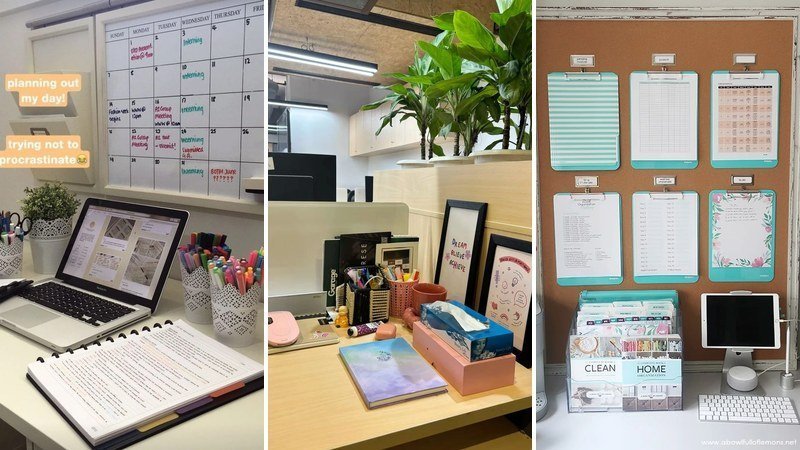
A whiteboard calendar spans the wall behind a clean white desk, filled with handwritten notes about internships, meetings, and deadlines. The desk itself holds only a laptop, a notebook, and two white pen holders — everything else is off the surface. A small potted plant in a white pot adds a touch of green without clutter. Use wet-erase markers for dates that stay all week, and dry-erase for daily tasks — you won’t accidentally wipe next Thursday’s deadline when you update your Monday list. The bright ambient lighting keeps the calendar readable, even from the far side of the room.
Divide Your To-Dos by Project, Not Urgency

by Pinterest
An acrylic task board hangs above the desk, with labelled columns for Website, Marketing, Videos, Projects, Social, and Tech. Below it, a black printer sits to one side, and four purple vertical file organisers line the other, keeping ongoing paperwork sorted by category. The muted grey wall colour makes the bright board pop without competing. Mount the board at eye level — anything higher and you’ll stop reaching to update it after the first month, no matter how smart the system looked in the shop. The soft ambient light means no glare bounces off the acrylic, so handwritten to-dos stay readable all day.
A Corkboard Divider That Zones the Room

by Pinterest
A floor-to-ceiling corkboard wall divider separates the workspace from the rest of the room, creating a dedicated office zone without adding a single piece of furniture. The wooden desk faces a window to the left, so natural light falls across the papers without hitting the screen directly. A metal shelving unit holds potted plants and books, and a desk lamp provides warm illumination for darker afternoons. If you lean toward a Scandinavian home office, this divider does double duty — it blocks visual noise while giving you a place to pin references and reminders.
A Shelf That Manages Your Paper Inflow

by Pinterest
Above the wooden desk, a shelf holds three wire baskets with wooden labels: Groceries, Mail, and School Papers. Next to them, a modern black wall lamp angles to light the workspace, and a large framed wall calendar hangs beside a corkboard. The combination keeps everything that would normally pile up on the desk — incoming mail, notes, reminders — up on the wall and organised. Use the baskets for incoming paper only — when one fills up, it’s a signal to act, not to shuffle things into another pile. The charcoal and warm wood palette grounds the nook in a modern farmhouse feel, not a sterile office one.
Clipboards Keep Projects Moving Forward

by Pinterest
A large cork bulletin board dominates the wall above the desk, fitted with six clipboards, each labelled for a different work stream: pending invoices, projects, to do, long challenges, wellness challenges. Beneath the board, a clear acrylic file organiser holds books and folders, while a tablet on a stand and a small smart speaker sit to the side. Limit each clipboard to one active project — when the documents are finished, move the whole clipboard to an archive hook, and the board stays current instead of becoming a graveyard of half-done tasks. The ambient indoor lighting ensures the labels stay legible.
Desk Tools That Do the Heavy Lifting
You do not need a hundred little pots. A few well-chosen pieces keep the surface clear and the workflow smooth. These are the organisers that earn their spot — not because they match, because they handle the daily mess.
A Desktop File Station That Means Business

by Pinterest
A mesh metal file organiser sits squarely on the white desk, holding hanging folders in bright red, fuchsia, and sage green. Each folder is clearly labelled: TO CALL, TO FILE, TO READ, TO ENTER, TO DO. A black electronic label maker sits to the left, ready to create new categories as the work changes. If a folder says “TO READ,” commit to emptying it every Friday — otherwise, it becomes a permanent library of unread articles and the whole system breaks down. The metal mesh is sturdy and doesn’t trap dust the way a plastic version would, so it stays looking sharp even with daily use.
Two Screens, One Happy Desk

by Pinterest
In a grey fabric cubicle, dual Dell monitors take centre stage, with a large pink desk mat uniting the keyboard, mouse, and phone. A white desk organiser tucks pens, a calculator, and sticky notes into one neat block, while a bubble-shaped tissue box adds a soft touch. A text height conversion chart pins to the cubicle wall. Use a desk mat in a light colour to define your work zone — it stops small items from wandering and makes even a rented cubicle feel like a minimalist workspace you chose. The overhead lighting is even but not harsh.
Lift Your Screen, Free the Space Below

by Pinterest
A white monitor riser raises the screen to eye level, with a closed ThinkPad laptop tucked neatly underneath. To the right, a gold-toned wire document tray holds current papers and notebooks, while a business card holder and a wooden box with a message in a bottle sit to the left, injecting personality without clutter. Use the space under the riser only for items you access once or twice a day — if you stuff it with daily tools, you’ll waste time pulling things out and pushing them back in. The soft, diffuse lighting prevents monitor glare and softens the herringbone patterned wall divider behind.
A Desk That Breathes

by Pinterest
The desk faces a large window, bathing the workspace in natural light. A Microsoft Surface laptop sits on a wooden stand, paired with a separate monitor and a roomy Orbitkey desk pad. Potted plants cluster on the desk and the windowsill, and a simple desk lamp provides backup for grey days. The colour palette stays sage green, off-white, and wood — nothing screams. Position the desk so the window is to one side, not directly behind the monitor, or you’ll fight glare all afternoon and end up with a headache. This is the kind of bright home office setup that makes you want to sit down and start.
Decor That Pulls Its Weight
Pretty things do not have to be useless. A well-chosen pen cup, a small vase, or a framed print can hide the fact that you are storing staples and highlighters. The trick is picking pieces that suit the room as well as the task.
A Lived-In Desk That Still Works

by Pinterest
This desk looks like it belongs to a real person with real projects. A computer monitor on a riser creates a bit of breathing room underneath for small items, while books, a pencil cup, and a miniature retro television decor piece huddle on the right. A framed piece of calligraphy hangs on the white wall, and a green plant brings life to the left side. Rotate the decorative objects every two months — it forces you to dust under them and helps you notice if something hasn’t been touched since winter. The bright overhead lighting works well for paperwork, but you might want a smaller task lamp for screen hours.
A Crate That Hides the Personal Stuff

by Pinterest
A sage green plastic storage crate sits on a charcoal grey desk, holding a bottle of body spray, a sunflower-print notebook, and a small artificial pink flower in a white pot. A wooden mirror and a candle in a glass jar complete the setup, making the corner feel less like a workstation and more like a spot where a real human sits. If the crate has a solid front, it hides the contents from guests across the room; if it’s open, line it with a fabric that matches your room’s colour scheme to keep the view tidy. The ambient office lighting is standard, but the personal items soften it considerably.
A Cubicle That Feels Like a Room

by Pinterest
An otherwise standard cubicle workstation gets a personality transplant. Potted plants sit atop the wooden partition, while framed prints reading “Dream Believe Achieve” and “Daily Affirmations” hang nearby. A woven pen holder and a pink mesh cup keep writing tools from rolling away, and a tissue box stays within reach. When adding plants to a cubicle, choose varieties that thrive under fluorescent light — pothos and snake plants are the workhorses; ferns will let you down within a fortnight. The overhead fluorescent lighting is harsh, but the greenery and soft pink accents warm it up enough to feel like a chosen corner, not a forced assignment.
A Phone Riser That Also Organises Papers

by Pinterest
A dusty rose mesh document holder sits under a black office phone, lifting it off the desk and keeping active papers within easy reach. A crocheted pink and yellow flower arrangement in a small white pot adds a handmade, personal touch. The pink desk mat ties the whole area together, and a printer stays accessible on the left. If you stack a phone on a document tray, stick a sticky note to the tray with the day’s essential numbers — you won’t have to lift the handset every time you need to dial. The space is compact, but nothing feels cramped.
Fresh Flowers Where You Work

by Pinterest
The white desk is a study in restraint, with a computer monitor as the centrepiece and several small vases of pink and purple flowers arranged around it. A white lamp, a coffee cup, and a tea cup share the space, while labelled white boxes store supplies underneath the desk. A Smeg kettle waits on the right, because a hot drink makes any task more bearable. Use opaque boxes under the desk — clear boxes might seem convenient, but they show every odd-shaped item and ruin the calm, collected look you worked for up top. The bright overhead lighting keeps the white surfaces from feeling dull or clinical.
A Tray That Tells Your Brain ‘Work Happens Here’

by Pinterest
A decorative tray sits in the centre of the desk, containing only a spiral-bound notebook, a gold pen, and a few rolls of colourful adhesive tape. A desk calendar on a gold metal frame stands to the right, next to a pencil holder filled with pens and pencils. The computer monitor and keyboard sit to the left, keeping the centre free for analog thinking. At the end of the day, clear the tray of everything except the pen and a single object you enjoy looking at — the empty space signals that the workday is over, and the morning brain will thank you.
Hide It, Then Forget About It
Not everything deserves a permanent spot on the desk. These are the storage pieces that sit beside you, roll under the worktop, or tuck into the next room — and keep the chaos out of sight.
A Rolling Cart That Goes Where You Need It

by Pinterest
A mint green three-tiered rolling cart holds binders in wire shelf dividers on the top shelf, clear plastic bins with lids on the middle, and a large Canson XL watercolour pad on the bottom. Grey holster-style containers attached to the front hold pens and markers, keeping them vertical and visible. The cart on its casters can roll into a cupboard when guests arrive. If you use a cart for daily supplies, park it no more than an arm’s reach from your chair — otherwise, instinct takes over and items land on the desk because the cart feels too far away. The powder-coated metal won’t rust or yellow, so it stays presentable for years.
Drawer Dividers That Actually Fit

by Pinterest
Inside a light wood desk drawer, clear plastic trays section off every category of stationery: a tray for sticky notes, one for Sharpie highlighters, one for Paper Mate pens, one for binder clips. The top-down view shows nothing jumbled, nothing missing its lid. It’s the kind of order that makes you smile when you pull the drawer open. Measure the drawer depth before buying any tray — standard dividers often sit too tall and prevent the drawer from closing completely, forcing you to keep it ajar and inviting dust and frustration. This setup works because it matches the drawer exactly, not the shop display.
A Command Station for the Room That Isn’t an Office

by Pinterest
A matte black metal file holder sits on a light-coloured kitchen counter, with a January 2011 calendar clipped to the front and a floral-patterned notebook tucked inside. Beside it, a cylindrical container wrapped in tan jute twine holds pens and markers. The whole setup takes less than a foot of counter space and doesn’t scream “supply closet.” Anchor lightweight file holders with a strip of museum putty on the bottom — a small bump from a passing elbow sends papers flying, and you don’t want to chase them behind the toaster. This makeshift kitchen office works because it respects the room it’s in.
Why Cheap Plastic Organizers Cost You More in the Long Run
Most home office organization guides push budget bins as the smart starter move. I’d argue that’s a false economy—plastic degrades in ways solid wood and coated steel never do, and you end up paying twice for the same drawer.
Cloudy acrylic: Translucent acrylic and cheap polypropylene trap dust in micro-scratches within weeks. Hold a clear drawer up to the light after six months and it’s already fogged, so the “clean” look you wanted is gone—and no wipe-down brings it back.
Swollen MDF: Those pressboard drawer units seem sturdy until summer hits. In a kitchen-adjacent desk or a basement corner, humidity makes the unsealed edges swell until the drawer no longer glides. Almost no affordable organizer seals the edges with a waterproof finish, so the unit warps and jams.
Snagging mesh: Bent metal mesh trays don’t warp, but their raw edges catch delicate papers and trap visible dust bunnies that guests spot from across the room. A powder-coated steel version costs only a little more, stays chip-free, and doesn’t turn into a cobweb gallery.
Real wood worth keeping: Even a simple pine tray can be sanded and re-oiled to look fresh for years. That gives it a cost-per-use edge over a matching plastic set that loses its finish in one season. In a bedroom nook where every surface reads as part of the room, a wood piece ages gracefully instead of looking worn out.
Fabric’s coffee problem: Felt and fabric bins soften a shelf visually, but one coffee spill soaks in and leaves a stain you can’t fully remove. Save these for very low-mess zones—everywhere else, they become an one-way ticket to replacing the bin.
The 2-Foot Rule: Organizing a Desk That Sits in a Living Room
When a desk shares square footage with your sofa, the usual organizing advice falls apart. What works in a closed office reads as visual static in a multi-use room, so the layout matters as much as the storage.
Back of the desk as decor: If the desk faces the sofa, everything on the surface becomes living-room decor. That means no exposed surge protectors, no primary-colored supply caddies, no teetering paper piles. Anything visible must match the room’s palette or disappear into closed boxes. The same principle holds for a corner desk tucked into a dining nook—your dinner guests shouldn’t see a tangle of cords.
Six inches of breathing room: Pushing a desk flush against the wall chair-side screams “temporary office.” Leaving as little as six inches behind the desk chops that visual weight in half and lets you route cords along the wall where nobody sees them from any angle.
Measure two feet out: Mark a 2-foot radius from your seated position. If the chair backs into a walkway, blocks a door, or clips a sofa arm, no arrangement will feel comfortable—no matter how neatly the supplies are corralled. This radius applies just as strictly in a bedroom entry or a hallway nook; if you can’t pull the chair out without a shimmy, the setup fails.
Room divider traps: Using the desk as a room divider works only if both sides stay visually tidy. Avoid transparent organizers on the outward-facing side—they turn into a cluttered shop window for anyone walking past. Solid-front bins or a low console-style setup keep the space calm.
Light That Helps You Stay Organized Without Stealing Desk Space
Desk clutter collects in dim corners. Fix the light, and you fix half the mess—without buying a single extra basket.
Clamp-on task lamps: A lamp that clamps to the desk edge or a shelf frees the surface square inches a base lamp eats. Its adjustable arm washes light across the whole work zone, so pens, sticky notes, and file tabs aren’t hiding in shadows. A bright home office doesn’t need a bigger desk—it needs light that reaches every inch.
3000K–3500K bulbs: Bulbs in this range cut eyestrain for paper-and-screen work without the cool, clinical glare that makes a desk feel like a dentist’s chair. Warmer light also softens the look of utilitarian organizers, blending them into a living space instead of announcing “supply station.”
Under-shelf LED bars: A LED light bar mounted under a floating shelf above the desk creates a shadow-free writing surface. Color-coded files become easy to distinguish at a glance, all while the light source stays tucked out of sight—no bulb in your line of vision.
Drawer puck lights: A small warm puck light inside a deep drawer kills the “I can’t see what’s in there” excuse that lets odds and ends pile up unseen. It turns a black-hole drawer into a clearly visible storage spot with zero extra effort.
Office Desk Organization That Lasts: Where to Find Second-Hand Storage Gold
The most character-rich organizers live in thrift shops, not big-box aisles. They just need a second look and a willingness to see past the dust.
Wooden cutlery trays and cigar boxes: Old wooden cutlery trays, cigar boxes, and slant-front writing boxes often have dovetail joints and solid-wood construction that outperform new pressboard organizers. The patina they carry already complements farmhouse, traditional, or eclectic boho decor without a single brushstroke of “distressing” paint.
Skip the must and laminate lift: Pass on anything with a strong musty smell or visible lifting laminate. Scratched finishes are easy to sand and repaint, but particleboard that has already started to swell can’t be saved—it’s heading for the bin no matter what you do.
Brass and ceramic desk cups: Old toothbrush holders, bud vases, or small ceramic pitchers sit unnoticed on estate-sale tables. They bring an upscale, non-office-store feel to pen storage and wipe clean without scratching. One brass cup on a desktop reads intentional, not repurposed.
Repaint with care: Chalk paint or matte spray enamel in a colour pulled from your room’s textiles makes a second-hand organizer look custom right away. This step adds no more VOC exposure than a new plastic bin would off-gas, and the result fits your room exactly.
1970s metal filing baskets: Baskets from the Seventies often use heavier gauge steel and baked-enamel finishes that don’t chip like today’s thin wire. When you find one without rust, it will outlast anything in a big-box aisle—and the thicker wire holds up under daily file grabs without bending.
Your Desk-Closing Ritual: A 10-Minute Habit for Lasting Office Desk Organization
Clean Sweep: Clear the main surface until only your laptop, a lamp, and one decorative piece remain.
That bare expanse first thing in the morning tells your brain the day begins fresh. I keep a small ceramic dish from Munich’s flea market as my one object — it holds nothing but catches the early light. You do not need to polish or dust; just push everything else off to the staging tray.
Staging Tray: Corral every stray item into a single tray you will empty tomorrow.
A simple wooden or ceramic tray, roughly the size of a dinner plate, works best. It caps visual chaos without forcing a full tidy-up at 9 p.m. In the morning, you take five minutes to put each thing where it belongs, and the tray sits empty for the next evening.
Cable Tuck: Feed all leads back toward a hidden charging station or cord box.
Nothing shouts “unfinished” like a tangle of black wires snaking toward a power strip. I use an under-desk cable basket, but even a repurposed shoebox with a lid will do. The goal is to see no cord at all from standing height.
Tomorrow’s Task: Write one priority on a notepad and leave it centre stage.
The act of writing by hand signals to yourself that the workday is complete. When you sit down the next day, that single note is impossible to ignore, so you dive straight into the important work instead of faffing with emails.
Light Switch: Turn off the desk lamp or dim it to a warmer setting.
A bright 4000K bulb screams “keep working,” even when you’ve closed the laptop. Switch to a warmer, dimmer light as you leave the desk. It tells your mind the space is now reserved for evening calm, not another hour of overtime.
FAQ
How do I organize a desk with no drawers?
Treat the wall above the desk as your drawer. Mount a slim floating shelf for daily items and use vertical file sorters that screw directly into the wall. Decorative boxes with lids on the desk surface become invisible storage that doubles as a monitor riser.
Can my office desk organization look stylish and not clinical?
Yes, if you choose natural materials over white plastic. Woven baskets, wooden boxes, and ceramic vessels in your room’s accent colour do the job without looking sterile. Swap a stark whiteboard for a fabric-covered bulletin board and pick matte black or brass accessories instead of primary-coloured bins — the same thinking that makes a Japandi-inspired workspace feel calm rather than cold.
What’s the best way to hide all those cords?
Start with a power strip fixed underneath the desk with adhesive clips. Bundle the wires into a single braided cable sleeve in a neutral colour. For the visible run from desk to wall, paint a cord cover the exact wall shade — it disappears optically even though it’s right in view.
I have a tiny desk; how do I fit everything without it looking cluttered?
Restrict the surface to only what you use every session. Storage moves off-desk. In a bedroom, a narrow wall-mounted magazine rack pulls papers up and away. In a living room, a rolling cart beside the desk holds supplies without claiming floor space permanently. A dining nook often works better with a corner desk setup that follows the wall, freeing the centre for a slim monitor and a notepad. The rule stays the same: if you don’t touch it daily, it does not live on top.
How do I keep my desk organized if I’m not naturally tidy?
Give yourself one designated drop zone: a pretty bowl or tray where everything lands when you’re in a hurry. The mess is contained to one vessel, so the rest of the surface stays clear enough that tidying up takes two minutes instead of a hour. Empty that bowl every Friday afternoon and start Monday with a blank slate.
Does an organized desk really make you more productive?
The productivity lift is real but not magical. Each stack of paper or rogue pen forces your brain to make a micro-decision every time you glance at it, draining focus you could use for actual work. When every item has a fixed home, those tiny distractions stop, and you stay in a flow state longer.
How often should I declutter my desk organization system?
A quick tidy once a week — Friday afternoons feel right for most — and a full purge every quarter. During the quarterly scan, throw out dried-up pens, expired sticky notes, and files you can archive. That rhythm stops clutter from becoming permanent resident rather than a temporary guest.