Stylish 15+ Retail Job Outfit Ideas for Your Shift

Most advice on the perfect retail job outfit starts from a magazine page, not the stockroom floor. It pictures a woman folding sweaters in pristine tailoring, not climbing a ladder with a box of floor wax under one arm. The real problem is simpler: you need clothes that survive eight hours of standing, bending, and customer-facing pressure, without looking like you gave up or spent your entire paycheck. That means finding comfortable retail job shoes women actually wear past lunch, decoding the unwritten retail dress code women inherit from their specific store, and sourcing affordable retail work clothes women can wash on repeat.
If you are navigating a new role or just want a wardrobe that stops creating problems before your shift starts, the business dress code guide breaks down the official rules managers rarely explain out loud. For footwear that actually ends the search, the work shoes list covers styles built for concrete floors, not carpeted offices.
20 Retail Job Outfit Mistakes (and What to Wear Instead)
Most retail outfit advice ignores the floor. It shows looks that would leave you dress-coded before lunch or hobbling by hour four. Real retail means standing on concrete, restocking shelves, and hiding sweat when the AC breaks. The clothes that work in an office often fail under those conditions. Below, I’ve pulled the twenty most common outfit pitfalls I see on the floor — shoe disasters, fabric meltdowns, and dress‑code gray zones — and paired each with a specific, wearable fix. All the visuals here show the corrected version, but the real wisdom is in the small adjustments that turn a liability into an asset. If you’re already mixing casual work outfits with more polished pieces, you’re halfway there. The rest is in the details.
The Olive Skirt Gambit

That olive skirt and soft white tee feel like a win on a warm morning, and the brown sandals seem practical. But an unstructured skirt invites manager comments about “professional silhouette,” and open-toe shoes are a safety hazard the first time a display shelf gets rearranged around you. If your store permits skirts, choose one with a discreet side zip and knee-length cut, and swap those sandals for closed-toe leather flats. The lanyard and sunglasses hint at a casual on‑the‑clock vibe, but you’ll look intentional if the tee is slim‑fit cotton and tucked cleanly. Remove the sunglasses indoors and trade the oversized frames for a streamlined style you can clip away.
Cream Trouser Realness

by @ah.teachess
A slim‑fit jersey turtleneck in olive and wide‑leg cream trousers feels like the quiet luxury everyone talks about, and the lanyard with gold jewelry proves you can blend ID‑required accessories with actual style. The problem isn’t the look — it’s the fabric. Cream woven trousers will show a water spill or scuff within the first hour of a stockroom shift. Pretreat them with a stain repellent before you ever wear them to work, and always keep a stain‑removal pen in your locker. The gold layered necklaces and bracelet add warmth, but limit jewelry to pieces that won’t catch on clothing racks; a smooth chain is safer than a textured one that can snag and snap.
Denim Decision Day

A relaxed white button‑down tucked into black straight‑leg jeans, cinched with a black leather belt, is a deceptively simple formula. Black loafers and gold jewelry polish it just enough. But this outfit lives or dies by your store’s denim rules. Many retailers forbid jeans outright, regardless of color. Before you invest, read the handbook’s fine print — if “dark denim without distressing” is allowed, this works; otherwise, swap the jeans for black ponte trousers. The gold earrings and necklace will slide under most radars, but make sure your shirt isn’t sheer under the shop lighting. Lean your phone flashlight behind the fabric at home to test.
The Navy Anchor

by @g3orgina_
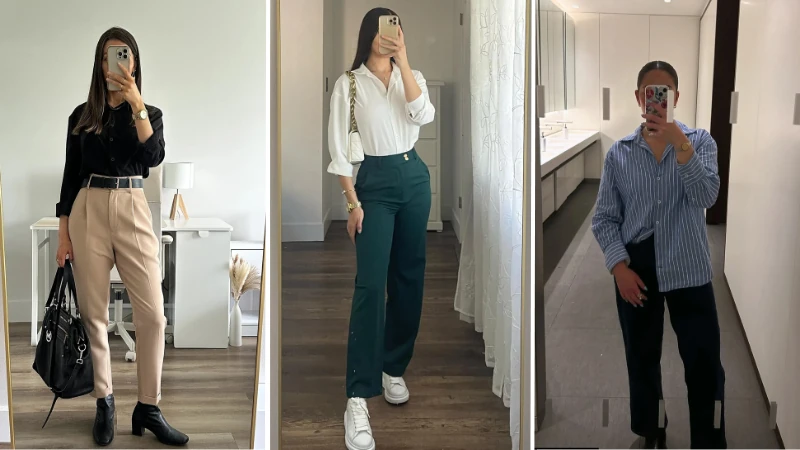
A relaxed‑fit blue button‑down and dark navy denim‑look trousers are a pair I’d reach for when the dress code says “business casual” but the shift involves ladder climbing. The black leather boots provide ankle stability that ballet flats can’t match. When selecting boots for retail, look for a modest heel (under two inches) and an oil‑resistant outsole — pretty leather won’t save you on a waxed floor. The gold watch and silver rings add personality without being loud, but note that many store policies limit rings to a single band per hand to prevent glove‑tear or caught fingers. Leave the stack at home if you work in hardware or grocery.
The Mini Dress Misstep

A slim‑fit dark brown mini dress paired with black knee‑high boots and white crew socks looks editorial, but on a retail floor it’s a hazard. Bending to stock a low shelf or reach a bottom drawer in that hemline will get side‑eye from management and probably a quiet verbal warning. The oversized leather tote and lanyard pull it into “I tried” territory, yet the silhouette remains the weak point. If you love the dress‑and‑boots combination, choose a tunic‑length style that hits at least mid‑thigh and wear opaque black tights underneath for coverage when you move. The socks add a preppy layer, but they’ll show dirt fast on a dusty stockroom floor — keep a backup pair.
Wide‑Leg Green Machine

White button‑down, dark green wide‑leg trousers, and chunky white leather sneakers — this is the direction I’d point anyone staring at a “smart‑casual” dress code with no time to think. The polyester‑blend trousers resist wrinkles better than 100% cotton, and the dark green hides minor scuffs. Wide‑leg cuts are forgiving on the thigh but a menace around pallet jacks and stockroom doors if the hem drags; have them tailored to just skim the floor when you’re flat‑footed. The gold watch and white shoulder bag keep the look expensive without testing the budget, but skip canvas sneakers — the white leather here will wipe clean after a customer‑spilled latte while canvas soaks it in forever.
Beige & Black Balance

A relaxed black button‑down and high‑waisted beige trousers, grounded by black ankle boots, read as polished without screaming “I’m new.” The structured leather handbag and slim black belt pull the waist in, and the gold watch supplies just enough personalization. Beige trousers are a retail cheat because they mask dust, but they’re also a beacon for grease and ink. Invest in a pair with a stain‑release finish, and if you spend time in a stockroom, carry a tide‑to‑go pen — beige won’t forgive a pen mark. The fitted ankle boots save your feet more than flats would, but make sure the toe box is roomy enough to wiggle your toes after lunch when swollen feet are a reality.
Blackout Chic

A slim‑fit black knit sweater and straight‑leg black trousers, finished with white sneakers, is the kind of outfit that makes you look intentional in three minutes. It’s essentially a blank canvas, which is its strength. All‑black can trigger the “are you in mourning” manager comment if you don’t break it with something — socks, a belt, or a subtle earring. Here, the white sneakers and gold jewelry do the job, but many retail dress codes forbid athletic shoes entirely. Check whether your white leather pair passes as “fashion sneaker” before committing. The knit fabric won’t wrinkle behind the cash wrap, but it will pill on the sleeves from cart friction, so keep a lint shaver.
Polo Power

by @ritajokinen
The slim‑fit white polo and dark blue wide‑leg jeans lean into that cute professional outfits territory without a blazer, and the black ankle boots anchor it. But a polo’s cotton‑blend collar snags easily on hangers, which ruins the neckline by week two. Wash polos inside out in a mesh bag and never hang them by the collar — fold instead. Dark blue jeans can read as uniform in some stores, but if denim isn’t explicitly banned, this is a safe bet. The omission of a belt might seem minor, but managers notice when belt loops are empty, so add a slim black leather one to match the boots.
Sleeveless Solution

A slim‑fit black sleeveless top tucked into relaxed grey trousers is a smart‑casual base that works under a blazer for management meetings or on its own for a floor shift. The white sneakers and black shoulder bag keep the line clean. Sleeveless tops often violate dress codes that require covered shoulders, even if the handbook doesn’t say so explicitly — layering a wrinkle‑resistant cardigan over it gives you the option to adapt to sudden rule shifts. The gold watch works, but the belt should sit exactly on your natural waist for the most flattering ratio; anything lower cuts the leg line. The grey cotton‑blend trousers will breathe better than polyester in summer stockrooms.
Slide Sandal Slip

A regular‑fit white button‑down and beige tapered trousers paired with brown leather slide sandals look like the old‑money aesthetic everyone’s chasing, but slides on a retail floor are a trip hazard no manager will ignore. Swap the slides for brown leather loafers with a low block heel — they maintain the same visual weight while giving you the traction and toe protection that sanitation and safety audits demand. The brown leather tote and gold watch reinforce the quiet‑luxury feel, but the trousers’ tapered cut means they’ll ride up when you crouch, so size for a slight break at the ankle. A single‑fold cuff can prevent fabric from dragging on dirty floors.
Blue & Black Standard

A relaxed blue button‑down and black straight‑leg trousers anchored by black loafers is one of the most boring possible outfits, and that’s exactly why it works. Boring doesn’t get you dress‑coded. The gold necklace and earrings nudge it away from “mandatory uniform” territory without crossing any line. If your store requires a branded apron or vest, this entire base stays visible and professional — and the dark trousers hide the inevitable belt‑rub the apron will cause. Loafers are my pick over sneakers for most floors, but only if they have a padded insole; a hard leather footbed will send you straight to comfortable shoes by month’s end.
Sweater Vest Strategy

A blue‑and‑white striped button‑down under a navy sweater vest, paired with beige wide‑leg trousers, reads as smart but approachable — the kind of person a customer trusts to know inventory. The brown belt and tan shoulder bag loop into that. A sweater vest adds core warmth without restricting your arm movement, which matters when you’re reaching for high shelves or carrying armloads of hangers. The gold jewelry avoids dangle, so it’s unlikely to snag, but the wide‑leg trousers need a break check: if they pool on the floor, you’ll be slipping on the heel after one shift. Tailor them to just clear the ground in your work shoes.
Charcoal Cool

A slim‑fit grey tank and wide‑leg charcoal wool‑blend trousers, cinched with a black belt, is a masterclass in monochrome layering. The burgundy crossbody bag adds the single shot of color this outfit needs, and the pointed‑toe black flats keep it sleek. Wool‑blend trousers resist wrinkles through a full shift, but they can itch if the lining is cheap; wear a thin, seamless cami underneath to block contact. The tank is the weak link — most retail dress codes call tank tops “undergarments” regardless of how polished they look. Check your handbook, and if in doubt, add a cropped cardigan in a matching grey that you can remove during stockroom hours.
The All‑Black Sandal Fail

A regular‑fit black tee tucked into straight‑leg black wool‑blend trousers, cinched with a brown belt, is the quiet‑luxury base I’d recommend to anyone who wants to look intentional while stocking shelves. But the black suede sandals sink it. Open‑toe rules aren’t just for kitchens — any retailer that handles glass, cleaning chemicals, or carts will enforce a closed‑toe policy, and those sandals flag you as someone who hasn’t read the safety memo. Replace them with black leather loafers or oxfords, and suddenly you have an outfit that works for a boutique floor or a cash‑wrap shift. The gold jewelry and brown tote add personality without noise.
Blue & Tan Tweaks

by @jeanwang
A relaxed light‑blue button‑down and tan high‑waisted wool‑blend trousers create a soft contrast that photographs well but demands maintenance on the floor. The beige pumps and suede handbag upgrade the look, but pumps with a heel higher than two inches become torture by hour four. Choose a block‑heel pump or a sturdy wedge — anything pointier than a square toe will pinch after prolonged standing, no matter how many gel inserts you use. The silver watch keeps metal tones cool, but light‑blue cotton shows sweat fast under store lighting; a sweat‑proof undershirt or clinical‑strength deodorant is non‑negotiable here. Hang the shirt immediately after washing to minimize ironing time.
Grey Layered Luxe

by @verena.lr
A white button‑down layered under an oversized dark‑grey knit sweater, tucked into wide‑leg grey wool‑blend trousers, is the winter‑shift outfit that hides fatigue and flatters. The black belt, black handbag, and pointed‑toe grey suede ankle boots pull it into quiet‑luxury territory. When layering a sweater over a button‑down, make sure the shirt collar and cuffs aren’t too tight — constriction around the neck makes you overheat during a rush hour, and tight cuffs trap sweat. Wide‑leg trousers risk dragging in a stockroom; roll‑cuff them once if you’re expecting a heavy shipment day. The tonal grey palette masks minor dust, but suede boots will stain if you walk through a wet entryway; spray them with protector.
Scarf & Sandal Swap

A dark‑brown relaxed button‑down and cream high‑waisted wide‑leg trousers, accessorized with a black‑and‑white silk scarf, gold earrings, and dark brown sandals, would work for a brunch — not for a register. The scarf adds the kind of personal touch most employees abandon, but the sandals undercut everything. Closed‑toe leather sandals or a woven leather loafer in the same dark‑brown shade will give you a similar line while meeting safety standards. The straw‑trim tote introduces texture, but many stores restrict large bags on the floor; check whether you’re allowed to keep it at your station. The scarf can stay, as long as it’s tied safely and doesn’t dangle.
Pink & Beige Power

by @ewa_vu
A pink button‑down under a beige sleeveless trench coat, paired with slim‑fit beige trousers and beige pumps, is the outfit that proves you can inject color without a costume. The gold watch and shoulder bag give it polish. A sleeveless trench is a smart layer for air‑conditioned floors, but make sure your store doesn’t classify it as “outerwear” — some managers require you to remove it indoors, which would leave you in a sheer pink shirt. Test the shirt’s opacity under the store lights during a training shift; if your bra lines show, layer a nude camisole underneath. The beige‑on‑beige palette works best when the textures differ, so the knit topcoat plays against the smooth trousers.
Cardigan Commander

A white bouclé cardigan over black wide‑leg denim, teamed with black suede boots and a simple black handbag, is the formal‑casual compromise I’d wear to meet a regional manager. The cardigan’s texture adds interest without a single accessory required. Bouclé fabric can snag on jewelry, so wear it solo or with smooth studs only; a textured necklace will loop into the weave and pill the yarn. The wide‑leg denim looks crisp, but confirm your store’s denim policy — many classify any blue‑based weave as jeans regardless of wash. If in doubt, swap for black ponte trousers. The boots’ slim suede shaft won’t rub under the wide hem, but spray them for stain protection immediately.
What Your Store’s Branding Says About What You Should Wear
Fast-fashion chains signal trendy-but-disposable: The whole floor is selling a look that moves fast. You need to adopt current silhouettes, but never outshine the inventory. If your top looks more expensive than what’s on the racks, customers will ask where you bought it, not what they came for. A $15 ribbed knit from Old Navy fits better here than a silk blouse.
Luxury boutiques expect you to embody the brand without eclipsing the product: Fabrics and fit matter more than logos. A blazer with clean shoulder seams in a neutral wool blend signals you understand the client’s world. Cheap zippers or shiny polyester will read as a costume. Keep it quiet: no flashy hardware, no loud patterns that compete with the merchandise.
Outdoor and hardware retailers hide safety requirements in the dress code: Loose sleeves near machinery, open-toe shoes in a stockroom used for lumber — these get you sent home. Steel-toe boots designed to look like streetwear exist. Seek them. No flowing scarves, no delicate necklaces that can snag on a pallet jack. The unspoken rule is function-first, even if management doesn’t say it.
The “accessory dead zone” is real: Some stores ban scarves, statement necklaces, or dangling earrings not for style, but for loss prevention or safety. A long necklace can catch a falling display, a scarf can brush against a sensor tag and look suspicious, a big bracelet can scratch a polished surface. I’d skip anything that swings, clanks, or dangles. A single stud is always safer.
Read the manager’s look as a cheat sheet: If she wears all black with polished flats, your wild prints will flag you as an outsider. This is the kind of unspoken rule that HR handbooks never spell out. Mirror the formality level, not the exact pieces, and you’ll blend into the store’s culture without losing your job over a too-casual Friday interpretation.
How to Pick Shoes That Won’t Destroy Your Feet by Hour 6
The lie of “just break them in”: Most guides tell you to tough it out with cheap ballet flats. I’d argue that’s terrible advice, because rigid soles never soften — they deform your arch instead. Once that support flattens, you’re standing on cardboard, and the pain radiates upward to your knees and lower back. Start with a flexible sole from day one.
Compression socks prevent the end-of-shift hobble: Medical-grade graduated compression (15-20 mmHg) reduces swelling and helps prevent spider veins from 8-hour standing shifts. Wear them under slim trousers or cropped pants — no one notices, but your feet will. Skip the flimsy fashion versions. They’re just tight tubes.
Non-slip isn’t a suggestion: Water puddles near the entrance, floor wax after closing, spilled soda in aisle three — these are your true enemies. Look for oil-resistant outsoles, not just textured rubber. A shoe that passes the wet tile test in a breakroom is worth more than any style point. I’d pick a pair with a legit slip-resistance rating (like ASTM F2913) over a cute pattern every time.
The “two-shoe rotation” is science, not indulgence: Alternating pairs every other day gives foam midsoles time to rebound and presses your foot into different pressure points, reducing repetitive stress injuries. I’ve seen this work firsthand; a good shoe rotation doubled the lifespan of my work flats and ended the late-shift burn in my arches. It costs more up front but saves a podiatry bill.
Heel-to-toe drop matters: Zero-drop shoes feel weird at first — your heel is level with the forefoot, and it forces your posture to realign. After a two-week adjustment, that chronic lower-back ache from standing on a hard floor often disappears. Traditional sneakers with a high heel drop tilt your pelvis forward and strain your spine. A flat, wide-toe-box design gives your feet space to spread naturally as the hours tick by.
The Truth About Fast Fashion for Retail Work (And Where to Shop Instead)
Polyester blouses betray you after three washes: They pill under the arms, trap odor, and hold stains from a single spilled coffee. Look for brushed cotton, lyocell, or rayon blends that breathe better and release stains in a normal cycle. The slight texture of a brushed twill blouse also hides sweat marks better than a shiny polyester shell.
Thrift stores are goldmines if you search by brand name: Instead of browsing “work clothes,” zero in on J.Crew, Banana Republic, Uniqlo, and Eileen Fisher. Their fabrics and construction hold up far longer than the average fast-fashion find. I’ve pulled blazers for $12 that still had retail tags. The key is checking seams and zippers before you buy — no amount of savings fixes a busted fly.
The hidden cost of $15 pants is seam tape and stretch recovery: Those cheap trousers lose shape after a few squat-and-reach motions in the stockroom. The inner elastic breaks down, the waistband curls, and you’re hiking them up all shift. A $40 pair from a reputable workwear line (Dovetail, Dickies, or Lee’s Motion line) uses bar-tacked seams and better recovery fiber, lasting five times longer. The conventional take is that cheap pants save money. That misses the cost-per-wear math: a pair you replace every two months burns cash faster.
Discount “professional” polyester career pants can melt: How? A stockroom ironing station left too hot, a stray spark from a stapler, even direct heat from a space heater warps the synthetic fibers and creates shiny iridescent patches. The color degrades, and suddenly your black slacks look greenish under fluorescents. Not worth it.
A fabric shaver and some Scotchgard extend a piece’s life by months: This clothing care investment gets ignored by most budget guides. A $10 shaver removes pills from high-friction zones (inner thighs, under sleeves), and a light spray of fabric protector keeps spills from setting. I treat every new retail-work top before its first wear. It’s the difference between a piece surviving a season and landing in the rag pile by week three.
Balancing Rules and Personality: 4 Ways to Make Your Retail Job Outfit Feel Like You
The “signature earring” loophole: Many dress codes only restrict dangling jewelry. One bold, silent stud or a fine ear crawler becomes your recognizable asset. A small sculptural shape in sterling silver or matte resin looks intentional without waving for attention. It’s the whisper that says, “I’m still me,” even in an uniform polo.
Nails as the controllable canvas: OPI’s “Barefoot in Barcelona” or a quiet lavender like “Lisbon Wants Moor” reads professional but personal. Stiletto shapes tick off management because they can snag delicate stock and signal impracticality on the floor. A short, rounded nail in an unexpected neutral lets you sidestep the no-distracting-colors rule while still giving your hands presence.
Sock strategy: Funky patterned socks peeking out of cropped trousers or work sneakers show spirit without breaking any rule about visible body art or accessories. A narrow striped crew sock in the store’s accent color, or a dot pattern in navy and blush, adds a deliberate detail. Your feet stay compliant, your personality stays intact.
Mastering the neckline fit: A lace-edged camisole worn under a provided tee or polo gives texture and femininity that stiff cotton never delivers. The key is the narrowest strip of lace — just enough to soften the neckline without reading as lingerie. You’ll hear that accessories are the way to express yourself. In retail, that’s a trap: statement necklaces catch on stock, and scarves get flagged by loss prevention. The clever move is subtle texture, a detail that fights the all-neutral trap without a single rule broken.
Hair as your statement: Intricate braids, gentle color streaks (rose gold tips, not a full punk dye job), or a silk scarf tied around a ponytail signal creativity the handbook never bans. A French braid keeps hair off your face during busy rushes, but it looks polished and intentional. The trick is keeping it controlled — no loose strands that brush against merchandise or get caught in packaging. A silk scarf in a subdued floral print changes the whole tone of a black-on-black uniform without a whisper of noncompliance.
Your 7-Day Retail Job Outfit Capsule Checklist
The 3-Bottom, 5-Top, 2-Layer Formula: Stock exactly three bottoms, five tops, and two lightweight layers that all mix without clashing.
This gives you 15 distinct outfits no one will track. Choose colors inside a single temperature family—cool tones like charcoal, navy, and blush, or warm ones like camel, olive, and rust—so every combination reads intentional. Avoid white tops unless you’re certain your store’s lighting won’t turn a tiny underarm shadow into a visible stain. Stretch-cotton twill bottoms in a deep tone hide scuffs from kneeling better than lighter shades ever will.
Manager Meeting Trousers, Floor Chinos, Stockroom Joggers: Own one pair dark structured trousers for moments of notice, one pair washable chinos for day-long floor shifts, and one technical jogger for stockroom tasks that demand reach and resistance.
The structured trouser must have a zip fly, not a hook-and-eye—hooks catch on fixture corners the second you twist toward a shelf. Look for reinforced knee panels in the jogger, the kind you find on hiking pants; they prevent seam blowouts when you’re climbing ladders with a box in one hand. And make sure those trousers are hemmed for the exact flats you’ll wear, because one wrong hem dragging across the floor frays and flags you as sloppy faster than a wrinkled shirt.
The Layer Lifeline: Keep a wrinkle-resistant cardigan or chore jacket in your store’s dominant neutral—black, navy, or camel—so it disappears into any outfit.
Retail air conditioning doesn’t care about layering theory. A piece that rolls into a ball and shakes out smooth saves you when you’re reassigned to the frozen-foods aisle or stationed under a blower vent. That kind of worry-free layer anchors classic work outfits without you looking like you’re headed to a boardroom. Hunt for an interior hidden pocket to stash a work phone or a lip balm; many chore styles have them without any tactical look.
Emergency Kit Checklist: Stash deodorant wipes, static spray, blister bandages, a travel-size lint roller, and a mini fabric shaver in your locker or bag.
Static cling can turn a dress-code-approved skirt into a bunched, awkward mess after a walk across carpeted fitting rooms—spray before shift start, not after. The lint roller isn’t just for pet hair; it lifts fine shelf dust off black trousers after you’ve been restocking. A tiny tube of clear nail polish stops a hosiery run instantly, and nobody will notice. The fabric shaver erases the fuzzy nubby buildup on poly-blend knits that whispers “I slept in this.”
The Sweat Test Pre-Shift Routine: Retire any top that reveals bra outlines or sweat rings when you raise your arms—test it in natural light before you leave the house, and if you’re unsure about unspoken rules, understanding business dress code nuances can clarify why a simple tank might get you flagged.
Bedroom bulbs lie; they hide damp shadows that fluorescence magnifies into a spotlight on the sales floor. Do the “lean over the bathroom sink” move to mimic bending over a display table—that’s how you’ll truly know. Fabrics labeled “moisture-wicking” often turn transparent when stretched across your back under overhead lights, so check with a mirror from behind before you commit to a full eight hours.
FAQ
Can I wear leggings for my retail job if the dress code doesn’t say no?
Leggings almost always read as athleisure and can trigger a conversation about professionalism that the handbook implies. If you must, wear thick ponte leggings with zero sheerness and pair them with a tunic or long cardigan that fully covers your rear. Even then, many managers see them as borderline, so it’s safer to skip unless you’ve explicitly asked HR. Knowing how dress codes are actually enforced can keep you out of that gray zone.
What if I’m plus-size and can’t find retail job outfits that fit comfortably off the rack?
Seek brands that design workwear specifically for curves—like Eloquii or Universal Standard—and skip junior sizing entirely. Tailoring cheap pants is often a faster, cheaper fix than hunting for a miracle off the rack: hemming and taking in a waist costs under $20 and transforms a frumpy cut into a custom fit. A good tailor can also add discreet gussets that let you bend and reach without pulling at the seams.
How many retail job outfits do I really need if I work 5 days a week?
You need five to seven tops and three to four bottoms; that’s it. Washing midweek and rotating them yields a month of distinct looks because colleagues are too busy to track repeats. The capsule approach works best when every piece shares a single color family so nothing looks like a leftover.
What shoe brand is genuinely non-slip without looking like kitchen clogs?
Skechers Work, Dansko, and Dr. Scholl’s Harrington line all build hidden slip-resistant soles into silhouettes that resemble normal flats or sneakers. I learned that when I bought the comfortable shoes and stopped apologizing for prioritizing function—look for oil-resistant outsoles, not just textured rubber, because floor wax and spilled drinks defeat the cheap stuff.
Can I wear a decorative or branded mask with my retail job outfit?
A solid color or subtle print gets you through the door; masks with competitor logos, pop-culture characters, or political statements risk being flagged, even if no written rule exists. Keep a plain black or tonal backup in your bag so you can swap instantly if a manager’s expression shifts when they see yours.
How do I handle sudden dress code changes my manager never announces?
Always keep a backup plain black tee and dark trousers in your locker or car—it’s a non-negotiable safety net. Leaders sometimes shift rules verbally, and being caught in a newly banned pattern feels humiliating. Think of that standby as decoding HR’s unspoken rules before they become a surprise.
Is it okay to wear perfume or strong-scented deodorant for a retail job?
No. Many customers and coworkers have allergies, and scent-free policies are becoming standard. Your retail job outfit should never announce itself by smell; use an unscented crystal deodorant or a fragrance-free formula to avoid complaints and migraines. If you crave a signature, put a tiny dab of solid perfume on your wrist only on days off.