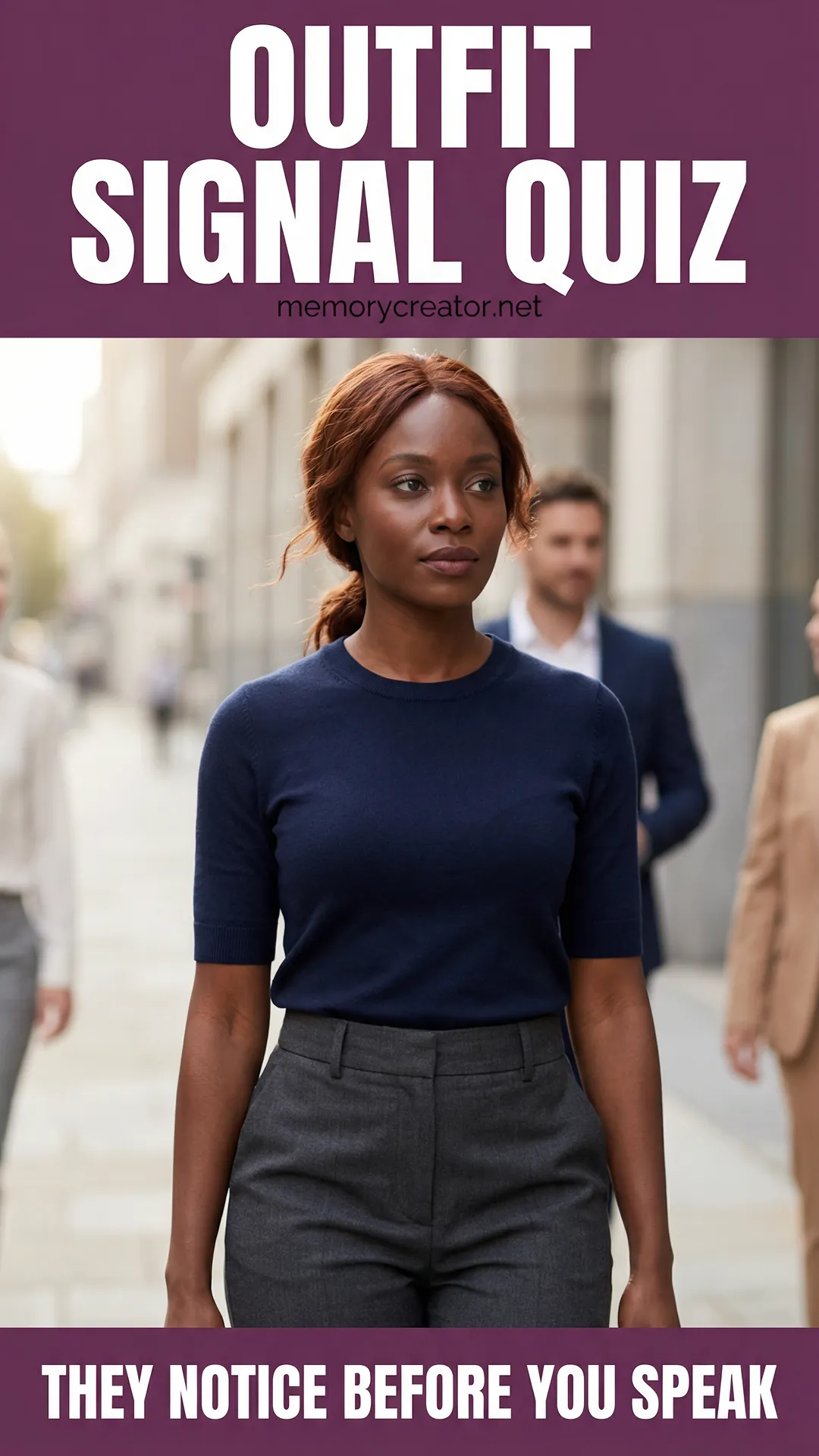
Before you say a word, a conclusion has already been drawn. The research from Princeton University is unequivocal: it takes the human brain 100 milliseconds to assess a stranger’s face and appearance, locking in judgments on competence and trustworthiness [Willis & Todorov, 2006]. Giving people more time to listen to your ideas does not change that initial verdict; it only makes them more confident in it.
I spent a long time believing my work would speak for itself. Then I read the study by DongWon Oh at Princeton, which found that observers link the perceived quality of your clothing directly to your perceived intellect. This bias is so automatic that even when people were warned about it and offered money to ignore clothing cues, they still could not stop themselves. Your outfit is not a superficial detail. It is a data point in someone else’s rapid, involuntary calculation about your capability and your so-called invisible competence.
This is not about trends. It is about the psychology of what works. The concept of ‘enclothed cognition’ shows that what you wear alters your own psychological state. In one experiment, people wearing a lab coat described as a doctor’s coat made 50% fewer errors on a task than those in street clothes. But when the same coat was called a painter’s smock, the cognitive boost vanished. The symbolic meaning matters.
And the stakes are asymmetric. Sylvia Ann Hewlett’s research on Executive Presence notes that while ‘Appearance’ is only 5% of the formula for being seen as leadership material, it acts as a non-negotiable filter [Hewlett, 2014/2024]. Fail it, and no one evaluates the remaining 95%—your gravitas and communication. For women and people of colour, this filter is applied more narrowly.
You are being assessed the moment you enter a room, a call, or a meeting. The question is not if you are being judged, but on what criteria. Is your silent broadcast one of deliberate authority, or does it signal uncertainty? Does it show you understand the environment, or that you are disconnected from it?
You’re about to walk into a high-stakes meeting with senior management. You take a last look in the mirror. What’s your main thought?
It’s a casual Friday, but you have a client presentation. What do you wear?
You’re giving a presentation and realise your microphone isn’t working. Your body language defaults to…
When shopping for work clothes, what’s your primary criterion?
You’re working from home and have a video call with a new team. What are you wearing?
A colleague compliments your outfit, saying it looks expensive. Your reaction is…
You’re asked to lead a project last-minute. Before the kick-off meeting, you…
Your company announces a new dress code: ‘business casual’. You interpret this as…
They think you didn’t try
You prioritise comfort and cost over strategic signalling. Research shows that in 100 milliseconds, observers link poorer-quality clothing to lower competence. Your outfit says you’re not invested, so why should they be? You’re leaving authority on the table because you think it doesn’t matter. Start by investing in one tailored piece you wear for important meetings.
You read as the intern who updated nothing
You dress appropriately but generically, avoiding risk. According to the Executive Presence framework, appearance is a filter; by not mastering it, you render yourself invisible. You blend in, which means you’re overlooked for projects that require gravitas. Your clothes scream “reliable worker,” not “future leader.” Pick one element—like the fit of your trousers—to master this month.
Overdressed and they noticed
You err on the side of formality, which can read as insecurity or lack of cultural fit. The Red Sneakers Effect only works if nonconformity is deliberate; otherwise, it’s just a mismatch. You’re perceived as trying too hard, which undermines the natural authority you might actually have. Ask a trusted colleague for an honest opinion on whether your outfit fits the room.
The room thinks you’re in charge
You use attire as a cognitive tool, choosing clothes that project authority and trigger your own confidence. Studies on enclothed cognition show that wearing symbolic garments can reduce errors by 50%. Your aesthetic is deliberate, so observers assign you higher status and competence before you speak. Keep doing what you’re doing, but remember that appearance is just the filter—now make sure your gravitas fills the room.
What Your Result Actually Means
The room thinks you’re in charge. You have likely internalised the principles of enclothed cognition without knowing the term. Your choices are congruent; your clothes, posture, and grooming send a unified signal of preparedness. This is not about being the most expensively dressed person, but about understanding and aligning with the unwritten codes of your environment. The cost of getting this right is low cognitive friction for others when they assess you. They spend less energy deciphering your status, which leaves more bandwidth for your actual ideas. One concrete thing: audit one item you wear weekly. Does its fit, fabric, and condition still support that signal of control? A pilled knit or a perpetually wrinkled shirt can quietly undermine the whole effect.
They think you didn’t try. This result often comes from a conscious or subconscious rejection of ‘superficial’ judgments. The problem is that the judgments happen anyway, and they are not superficial to the people making them. You may believe comfort or personal style should trump office politics, but the 7-38-55 rule of communication is clear: in moments of incongruence, people trust the visual message over the verbal one. If your attire signals ‘I opted out’, that is the message received, regardless of your actual work. The real-world cost is being perpetually framed as casual, which can limit your inclusion in serious projects. One concrete thing: next week, match the formality level of your most consistently respected peer, item for item (e.g., tailored trousers instead of jeans, a structured knit instead of a hoodie). Observe any difference in how you are addressed.
You read as the intern who updated nothing. This archetype is defined by a mismatch between your actual experience and your aesthetic signalling. You may be relying on items that served you at the start of your career but now read as junior—think overly trend-led pieces from fast-fashion brands, fits that are too loose or too revealing, or fabrics that lack substance. The research on economic status cues from clothes is relevant here; observers subliminally link cheaper-looking materials with lower competence. The cost is being underestimated and given tasks beneath your actual capability. One concrete thing: identify one ‘competence anchor’ item—a well-tailored blazer, excellent leather shoes, a premium wool coat. Wear it consistently in key interactions. It provides a visual shortcut to a more senior perception.
Overdressed and they noticed. This is a failure of the Red Sneakers Effect boundary conditions [Bellezza et al., 2014]. Harvard researchers found that nonconformity only signals high status if it is seen as a deliberate, knowledgeable choice by someone with the social capital to break a rule. If your overdressing is perceived as a misunderstanding of the culture—showing up in a full suit when everyone else is in cosy knitwear—it registers as a social misstep, not authority. It creates distance. The cost is being marked as out of touch, which can isolate you from informal networks and collaborations. One concrete thing: For your next low-stakes internal meeting, deliberately dress one clear notch down from your usual standard. Pay attention to whether the conversational tone feels different.
Adjusting Your Signal
Build a uniform, not a wardrobe. This is the single most effective way to reduce daily decision fatigue and ensure consistency. Dr. Carolyn Mair, a behavioural psychologist, notes that a reliable work uniform frees cognitive resources for actual problem-solving. Do not overcomplicate it. Identify two to three bottom silhouettes you like (e.g., straight-leg trousers, a midi skirt) and three to five top categories (e.g., a fine-gauge merino rollneck, a silk blouse, a structured knit blazer). Stick to a cohesive colour palette. I wear variations of the same outfit in black, grey, and navy most days. It eliminates guesswork.
Understand your environment’s true dress code. This is not about the official policy. It is about the unwritten rules that govern perception. The Red Sneakers Effect research from Harvard Business School is key: conformity is the baseline, and successful deviation requires insider knowledge. Spend a week actively auditing what the most influential people in your office wear. Note the fabrics (is it technical knits or traditional cottons?), the shoe types, the level of tailoring. This is not to copy them, but to understand the semantic range of ‘appropriate’ in your specific context. Use our Business Dress Code Guide to decode the common categories.
Invest in enclothed harmony, especially for remote work. Studies on remote workers have found that ‘enclothed dissonance’—like wearing a professional top with pyjama bottoms—fails to trigger the psychological states of authority and engagement that a fully coherent outfit does. Dressing fully, even from the waist down, cues your brain for work. It is a placebo effect with measurable results. On days with important video calls, I get fully dressed, including shoes. It changes my posture and my focus.
Use colour and fit as deliberate tools, not afterthoughts. In the Princeton study on economic status cues, it was the cut, fit, and apparent quality of the clothing that drove competence judgments, not branding. A high-rise, wide-leg trouser in a substantial wool blend reads as more authoritative than a low-rise jegging. A simple, well-fitting navy rollneck from Arket or Uniqlo projects more calm competence than a fussy, brightly patterned blouse. Prioritise fit and fabric first. Colour is a secondary signal: dark neutrals often read as more authoritative, while very pale pastels can read as softer. For specific formulas, see our guide on corporate outfits for women.
Anchor your outfit with one ‘status’ item if you are aiming for a promotion or new role. As Sylvia Ann Hewlett’s Executive Presence research outlines, appearance is a filter. One impeccable item can serve as that filter pass. This does not mean the most expensive item. It means the item with the most undeniable intrinsic quality: perfect leather loafers, a wool coat that holds its shape, a watch with a quiet weight. This item does the heavy lifting of signalling that you understand unspoken codes of polish. I have a pair of black leather ankle boots from COS that I wear for any first meeting or important presentation. They are my non-verbal cue.
Practice the mechanics until they are automatic. This means learning basic maintenance. Polish your shoes. Use a fabric shaver on pilled knitwear. Steam or iron your clothes. A wrinkled shirt made of beautiful cotton reads as poorer quality than a polyester-blend shirt that is crisp. These are not vanity points. They are the details that feed into the 100-millisecond assessment of your conscientiousness. I keep a handheld steamer plugged in next to my wardrobe. It takes two minutes.
When in doubt, err on the side of slightly more formal and slightly more covered. This is a defensive strategy based on the asymmetric penalty women face. A clean, tailored silhouette in a dark neutral is rarely wrong. It is easier to subtly roll up sleeves or remove a blazer to appear more approachable than it is to magically add authority when you are underdressed. My default for an unknown situation is a black merino turtleneck, high-waisted trousers, and leather shoes. I can adapt it from there. The business casual guide shows how to do this precisely.
Align your words with your look. The 7-38-55 rule means that if your confident words clash with an unsure appearance, people will believe your appearance. Before a high-stakes interaction, check for congruence. If you are delivering a tough message, wear something structured. If you are leading a brainstorm, slightly softer fabrics can work. The goal is to avoid forcing people to choose between what they see and what they hear.
Know the stakes are higher for some. Hewlett’s data shows 56% of professionals of colour report facing steeper aesthetic requirements to pass the appearance filter. The margin for error is smaller. This makes strategic conformity less about style and more about professional preservation. Choosing a classic, high-quality uniform reduces the cognitive tax of navigating this narrower path every day.
Sources
Willis, J., & Todorov, A. (2006). First Impressions: Making Up Your Mind After a 100-ms Exposure to a Face. Psychological Science. https://www.princeton.edu/news/2006/08/22/snap-judgments-decide-faces-character-psychologist-finds
Oh, D. et al. (2020). Economic Status Cues from Clothes Affect Perceived Competence from Faces. Nature Human Behaviour. https://spia.princeton.edu/news/split-second-clothes-make-man-more-competent-eyes-others
Adam, H., & Galinsky, A.D. (2012). Enclothed Cognition. Journal of Experimental Social Psychology. https://researchportal.bath.ac.uk/en/publications/enclothed-cognition/
Hewlett, S.A. (2014, updated 2024). Executive Presence. The Center for Talent Innovation. https://chief.com/articles/the-new-executive-presence-has-a-difficult-decade-changed-the-definition/
Bellezza, S., Gino, F., & Keinan, A. (2014). The Red Sneakers Effect: Inferring Status and Competence from Signals of Nonconformity. Journal of Consumer Research. https://www.hbs.edu/faculty/Pages/item.aspx?num=45809