Sharp 15+ Law School Outfit Ideas to Steal

You’ve searched for Law School Outfit ideas and found two extremes: stiff corporate looks that feel absurd in a 9 a.m. lecture, or casual outfits suited for undergrad. Neither fits the reality of law school—a space where you need to look credible, stay comfortable, and navigate unspoken dress codes that aren’t quite business casual. That tension is the real problem most guides miss. You want to signal you take the room seriously without looking like you’re cosplaying an attorney. Your peers notice both extremes. And your schedule demands outfits that pivot from class to clinic without a full change.
The lawyer outfit essentials cover a similar balance for courtroom-ready looks, while the business casual outfits article breaks down the gray area between office and lecture hall.
18 Law School Outfits That Actually Work for Real Life
Forget the stiff corporate gear that makes a 9 a.m. lecture feel like a board meeting, and forget the sweats that scream “I just rolled out of bed.” The 18 combos below solve the real law school tension: looking like you belong here without outdressing the room or sacrificing a full day of comfort. Each works for carrying a 15-pound bag, sitting for four hours, and fielding a cold call with zero wardrobe anxiety.
The Everyday Class Formula
These outfits prove you can show up to Torts looking intentional without wearing a full suit. The key is structure — in the silhouette, not the starch content.
The Trench-and-Pleats Standard

A beige trench coat thrown over a black blouse and pleated skirt feels like a style cheat code. That black-and-beige contrast reads instantly polished, and the white crew socks peeking above loafers steal a nod from the trench coat outfit playbook without trying too hard. The secret here is the fabric weight: a cotton-blend trench won’t wrinkle under a heavy backpack strap. Avoid thin polyester versions that shine under fluorescent lights — you’ll look like you’re wearing a rain poncho, not a layer. Swap the sunglasses for clear frames indoors and you’re set from Civ Pro to evening study.
The Sweater-and-Blazer Layer

by @e_ddiee
An oversized charcoal blazer over a grey sweater and mini skirt sounds like a lot of grey, but the black tights and loafers anchor it. The chunkiness of the shoes balances the short hemline, so the look stays academic, not night-out. Make sure the blazer has enough room in the shoulders to layer a sweater underneath without pulling — if you can’t cross your arms, you’ll be distracted all through Constitutional Law. The white socks peeking out are a small detail, but they keep the outfit younger and a bit irreverent. A shoulder bag in black leather carries casebooks without breaking the clean lines. This is an uniform that fits a range of business casual outfits without the stuffiness of a suit.
The Cardigan Classroom Classic

by @verena.lr
When a blazer feels like overkill, a fitted black cardigan paired with a black mini skirt and loafers does the job quietly. The headband adds a preppy signifier without screaming “I tried hard.” Socks and loafers give it the academic grounding that ballet flats lack. A wool-blend cardigan holds its shape through a full day of sitting, while cheap acrylic will pill and sag by mid-afternoon. This is a look that says you’re here to listen and take notes, not to peacock. It’s the outfit equivalent of good penmanship — understated, memorable, and a little intimidating in the right way. Pair with a structured handbag to avoid any “I’m still in undergrad” static.
Brown Blazer, Black Skirt, Done

by @renaciuki
The brown blazer over a black top and pleated black skirt is a neutral recipe that never fails. The gold necklace breaks up the dark palette and catches the light without jangling. A relaxed wool-blend blazer like this one doesn’t restrict movement, so you can write for hours. Choose a skirt with some swing — a stiff pencil skirt looked great at the store but feels like a tourniquet by your third class. The patent leather texture on the loafers adds just enough sheen to feel intentional, not accidental. A structured shoulder bag in black leather keeps the silhouette sharp. This is a workhorse lineup you’ll reach for when you have zero minutes to think and ten seconds to leave.
The Jacket-and-Skirt Uniform

by @iseliza_
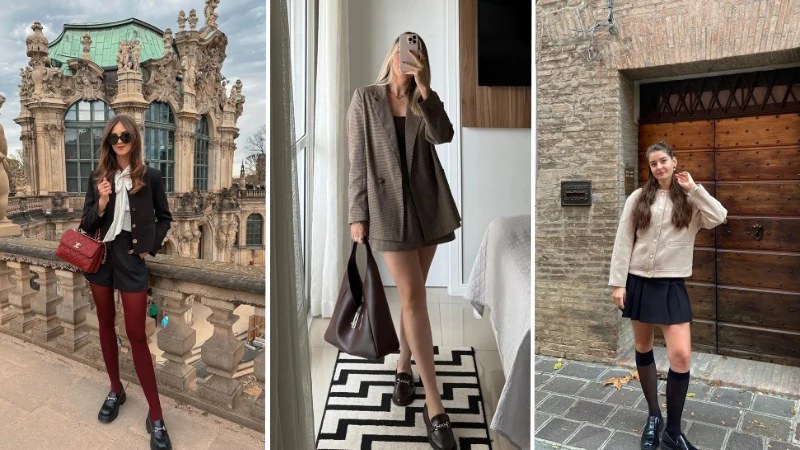
A beige jacket with a black pleated skirt and knee-high socks works because every piece is simple. The minimal palette lets the silhouette do the talking. Pearl or gold earrings are the only jewelry you need — they bounce light under fluorescents and make you look awake even when you’re not. This kind of casual jacket, with a relaxed wool-blend, is more forgiving than a structured blazer for all-day wear; you won’t feel like you’re in armor. The socks-and-loafers combo is a deliberate choice that keeps the outfit from sliding into “I gave up” territory. Swap the jacket for a trench on rainy days, and you have a second outfit with little planning. Pay attention to sock quality: thin ones will sag, ruining the clean line at your ankles.
Monochrome Brown Layering

Layering a brown oversized blazer over a dark brown bodysuit and brown mini skirt creates a tonal column that elongates. The dark brown tote bag and loafers extend the line, making you look taller — a bonus when lugging books. A bodysuit is your secret weapon here: it won’t come untucked or bunch awkwardly under the blazer, unlike a regular tee. A slim gold necklace adds a small focal point without competing. This is a good outfit for days you need to project quiet confidence in a seminar. Avoid adding a busy print scarf or pattern — the strength is in the smooth, uninterrupted color. The wool-blend blazer will look sharp even after you’ve been pressed against a library chair for three hours.
Navy Blazer, Cream Shirt, Confidence

A navy oversized blazer paired with a cream button-down and black tights — note the absence of a skirt — reads more modern than a full suit but still completely law school appropriate. The black-and-white loafers add a graphic pop that says you have a pulse beyond the Bluebook. Invest in opaque, high-denier tights; cheap sheer ones will run after two hours in a desk chair, and you’ll be self-conscious all afternoon. A shoulder bag in black leather is the right proportion — not a tiny crossbody, not a backpack. The gold ring is the only jewelry needed. This look walks the line between book-smart and street-smart, perfect for a day when you’ll toggle between library carrels and a quick coffee chat with a career advisor.
For Clinic Days and Networking
When you might go from a lecture to observing court or meeting an alum, these looks pivot fast. They read as professional but won’t get side-eye from classmates at 10 a.m.
The Brown Power Suit, Relaxed

A chocolate brown blazer and wide-leg trousers in the same tone make a suit that doesn’t scream “interview.” The white tank underneath softens the formality, and pointed-toe leather loafers keep it grounded. Check the trouser hem — wide legs that drag on the ground pick up moisture and dirt, instantly cheapening the look. Aim for a break that grazes the top of your shoe. The belt and tote bag in dark brown leather tie the whole thing together, and the gold necklace is just enough shine. This is a clinic-day staple that also works for a casual networking event if you swap the tank for a silk shell. The oversized cut breathes, so you won’t feel shrink-wrapped after a three-hour sit.
The Tie-Waist Preppy Statement

A white overcoat, navy blazer, white shirt, grey pleated skirt, and a dark blue tie — this is peak dark academia. It’s a lot for a regular Tuesday, but for a moot court practice or a day when you’re observing court, it telegraphs competence memorably. If the tie feels too “school uniform” for your taste, lose it and unbutton the top two shirt buttons; the outfit still holds without it. The black patent-leather shoes and brown handbag add warmth to an otherwise cool palette. Make sure the skirt length allows you to sit without constant tugging — that’s a distraction you don’t need while answering a judge’s question. This is a high-confidence look that doesn’t rely on a single branded piece to get attention.
Burgundy Tights, Sharp Blazer

A black tailored blazer over a white blouse and black tailored shorts reads formal, but the burgundy tights inject color and personality. It’s a strategic move: the tights catch the eye just enough to make the outfit yours, not just another classy business outfit clone. Make sure the shorts are high-waisted and not too short — you want a silhouette that still looks deliberate when you’re standing next to a judge, not like you forgot your skirt. Black loafers and a burgundy handbag tie the palette together. This works well for a clinic intake meeting or a law review reception where you need to signal that you understand the room’s formality without being boring. The silk blouse adds softness that contrasts with the structured blazer.
The All-Black Architecture

by @andreiagvr
An oversized grey blazer thrown over a black turtleneck and mini skirt is a masterclass in monochrome layering. The black tights and loafers make the look seamless, while the black leather handbag and sunglasses add polish. When wearing black-on-black, fabric texture does all the work — here the wool-blend blazer, jersey turtleneck, and tight nylon tights create depth without a single color clash. A slim black belt defines the waist without chopping the body. This outfit works for a cold walk to the courthouse or a formal evening lecture. The key is the proportions: the oversized top half balances the short skirt, so it reads refined, not trying-too-hard. It’s a rare formula that carries you through a winter term without a single bulky layer ruining your lines.
The Blazer Dress Power Move

by @andreiagvr
A black blazer dress worn over a white button-down shirt is an one-and-done professional outfit that requires zero coordination. The tights and loafers keep it law school appropriate, while the oversized sunglasses add a touch of off-duty cool. A blazer dress must fit impeccably through the shoulders and bust — no pulling, no gaping. If those are off, it reads as sloppy rather than sharp. This look is perfect when you’re running from a morning class to a 2 p.m. mock trial with no time to change. The shirt collar peeking out makes the dress feel more like a jacket-and-skirt combination, not a single piece. Pair it with a structured handbag and you’re ready for anything from a client intake to a post-hearing debrief.
Weekend Libraries and Loose-Leaf Days
Saturday study sessions, coffee runs, and group projects call for something softer — but still sharp enough that you don’t feel out of place when your professor walks in.
The Vest-and-Shorts Layer

by @renaciuki
A white blouse under a black tailored vest and black tweed shorts — yes, shorts in law school. The key is the opaque tights and loafers that pull the look firmly into academic territory. Shorts in a formal fabric like tweed or wool-blend and a longer inseam (think just above the knee) work; anything shorter or in denim starts to feel like you wandered in from a tailgate. The shoulder bag in black leather adds the needed structure to balance the boyish silhouette. This outfit walks a clever line: it’s comfortable enough for a Saturday library marathon but stylistically coherent enough that if you run into your professor, you won’t want to hide behind a bookshelf. Keep jewelry minimal — the vest is detail enough.
The Leather Coat Edge

by @alexcrpn
A black oversized leather coat over a white button-down, navy-and-brown tie, and black leather shorts is definitely not for shrinking violets. Leather coats are heavy — if you’re carrying a laptop, make sure yours has reinforced pockets or you’ll add shoulder strain. The patterned tie and knee-high socks anchor the look, while the black clutch keeps it sleek. Sunglasses and gold-black earrings add a layer of protection for days you need armor. For a gallery opening or a creative-law networking event, it’s a knockout. Swap the shorts for black trousers to make it instantly more conventional.
Casual Beige Jacket, Grey Skirt

by @iseliza_
A beige wool-blend jacket with a grey A-line skirt, black tights, and loafers is an easy three-second outfit that doesn’t look like you gave up. The white crew socks peeking out are a deliberate preppy signal. Avoid boxy jackets that don’t close — you need at least one button to keep the shape when a gust of autumn wind hits on the way to the library. The black canvas tote bag is practical for hauling casebooks but doesn’t drag the outfit down; its simple shape blends with the clean lines. Sunglasses add mystery, but indoors, swap for a tortoiseshell headband if you want to keep the preppy thread. This is a reliable Saturday uniform that works as a basic office outfit outside of school, too.
Jeans That Mean Business

A brown blazer anchors the whole blazer outfit — the light blue button-down underneath keeps it from feeling too stiff, while the light-wash straight-leg jeans make it campus-friendly. The trick is the sweater: a beige knit draped over the shoulders adds polish and screams “I summer in the Hamptons” (even if that’s a lie). Make sure the jeans are free of rips and fading; any sign of distress and the whole formula collapses into “undergrad trying to pass.” Black loafers and a black leather shoulder bag ground the lighter colors. The belt matches the bag, which is a small but important detail. This outfit works for a Friday class and a casual group meeting; it’s approachable without being sloppy. The layers let you adapt to the classroom’s unpredictable thermostat.
Cream and Blue Minimalism

by @verena.lr
A brown blazer, white turtleneck, and light-wash jeans — the minimal color palette makes this feel cleaner than your average denim day. Cream loafers echo the cream tones in the top, and the beige handbag doesn’t fight anything. Light wash jeans can work if the top is crisp and the blazer is tailored; the contrast is what saves it from looking like you just left a picnic. This outfit requires precision in fit — the turtleneck must be slim enough not to bunch under the blazer sleeves, and the jeans should hit right at the ankle to give the loafers room to speak. It’s a quiet, almost academic minimalist look that says you value substance over statement. The cream loafers and beige handbag are subtle but they upgrade the whole look, proving you don’t need black to be taken seriously.
Burgundy Blazer, Grey Skirt, Mary Janes

by @anneorion
A burgundy oversized blazer over a dark grey t-shirt and grey mini skirt is a break from the usual neutrals. The burgundy Mary Jane shoes and matching blazer tie the look together with intention. Mary Janes can be loud on hardwood floors — choose a pair with a quiet rubber sole if you don’t want to announce your every move in a silent library. The black belt and gold necklace keep it from feeling like a costume, and the beige handbag softens the palette. Dark grey socks add a preppy finish. This is a good look for a study group or a day you want to feel a little more styled than the typical jeans-and-sweater crowd. It’s youthful but controlled, the exact energy you want when you’re still figuring out your place in the classroom hierarchy.
Why Your Law School Outfit Isn’t Business Casual (And What It Actually Is)
Most guides label law school attire as “business casual” and leave it there. I’d argue that term sets you up to fail, because it imports office rules into a room where you’re being graded on your thinking, not your deliverables. The real dress code is unwritten, situational, and varies by institution in ways no Pinterest board captures.
The professor factor: Many faculty members still expect a baseline of decorum that signals you take the room seriously. This isn’t a courtroom, so a full suit reads as costume. But a collared shirt, clean trousers, and closed-toe shoes tell a professor you’re prepared before you open your mouth. Skip the ripped denim and graphic tees entirely — those register as disengagement, not personality.
The peer-pressure paradox: In some law schools, dressing noticeably professional reads as trying too hard. In others, dressing too casually reads as disrespectful. Most 1Ls misread the balance for weeks. The safest move: aim for the middle of your section’s range on day one, then adjust. You’ll spot the baseline within three class sessions.
Regional undercurrents: An East Coast school, a Southern school, and a West Coast school have distinct baselines. The same classy business outfit that blends in at Georgetown can look stiff at UCLA. Southern law schools skew more formal; West Coast schools lean relaxed but sharp. Most online advice flattens these differences entirely.
The hidden curriculum: During Socratic exchanges, professors and classmates unconsciously assign more authority to someone who looks put-together. Not flashy — just pulled together. A pressed blouse and structured trousers project readiness. A wrinkled cardigan and beat-up sneakers project something else. It’s not about fashion. It’s about signaling you understood the assignment.
The class-to-clinic switch: Many 2Ls and 3Ls go straight from a lecture to a client meeting or courtroom observation. Your outfit has to pivot fast without a full change. This is where business casual advice fails completely — a “nice top and jeans” won’t get you through a courtroom door, and generic guides never address the five-minute turnaround between Civ Pro and a real client.
Building a Law School Wardrobe on a Realistic Budget
You’ll hear “just buy quality” in most wardrobe guides. The better move is buying quality in the two places that count and spending less everywhere else. A $300 cashmere sweater and a $40 Uniqlo merino look identical from three classroom rows back. But nobody mistakes a cheap blazer for a good one.
The capsule reality: Ten well-chosen pieces get you through a semester without daily meltdowns. Fast-fashion blazer outfits that pill by October cost more per wear than a single quality blazer that lasts three years. You don’t need fifty items. You need the right ten, on repeat, with no shame about it.
Splurge points: Shoes that support you through twelve-hour library days and a blazer that fits across the shoulders without pulling at the arms. These affect your physical comfort and your concentration, not just photos. Cheap shoes cause back pain that distracts you during Con Law. A bad blazer restricts movement when you’re raising your hand.
Save points: Layering tops, basic tees, and simple knitwear. Nobody can tell if those came from a department store sale rack. They do notice if your blazer lapels buckle or your trousers bag at the knee. Put your money into structure, not into the pieces that sit underneath.
Secondhand strategy: Law school buy/sell groups, consignment shops, and post-bar-exam clear-outs are gold. You can find high-end blazers and work tote bags worn only a handful of times — often from graduates who bought a full wardrobe and landed a job with a casual dress code. Search for specific brands, not generic terms. Know your measurements, not just your size.
Cost-per-wear math: A $40 pair of trousers worn 60 times costs $0.66 per day. That $15 pair that wrinkles irreparably after five wears? $3.00 per day and a morning full of regret. Apply this logic before every purchase. It kills the urge to buy cheap things that don’t last.
How to Dress for Long Days, Heavy Bags, and Fluorescent Lights
Law school is a physical endurance test disguised as an academic one. Your outfit has to survive hours of sitting, pounds of casebooks, and lighting that makes everyone look vaguely ill. Choose wrong, and you’ll be distracted by your own clothes by 2 p.m.
The weight reality: Your bag — laptop, casebooks, water bottle, lunch — can top 15 pounds. Thin straps dig into your shoulder. Delicate knits pill under friction. A structured work tote bag with wide straps or a backpack with padded shoulders saves your back and your clothes. Anything with chain straps or thin leather handles won’t survive a semester.
Fabrics that survive: Wrinkle-resistant synthetics with stretch, wool blends that don’t go shiny under friction, and mid-weight cotton twills hold up. Pure linen? You’ll look like you slept in the library by noon. Rayon crepe? Same fate, faster. Pick fabrics that forgive you for sitting in them for six hours straight.
Footwear that protects your back: Ballet flats with zero support cause more lower-back pain after a day of law school than a low block heel with a padded insole. The wrong shoes for work outfits distract you as much as hunger. Look for a slight heel — even half an inch — and a cushioned footbed. Your spine will thank you during Torts.
The fluorescent test: Under standard institutional lighting, certain pastels wash you out completely. Neon reads as strangely aggressive. Small busy patterns vibrate unpleasantly from a distance. What looks great in your bedroom mirror can look jarring under overhead fluorescents. Test your outfits in the harshest light you can find before committing.
The freezing-classroom layer system: You need one layer that looks intentional on its own when the room hits 78°F and another you can add without it draping around your neck like an afterthought. A trench coat outfit works well as an outer layer, but inside, reach for a fitted knit blazer or a merino cardigan that holds its shape. Nothing kills a look faster than a bulky sweater scrunched into a lecture seat.
Navigating Law School Events Without Overthinking Your Closet
Law school runs on last-minute pivots. You’ll find out at 2 p.m. that you’re observing a hearing at 4 p.m., or a professor invites your section to a reception that evening. The wardrobe that handles these transitions without panic is the one that actually works.
The clinic-ready pivot: Keep a structured jacket and a pair of closed-toe heels or polished loafers in your locker or car. Throwing a blazer over your classroom outfit and swapping your flats takes under two minutes. Suddenly, your lecture look crosses the courtroom threshold. This is the single highest-return habit you can build for your lawyer outfit preparedness.
The cocktail-hour solve: For law review receptions or networking event outfits, the shift is smaller than you think. Swap flats for a pointed-toe heel. Add a red lip. Remove the shoulder bag and carry only a sleek tote or clutch. The difference between “just came from class” and “ready for this room” is often three small changes.
The interview stealth: On callback days, wear the full suit under a long coat or layer a blazer over a silk shell that reads as a dressy blouse. Classmates won’t register it as interview armor until you’re already gone, which saves you the pre-explanation and the questions. You get to move through your day without signaling your business to everyone in the hallway.
Summer associate alignment: The formulas you rely on for 1L summer mirror pieces you already own. A structured sheath with a cardigan. A blazer with cigarette trousers. These same summer corporate outfits pull from your existing closet, so you don’t need an entirely new wardrobe between spring finals and day one of the internship.
The accessory signal: A good watch, a structured bag that holds its shape, and one simple piece of jewelry — small hoops or a bar necklace — project competence without anyone being able to articulate why. It’s the visual equivalent of good posture. No logos, no statement pieces, no jangling. Just quiet, deliberate choices that say you belong in the room before you’ve spoken a word.
The Pre-Semester Closet Audit: Edit Your Wardrobe for Law School Success
Map the Real Week: Lay out a typical seven-day stretch — class-heavy days, a library marathon, a clinic morning, and one networking mixer — and cross-check your closet against it.
The gaps rarely announce themselves in a mirror; they show up when you realize Tuesday’s trousers can’t make it from a 9 a.m. lecture to a 4 p.m. clinic observation without looking rumpled. Often the missing link isn’t another jacket — it’s a simple knit that bridges air-conditioned layers and a reception handshake without changing. I’d take one blazer that actually holds its shape over three trendy jackets that never leave the hanger.
The Three-Outfit Test: Pull out any blazer, trouser, or shoe you’re unsure about. Can it create at least three distinct Law School Outfit combinations with pieces you already own?
If the answer is no, it’s adding decision fatigue, not function. A pair of trousers that only works with one specific blouse and one specific heel isn’t pulling its weight — it’s a costume part, not a wardrobe tool. In a semester where every mental calorie counts, each piece has to earn its keep.
The Sit-and-Carry Check: Try on the outfit, sit on the hardest chair you own for 45 minutes, then walk up and down a flight of stairs with your usual bag load.
Waistbands that feel fine standing can turn hostile twenty minutes into a lecture, and a tote bag strap that digs into a wool-blend shoulder creates friction that pills fabric by midterm. If you’re adjusting anything mid-motion, it’s a distraction you can’t afford while a professor is cold-calling on civil procedure.
Quarantine the Noise: Identify every item in your closet that only works with one undershirt, one emotional state, or one very specific weather window — and move it out of your weekday line of sight.
These pieces don’t just eat space; they force your brain into micro-negotiations at 6:45 a.m. when you’re already running late. Removing them strips the closet of option paralysis and leaves only the pieces that cooperate under pressure.
Write a Purpose-Driven Shopping List: Draft exactly five items — tops, bottoms, a layer, shoes, a bag — based on the schedule gaps you mapped, not on back-to-school hauls.
Assign a specific day and purpose to each before buying. The jacket you “might wear to a networking event someday” isn’t helping you survive tomorrow’s 8 a.m. Torts class, and a shopping list tethered to real-life demands kills aspirational purchases before they hit the cart.
FAQ
Can I wear jeans to law school?
Yes, but only dark-wash, unfaded, and free of any rip or whiskering — paired with a structured top and clean shoes. The whole look signals competence, and swapping in a blazer elevates it instantly without looking like you’re playing dress-up.
Do I need to wear a suit every day in law school?
No. Daily suits are rare outside of competition days and interviews. Most mornings call for intentional dressing — trousers and a blouse, a sheath dress, or jeans with a tailored jacket — and the full suit stays in your closet until it’s necessary.
How do I dress for law school if I’m plus-size and nothing seems to fit right?
The real culprit is often the tailoring gap, not your body. Seek out brands that design for curves rather than just sizing up straight cuts, and spend the extra $25 to have a tailor adjust the waistband of trousers or the armhole of a blazer. Fit changes the entire narrative — it’s the difference between an outfit that fights you all day and one that disappears into the background so your mind can stay on the material.
Is it okay to repeat outfits in a week without people noticing?
Yes, and it’s the norm. A rotation of 10–15 core pieces gets you through a semester without anyone tracking repeats. If you’re still uneasy, swapping a necklace or switching the topper — cardigan one day, blazer the next — breaks the visual memory completely.
What shoes are actually acceptable with skirts in a law school setting?
Low block heels, sleek loafers, pointed-toe flats, and clean leather sneakers (only at the most casual schools) all work. The real tell isn’t the silhouette — it’s the noise: avoid anything that creates a hollow clip-clop on hardwood floors or looks like beachwear.
How do I tell if my outfit is too “undergrad” for law school?
If you could walk into a tailgate or a dorm lounge and blend in without a second glance — logos, sweatpant-fabric skirts, flip-flops — it’s probably too casual. Swap just one element for a structured piece (tailored trousers, a collared shirt, a blazer) and you’ve injected enough polish to read as intentional, not accidental.
Will my classmates judge me if I don’t wear designer brands?
No. Across a lecture hall, no one can tell the difference between a $30 sweater and a $300 one. What registers is fit, cleanliness, and coherence — and the student in a well-tailored consignment blazer always looks more pulled-together than someone swimming in an ill-fitting luxury piece.