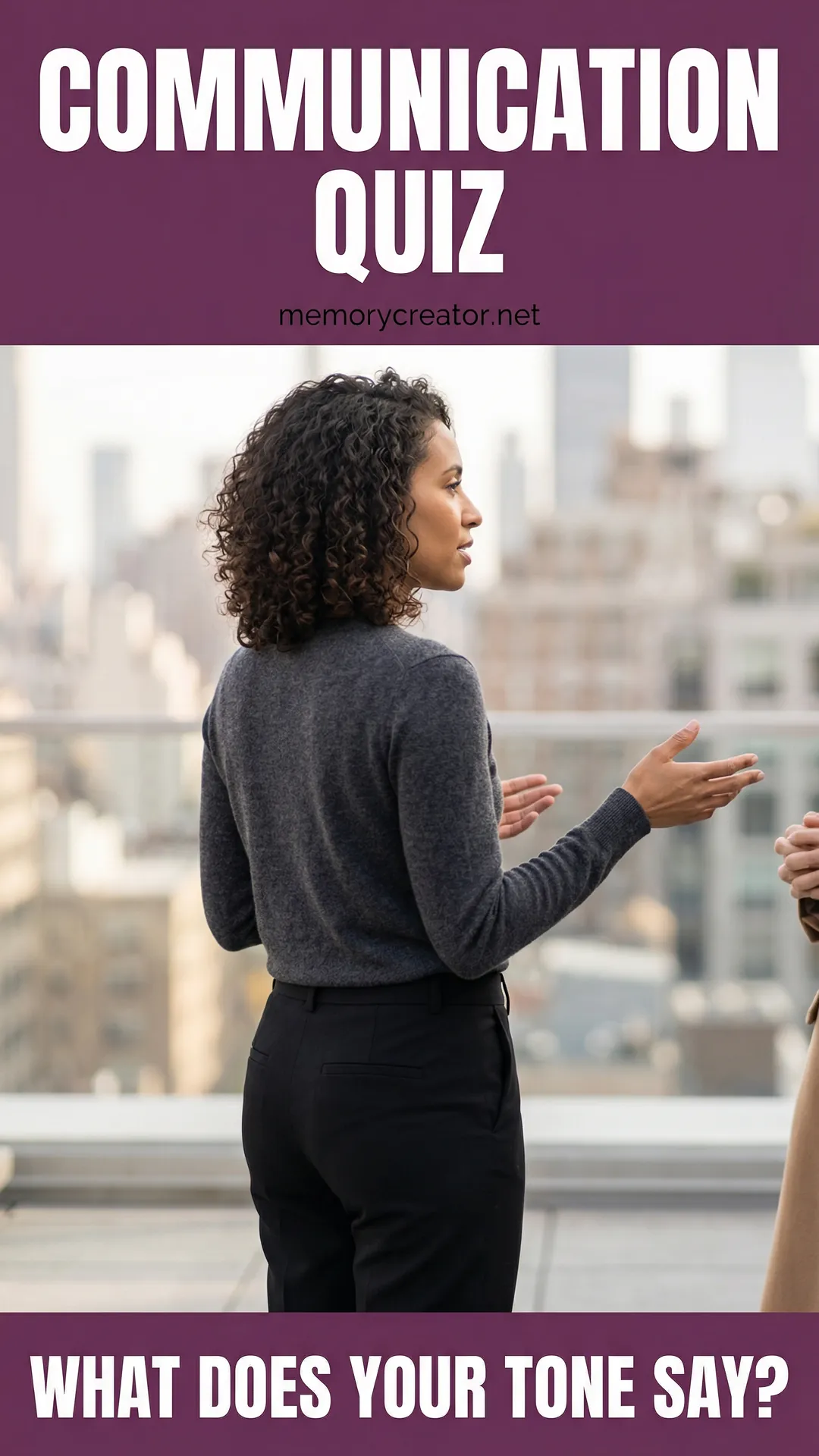
What’s Your Professional Communication Style?

A performance review told me my delivery could be “softer.” The feedback did not mention the project’s 12% revenue increase, which I had delivered. Research published in the Harvard Business Review found 57% of women receive vague, non-actionable praise in reviews, compared to 43% of men. Another study found women are 1.5 times more likely than men to receive feedback about their communication style (IZA Discussion Paper No. 13273, 2020). When the feedback is specific, it is disproportionately about how we communicate—tone, phrasing, directness—not what we achieve.
This is not an abstract problem. Catalyst research notes one in two women worry about how they come across in meetings, with the same proportion avoiding raising work problems for fear of being labelled a problem. The linguist Deborah Tannen documented the trap in Talking from 9 to 5: women who manage directly are seen as lacking confidence, and women who manage indirectly are also seen as lacking confidence. Your communication style is a primary axis for professional evaluation.
The DISC framework, first proposed by psychologist William Moulton Marston in 1928 and now used in assessments across Fortune 500 companies, maps four fundamental behavioural styles. It explains why you prefer certain types of meetings, how you give feedback, and where your natural strengths create friction you did not intend.
Your style also shows up in what you wear. Research on enclothed cognition finds that formal clothing can shift your own thinking toward more abstract, strategic processing. Meanwhile, Tannen’s concept of the “marked woman” applies: there is no communicatively neutral outfit for a woman. A Driver’s structured blazer, a Steady’s soft knit, an Influencer’s statement colour—each sends a signal before you speak.
This is not about changing who you are. It is about knowing your default settings well enough to use them deliberately. Eight questions. Under two minutes. You might not love the answer.
A colleague takes credit for your idea in a meeting. You…
You need to give critical feedback to a junior team member.
The weekly team meeting is going in circles. Your patience is…
When you write an important email, you spend the most time on…
A last-minute, high-stakes task lands on your desk.
You’re put on a new project with people you don’t know.
Preparing for a big client presentation, you rehearse…
You make a mistake that’s visible to others.
The Steady
Your default is patience and support, ensuring everyone feels heard and the team stays cohesive. Research from linguist Deborah Tannen (Talking from 9 to 5, 1994) highlights the strength of this rapport-building style. In fast-moving environments, the cost is being perceived as hesitant or lacking ambition. To be heard, practice stating your contributions directly at the start of meetings.
The Conscientious
You communicate with precision and are valued for your accuracy and systematic thinking. This aligns with the ‘Compliance’ axis of the DISC model (Marston, 1928), where detail and quality control are paramount. The friction point is pace: your thoroughness can be seen as nitpicking. To avoid slowing projects, set a 15-minute timer when reviewing documents and only note critical errors.
The Influencer
Your style is collaborative and enthusiastic, building energy around ideas through optimism and connection. This is classic ‘I’ type behaviour in the DISC framework (Marston, 1928). Tannen’s research (1994) notes that enthusiastic communication from women is sometimes filtered as ‘not serious’. To ensure you’re heard, pair your enthusiasm with one concrete data point or example.
The Driver
You’re direct and results-focused, cutting to the chase to get things done efficiently. This maps to the ‘Dominance’ dimension of DISC (Marston, 1928). The enclothed cognition research (Slepian et al., 2015) shows that formal clothing increases feelings of power, and your direct style can have a similar effect. To avoid being misread as aggressive, frame your direct requests with a one-sentence explanation of the goal.




What Your Result Means in Practice
Driver. You are direct and prefer to move quickly to results. In a meeting, you want the agenda followed and decisions made. The friction point is that this can be read as aggressive or dismissive, particularly from a woman. Tannen’s research on “report talk” versus “rapport talk” explains the mismatch: your efficiency can be misinterpreted as a lack of collaboration. The real-world cost is that colleagues may withhold information from you or become defensive, slowing you down in the end. This week, before you state your conclusion, ask one open-ended question: “What am I missing here?”
Influencer. You are enthusiastic and persuasive, focused on building energy and connection. You think out loud and use stories. The risk is that your optimism and collaborative tone can be misinterpreted as a lack of substance or gravitas. In cultures that value a reserved, data-first demeanour, your style may cause others to question your analytical rigour. The cost is being sidelined on high-stakes, analytical projects. This week, in one email or update, lead with the single most important data point or outcome before adding any narrative colour.
Steady. You are patient, reliable, and focused on team harmony. You listen more than you speak and avoid public conflict. The strength is that people trust you with sensitive information. The friction, as outlined in the Catalyst double-bind dilemma, is that this supportive style is often incorrectly equated with a lack of ambition or leadership potential. The cost is being passed over for visible, stretch assignments because you are seen as “too nice” to handle tough negotiations. This week, in a low-risk setting, practice stating a dissenting opinion with a factual preface: “From a process perspective, I see a different priority.”
Conscientious. You are analytical, accurate, and systematic. You prefer prepared statements over off-the-cuff remarks and value precision above persuasion. The strength is that your work is rarely questioned. The friction is that your thoroughness can be perceived as nit-picking or a reluctance to commit, and your reserved tone can read as cold or unengaged. The cost is exclusion from early-stage brainstorming where your critical thinking is most valuable, because others fear it will dampen the flow of ideas. This week, in one discussion, consciously withhold your first critical correction and instead articulate a potential upside in the proposal.
How to Use This
Track the adjectives used in your feedback. Keep a simple note: “Q3 review – ‘forceful’ in client meeting.” Correll and Simard’s HBR research shows vague feedback holds women back. Concrete descriptors are data points. If you hear “more confident,” ask for the specific behaviour that would demonstrate it: “Would that be speaking first in the Monday meeting, or presenting the financials without slides?” You translate a subjective label into an action.
Adjust your language for your audience’s style, not your own. A Driver presenting to a Steady team should front-load the implications for team stability. A Conscientious person briefing an Influencer should start with the headline vision, not the methodology appendix. This is translating. The DISC framework predicts these friction points. It takes the emotional sting out of miscommunication when you frame it as a style mismatch, not a personal failure.
Use enclothed cognition intentionally. Slepian et al. (2015) found formal clothing increases feelings of power, which promotes abstract thinking. If you are a Steady or Influencer who needs to project authority in a high-stakes negotiation, a more formal, structured outfit from our Business Formal Guide can shift your own psychological stance toward big-picture strategy. Conversely, if you are a Driver who needs to build rapport, a softer fabric like a merino knit can signal a different mode of engagement. The clothes change how you think.
Choose clothing that supports your message, not distracts from it. Tannen’s concept of the “marked woman” means every clothing choice a woman makes is interpreted. Use this by selecting outfits that align with the tone you want to set. For a client pitch, a structured blazer (like those in our Corporate Outfits Guide) conveys authority. For a team-building day, a smart casual look from our Smart Casual Guide signals approachability. The goal is to make your clothing work for you, so your words are heard without static.
Practice the specific phrases that bridge your style’s gap. For the direct Driver: “I want to make sure I understand all perspectives, so let’s go around the table.” For the enthusiastic Influencer: “Let me bottom-line this first, and then I’ll share how we got there.” For the harmonious Steady: “I appreciate that plan. My role here is to pressure-test it, so I have one concern to flag.” For the precise Conscientious: “The strategic goal is clear. I’ll handle documenting the specific steps to get there.” Write one down and use it twice next week.
Stop apologising for administrative things. Tannen’s analysis shows women use apologies as conversational lubricant to signal empathy; men often hear them as admissions of fault. Replace “Sorry for the long email” with “Thank you for your time reviewing this.” Replace “Sorry to bother you” with “Do you have a moment for X?” This linguistic shift reduces the marked-ness of your communication.
If you receive vague feedback, schedule a follow-up. Say, “Thank you for the feedback on being more strategic. To make sure I action this, could you give me an example of a time I was not strategic enough, and what a more strategic approach would have looked like?” This moves the conversation from the abstract to the concrete. It also signals that you take development seriously. Do this once and note the difference in the quality of the answer you receive.
Limit your relational accounts. Bowles and Babcock’s research on negotiation found women often justify requests with relational reasons (“My team needs…”), while men use agentic ones (“The market rate is…”). In your next request—for a deadline extension, a budget, or a salary review—lead with the objective, business-centric reason. Practice stating it without a softening preface. Record yourself saying it. The goal is to sound definitive.
Sources
Correll, S., & Simard, C. (2016). Research: Vague Feedback Is Holding Women Back. Harvard Business Review. https://hbr.org/2016/04/research-vague-feedback-is-holding-women-back
Tannen, D. (1994). Talking from 9 to 5: Women and Men at Work — Language, Sex, and Power. New York: Avon Books. https://www.goodreads.com/book/show/583345.Talking_from_9_to_5
Catalyst. (2007). The Double-Bind Dilemma for Women in Leadership: Damned if You Do, Doomed if You Don’t. New York: Catalyst. https://www.catalyst.org
Slepian, M.L., Ferber, S.N., Gold, J.M., & Rutchick, A.M. (2015). The cognitive consequences of formal clothing. Social Psychological and Personality Science, 6(6), 661–668. https://doi.org/10.1177/1948550615579462
Adam, H., & Galinsky, A.D. (2012). Enclothed cognition. Journal of Experimental Social Psychology, 48(4), 918–925. https://doi.org/10.1016/j.jesp.2012.02.008