Trendy 10+ Blue Office Looks for a Polished Day

You paint one wall a beautiful dusty blue on Saturday, and by Monday’s video call your Blue Office looks flat and grey under webcam light, the room somehow smaller than before. Most blue home office ideas assume perfect daylight and walls you are free to repaint. Real life is a dim north facing corner with the router strapped to the skirting board and a lease that forbids paint. The colour was never the problem. The planning around it was. Done properly, blue office walls give a workspace calm and depth. Done carelessly, they guarantee bad lighting on every call.
If your Blue Office is squeezed into a corner of the spare bedroom, small space office ideas help you fit the desk without overwhelming the room. For a repurposed closet, cloffice layouts show how storage and desk fit in one small footprint.
17 Blue Office Ideas That Solve Real Small-Space Struggles
Blue offices in magazines always have floor-to-ceiling windows and cloudless sunshine. Real life tends to have one north-facing window and a desk crammed next to a radiator. But a blue room can work brilliantly in a small or awkward home office—if you borrow a few smart moves from women who have already done it. These seventeen setups use paint, light, and clever furniture placement to make blue a practical choice, not just a pretty one.
Serene & Sunlit Setups
These dusty and muted blues mimic the coast, making even a windowless corner feel more open. Natural textures like rattan and woven baskets keep the look grounded, not floaty.
The Built-In Nautical Nook

A floor-to-ceiling built-in painted one shade of dusty blue turns a plain wall into a workspace that feels intentional, not squeezed in—perfect for a closet-turned-office. The rattan chair and brass desk lamp warm up the cool blue, while the framed map and model boat add personality without clutter. Notice the wall-mounted sconce beside the shelves: it washes light across the blue surface, making the alcove feel deeper than it really is. This kind of indirect lighting is a quick fix for rooms where overhead cans cast harsh shadows. The result is a corner that works for both spreadsheets and daydreaming.
The Art-Filled Transitional Cubby

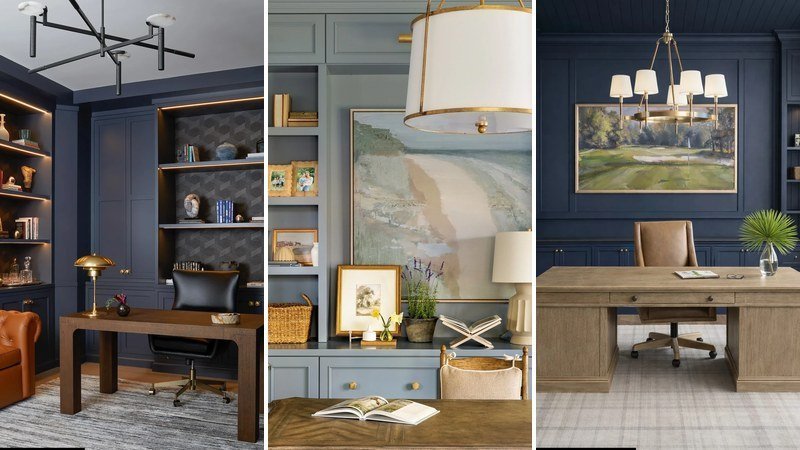
This built-in unit spans an entire wall, combining closed storage, open shelves, and a desk slot into one cohesive piece. A large landscape painting hangs against the centre panel, breaking up the blue and drawing the eye upward. Woven baskets on the lower shelves hide office clutter—use containers that match the wall’s undertone so they blend rather than stick out, keeping the small room from feeling busy. The drum pendant light overhead provides soft, even illumination that keeps the blue-grey from turning murky in photos or on video calls. A simple wooden desk and beige chair finish the setup without competing for attention.
The Paneled Ceiling Escape

Deep blue walls with a subtle geometric pattern and a matching paneled ceiling wrap this office in colour without making it feel boxed in. Painting the ceiling the same blue as the walls, but with a slight sheen difference, blurs the boundary and adds perceived height—essential in rooms under eight feet. A white desk with brass details contrasts cleanly, while a light blue sofa under a bamboo shade creates a second zone for reading or taking calls—a cosy landing spot away from the screen. Two tall floor lamps with patterned shades cast warm pools of light, so the room never feels like a dark cave even on overcast days.
The Subtle Shoreline Office

A slate blue built-in with a L-shaped desk works hard in this calm office. The framed beach photograph above the central work area serves as a focal point and brings in a sense of distance, which optically pushes the wall back and makes a narrow room feel less like a corridor. Natural oak open shelving on either side displays books and small sculptural pieces, while decorative coral adds texture without veering into theme-park nautical. The brass picture light washes the shelves with a warm glow that counteracts any coldness from the blue, keeping the whole setup polished but friendly.
The Warm Wood & Leather Study
These navy and deep blue offices lean into richness rather than airiness. Dark wood, leather seating, and carefully placed brass accents create spaces that feel both professional and cocooning—perfect for long focused days.
The Symmetrical Navy Command Centre

This built-in unit in navy blue stacks drawers, open cubbies, and a desk area into one orderly composition. A white upholstered office chair lightens the dark backdrop and is easy to wipe down after a coffee spill—choose a performance fabric instead of linen here; it resists staining from daily use. Brass boxes and ceramic jars on the upper shelves add warmth and hide small office supplies. The picture light above the shelves points downward, highlighting the books and brass without casting glare on the monitor. This setup proves that a dark wall colour can still feel open when broken up with lighter furniture.
The Mixed-Leathers Lounge Office

A moody navy backdrop sets the stage for a workspace that doubles as a conversation area. A black leather desk chair faces a wooden desk on a grey textured rug, while a cognac leather sofa sits off to the side, turning the office into a lounge. Integrated LED strips on the shelves light up the blue without casting unflattering shadows on your face during video calls. A geometric brass chandelier and wall sconces add layered lighting so the room never feels harsh. This arrangement works well in a larger spare bedroom where the desk zone needs to coexist with a sitting zone.
The Equestrian Wall Unit

Four symmetrical horse prints hang above the desk, framed by tall integrated bookshelves painted a deep matte navy. The matte finish absorbs light, which gives the blue a velvety depth—but in a low-light room, swap matte for eggshell so the blue doesn’t swallow all the brightness. Rattan boxes on the lower shelves add texture and store papers out of sight, while a cream upholstered chair with a wooden base brings softness without losing structure. The horizontal picture lights above the bookshelves ensure the displays are well lit, making the whole built-in feel like an intentional feature wall.
The Fireplace-Facing Formal Office

by @laylagrayce
This office uses a symmetrical arrangement to create a grand yet functional workspace. A large wooden desk sits directly in front of a fireplace clad in blue-grey built-in shelving, with an abstract painting above the mantel drawing the eye upward. The glossy gold chandelier reflects light around the room, stopping the dark slate walls from closing in. Glass-paned doors separate the office from the rest of the home, offering sound privacy without visual isolation. An off-white area rug under the desk defines the work zone and keeps the dark floor from making the room feel heavy.
The Executive’s Earthy Blue Office

A traditional set-up where a substantial wooden desk faces into the room, backed by built-in shelving painted dark navy. A brown leather swivel chair adds warmth, while a brass chandelier overhead provides ambient light that reads well on camera if you position a small task lamp behind the monitor to neutralise blue reflections on your skin. The landscape painting above the desk introduces soft greens and browns that break up the wall of blue, and a plaid patterned rug underfoot ties the colour story together without busyness. This layout works in rooms where the desk must float, not sit against a wall.
The Window Seat Workstation

A built-in navy unit houses a desk and shelves in one corner, while a window seat extends along the adjacent wall, making use of every inch. A brown leather armchair slides up to the wooden desk, which is positioned beneath the shelving to keep the work surface clutter-free. The tall window floods the corner with daylight, so the deep blue walls feel crisp, not sombre—position your desk perpendicular to the window to avoid glare on your screen. A brass picture light above the books adds a soft glow in the evening, and decorative touches like a model duck keep the room from feeling too corporate.
The Velvet and Panelled Evening Retreat

Vertical wood panelling painted a dark, inky blue gives this small office a glamorous, cocooned feel. A wooden desk with geometric drawer fronts sits under a window dressed in a patterned Roman shade, while a blue velvet armchair and marble-topped side table create a secondary spot for after-hours unwinding. A brass task lamp on the desk and gold-toned ceiling lights warm up the cool walls; without them, the blue would lean icy. An intricately patterned rug covers the floor, adding softness and absorbing sound—important in a room with hard surfaces like panelling and marble.
The Wainscoted Scholar’s Corner

Wainscoting in navy blue adds architectural weight to this small study, with a mahogany desk and brown leather armchair leaning fully into the traditional library look. A built-in bookshelf stretches to the ceiling, holding a mix of books and framed photos that feel collected over time. To keep the dark wood and blue from becoming too heavy, a brass wall sconce and desk lamp bounce warm light off the wainscoting, highlighting its texture. A framed ship painting hangs on the adjacent wall, reinforcing the classic feel without veering into kitsch. This is an office for deep focus and long reads.
The Dual-Zone Study With Guest Seating

by @samplize
This office pairs a spacious wooden desk with a tufted cream chair with a seating area of two brown leather armchairs placed opposite. When you have clients or colleagues in your home office, position guest chairs at an angle to the desk so the blue built-in behind you serves as a distinguished backdrop on video calls. Three gold-toned picture lights above the shelving provide warm ambient luminescence that makes the dark blue walls feel inviting rather than corporate. A small globe and selected decorative pieces on the shelves add personality without distracting from the professional purpose of the room.
Sleek & Streamlined Setups
These blue offices skip the bulk. Clean lines, light wood, and careful editing of accessories keep the look fresh, even in minimal footprints.
The Round Desk and Window Bench Duo

This room is enveloped in a single shade of dusty blue, from the built-in cabinetry to the walls and even the window bench. A kidney-shaped desk floats in the centre on a large light-coloured rug, which anchors the workspace and prevents the all-over blue from feeling like a paint explosion. A gold chandelier adds a soft gleam, and recessed lights keep the ceiling bright. The window bench doubles as storage and a spot for taking breaks without leaving the room. This layout works especially well in a square-shaped space, where a central desk allows flow around all sides.
The Slatted Wall Work Nook

by @theinteriordesignassistantuk
Vertical wood slats painted dark navy bring texture to a minimalist desk setup. A long, seamless built-in desk stretches across one wall, with a brown leather office chair that rolls easily on the flush floor. To prevent the dark slats from sucking light out of the room, place a reflective desk lamp with a warm bulb near the monitor—it pushes light upward and softens the contrast. White sheer curtains to the left filter natural daylight, which keeps the blue from looking black on camera. Open cubbies under the desk and a single integrated bookshelf offer storage without bulk, making it perfect for a small spare room.
The Leaf Chandelier & Light Wood Contrast

A deep blue built-in forms the backdrop for a light oak desk that feels airy against the dark cabinetry. A tan leather office chair with a classic silhouette adds natural warmth, while a gold leaf-shaped chandelier hangs overhead, sprinkling light across the textured grey wallpaper on the feature wall. The mix of materials—smooth lacquered paint, natural wood grain, and tactile wallpaper—prevents the room from reading flat and one-dimensional. A wall sconce positioned above the built-in washes the shelves in a soft glow, and the overall restrained palette means the space works even if you add a monitor and daily office clutter.
The Midnight Blue Sitting-Area Office

This study balances work and relaxation with a central desk facing the built-in cabinetry and a pair of grey armchairs placed to the side on a patterned rug. In a room with dark walls, always position task lighting at multiple heights—a floor lamp, recessed ceiling lights, and a desk lamp—to eliminate harsh shadows that make the space feel small. The large landscape art above the desk draws the eye across the room, while light wood floors and light-coloured curtains keep the foundation bright. The grouping of armchairs creates an intentional second zone, so the room feels like a multipurpose retreat rather than just a desk in a corner.
Why Your Blue Office Lighting Matters More Than the Paint Color
Bulb temperature: A 2700K warm white bulb turns blue walls a muddy grey, and 4000K cool white can feel sterile. The sweet spot for a blue office is 3500K—clean without being clinical, and it keeps your skin tone friendly on Zoom, not washed out. Swap all bulbs in the room to the same temperature; mixed lighting makes the colour look patchy.
Overhead shadows: A single ceiling fixture throws a cone of light downward, leaving the blue walls in shadow and making the room feel smaller. Bounce light off the wall behind your monitor with a plug-in wall sconce or a LED strip tucked along the top of a bookcase. The reflected blue glow expands the space visually, no extra square footage needed.
Video call blue cast: A blue wall behind you can reflect a cool tint onto your jawline. Fix it with a small desk lamp pointed away from you, toward a white ceiling or a neutral art print. That warm bounce neutralises the cool reflection without adding harsh light to your face.
Window orientation: North-facing rooms intensify blue’s coolness, which can make a blue office feel cave-like. Choose an eggshell finish rather than matte; the slight sheen catches whatever diffuse daylight exists and stops the room from absorbing all the light. In a sunny south-facing room, the same blue will look brighter, so you can afford a deeper shade.
The Paint Finishes and Wall Treatments That Survive an Actual Workday
Flat paint fails: Matte finishes on a desk wall scuff from chair backs and coffee mugs and can’t be wiped without leaving a burnished mark. Use a satin or eggshell acrylic formula—it cleans with a damp sponge and holds colour depth better than gloss, which shows every roller imperfection if you do it yourself.
Peel-and-stick prep: Renters love removable wallpaper, but skipping the primer step is why it peels paint later. Apply a wallpaper adhesion promoter to clean walls first. A blue patterned wallpaper on one accent wall gives you a blue office without a drop of paint, and it removes cleanly if you prep right.
Painted furniture: If you paint a thrifted desk or shelf blue, standard latex chips in sheets on high-contact edges. Chalk paint sealed with wax holds up better—it resists daily kicking and won’t peel like latex over old varnish. For a blue desk, this means fewer touch-ups and a finish that actually lasts.
Acoustic panels: A blue fabric-wrapped acoustic panel on the wall kills echo from hard floors and the hollow sound on calls. Look for panels with removable, washable covers in a deep blue—you get the colour impact without permanent paint, and you can swap the fabric in two years when you want a change.
Making a Blue Room Work When Your Desk Can’t Face the Window
Perpendicular desk: The conventional take is a desk should face the window for light. I’d argue that’s wrong for a blue office. Placed perpendicular, the blue walls flank your sightline, deepening the view outside, and your screen stays glare-free. It also stops blue reflections from bouncing onto the monitor and causing eye strain.
Recessive colour trick: Blue’s recessive quality can visually push a wall back. Paint the farthest short wall two shades lighter than the others—like mist blue against navy—and the eye reads it as further away. This adds literal depth without moving a wall, handy in narrow bedrooms or boxy guest rooms turned offices.
Three zones: A blue office smaller than 8×10 feet needs three distinct zones to avoid feeling like a messy closet: a work zone (desk only), a supply zone (tall slim shelf painted the same blue to blend in), and a thinking zone (a small chair and floor lamp against a blue wall). Repetition of the same blue tone across all three unifies the room. In a living room that doubles as your workspace, the thinking zone might already be that reading chair by the window. In a closet office, tuck the supply zone behind the door with vertical shelving—the same blue ties it together, as you’d see in a well-planned cloffice.
Rug size: A rug that sits only under the desk chair shrinks the room visually. Go at least 5×7 feet; it should extend beyond the chair’s full rolling path so the blue room feels anchored, not fragmented. In a tiny bedroom, a 4×6 works if the desk floats in a corner—the key is that the rug defines the whole work area, not just the chair mat. For more on arranging the whole setup, small-space layout ideas help you avoid a cramped feel.
Low-VOC Blues and Secondhand Finds That Don’t Look Like a Compromise
Zero-VOC paints: Older low-VOC blues were thin and streaky, but today’s formulas—like Benjamin Moore Natura or Clare Paint—cover in two coats over primed drywall. You can paint at 9am and work in the room by noon without a headache, which matters when the blue office is in daily use. The colour depth rivals conventional paints, so you’re not sacrificing richness for air quality.
Secondhand desk selection: When sourcing a solid-wood desk to paint blue, look for dovetail drawer joints and a solid wood back panel. Skip anything with a paper-thin back or staples—paint will warp it over time. A sturdy piece from a thrift shop, painted in a deep navy, becomes a focal point that outlasts flat-pack furniture.
Grey undertone blue: Choose a dusty blue with a distinct grey undertone over pure cobalt. The grey masks the fine white dust that settles on surfaces in a dry office, so you notice it less and clean less often. That’s a quiet sustainability win because you’re not scrubbing or repainting as frequently, and the colour still reads blue on the wall.
Chair durability: For the desk chair, Oeko-Tex certification is a starting point, but ask if the fabric passed a Wyzenbeek abrasion test of 15,000 rubs or more. This ensures the blue upholstery won’t pill from clothing friction—a common failure that sends chairs to landfill early. A well-made chair in a sturdy blue fabric keeps the office looking pulled-together for years.
The Blue Office Renter’s Toolkit: 8 Non-Paint Ways to Get the Look
Not every Blue Office starts with a tin of paint. For rented walls, tight lease terms, or the sheer exhaustion of choosing a finish, these five pieces deliver a blue workspace using only what you can remove on a Sunday afternoon. No holes, no fumes, no argument with the landlord.
Grasscloth Wallpaper Panels: Cover the main wall with large-format removable wallpaper in an indigo grasscloth texture.
The texture catches light differently across the day, which stops the blue from reading flat or cheap. Grasscloth specifically hides small wall dents and uneven patches that smooth peel-and-stick blue wallpaper would highlight. Apply it to just one wall — the one behind your monitor — and the room feels intentionally blue without a single brushstroke.
Linen-Look Tiles on Furniture: Apply matte linen-look peel-and-stick tiles to the back panel of a bookshelf or the side of a filing cabinet.
The eye lands on these surfaces when you reach for a file or a book, so that small patch of blue does more visual work than you would expect. Choose a matte finish — glossy tiles under a desk lamp create a distracting hotspot that cheapens the whole piece instantly. This is renter-friendly blue decor at its most surgical.
Back-Painted Glass Desk Mat: Swap a standard desk mat for a back-painted glass one in deep navy.
It shields the desktop from coffee rings and chair scrapes while throwing a soft blue glow upward onto your face — oddly flattering on video calls. Order it a few centimetres larger than your keyboard-and-mouse footprint so the blue extends into your peripheral vision while you work.
Washed-Linen Curtains on a Tension Rod: Hang medium-blue washed-linen curtain panels from a tension rod inside the window frame.
No drilling, no brackets, and the linen filters daylight into something softer, which makes the whole Blue Office feel more expensive than it is. The washed finish matters — crisp, structured linen looks out of place in a room you actually work in, but washed linen already reads as relaxed and intentional.
Clip-On Fabric Shade for Task Light: Attach a clip-on blue fabric shade to an utilitarian desk lamp you already own.
The warm LED behind it throws a blue-tinted glow across the desk without needing a coloured gel or a new fixture. Look for a shade with a subtle texture — a cotton twill or a faint stripe — because solid, flat colour reads as a cheap accessory rather than a considered choice. Light over furniture, always.
FAQ
Will a Blue Office make me feel sad or depressed
No. Blue lowers heart rate and sharpens concentration — the research holds up. The risk sits entirely in icy, cold blues with no warmth. Pick a shade with a green or red undertone, like a deep teal or a dusty slate, and the room reads as calm rather than clinical.
Does a Blue Office make the room look smaller
Dark blue can pull walls inward visually, but painting the ceiling the same mid-tone blue eliminates the harsh white break that caps the room. A stark white ceiling is what actually shrinks the space by creating a hard boundary where the eye stops. For rooms under 100 square feet, small-space office layouts show how a single colour wash makes the footprint read larger.
What is the best blue paint for a home office with no natural light
A blue with a light reflectance value above 50, like a pale periwinkle or a soft grey-blue. Sample pots are non-negotiable — paint swatches onto poster boards and move them around under your actual artificial light at different times of day. Even a north-facing room opens up when you pair the right paint with bright office lighting placed at desk and ceiling height.
Can I mix blue with warm wood tones
Yes, and you should. Walnut and golden oak carry orange undertones that sit directly opposite blue on the colour wheel, so the contrast makes both read richer. Anchor the look with a neutral rug in cream or beige to keep the red-white-blue combination from tipping into something unintentionally patriotic.
How do I keep my Blue Office from looking like a little boy’s room
Stay away from primary blue paired with bright red or yellow. Use texture to mature the palette — a velvet chair, a wool throw, a brass lamp — and bring in generous amounts of white or cream through the desk, trim, and lampshades. A high-contrast black and white approach in the accessories keeps everything adult and intentional.
Is a dark blue ceiling a terrible idea in an office
Only if your ceilings sit under 8 feet. At standard height, a deep blue matte ceiling blurs the boundary where wall meets ceiling, which tricks the eye into reading more height. Paint the walls the same colour and keep the floor light, and the room feels taller than it measures.
Will blue walls affect my mood during video calls
Yes, but you can fix it in under a minute. A blue wall behind you throws a cool cast onto your face on camera. Place a warm LED panel behind your monitor aimed at the blue wall — it neutralises the cool tones and reads as a soft, professional backdrop without adjusting a single camera setting.
Does a Blue Office work the same in a spare bedroom, a living room corner, and a repurposed closet
No. Each room shape changes how blue behaves, and ignoring the room type is where most designs fail.
Spare bedroom: You have four walls and a door, so go for depth. A navy or deep teal on all four walls with a satin finish makes the room feel separate and intentional. Keep the door closed during calls and the blue wraps the room completely.
Living room corner: Blue needs a clear boundary to not bleed into the rest of the space. Use a rug to define the zone and paint only the section of wall directly behind the desk, stopping at a natural break like a window frame. Basement office setups face the same zoning problem and solve it with rugs and directional lighting.
Repurposed closet: Skip paint entirely. The tight space traps fumes for days, and dark blue in a windowless box turns into a cave fast. Cloffice ideas that use peel-and-stick wallpaper or fabric panels give you the blue without the smell or the visual weight.