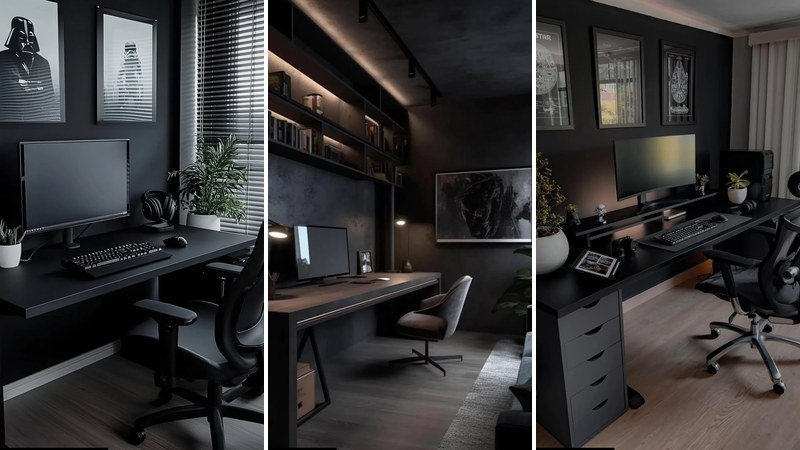
Black Office Ideas for a Bold and Sophisticated Workspace

A Black Office looks easy in photos, where matte walls and sculptural lighting do all the talking. What the photos never reveal is how that same room behaves by late afternoon, when the light shifts and the dark starts working against you. Most moody home office design advice stops at choosing the right shade. It never explains how black fails under real lighting and daily wear, or how a dark home office shrinks until it quietly drains focus and joy. The distance between a refined workspace and a draining cave is rarely the colour itself.
If you’re weighing whether black works in your space, a black and white office is a softer entry point — same drama, more light. And because warmth keeps a dark room alive, the principles behind a cosy home office carry straight over when the whole room goes black.
18 Black Office Ideas That Defy Gloom
These real offices prove that dark walls and black furniture, when paired with smart lighting and texture, create a workspace that feels expansive and alive—not a bit like a cave.
For the Clean-Lined Workspace
Minimalist rooms need enough visual weight to avoid blandness, and black furniture delivers. The trick is balancing contrast so the space stays crisp, not cold.
The Cloud Chair and Clean Lines

This setup pairs a matte black desk and a sculptural cloud-shaped office chair against a neutral beige wall, with a wall-mounted shelf above for decor. A rolling cabinet keeps office supplies tidy while adding a third black element. The room feels orderly and calm—proof that even a minimalist workspace can handle bold black pieces without losing its airiness. Using a soft wall color behind dark pieces prevents the workspace from feeling like a velvet-lined box. Small personal touches—a framed photo, a potted plant, and a figurine—give the otherwise stark palette warmth without clutter.
The L-Shaped Corner Perch

A matte black L-shaped desk hugs the corner of this taupe-walled room, creating two clear work zones while leaving floor space open. A black velvet chair stands on one side, a leather office chair on the other, making it easy to switch between tasks. Natural light filters through a roller blind, with a linear pendant throwing a soft, even glow across the desk. This makes it a smart corner desk solution for working from a tight spot. A long suspension light mounted horizontally above the work surface visually stretches the corner, making the room feel larger than it is. A white printer and small plant add quiet contrast.
The Apple-Clean Monochrome

A dark desk anchors this compact workspace, with an Apple computer monitor and laptop creating a seamless digital surface. Two black floating shelves overhead display framed photos and a small potted plant, keeping the wall area visually active. The office chair remains pulled up and ready, while a large leafy plant near the left window softens the monochrome severity. Because the black walls and furniture absorb so much ambient light, a plant may starve unless it’s positioned right next to the glass. The result is focused, professional, and quietly elegant.
The Warm-Glow Shelf Wall

Against light grey walls, a black desk and ergonomic chair form a no-nonsense workstation. The real design move is above: three floating black shelves bathe the wall in a warm, integrated glow, illuminating books, a ceramic bowl, and a small potted plant. A black desk lamp provides focused task lighting. When you replace a single ceiling light with shelf-mounted LEDs, you control exactly where brightness lands—and avoid the flat, shadowless look that makes dark rooms feel institutional. The beige carpet softens the palette, and the whole setup reads organized and calm.
The Monochrome Sanctuary

This workspace commits fully: matte black walls, a dark paneled backdrop, a black desk, and a leather office chair on a dark concrete floor. Three floating shelves hold books and a decorative sphere. Two tall potted plants, one on either side of the desk, introduce the only living color. A desk lamp throws a concentrated pool of warm light across the monitor and keyboard. Because every surface absorbs light, the plants need to sit close to the window or receive a dedicated grow bulb—otherwise they’ll fade within weeks. The effect is dramatic, focused, and deliberately severe, softened only by the green.
For the Room That Works Twice as Hard
When the office must also host a sofa or lounge area, black can anchor both zones without making the space feel divided. The key is keeping the visual flow intact.
The Library That Works

A long dark desk sits on a grey rug in the center of this spacious room, with a black office chair facing the laptop. To the right, a charcoal sofa offers a place to read or nap; to the left, a towering bookshelf covers the wall. A tall plant catches light near the window, while abstract canvases add texture to the walls. A linear recessed ceiling light runs the length of the room, washing the space evenly. When you use one large rug under the desk and keep the lounge area flooring bare, the eye instantly separates work from relax without a physical divider. Refined and practical.
The Built-In That Glows

by @arcxdesign
A long, built-in desk spans the charcoal wall, paired with a swivel office chair. Above, a custom shelving unit with integrated LED strips holds books and objects, the warm light adding depth to the dark surface. A grey sofa rests in the adjacent lounge zone, next to a large potted plant and a framed abstract painting. The matte black metal and wood materials keep the room cohesive. Placing the desk lighting under the shelves rather than overhead eliminates glare on your screen while lighting the exact area you need. The room reads as a calm, modern library.
The Moody Window Seat Office

by @arcxdesign
Charcoal walls envelop this office, offset by a large window overlooking trees. A leather sofa and matching ottoman form a lounge area, while a wooden desk with computer faces the view. A black dresser stores essentials, and a textured brown rug softens the dark floor. Recessed ceiling lights provide general illumination, but the star is the warm LED strip above the woven window shade. The result is a cozy office that doesn’t require a single cream wall. Because west-facing windows bring hot afternoon sun, a brown-black paint undertone keeps the room from feeling cold or steely. The space feels moody yet open, thanks to the massive window.
For the Refined Setting
When clients walk in or you need a backdrop that reads authority, black with refined materials delivers. These rooms use luxury finishes to lift the darkness.
The Tan Leather and Marble Contrast

by @aleksandratrocewicz_interiors
This elegant office pairs a dark wood desk with a tan leather office chair, positioned in front of floor-to-ceiling white curtains that flood the room with soft natural light. A tall glass-fronted bookshelf on the right wall displays books, while a large black-and-white abstract print hangs opposite. A marble-topped side table and a modern pendant light add luxury. The glass bookshelf doors reflect light and keep dust off volumes, a smart choice in a dark room where dust shows faster. The dark wood floor and white wainscoting trim balance the room, creating a refined, calm workspace.
The Brass-Accented Built-In

A wall of charcoal built-in cabinetry frames this dual-desk workstation, with two monitors beneath a serene landscape painting. Wall-mounted sconces with gold accents light the shelves and work surface, while a multi-bulb chandelier overhead adds a traditional touch. Potted plants and framed photos break up the dark shelves. Paint the back panel of an open bookshelf in a slightly lighter tone than the cabinets to create a visual shadow line, adding depth without extra lighting. The layout is symmetrical, making the workspace feel balanced and professional.
The Meeting Room With Edge

A black desk commands the dark paneled wall, with two tufted leather armchairs facing a high-backed office chair. The wall sconces on either side wash the paneling with light, while a modern geometric linear pendant casts a concentrated beam on the work surface. The off-white wall opposite the paneling balances the darkness. When a room has two distinct wall colors, keep the darker one as the backdrop for the desk—it draws the eye forward and makes the space feel longer. This setup feels dramatic yet perfectly suited for client calls.
The Slatted Wall Statement

A dark monochromatic wall of vertical slats makes this private office feel like a high-end suite. A large marble-topped desk sits centrally, with three black leather chairs arranged for meetings. A sculptural gold pendant light hangs above, and a tall potted plant softens the corner near a window. The light marble floor reflects light, keeping the room from feeling heavy. This is the kind of CEO-worthy workspace that demands attention when you walk in. Because the slats create grooves that catch shadow, they add texture without requiring a contrasting color. The overall mood is dramatic and professional, with the gold accents adding just enough warmth.
The Symmetrical Formal Office

Charcoal walls sit above crisp white wainscoting, framing a black desk on a beige rug. Two tall dark bookshelves flank the desk symmetrically, with geometric art and a circular shelf adding visual interest. A rectangular glass chandelier hangs from a coffered ceiling, casting soft light. A black bench and a potted plant in a woven basket complete the room. When you design a symmetrical layout, make sure one side has a slightly different element—like a plant vs. a bench—to avoid a stiff, catalog-like feel. The space is structured, professional, and inviting.
For the Screen-Focused Space
Gaming chairs, multi-monitor rigs, and LED accents live here. Black is the natural shell for high-tech gear, but without light layering the result is a headache by noon.
The Pegboard Productivity Wall

by @damnsetup
A chunky wooden desk sits against a matte black accent wall, holding dual monitors on arms and a set of white speakers. A black ergonomic gaming chair anchors the setup, while a white pegboard on the adjacent grey wall provides vertical storage for tools and accessories. Above the monitors, a floating shelf displays a few decorative items. When your desk is against a dark wall, adding a light-colored element like the pegboard on the side wall draws the eye outward, balancing the heavy focal point. Black-and-white art prints continue the monochrome theme, creating a sleek, focused room.
The Amber-Glow Coding Den

A long wooden desk spans the plank wall, with dual monitors running code. Two black floating shelves above the desk glow from integrated orange LED strips, casting a honeyed light across the surface. A black ergonomic chair with an orange cushion sits on a light rug, and storage boxes keep clutter hidden. Small potted plants dot the shelves, adding life. Because the room likely has limited natural light, the warm LEDs serve as the main ambient source, preventing the black components from feeling cold. The vibe is focused and refined, perfect for evening work.
The Dark Side Desk

Against a dark grey wall, a black desk holds a computer monitor, mechanical keyboard, and headset stand. An ergonomic office chair in black faces the screen, with two framed Star Wars posters above. A small potted plant and a window with horizontal blinds offer the only break from the deep palette. Because the room relies on natural light from the side, keep the blinds angled upward to bounce daylight onto the ceiling, diffusing it without creating sharp shadows on the posters. The result is dramatic and focused, exactly what a fandom workspace should be.
The Bedroom Battle Station

Tucked into a corner of a charcoal grey bedroom, this desk setup holds a monitor, keyboard, and mouse. A gaming-style chair faces the screen, while floating shelves above hold books and decor. Extensive LED strip lighting runs along the wall and ceiling edges, bathing the room in a cool glow. The bed with dark bedding sits adjacent, with a circular pendant light above. Because the workspace and sleep area share the same floor plan, a rug under the desk helps visually separate the ‘office’ from the ‘bedroom.’ The whole setup feels sleek and futuristic, ideal for late-night work.
The Curved Monitor Corner

A black desk with matching drawer unit occupies the main wall, painted in a deep charcoal accent color. Three framed Star Wars posters hang above a curved computer monitor. A black ergonomic chair sits on the light wood floor, while floor-to-ceiling white vertical blinds filter daylight. A small bonsai, tablet, and potted plant decorate the desk. Because the dark wall pulls focus, keep the rest of the room’s palette neutral—the white blinds and light floor create the reflective bounce needed to avoid a cave-like feel. The layout is orderly and sleek, blending work with fandom.
How to Size Up Your Black Office Before the Paint Dries
The 60‑30‑10 rule with black as the 60% means the room needs 40% reflective rescue. A room where black walls dominate swallows light faster than a white room. The fix is not to avoid black, but to give the eye bounce points: a high-gloss white ceiling, a large mirror leaning against one wall, or a creamy wool rug that acts as a floor-level reflector. Without at least two of these, the space will feel bottom-heavy by mid-afternoon. If your office is a corner of a living room or bedroom, the 30% secondary color could come from the existing room’s palette carried in a curtain or chair, so the zone reads intentional rather than quarantined.
Ceiling height and black: same colour, different finish—different room. In a typical American home with 8-foot ceilings, a flat black ceiling will pull the plane down and make you hunch your shoulders. Swap to eggshell or satin black—it catches a whisper of light and recedes upward. In a loft or Victorian with 10-foot-plus height, matte black on the ceiling can envelope the room like a quiet canopy, especially when paired with a minimalist office layout where nothing competes for airspace. The finish choice is the difference between a refuge and a coffin.
Furniture scale and the “depth trap.” A chunky black desk shoved against a black wall collapses all perspective. You lose the wall plane and the desk reads as one dark blob. Instead, choose a desk in black-stained oak so the grain breaks the surface, or use a slim floating desk mounted 15 cm from the wall with a hidden LED strip behind it. That gap of light tells the brain there is space beyond, and your room gains perceived depth. For small studios or bedroom-corner offices, a corner desk in a lighter wood tone while keeping the black on the walls creates a clean separation between work surface and background.
Traffic flow and the black corner problem. Dark corners in a black office can become dead zones where the eye stumbles. Plan your walking path to be front-lit by wall sconces mounted at eye level (around 150 cm). That wash of light guides you through the room and stops the “where does the room end?” hesitation. Black is a backdrop, not a hiding place, so keep the area around doorways and cabinets illuminated—especially in multipurpose rooms where you might walk in from a bright hallway.
The disappearing wall for long, narrow rooms. Many American row houses and suburban dens are bowling-alley shaped. Paint only the short end wall black and leave the long walls a warm off-white. That dark plane visually recedes, making the room read as a balanced rectangle. This is an optical trick, not an opinion: the eye interprets darker planes as further away. I’ve seen this single move make a glorified hallway feel like a proper study, and it costs two hours and a tester pot. Most guides push for accent walls in the middle of a long wall—that misses the spatial leverage of the end wall entirely.
The Hidden Light Rules of a Black Office
Colour temperature shapes the black you actually see. Warm LEDs at 2700 K will turn your black walls a muddy brown-orange by evening, like old coffee. For a crisp architectural black, use 4000 K neutral white in your ambient fixtures. Desk task lighting should sit at 3500 K—sharp enough for paperwork without feeling clinical. And a small cove strip at 3000 K near the ceiling adds softness without discolouring the paint. No single temperature works everywhere in a black office. If you have a bright home office during the day and go dark at night, install a dimmable tunable-white system and dial the Kelvin up or down as needed.
Uplights vs. downlights: the ceiling-first rule. Pot lights alone create islands of light and deep craters of shadow between them, especially against black surfaces. Pair every downlight with an uplight—a wall-washing sconce or a floor lamp aimed at the ceiling. That fills the mid-zone where black eats light and keeps your room from shrinking 30% after sunset. In a black office with low ceilings, skip recessed cans entirely and use linear LED strips along the tops of bookshelves to wash the ceiling indirectly—the glow lifts the whole room.
Mirrors opposite windows: bonus glare, not just bonus light. Placing a mirror directly across from a window doubles the daylight but also throws a harsh window-shaped glare onto your screen. Angle a convex mirror or a series of small mirror tiles diagonally toward the window instead. They scatter diffuse light deeper into the room without creating a second bright rectangle to fight your monitor. This matters especially in west-facing black offices where afternoon light blazes.
Linear suspension lights tame the black ceiling. A long horizontal pendant hung 30 inches above the desk pulls your gaze across the width of the room. That horizontal line stops the black ceiling from reading as a lid and instead frames the workspace. In a black office with no view, a linear fixture in brushed brass or warm copper becomes the room’s visual anchor, taking the place of a window.
East-facing vs. west-facing black offices demand different paint undertones. East rooms get cool bluish morning light that can make black paint read as steely naval. Choose a brown-black (like Farrow & Ball’s Tanner’s Brown) to keep warmth that lasts past noon. West rooms absorb hot afternoon sun; a blue-black such as Farrow & Ball Railings feels visually cooler and won’t turn the room into a heat trap by 4 p.m. The conventional take is that black is black. That misses how much your window direction shapes the colour you’ll live with. Test your swatch on each wall and watch it shift from 10 a.m. to 3 p.m. before you commit.
What Survives (and What Fails) in a High‑Use Black Office
Paint sheen by zone—there is no “one finish fits all.” A matte black wall behind your desk is a magnet for fingerprints, coffee splatter, and the odd pen mark, and it cannot be wiped without leaving a shiny smear. Use matte only above chair-rail height (or above a wainscoting line). The lower three feet should be satin or eggshell, which takes a daily kicking from your chair and a bag bump without ghosting. In a rental where painting wainscoting isn’t an option, a black and white office scheme with a white lower wall in scrubbable semi-gloss will solve the wear issue while still giving you the dark upper volume.
Black-stained wood vs. painted MDF vs. powder-coated metal furniture—a survival report. Black-stained oak shows scratches as a warm brown patina and gets better with age. Painted MDF chips at corners within 18 months, exposing pale composite beneath, and looks cheap quickly. Powder-coated steel desks resist chips but show every fingerprint unless you choose a textured matte finish. For a home office for small spaces where you can’t afford a bulky piece, a slim metal desk in matte black powder coat with a wooden top keeps the look and survives daily use.
Dark flooring doesn’t have to be a full-time job if you pick texture over gloss. Glossy black laminate floors show every speck of dust and footprint five minutes after cleaning. A black-washed engineered wood with its subtle grain, or a textured matte porcelain tile in near-black charcoal, hides daily debris while keeping the black office grounded. The secret is micro-texture, not a lighter colour. In a basement office, go for porcelain tile over wood to handle any moisture.
Black window treatments that don’t fade or warp. Black roller shades facing west can bake to 130°F and delaminate by September. Choose dual-layer styles with a white heat-reflective backing, or install inside the window frame so the fabric doesn’t rest against hot glass. A black linen curtain with a blackout lining drapes softly and will hold its colour for years, especially if you go for a cozy home office feel where textiles soften the dark palette.
Dust and the anti-static solution no one talks about. A dry microfiber cloth on any black surface builds static and pulls dust back within the hour. Lightly mist your cloth with a mix of 1 part fabric softener to 10 parts water (safe for sealed paint and metal) and the static disappears. This is how high-end hotel black suites stay glossy between guest check-outs, and it takes ten seconds.
The Personality Test Your Black Office Didn’t Know It Needed
Black + warm wood = calming, black + cool metal = activating. A black office with a walnut desk, brass drawer pulls, and a jute rug can lower your stress response during deep-focus tasks. Swap in chrome legs, a steel desk, and black glass accessories, and the same room accelerates you—great for a week of sprints, exhausting for daily admin. Choose the metal family your workload actually needs, not the one that looks best in a photo. Most people don’t need a high-octane workspace every day. You’ll hear designers say mix metals for interest. The better move is to pick one dominant metal tone that matches your temperament, and use the other as a tiny accent, not a 50/50 split.
The “blackout” effect and the single-anchor cure. An all-black office without a focal point leads to sensory flatness; your brain stops registering the space and you feel mentally dull by 2 p.m. Introduce one high-contrast element—a vermillion chair, a large piece of saturated art, or a Japandi office element like a pale wood shelf with a single ceramic vessel. It acts as a visual reset button each time you glance up. This is sensory hygiene, not just decoration.
Plants pop in black but they also starve faster. Black walls absorb ambient light that plants would normally catch. Snake plants and ZZ plants tolerate it, but they still need a full-spectrum grow bulb placed about 60 cm away. Without it, a black environment cuts their usable light by nearly 40%. Cluster a few plants on a black shelf and you get a terraced green sculpture against the dark backdrop—one of the easiest ways to bring a moody home office design to life.
The circadian clock gets lost in a black box. When a room has no colour shifts—no bluish morning light, no warm evening glow—your body loses time cues. A full-spectrum 5000 K desk lamp aimed at your face (not the black wall) keeps your internal clock synced. Place it so the light hits you, not the dark surface behind you, or the contrast will trigger eye strain by lunchtime. A home office lighting plan that follows the sun’s rhythm, even artificially, makes long winter afternoons survivable.
Memory associations are real—acknowledge them, don’t fight them. If you once dreaded a dark basement or felt trapped in a windowless room, a 100% black office can retrigger that unease instantly. The fix is not “just get used to it.” It’s a 30% non-black surface rule: a white ceiling, light linen curtains, or a pale sheepskin draped over the chair. That chunk of lightness cuts the emotional response while still letting you live in the deep colour you wanted. A black office isn’t a test of toughness; it’s a backdrop for your best work, and it should feel like yours.
Renter‑Friendly Black Office Hacks That Landlords Love
Peel‑and‑stick black wallpaper: Use a low‑tack vinyl with a matte finish and remove it within two years by peeling slowly at a 180‑degree angle, not straight out from the wall. That angle saves the drywall paper beneath. Matte hides imperfections better than gloss, so the wall reads as painted, not pasted on.
Floor‑to‑ceiling black curtains: A tension rod holds triple‑weave blackout panels to create a soft black accent wall that deadens sound and makes a rental corner feel like a proper room. No drill, no patch. Choose panels that touch the floor to stop light leaking underneath—that inch of glow kills the cocoon effect.
Modular black grid panels: Wall‑mounted metal grid systems, like IKEA’s SKÅDIS sprayed matte black, turn a blank wall into floor‑to‑ceiling storage that disassembles cleanly in half a hour. Clip on small shelves, a black mirror tile, and a hanging planter. The gridded texture keeps the black from reading flat, even in low light.
Removable black foam floor tiles: Interlocking EVA foam mats in matte black go right over carpet or vinyl, protect against chair casters, and lift out when the lease ends. Go for 40 mm thickness—thinner tiles compress under a heavy desk and can make it wobble. The matte surface hides scuffs and doesn’t send glare onto your screen.
Command‑hook black decor cluster: Mount a black‑framed cork board, a flat black mirror tile, and a small hanging planter in a diagonal arrangement on the wall. This grouping tells the eye the black is intentional design, not a temporary fix. Space the hooks so the pieces don’t shift—a 2‑inch gap between frames lets each piece breathe.
FAQ
Is a black office really that hard to keep clean?
No, if you choose the right finish. Satin or eggshell on walls wipes down with a damp cloth, unlike matte which holds fingerprints. For surfaces, a microfiber cloth lightly misted with a 1:10 mix of fabric softener and water kills static so dust doesn’t resettle within hours. Avoid glossy black floors—they show every speck.
Will a black office make my room hotter?
Only if you have direct afternoon sun and thin windows. Pick a paint with a blue‑black undertone because it reflects slightly more infrared. In west‑facing rooms, add white‑backed blackout blinds to bounce heat before it reaches the glass. That simple swap can cut the temperature gain noticeably.
Can I have a black office with no natural light?
Absolutely. You need three layers of artificial light: ambient (cove lights or uplights washing the walls), task (a desk lamp at 3500 K), and accent (a narrow‑beam spotlight on a piece of art or textured panel). Place a convex mirror diagonally toward the door to scatter whatever light enters the room. I’ve seen this work well in a basement office with zero windows.
Does a black office affect my video call background?
Yes, dramatically. A black wall behind you swallows your laptop’s fill light and can make your face look ghostly. Place a dimmable ring light at 45 degrees to your side and hang a small textured panel—like cane webbing or a piece of fabric art—on the wall behind you. That breaks up the void and gives the camera a focal point to balance exposure.
I painted my office black and now it feels like a cave—what can I fix?
First, add a large mirror opposite any light source—window, lamp, or door. Then swap the matte ceiling paint for a satin finish; the sheen lifts the ceiling visually. Finally, mount one piece of high‑contrast art at eye level. These three changes undo the cave effect over a weekend without repainting the whole room.
How do I convince my partner that a black office isn’t depressing?
Show them images where black is paired with warm wood and soft textiles. The combination reads more like a quiet library than a gothic set piece. Suggest a trial: a single peel‑and‑stick black accent wall panel that you both can remove after two weeks if the mood feels off. Keeping the ceiling white and adding a rug also bridges the comfort gap. For ideas that feel snug rather than severe, look at cozy home office setups that layer in black sparingly.
Can I apply these black office ideas in a bedroom, living room, or kitchen?
Yes, with adjustments. In a bedroom, keep bedding light and add warm wood bedside tables—the black wall becomes a restful backdrop, not a cave. In a living room, balance a black feature wall with a white ceiling and bright art to prevent the space from feeling heavy. In a kitchen, use black only on a single wall with open shelves; light‑coloured cabinets and a glossy backsplash keep the room from shrinking. Black works wherever the eye gets enough relief from contrast.