Stunning 15+ Home Office Ideas For Small Spaces You’ll Love

The desk that looked perfect in the showroom becomes a different beast in your bedroom, where it blocks the wardrobe doors and collects post. Home office ideas for small spaces only work when they face that reality — a corner never meant for a desk, a room with no storage of its own. A small space desk setup has to earn every square inch, and compact storage has to be planned from the start. The versions that survive real workdays fold away when you log off, letting the room go back to being just a room.
If this sounds like the corner behind your bedroom door, a corner desk that fits the angle is often the smartest start. If the spare wardrobe is calling, cloffice ideas show how a closet can hold a full workday and then close the door on it.
22 Home Office Ideas For Small Spaces That Actually Work
Most “small space office” inspiration leaves out the messy parts—the radiator that steals half the nook, the chair that can’t roll back without hitting the bed. These 22 ideas come from real corners, closets, and alcoves where every inch counts. Each one includes a detail you can steal, from a pegboard that hides the Wi‑Fi router to a floating shelf that doubles as a video‑call backdrop. No staging, just solutions.
Corner Setups That Actually Fit
A corner desk is the obvious first move for a tight room, but a poorly planned corner can trap you in a sideways shuffle. These eight setups use every angle without making you feel like you’re working inside a cupboard. I always mount the monitor on an arm the moment the desk is assembled—freeing up the surface changes how the whole corner feels.
Pegboard Storage That Frees the Desk

by @_faithhome
A white desk in a corner with a soft grey ergonomic chair, but the real hero is the white pegboard mounted on the wall. Baskets, a tiny shelf for a plant, and hooks for headphones keep everyday tools off the work surface. Above the pegboard, wall shelves hold framed photos and a bouquet, so the corner feels personal, not like a supply closet. Mount the pegboard directly into studs—the weight of all those accessories adds up fast, and anchors alone can rip out of drywall over time. The warm under‑shelf light keeps the corner from feeling like a forgotten backwater.
The Sit‑Stand Corner With Backlit Warmth

by @by.angellee
This corner features a wooden sit‑stand desk paired with a breathable mesh chair. A large potted plant to the left creates a green buffer from the rest of the room. Behind the monitor, a LED strip glows terracotta orange, which reduces the harsh contrast of a dark corner after sunset. If you use a sit‑stand desk in a small room, check the maximum height against any window sills or shelves—you don’t want to collide when you stand. The wall‑mounted pegboard holds the daily essentials, keeping the desk clear for Monday‑to‑Friday work.
Floating Shelves Above a Patterned Rug

A wooden standing desk sits in a corner, topped by two floating shelves that hold small plants, books, and framed art. To the left, a wooden shelving unit with woven baskets hides paperwork and cables while adding texture. A patterned rug under the desk demarcates the office area in a room that otherwise reads as a bedroom. The rug needs a flat weave if you use a rolling chair—anything with a high pile will catch the casters and bunch up within a week. A lamp and a vase of eucalyptus keep the mood calm.
Rattan Chair and Wall Grid Storage

A small white desk nestles next to a tall cabinet, with a rattan chair and a textured white cushion making the corner feel like a café spot. A black wire wall grid holds notes and a tiny macrame planter, so the desk surface stays free for a laptop and a vintage‑style radio. Two floating shelves above display dried flowers and a framed picture. Position the grid low enough that you can reach it without leaning over the desk—anything too high becomes a display, not a working tool. Soft light from a black desk lamp pools on the worktop, while the window beside it keeps the space bright all morning.
White Standing Desk With Natural Light

by @exalslife
A white standing desk sits flush against a wall in a clean, minimal corner. A laptop on a stand keeps the screen at eye height without hogging the surface, and a single framed print hangs above—nothing else. To the left, a large window bathes the whole setup in daylight, so a task lamp becomes an optional extra. If your desk faces a bright window, angle the monitor slightly away from the glass to kill glare without shutting the blinds all day. A light‑coloured mesh office chair keeps visual mass low, so the room doesn’t close in around you.
The Tapestry and Disco Ball Desk Corner

by @flowbylara
A wooden desk sits in a corner next to a window with white blinds, paired with a rattan chair and a soft beige cushion. Above it, a large colourful tapestry of a seated figure dominates the wall, making the workspace feel selected rather than office‑basic. A tiny disco ball on the desk catches the window light and throws flecks across the room in the late afternoon. Hang a tapestry with a single rod and stud brackets; adhesive hooks can pull away from the wall under the weight of heavy cotton. A tall white chest of drawers to the right tucks away office supplies and holds a trailing ivy on top.
Tufted White Chair in a Scandi Corner

A light‑oak desk with a built‑in white drawer unit anchors one wall, while a tufted white office chair adds softness without bulk. Two floating white shelves carry the eye upward, displaying ceramic pots, small frames, and a trailing plant. The walls are painted a warm beige, which stops the all‑white palette from feeling clinical. Keep the shelves at least 40 centimetres above the desk surface; any lower and you’ll bump your head leaning in to grab a pen. A laptop stand and a single monitor keep the footprint tight, leaving enough room to open a paper notebook alongside the keyboard.
Mustard Yellow Cabinet and Wall Collage

A warm walnut desk sits against the wall with a rattan‑back chair that slides completely under when not in use. To the right, a bright yellow metal storage unit acts as a bookcase and side table, topped with a mushroom lamp that glows dimly during evening work. The wall above is a collage of postcards, tickets, and a small hanging net bag, so the space feels genuinely lived in. If you use a mechanical keyboard in a flat‑share, add a desk mat with a thick felt layer—it absorbs the clack and saves your housemate’s sanity. A paper lantern overhead diffuses the light softly across the whole corner.
Alcove Nooks That Earn Their Keep
An alcove can be a blessing or a dead end. The trick is to treat it as a separate room, not just a dent in the wall. These eight nooks use vertical space, clever lighting, and built‑in surfaces to make a tiny footprint feel intentional. One thing I’ve learned: paint the alcove a shade darker than the main room, and it instantly reads as a dedicated office, not a leftover corner.
One Floating Shelf Over a Light Desk

A pale oak desk is set against a wall, paired with a beige ergonomic chair. Above it, a single floating shelf holds a few books, a vase of flowers, and a potted plant—just enough to add warmth without crowding. A brass table lamp on the left provides focused light for late hours, while the monitor’s backlight keeps the wall from turning into a dark slab at dusk. Use a floating shelf that’s at least 20 centimetres deep; anything shallower will have you catching a falling book every time you reach for the keyboard. The whole setup reads as calm, quiet, and strictly work-only.
Open Shelves Framing a White Desk Nook

by @atapdotco
A white built-in desk fits into a wall alcove, surrounded by four open shelves that hold a mix of books, potted plants, and two wall‑mounted face sculptures. The shelves reach all the way to the corners, so there’s no wasted gap—every square centimetre of vertical space works. A white office chair with a low back slides right under the desk when not in use. If your alcove is less than 120 cm wide, skip a traditional desk chair with arms; they will scrape the walls every time you push back, and the noise grates on your nerves by Tuesday. Soft natural light makes the terracotta pots and emerald green plants pop against the white.
Window Desk With a Metal Filing Cabinet

A wooden desk stretches across an alcove beneath a window, supported on one side by a dark grey metal filing cabinet—the kind you can pick up second‑hand for twenty quid. Three floating shelves above the desk carry books and a trailing plant that softens the hard lines. A black mesh chair tucks into the footprint, and a potted plant on the sill adds green without eating desk area. Make sure the filing cabinet’s top is flush with the desk surface; an uneven lip will snag papers and irritate you daily. Natural light floods the workstation all morning, so you rarely need the task lamp until late afternoon.
L‑Shaped Built‑In Nook With Warm LEDs

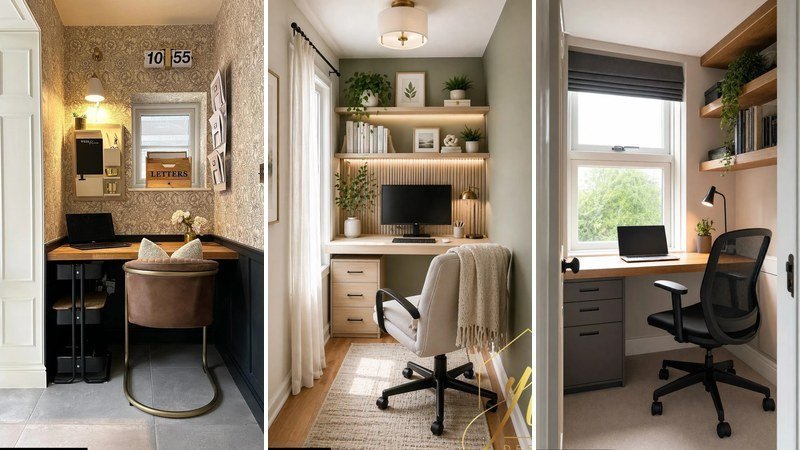
This built‑in alcove uses a L‑shaped desk so you can turn from screen to paperwork without leaving your seat. Cream cabinetry wraps around the corner, with upper shelves that glow softly from hidden LED strips underneath. A patterned upholstered chair adds comfort, and a monitor on a riser keeps the neck in line. If your L‑shape has a corner seam where the two desk sections meet, seal it with a thin strip of silicone—crumbs, coffee drips, and pen tips will inevitably find that gap. A small potted plant and a framed photo keep the space from feeling institutional. The warm light gives the illusion that the nook is larger than it really is.
Botanical Art and a Woven Pendant Light

by @flowbylara
A narrow alcove with white paneled walls hosts a wooden desk, a brown mid‑century chair, and a trio of floating shelves lined with botanical prints. Plants spill from every corner, and a woven pendant lamp hangs overhead, casting pinprick shadows on the rug. A three‑drawer wooden cabinet to the right stores stationery and notebooks, while a patterned rug underfoot defines the workspace. If the alcove gets only indirect light, choose hard‑to‑kill plants like pothos or snake plant—you want green, not a graveyard of crispy leaves. The overall effect is a tiny conservatory turned office, a room you look forward to entering even when the work is dull.
Olive Green Walls and an Upholstered Armchair

A wooden writing desk is tucked into a corner with walls painted a muted olive green. Instead of a typical office chair, an upholstered armchair with a floral throw pillow pulls up to the desk—making the nook feel like an extension of the sitting room. Wall‑mounted shelves hold framed botanical prints, a few books, and a wicker basket for cables. A metal desk lamp casts a focused circle of light across a laptop stand. Avoid placing the desk directly under the window if you use a monitor—the patterned blind will create distracting stripes of light on the screen all afternoon. The side window still provides plenty of natural light without glare.
Floral Wallpaper and a Rolling Storage Cart

A recessed alcove is given personality with dark‑painted wall panelling and a bold floral wallpaper inside the niche. A slim wooden desktop spans the width, with a brown upholstered chair on a gold frame. Under the desk, a rolling storage cart holds files and office supplies without any permanent installation—landlord‑friendly and easy to wheel out when the weekend arrives. When painting an alcove, extend the darker colour onto the side returns to make the space feel deeper; stopping at the edge flattens the whole nook. A wall sconce and a flip clock keep the setup tidy and reminiscent of a proper study.
Vertical Wood Slats on a Sage Green Wall

by @yfdesigns
This narrow nook is painted sage green, with the back wall behind the monitor clad in light‑toned vertical wood slats. That single material move adds enough texture to stop the small space from feeling like a leftover corridor. Floating shelves above the desk hold framed art, small pots, and a couple of paperbacks. A three‑drawer filing cabinet on one side keeps the floor clear of loose piles. If you install wood slats yourself, leave a small gap behind them for ventilation—trapped moisture in an external wall can lead to mould within a year. A LED strip under the upper shelves washes the workspace in soft light, and a ceiling drum fixture brightens the whole area when needed.
Closet and Attic Transformations
A cloffice takes the smallest footprint in the house and gives it a proper job. These three setups prove that even a cupboard or a sloped ceiling corner can hold a full workday. I’d rather see a desk crammed into a closet than a printer crammed onto a desk—keep the machines elsewhere, even if that means the hall cupboard.
A Navy Cloffice With a Gold Chandelier

by @atapdotco
Deep navy walls and cabinetry wrap this closet office, making the space feel like a jewel box rather than a leftover cupboard. A wooden desk spans the width, with open shelves above for books and a framed landscape. A curved office chair and a miniature gold chandelier push the room into grown‑up territory, while a small potted plant keeps it from feeling sterile. Paint the inside of the closet in a high‑gloss enamel—it reflects the chandelier’s light and resists scuff marks from the chair back. When the white doors close, the whole workstation disappears; open them on Monday morning and it’s ready to go.
Attic Alcove With a Pegboard and Skylight

This attic alcove sits under a slanted ceiling with a skylight that floods the desk with daylight. A wooden desk with deep drawers slides into the narrowest part, paired with a spindle chair and a black‑and‑white cushion. A pegboard on the wall holds small tools and a hanging plant, while two floating shelves above carry white magazine files and a camera. A woven basket beneath the desk corrals extra cables. Measure twice before mounting any shelf under a sloped ceiling—the angle can trick your eye, and you’ll end up with a shelf that slants the wrong way. A small desk lamp adds task light when the sun sets early in winter.
Pink Velvet Chair in a Wallpapered Cloffice

Inside this closet, beige and white arched‑line wallpaper covers the walls, and a pink velvet chair brings softness to the miniature room. A built‑in desk sits beneath a ‘hello sunshine’ neon sign that warms the space even on grey days. Floating shelves hold books and storage boxes, while a milk pitcher vase of tulips on the desk makes the whole setup feel like spring. Install the neon sign on a separate small adhesive hook first to test the placement—once it’s hardwired or fixed permanently, moving it later could tear the wallpaper. When the closet doors close, the room outside stays entirely free of work clutter.
Tiny Rooms That Do It All
When every surface multitasks, desk organisation becomes non‑negotiable. These three rooms pack a full workstation into a compact footprint without sacrificing livability. My rule is simple: if the room has to guest‑host, the desk chair must roll out and a folding screen must be within arm’s reach.
A Cubicle Nook With a Personal Whiteboard

This compact cubicle setup, inspired by a proper office, uses a dark‑wood desk and a rolling chair inside a small bedroom corner. A whiteboard on the back wall holds photos, a felt letter board, and a small plant, making the space feel like a private workstation rather than a desk in a family room. If you add a whiteboard in a small room, buy one with a magnetic surface—you’ll double its use as a photo board without needing extra pins. A yellow purse hangs on the side, adding colour, and a water jug on the floor keeps you from walking to the kitchen every hour. Overhead light is supplemented by an under‑shelf task strip, so the desk is evenly lit even in a windowless corner.
A Room With a Sofa, Desk, and Woven Light

This narrow room fits a wooden desk and mesh chair on one wall, and a small sofa on the opposite side. A woven roller shade and a rattan pendant light add texture, while open shelving holds grey binders that keep paperwork from spreading across the floor. A patterned rug under the desk defines the work zone, and a wall clock keeps the hour in view. If the sofa is used by guests, pick a desk chair that rolls out of the way completely—a folding screen placed in front of the desk at night hides the workstation in seconds. The overall scheme, all warm beige and oak, makes the room feel larger than its square footage suggests.
A Sunlit Office With a Standing Desk

A white standing desk faces a window covered by horizontal blinds, letting you control the light all day. A monitor on a riser keeps the neck happy, and a small digital clock sits beside a potted plant for a pulse of life. Storage drawers and a low bookshelf run along the side walls, so everything has a closed home. If the room is narrow, mount the bookshelf on the wall above the desk rather than on the floor—you’ll preserve the only walking lane through the room. The palette of off‑white, light grey, and warm beige keeps the space airy, and a desk lamp on the left fills in shadows when the blinds are drawn. Even at 40 square feet, it reads calm, not cramped.
Why Your Desk Surface Material Determines How Long You Can Work
You choose a desk for its footprint in a small room, but the surface is what you feel for eight hours. The wrong material fights you with glare, stains, and noise, so you end work earlier than you planned. I prefer a sealed laminate over raw wood for a desk that will see coffee, a plant mister, and maybe a late lunch. It’s not a purist’s choice, but it holds up without needing a coaster ritual, and that’s one less mental tax in a space you can’t escape.
Unsealed wood: It absorbs moisture from a mug or the humidity of a windowless corner. Within weeks you will see rings and subtle warping that makes your mouse wobble. A sealed finish, whether factory laminate or water-based polyurethane you brush on yourself, shrugs off those daily spills and keeps the surface flat.
Glass tops: They are often chosen to “disappear” visually, but on a sunny day the glare off the screen makes you squint. Fingerprints show in minutes, and wiping mid-task breaks focus. If the desk is in a bedroom corner where you also do makeup, the dust settles twice as fast.
Metal legs on hard floors: The tiniest shift sends a screech through a shared apartment. Stick self-adhesive felt pads under each foot before you roll the chair back for the first time. This stops gouges in a rental’s hardwood and kills the noise that irritates downstairs neighbours.
A hollow-core slab door as a desk: Lay it across two filing cabinets and you have a sturdy surface—but only if you support the underside every 30 inches. Without a centre bracket, the whole thing bows under a monitor arm. Check the hollow spots with a knock and place a metal L-bracket where the weight lands.
Sharp 90-degree corners: In a tight nook, you will brush past that edge multiple times a day. A bullnose or chamfered profile rounds off the danger and saves your hip. If you already own a square-edged desk, stick on clear corner guards until you can upgrade.
A surface that repels dust and fingerprints cuts daily tidying time, and that matters when your workspace sits in view of the living room. Small desk organisation ideas start with a material that doesn’t fight you—so you wipe less and work more.
Home Office Ideas For Small Spaces That Prioritize Traffic Flow Over Trends
Most Pinterest images show a desk pushed against the farthest wall, as if the only goal is to shrink the furniture. I’d argue that thinking ignores how a body actually moves through a room. You do not live in a floor plan; you need a clear path to stand, swivel, and leave without a bruise.
The two-foot myth: Many guides say leave 24 inches behind the chair. That is not enough. A standard office chair rolls back 36 inches before you can comfortably rise. Measure from the front edge of the desk to the nearest wall or furniture—if it is less than three feet, you will do a sideways shimmy every time.
Living room: Float the desk a few inches off the wall so light travels behind it. Position the chair so you exit toward the sofa, not into the main walkway. A flat-weave rug under the desk marks the zone, and a different texture in the path keeps your brain from mixing “work” with “rest.”
Bedroom: Never wedge the desk between the bed and the door. You want to slip out for a glass of water without waking a partner. A wall‑mounted monitor and a fold‑down keyboard tray save depth, so the desk can sit shallow and still feel generous. A cosy home office corner can live here without stealing your sleep sanctuary.
Hallway or landing: In a narrow passage, a desk must not narrow the walkway to less than 30 inches—that’s code for a reason. Mount shelves above head height for supplies and use a stool that tucks completely under a drop‑leaf surface. When work ends, the hallway returns to just a hallway.
Closet nook: The cloffice needs clearance for the door swing and enough depth to sit with elbows out. If you have less than four feet of width, skip the chair arms. Cloffice ideas that work keep the hanging rod high and the desk surface at 30 inches, leaving room to tuck a slim filing cart where shoes would live.
Swivel chair on hard floor: In a 4×4 nook, a swivel saves rear clearance but grinds casters into the wood. Add a low‑pile rug that grips the floor—it muffles sound for neighbours below and prevents scratches in a rental.
Lighting Tricks That Make a Tiny Office Feel Like a Real Room
You will read that warm light is always cosier. I would argue that in a windowless corner, a cool 4000K bulb keeps your brain on task, while a single 2700K lamp just makes the walls feel closer. You can switch back to warm after sundown; during the workday, you need light that signals “awake.”
Bulb temperature: A daylight‑leaning 4000K bulb in a clip‑on fixture stops the “cave effect” that washes over a dark nook by 3 p.m. Reserve a 2700K bulb for a small accent lamp on a shelf—use it only when you want the room to feel like evening, not all day.
Uplighting a shelf: Stick a plug‑in LED bar on top of a wall shelf, aimed upward and placed 12 inches from the ceiling. The light washes across the ceiling and pulls your gaze high, so the whole room reads taller. No wiring, no electrician, just a $20 strip and a day’s patience to hide the cord.
Clip‑on task light: Clamp it to the side of a floating shelf instead of placing a lamp on the desk. That frees every square inch of work surface and directs light exactly where you need it. Choose a model with an adjustable arm so you can angle it away from your screen during a video call.
Video call setup: One overhead fixture casts shadows under your eyes and makes you look tired. Mount a wall sconce beside you at face height and place an inexpensive LED panel behind the monitor. The side light fills shadows, the backlight separates you from the wall, and suddenly a tiny corner reads like a proper room.
Reflections: A glossy white desk top or a slim mirror hung opposite a window catches daylight and throws it deeper into the room. Angle the mirror so it bounces onto the wall beside you, not directly onto your screen—otherwise you get a sharp glare right when you are trying to read an email. Bright home office ideas scaled down work better than a bulky floor lamp that eats your floor space.
Sustainable Swaps That Keep a Small Home Office Clutter‑Free
I would rather restore one solid‑wood desk from a thrift store than assemble three flat‑pack versions that sag after two years. A minimalist approach is not about owning nothing; it is about choosing things that last and do not quietly poison your air. In a tiny room with poor ventilation, that choice matters more.
Secondhand solid wood: A 1970s oak desk, sanded and resealed with a low‑VOC finish, costs under $100 and will never off‑gas formaldehyde the way new particleboard does. You also get real wood grain that hides scratches, because it already has a few.
Snake plant as room divider: In a slim 6‑inch pot, a tall Sansevieria marks the boundary between work and living zones without stealing floor space. It filters airborne nasties and needs water no more than twice a month. That is less maintenance than a fabric screen that gathers dust and takes up a foot of depth.
Fabric cable sleeves: Instead of plastic zip ties that snap and land in the bin, cut old t‑shirts into strips, braid three together, and wrap your cords. The textile softens the clatter against the wall and keeps cables from tangling. When you rearrange, you can untie and reuse the same strips.
Monitor riser from reclaimed wood: Before buying a new stand, visit the offcut bin at a hardware store or a local reuse center. A piece of butcher block and two metal shelf brackets create a riser that fits your exact width and stays out of the waste stream. Sand it smooth so you can rest your phone on it without scratching.
Vintage metal recipe boxes: For the few paper files you must keep, old metal boxes stack better than plastic bins and can be sprayed any colour to disappear against a wall. They outlast modern acrylic organisers and give office desk organisation a tactile, collected quality that feels intentional, not cluttered.
Your Clutter‑Free Small Office Weekend Reset Plan
Empty without sentiment: Clear every surface. Every single thing.
Divide the pile into only three categories: daily‑use, weekly‑use, and “honestly, not this month.” The last two leave the room. Your desk surface is real estate, not a warehouse — and the smaller the footprint, the more ruthless the edit. I keep a shoebox in the hallway for the “not this month” things; if I haven’t missed them by Tuesday, they get donated or filed elsewhere.
Measure before you mount a single shelf: Studs, wall material, and clearance all matter more than you think.
Mark stud positions with a tiny pencil dot and use a level even if the shelf is only 60 centimetres long. Renters, you still have options: a heavy‑duty adhesive hook rated for 5 kilos or a freestanding pegboard that leans against the wall will hold your headset and a tiny plant without a single hole. The one thing I’d never skip is testing the weight with the tools themselves before loading it with anything precious.
Hide every cord in five moves, not five hours: Group and then disguise.
Run a single paintable cord channel along the baseboard from the outlet to the desk leg. Where cables climb up, gather them with a scrap‑fabric sleeve — an old cotton t‑shirt cut into strips and braided muffles the plastic noise and costs nothing. Label each plug with a tiny tag at the outlet; when you need to unplug a single device three months from now, you’ll thank yourself.
Add one light that changes the room’s mood: A small, warm point of focus.
Clip a slender task light to the side of a shelf instead of eating up desk space with a base. If the room feels dark even during the day, screw a 4000K bulb into a bare fixture — it pushes back the “cave effect” without making the space feel clinical. Even a £15 plug‑in LED bar tucked behind the monitor transforms how the wall reads at golden hour.
Wipe down with intention, not just a rag: Cleaning is the last design step.
Dust all horizontal surfaces top‑to‑bottom last. A spritz of mild wood cleaner or a damp cloth with a drop of lemon oil leaves a scent that cues your brain “work is done.” I’ve noticed a tiny office that smells fresh never feels like a compromise, no matter how many square metres it really is.
FAQ
Can I put a home office in my living room without it screaming “office”?
Yes, and the secret is a desk that closes up. A drop‑front secretary in the same wood tone as your sideboard hides everything — monitor, files, coffee cup — the moment you lower the leaf. Swap a dedicated task lamp for a slim table lamp with a fabric shade so the corner reads as part of the sitting area, not a separate zone.
How do I set up a home office in a windowless corner?
Light is your only negotiator here. Install a full‑spectrum daylight bulb (5000K) in a fixture that bounces off the nearest wall; it widens the space visually. Hang a small mirror opposite the light source to double the brightness, and place a low‑maintenance plant like a ZZ plant nearby — the live green tricks your eye into registering depth, even when there isn’t any real daylight.
What’s the absolute cheapest way to create a small home office?
A wall‑mounted drop‑leaf table paired with a folding stool gets you a full workspace for under £60. Bins you already own slide underneath for hidden storage. I’ve seen this setup in a narrow hallway with a clip‑on light and a single floating shelf — the whole thing folds flat in seconds and the cost stays well under £75.
Is it okay to push my desk right against the wall if I have no choice?
Yes, but you must reclaim the leg room you lose. Use a monitor arm that pushes the screen flush against the wall plane, and add a narrow keyboard tray that tucks under the desktop when you stand. That gives you an extra 15 to 20 centimetres of clearance — enough to roll your chair back without hitting a bed or a cupboard.
How do I make a small home office work in a bedroom, a living room, and a hallway?
Bedroom: Float the desk off the wall slightly, even 15 centimetres, to create a visual gap. Use a folding screen or a tall snake plant as a soft barrier so you don’t stare at work from your pillow. Living room: Anchor the zone with a flat‑weave rug that fits only under the desk and chair; choose one colour from your sofa and repeat it in the desk accessories so the area blends, not competes. Hallway: Go vertical with shelves above a narrow console desk — 40 centimetres deep max. A shallow picture ledge keeps mail and keys off the surface, and a motion‑sensor light means you never fumble for a switch in a dim stretch.
What paint colour makes a tiny office feel larger?
Soft whites with cool undertones — Sherwin‑Williams “Alabaster” or Benjamin Moore “Chantilly Lace” reflect the most light and soften the boundary between wall and ceiling. An eggshell finish adds a subtle sheen that deepens the sense of space; skip matte in a micro room, because it absorbs rather than pushes light back.
Can I really fit a dual‑monitor setup in a closet office?
Yes, but switch to a single ultrawide monitor if you can — it saves the 10 centimetres you’d lose between two separate panels. If you must have two screens, stack them vertically on a pole mount and ensure the closet has ventilation: a tiny USB fan near the back and the door left slightly ajar stops your equipment from overheating. A properly planned cloffice handles this better than you’d guess.