Polished 15+ Finance Outfits Women Love for the Office

You want Finance Outfits Women that actually survive a 14-hour day, a client dinner, and the walk from the subway without unravelling at the seams. Yet most advice either shoves you into a stiff power suit or a generic blazer-and-slacks combo that ignores the unspoken rules of your specific desk. What gets overlooked is the practical layer: fabrics that don’t bag, shoes that don’t scream, and the quiet code switch between a Charlotte commercial bank and a New York investment banking floor. This is corporate finance fashion as it’s actually worn, not pinned.
For the boardroom standard that most finance roles demand, start with business formal as your baseline—then learn where to break it without losing authority.
20 Finance Outfits Women Actually Wear to Work
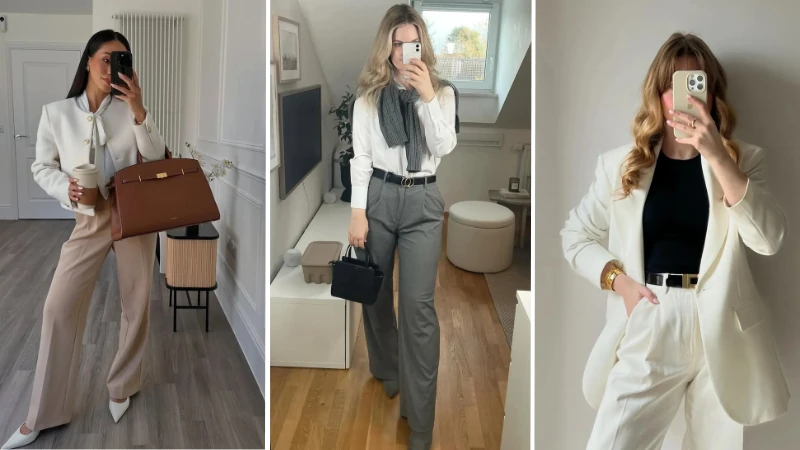
“Business professional” means something very different on a trading floor in New York than it does in a fintech office in Austin. The outfit ideas below aren’t pulled from a runway—they’re the real formulas finance women repeat week after week because they work for 10-hour days, client meetings, and strict unwritten dress codes. Each look is built on the exact items you see in the image, with one specific styling note worth remembering.
For the Most Traditional Finance Floors
These are the outfits that hold up at the strictest banks, in client-facing roles, and in cities where a bare leg or an open toe can get you a side glance. They lean conservative, structured, and anchored in tailoring.
The Tweed Pencil Edit

by @whatemwore
A relaxed white silk blouse tucked into a slim grey tweed pencil skirt, cinched with a black leather belt. Black suede pointed-toe pumps and a structured black top-handle bag complete the look. This outfit is as close to a formal uniform as it gets without wearing a full suit. Make sure the skirt has a full lining; tweed’s texture can catch on tights and bunch up, which nobody needs during a stand-up presentation.
Three-Piece Grey Authority

An oversized dark grey wool-blend blazer, matching tailored waistcoat, and wide-leg trousers. Underneath, a crisp white button-down, with a black handbag, black sunglasses, and gold earrings. The waistcoat is the centerpiece here. Waistcoats must lie completely flat when buttoned; if there’s gaping, size up and have the sides tailored—a gapping waistcoat reads sloppy, not powerful.
Black Suit, Red Statement Bag

by @ewa_vu
A relaxed black wool-blend blazer over a white satin blouse, slim black trousers, and the only real color: a red structured handbag. Black slim pumps and a skinny black belt keep the silhouette cohesive. This is exactly how you inject personality inside the strictest business formal limits. A single strong accessory does the work; don’t match your shoes or earrings to the bag, or the impact flattens out.
Knit Dress With Opaque Tights

A black slim-fit knit mini dress layered over opaque black tights, finished with black patent pointed-toe pumps and a structured top-handle bag. Chunky gold earrings add just enough gleam. This only works if your office culture accepts opaque tights as a polished alternative to hose; if legs are expected to be nude-sheer, swap the tights for a pair of stockings. The knit fabric must be substantial enough to hold its shape through a full sitting day.
Black Suit With Brooch Detail

by @mint_label_
A black tailored jacket and slim-fit trousers in suiting fabric, paired with a black silk shirt. The silver brooch on the lapel is the focal point—small, architectural, and deliberate. A black handbag and silver wristwatch round it out. Choose a brooch with clean, modern lines; anything whimsical or oversized turns this from serious to theatrical in a room that’s already skeptical about women’s accessories.
The Modern Finance Uniform
These are for offices where the dress code has relaxed slightly—still polish required, but you can wear a separated blazer, a wider leg, or a color that isn’t navy. Most finance women in corporate banking, accounting, and internal strategy live here.
The Green Suit Break

by @_yas_dak
A tailored green synthetic-blend blazer and matching flared trousers, with a white cotton top and pointed-toe white pumps. This is a bold color move that still reads suit. Before you walk into a client meeting, confirm the synthetic fabric doesn’t shine under fluorescent light; shiny synthetics look cheap fast—if it catches light, save it for internal days.
Navy-and-Cream Preppy

A relaxed navy wool-blend blazer over a light blue button-down, tucked into high-waisted off-white crepe trousers. Off-white accessories—belt and shoulder bag—plus gold watch and earrings. This is the preppy end of quiet luxury. High-waisted trousers demand a full tuck; a half-tuck cuts your vertical line in half, which is the opposite of commanding.
Crisp White Blazer Contrast

by @ewa_vu
An oversized white structured blazer over a slim black cotton-blend top, paired with wide-leg white linen-blend trousers. A black leather belt and simple gold jewelry keep it clean. Linen-blend trousers will wrinkle within a hour of sitting; for days when you’re chair-bound, swap them for a heavy crepe that gives you the same wide silhouette without the crease baggage.
Tailored Blazer With A Tee

A white tailored crepe blazer over a black-and-white slim cotton t-shirt, with white wide-leg crepe trousers. A black mini handbag, black sunglasses, slim belt, and gold watch. This is a modern twist that works for warm-weather client meetings. If your firm bans visible t-shirts in client-facing areas, the fix is simple: swap the tee for a silk shell in the same black-and-white palette—everything else stays.
Silk Blouse, Perfect Trousers

A loose cream silk blouse paired with black wide-leg tailored trousers, a slim black leather belt, and a black handbag. Four items. That’s it. The impact is in the fabric. Before you buy the blouse, hold it up to a window; if the light shows any silhouette details underneath, it’s too sheer for a finance office—even with a camisole.
When You Need to Own the Room
Board presentations, final pitches, or the day you sit down with the senior director who still thinks a skirt suit is the only option. These outfits bring the presence without looking like costume armor.
The Pussy-Bow Power Suit

A white structured cropped jacket over a relaxed white silk pussy-bow blouse, with beige wide-leg crepe trousers. White pointed-toe pumps, a large brown leather tote, and gold stud earrings. The bow softens the tailoring without taking away authority. Keep the bow moderate in size—an oversized floppy bow reads editorial, not executive; aim for something that falls neatly along the collar line.
Pink Monochrome Power Set

A light pink relaxed blazer, tailored vest, and wide-leg trousers—all in a matching polyester blend. A black structured handbag, black sunglasses, and gold jewelry. This is power dressing that doesn’t rely on grey or black. The difference between cheap and luxe here lies entirely in the fabric: if it shines like costume satin, skip it; look for a matte wool-blend in the same soft pink.
The Tie-Stripe Power Suit

An oversized brown wool-blend blazer and matching wide-leg trousers, worn with a white cotton shirt and a grey silk-blend tie. A black clutch, black sunglasses, and a gold watch. This pulls from dark academia but lands squarely in corporate power territory. If you’re not used to wearing a tie, loop it loosely and let it hang slightly undone; a rigid knot makes it look like you’re trying too hard.
Tweed & Texture Contrast

A white structured tweed jacket over a white fitted jersey top, with black slim-fit cotton-blend trousers, pointed-toe black pumps, a black structured handbag, and a slim belt. A single gold chain necklace sits at the neckline. When mixing a heavy texture like tweed with a smooth top, keep jewelry minimal—one chain is plenty; layering necklaces will compete with the jacket’s visual weight.
Grey Blazer, Burgundy Boots

An oversized grey wool-blend blazer, a white slim jersey top, and black straight-leg crepe trousers. The red structured handbag pops, but it’s the dark burgundy pointed-toe leather boots that make the outfit. Burgundy reads as a neutral in fall and winter, but only if the boots are polished; scuffed toes undercut the entire look, so keep a leather wipe in your drawer.
Smart-Casual Desk Days
Internal meetings, no client touchpoints, the Friday before a long weekend. You still want to look like you made an effort, but the business casual boundary lets you lean into softer layers and more relaxed silhouettes.
Tonal Knit Over Button-Down

by @verena.lr
A white button-down layered under an oversized dark grey knit sweater, tucked into relaxed grey wool-blend wide-leg trousers. A black slim belt, black handbag, and grey suede ankle boots. This is the look for freezing-cold offices. The shirt collar must hold its shape and stay visible; if it’s limp by 11 a.m., the layered effect reads unmade bed, not considered layering.
All-Black Maxi Skirt Chic

A black relaxed puff-sleeve top tucked into a slim-fit black maxi skirt, with black pointed-toe pumps, a black handbag, and gold hoops. Monochrome magic for days you don’t want to think about color. The maxi hem needs to barely graze the floor when standing; any longer and you’ll be hiking it up with one hand while carrying your laptop with the other.
Tweed Jacket, Sharp Trousers

A white regular tweed jacket over a white slim jersey top, paired with black straight-leg trousers, black pumps, a black structured bag, and a slim belt. The jacket adds old-money texture to an otherwise simple formula. Tweed jackets often need sleeve shortening and a slight waist nip to avoid overwhelming your frame—budget for tailoring before you buy.
High-Waist Trousers, Relaxed Blouse

by @ewa_vu
A relaxed white cotton blouse with black high-waisted tailored trousers, a gold watch, delicate gold necklace, and a thin brown cord bracelet. This is the minimum effective dose for a smart-casual office. High-waisted trousers demand a confident full tuck; don’t leave the blouse half-out thinking it looks easy—it looks unfinished.
Striped Sweater, White Trousers

A black cotton t-shirt under a relaxed black-and-white striped knit sweater, white tailored linen-blend trousers, a black structured handbag, and black-and-beige pumps. A black belt and gold watch keep it pulled together. Striped sweaters with white trousers can read “nautical weekend” if the sweater is too oversized; keep it trim or do a front tuck to stay in office territory.
The Unspoken Dress Codes Across Finance Sectors
Front-Office vs. Back-Office Reality: An IBD associate at a bulge-bracket bank operates under the strictest business formal rules in the building—closed-toe pumps, a full suit, minimal jewelry. A woman in internal audit or risk management two floors down can wear a knit blazer and loafers without a second glance. The hierarchy isn’t about title alone. It’s about who sees clients. Front-office roles demand armor. Back-office roles allow ease. Know which side of that line you’re on before you invest in a wardrobe that’s either too stiff or too soft.
The Seniority Loophole: You’ll notice something your first month: the Managing Director wears a sleeveless sheath dress to the Tuesday standup. You, as a first-year analyst, would get side-eye for the same choice. This isn’t hypocrisy—it’s an unspoken “grandfathered-in” rule. Senior leaders earn wardrobe flexibility through years of proven judgment. Early-career women need more armor because they haven’t yet built the reputation that fills the room before their outfit does. When you’re new, dress one notch more conservatively than the woman two levels above you.
The First-Week Recon Mission: Before you buy anything, observe. Note shoe choices—are women wearing block heels or stilettos? Closed-toe or slingbacks? Is the blazer-on culture rigid (blazers stay on during meetings) or relaxed (jackets come off at desks)? Watch jewelry: do senior women wear statement necklaces or just stud earrings and a watch? Your first-week observations will save you from the $300 blazer that’s wrong for your floor. Don’t guess. Watch. Then shop.
Where You Work Changes Everything: A bank-appropriate outfit in Charlotte looks nothing like one in San Francisco. Charlotte finance skews traditional—full suits, sheath dresses, pantyhose still common. San Francisco fintech lets you wear a cashmere crewneck and tailored trousers to a board meeting. Chicago splits the difference: polished but practical, with a heavier reliance on wool and outerwear that actually works. Texas finance adds its own wrinkle—think structured but breathable, with rodeo-season events demanding a separate closet entirely. Don’t copy a NYC capsule if you work in Austin. The climate and the culture won’t cooperate.
Finance Outfits Women: What It Really Costs to Dress the Part
The Starter Wardrobe Trap: Most guides recommend dropping $2,000+ before your first day. I’d argue you can build a finance-ready core for under $800, because the real drain isn’t the initial spend—it’s replacing cheap pieces that pill, fade, or lose shape after six months of weekly wear. Splurge on three things: two structured blazers (navy and charcoal), one pair of low-block-heel pumps, and a structured work tote that fits a laptop without bulging. Save on shells, trousers, and knit layers—Uniqlo and Quince make $40 tops that read as $200 under a good blazer. No one is inspecting your shirt label. They are noticing whether your jacket fits.
The True Cost of Fast Fashion Office Wear: A $49 Zara blazer replaced every eight months costs you $367 over five years—and looks cheap by month four. A $300 Theory blazer on sale for $180, worn weekly for five years, costs about $0.69 per wear. The math is brutal and boring and true. Polyester-blend trousers bag at the knees by lunch. Acrylic sweaters develop that shiny, pilled texture after three dry-clean cycles. Spending less upfront often means spending more, sooner. Calculate cost per wear before you swipe your card. If the math doesn’t work, neither will the garment.
Tailoring Is the Line Between Looking Hired and Looking Hopeful: A $60 Zara blazer with $30 of tailoring—sleeves shortened, waist taken in—reads as $400. Off-the-rack pants will not fit your hips and waist simultaneously. They never do. Factor tailoring into your budget from day one. A good tailor can reshape a boxy blazer so it skims your frame instead of swallowing it. This is non-negotiable. Skipping tailoring is the fastest way to look like you borrowed someone else’s clothes, and in a room full of custom-suit men, that visual gap matters.
Triple-Duty Dressing Solves the Dress Code Fatigue Tax: The hidden expense no one warns you about is buying separate outfits for work, client dinners, and business trips—pieces that sit unworn 90 percent of the time. Build instead around items that pivot: a charcoal trouser suit where the blazer works over a silk shell for dinner, the trousers pair with a knit for travel, and the full suit handles the 9 a.m. boardroom. Every piece in your daily corporate rotation should earn its hanger space by working across at least two contexts. If it only does one thing, it’s a luxury you don’t need yet.
Personal Style vs. Professional Credibility—The Tightrope Walk
The Likability Penalty Is Real: Research on perception bias backs up what you already sense: women in finance who dress too severely get labeled cold or unapproachable. Too much pattern or color, and suddenly you’re “creative”—which in a banking context is not a compliment. The solution isn’t to vanish into greige invisibility. It’s to route personality through texture, not print. A charcoal blazer in a subtle herringbone reads as authoritative but not harsh. A navy silk shell with a barely-there sheen signals polish without shouting. Let your jewelry do one small, intentional thing—a single sculptural earring, a thin gold cuff—rather than five competing things. Restraint lands harder than volume in rooms where most people are wearing the same Patagonia vest.
The Blazer Rule Hides the Real Problem: Everyone says a blazer thrown over everything solves any outfit gap. It does—until you need to take the blazer off. Underneath, you need sheath dresses and knit tops that stand alone as boardroom-appropriate. That means no bodycon cuts that pull across the hips. No boxy shapes that read as shapeless under conference-room lights. Most brands cut for one body type—straight, minimal curve—and if that’s not yours, you’ll try on twelve dresses before finding one that fits both your shoulders and your waist without alteration. Budget extra time for this hunt. The blazer is a shield. What’s underneath still needs to hold its own.
When the Feedback Comes for Your Clothes: A senior colleague comments that your skirt is “a little short for client day.” Someone asks if you “have an interview” because you wore a full suit on a Tuesday. These remarks sting because they’re never about the clothes—they’re about whether you’ve correctly decoded unspoken expectations. Have a script ready. For the skirt comment: “Noted—I’ll keep that in mind for next time.” Neutral. Unbothered. For the interview question: “Just felt like suiting up today.” Then redirect to work. Do not explain. Do not justify. Do not internalize it as a moral failing. One wrong hem doesn’t undo your deal sheet. Let the comment bounce off and keep moving.
Your Accessories Become Your Calling Card: In a male-dominated room, a single bold choice—a red pump, an architectural necklace, a cobalt scarf—can become the thing you’re remembered for. That cuts both ways. A red pump can read as confident and polished. It can also read as “the woman with the loud shoes” if the rest of the room is wearing black and navy. Before you invest in a statement piece, ask yourself: do I want to be remembered for this item specifically, or do I want my work to fill the room first? Early in your career, lean toward the latter. A well-cut blazer in an interesting neutral does more for your authority than a leopard-print flat ever will. Save the statement for evening networking events where the dress code loosens and personality is an asset.
Commuting, Travel, and 14-Hour Days—The Hard-Logistics Layer
The Shoe Strategy Nobody Tells You: You need three categories of work shoes that survive a finance schedule. Commuter shoes: clean sneakers or flat loafers that handle subway stairs and six-block walks in rain. Desk shoes: the pumps or low block heels you keep under your desk and swap into once you’re in the building. Client-meeting shoes: the impeccable pair reserved for pitches and presentations—worn only indoors, resoled before they look tired. Block heels aren’t always the hero they’re sold as. On hushed trading floors or marble-banked lobbies, a block heel lands louder than a slim heel. Noise matters. Test your shoes on hard floors in a quiet room before wearing them to work.
Fabric Science for Sitting Marathons: Wrinkle-resistant isn’t enough when you’re at a desk for ten hours straight. You need fabrics that pass the sitting-to-standing test—no deep creases across the lap, no bagging at the knees, no static cling by 3 p.m. under aggressive AC. Look for tropical wool blends (they breathe and hold shape), ponte knit with at least 5 percent elastane (structure without stiffness), and triacetate-lined dresses (the lining prevents static and sweat-spot visibility). Avoid 100-percent polyester shells—they trap heat and show underarm dampness by lunch. Avoid unlined wool trousers if you run warm—they itch and develop a sheen at friction points within weeks.
The Two-Day Deal Trip, Packed in a Carry-On: You can create five distinct outfits from two trousers, three tops, one blazer, and two pairs of shoes. Pack black tapered trousers, grey wide-leg trousers, a navy silk shell, a cream crewneck knit, and a subtle patterned blouse. Layer the blazer over each combination. The black trousers plus the shell plus the blazer is day one. Swap the trousers to grey for day two. The knit over the grey trousers with flats handles dinner. The patterned blouse under the blazer with black trousers reads as a third full look. Roll everything—rolling prevents creases better than folding. No steamer? Hang the blazer in the bathroom while you shower. Steam does the work while you do your makeup.
Layering for Temperature Whiplash: Your office is an icebox. The subway platform is a sauna. You need a system that doesn’t bulk up your shoulders or make you look like you’re hauling camping gear. Start with a thin merino or cashmere-blend shell (insulates without volume). Add a blazer in a year-round weight—tropical wool or a wool-silk blend. Carry a packable long coat or trench that layers cleanly over the blazer without bunching at the sleeves. Avoid chunky knit cardigans that add visual weight under a jacket. Avoid puffer vests that compress your silhouette and read as weekend casual. The goal is to add and subtract layers without anyone noticing. If you’re visibly peeling off three items when you sit down, your layering strategy needs editing.
Your 15-Piece Capsule That Delivers 30 Finance-Appropriate Looks
The Capsule List: 2 structured blazers (navy, charcoal), 3 trousers (black, mid-grey, subtle windowpane), 1 below-the-knee pencil skirt (charcoal), 4 shells/blouses (cream silk, pale blue cotton, black sleeveless shell, one small-scale print), 2 pairs of shoes (black closed-toe pump, dark brown loafer), 1 structured leather tote, 2 outerwear layers (trench coat, wool car coat), 1 thin leather belt that matches your loafer.
These 15 pieces live in the overlap of every strict finance dress code. The navy blazer gets paired with the grey trousers and cream shell on Monday; three days later, that same blazer works over the pencil skirt and print blouse. By owning nothing that only pairs with one other item, you eliminate the “full closet, nothing to wear” panic. The windowpane trouser is the quiet hero—it adds visual weight without a logo, and it breaks the solid-neutral monotony that reads as uninspired six months in.
30 Looks from 15 Pieces: Create a grid in your head: blazer 1 × trouser 1 × shell 1 = one outfit. Swap the shell = outfit two. Swap the bottom = outfit three. Repeat with blazer 2, then repeat with the skirt, then with the car coat layered open as a third piece.
When you treat outerwear as part of the outfit—not just a commute layer—you unlock at least 10 additional looks. The trench worn buttoned over the skirt and a blouse with no blazer reads as a polished, full ensemble that a client sees only in the elevator lobby. Two pairs of shoes keep it from feeling stale: the loafer grounds the windowpane trousers on a desk day; the pump sharpens the pencil skirt for a presentation. You don’t need a new outfit, just a new combination.
The Weekend Wash Strategy: Dry-clean blazers on a three-week rotation. Machine-wash shells on cold every two wears, and hang dry to prevent pilling at the underarm seam. Trousers go to the cleaner after five wears unless you sat on a dirty train seat.
This rotation means you’re never caught mid-week with the collar-crinkled blazer you wore during Monday’s pitch. It also prevents that specific fabric fatigue where wool-blend trousers start to shine at the thigh. Own fewer pieces, but keep every one in active rotation; a capsule only works if every item is clean and ready by Monday 6 a.m.
Where Most Capsules Fail: They ignore torso length. A cropped blazer from the store mannequin won’t cover your hip if you’re over 5’7”—and nobody in an elevator stares at your face when a gap of waistband shows.
Tailor the blazer to finish at least two inches below your natural waist. The windowpane trouser must break once over the loafer without pooling; otherwise it drags on the trade-floor carpet and frays. These fitting tweaks make the difference between looking like you bought a formula and looking like you own the room. A printable checklist idea turns this capsule into a packing list before you shop, not after, but the real power is in the fewer, better pieces.
The Cost-Reality Check: This capsule can be built for under $1,400 if you allocate $500 for two tailored blazers from a consignment site specializing in corporate castoffs, $200 per trouser, $100 for the skirt, and the remainder on shells and the tote.
You’ll spend another $150 on alterations—a non-negotiable line item. Skip the windowpane trouser if you find a subtle check; substitute a tonal grey plaid. Avoid black-on-black pairing all week; it washes you out under the overhead fluorescent and makes you disappear in a conference room. The capsule works because every piece plays with every other piece, no orphans allowed.
FAQ
Can I wear open-toed heels in a finance office?
No. Across investment banks, commercial banks, and most client-facing roles, open-toed shoes signal casual intent and can violate formal dress policies. Keep a pair of closed-toe pumps on your desk if you commute in sandals, and reserve peep-toes for office parties that fall outside trading hours.
Are pantsuits required, or can I wear a skirt?
Skirts are fully acceptable when the length stays at the knee or just below, in a fabric with weight like wool-blend or ponte. Avoid anything above the knee by more than an inch; that inch changes the conversation from “colleague” to something less useful in a review meeting. For a boardroom-ready look, pair a pencil skirt with a structured blazer and a silk shell, as seen in solid blazer outfits that anchor your proportions.
How do I dress for a finance interview when I can’t afford a suit?
Find a well-cut blazer at a consignment store in an affluent neighborhood—labels like Theory or J.Crew wear well and cost less than $50. Pair it with dark non-black trousers that don’t shine under office lights, a simple shell, and closed-toe pumps; no one will register it’s not a matched set. Focus your remaining budget on a clean, structured tote and a quick tailoring session to shorten sleeves, because a gap at the wrist kills the interview outfit presence faster than any missing label.
Is it okay to repeat outfits frequently in a finance job?
Repetition is the norm, not a shortcoming. Senior directors often cycle the same three suits, swapping blouses and dry-cleaning on a set schedule. When you change accessories—a different belt, a watch, or a fresh shell—the outfit reads as deliberate consistency, not a laundry emergency.
Do I have to wear pantyhose?
In traditional front-office settings and any meeting with external clients, sheer nude hosiery remains the safest choice—it evens skin tone and signals formality. For regular desk days, bare legs are fine if you keep a spare pair of hose in your tote; a last-minute client call can shift expectations instantly.
What if a male superior comments on my clothing in a way that feels off?
Redirect with a neutral, professional pivot: “Thanks, it’s holding up well through these long days—did you see the latest portfolio update?” If the remark repeats or feels like an evaluation of your body rather than a passing notice, document it and approach HR. Corporate outfits for women are meant to be frictionless, not a recurring topic of discussion, and any feedback that lingers on your skirt length isn’t about your outfit.
How do I handle a dress code when I’m plus-size and most suiting cuts aren’t designed for curves?
Invest in brands that engineer for a curved frame—M.M.LaFleur’s extended sizes, Eloquii, or Universal Standard—and then spend on a good tailor to adjust the blazer so it closes smoothly without pulling across the bust. Fewer well-fitted pieces always outperform a closet of gaping buttons; a blazer that sits flush instantly signals senior-level authority.