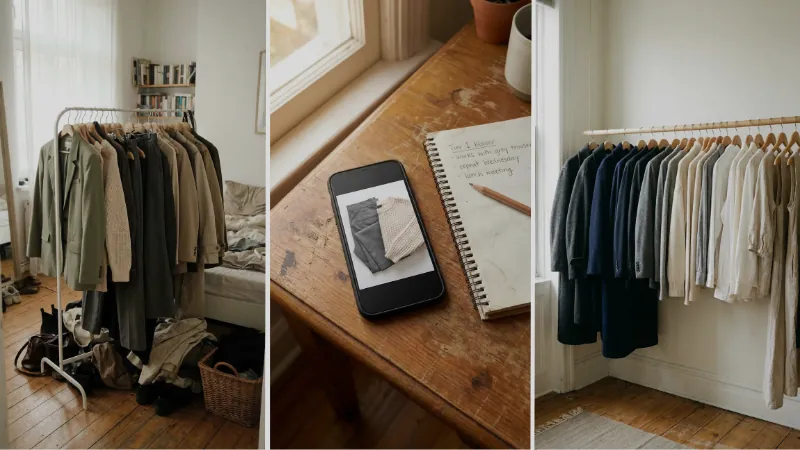
The Orphan Wardrobe: Why Nothing in Your Closet Goes With Anything Else

You have a closet full of clothes but nothing to wear. The usual advice is to buy more neutrals. That advice is wrong, and following it will cost you more money and create more frustration. The real problem isn’t color. It’s that your pieces live on incompatible levels of formality, defined by fabric weight and surface finish. They speak different languages. This framework will build you a coherent, effortless wardrobe. It is restrictive, by design. If your primary goal is highly expressive, avant-garde dressing that intentionally clashes these tiers, this system is not for you.
Quick Answer
- Stop shopping by color alone—wardrobe cohesion depends on compatible fabric textures first.
- Sort your clothes into three formality tiers: Crisp, Soft, and Textured.
- Mixing works best between adjacent tiers (Crisp + Soft or Soft + Textured).
- Most outfit failures happen because of a missing middle layer of Soft Tier 2 pieces.
- Before buying anything, identify its fabric tier and three items it can pair with.
- The system’s most powerful tool is a forensic closet audit sorted by fabric, not color.
If you only do one thing: Empty your closet and sort every item into three piles—Crisp, Soft, and Textured—based purely on the fabric’s weight and finish.
The Tuesday Morning Crisis: A Full Closet With Nothing to Wear
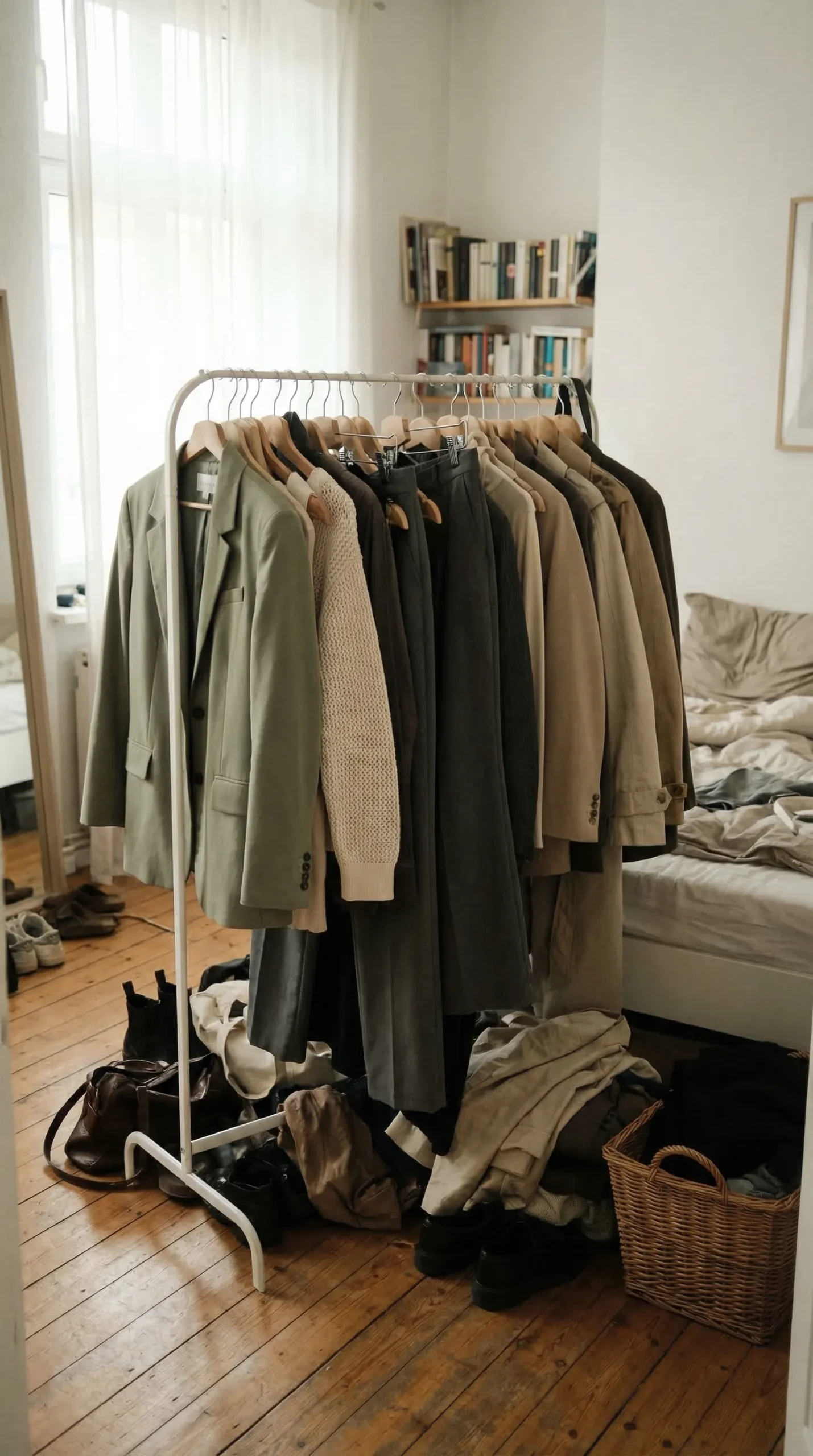
You know this scene intimately. You’re running late, staring at a rail of clothes that feels like a gallery of single, disconnected artifacts. The problem is not quantity. It’s a complete lack of connective tissue.
Take that beautiful dusty sage blazer. You bought it imagining a dozen outfits. In reality, it only works with one specific pair of trousers because its wool-mohair blend is too refined for your other pants. Your silk blouse feels wrong under it—too slinky, too dressy.
The “crisp” cream shell you try next has a bright, blue-white undertone that fights the blazer’s muted, greenish hue. This is the orphan wardrobe in action. Each piece is lovely alone but has no family.
The failure happens in the subtle details: the heft of a twill versus the airiness of a linen, the sheen of a satin-back crepe against the matte finish of a cotton poplin. You’re not matching colors. You’re trying to match contexts, and failing.
The classic “full closet, nothing to wear” paradox is rarely about a lack of options. It’s a failure of wardrobe grammar. When pieces exist on conflicting formality tiers, they cannot combine into coherent sentences. Solving it requires analyzing fabric syntax, not just color vocabulary.
Why “Buy More Neutrals” is a Trap
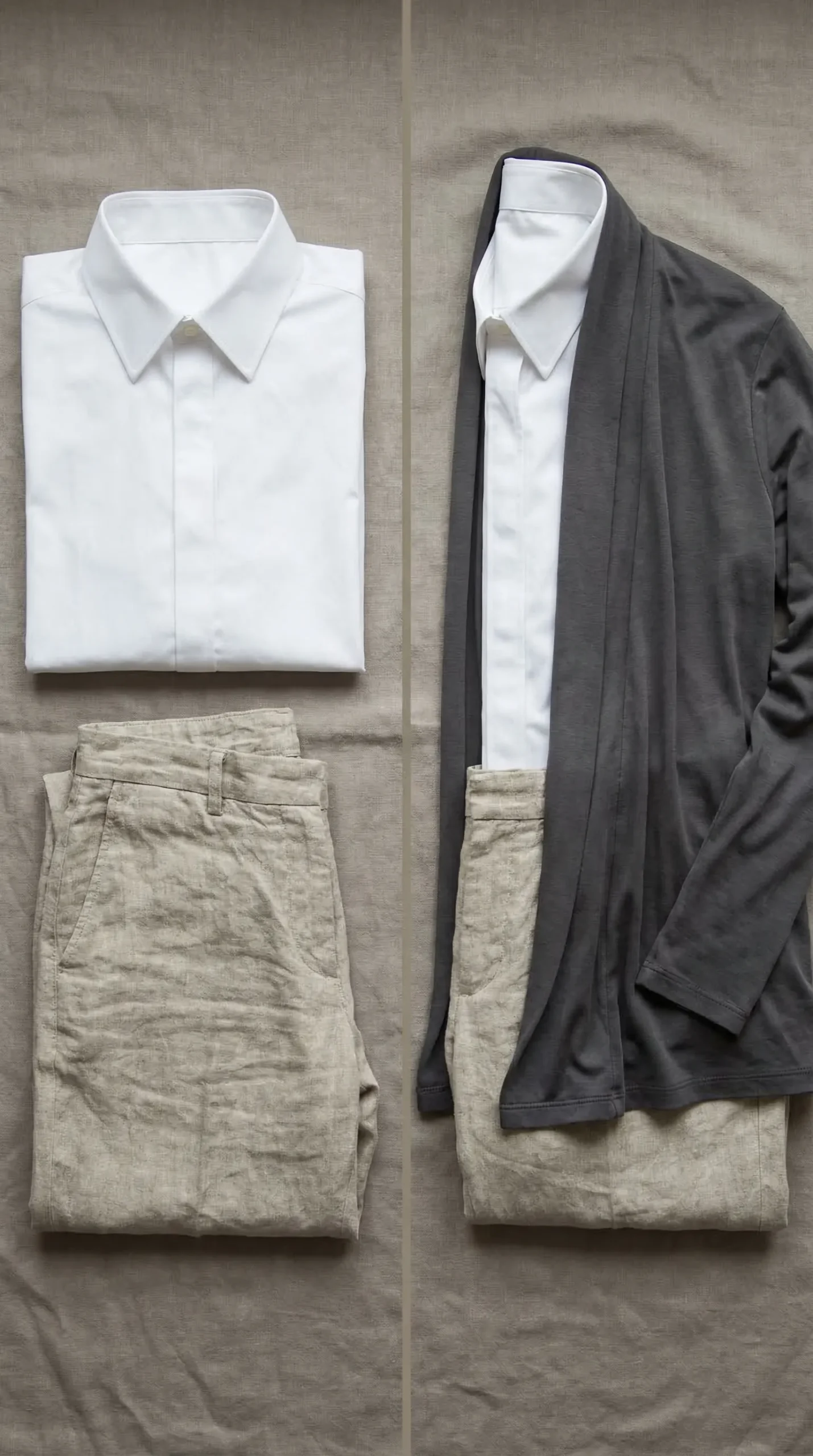
Telling someone with an orphan wardrobe to buy more neutrals is like telling someone with a shaky foundation to add another floor. It amplifies the underlying structural problem. You will simply acquire more incompatible pieces, all in beige.
Color is secondary. Texture is primary. Consider two blazers, identical in cut. One is in a dry, textured linen. The other is in a smooth, fine wool-crepe. Both are “neutral” shades of navy. They are not wardrobe allies.
They belong to different social classes. The linen blazer wants a cotton tee and wide-leg trousers. The wool-crepe blazer demands a silk blouse and tailored pants. Forcing them to mix often looks accidental, not intentional.
The standard advice ignores this fundamental texture register. You end up with five beige tops that don’t work with three beige bottoms. Each exists in a separate universe of formality defined by its fabric. It’s a waste of money and closet space.
Neutral colors guarantee nothing. A linen beige and a wool-crepe beige are as compatible as a sneaker and a stiletto. Wardrobe cohesion is built on shared fabric language first. Ignoring this means your neutrals will multiply your outfit problems, not solve them.
The Framework: Connecting Through Formality Tiers
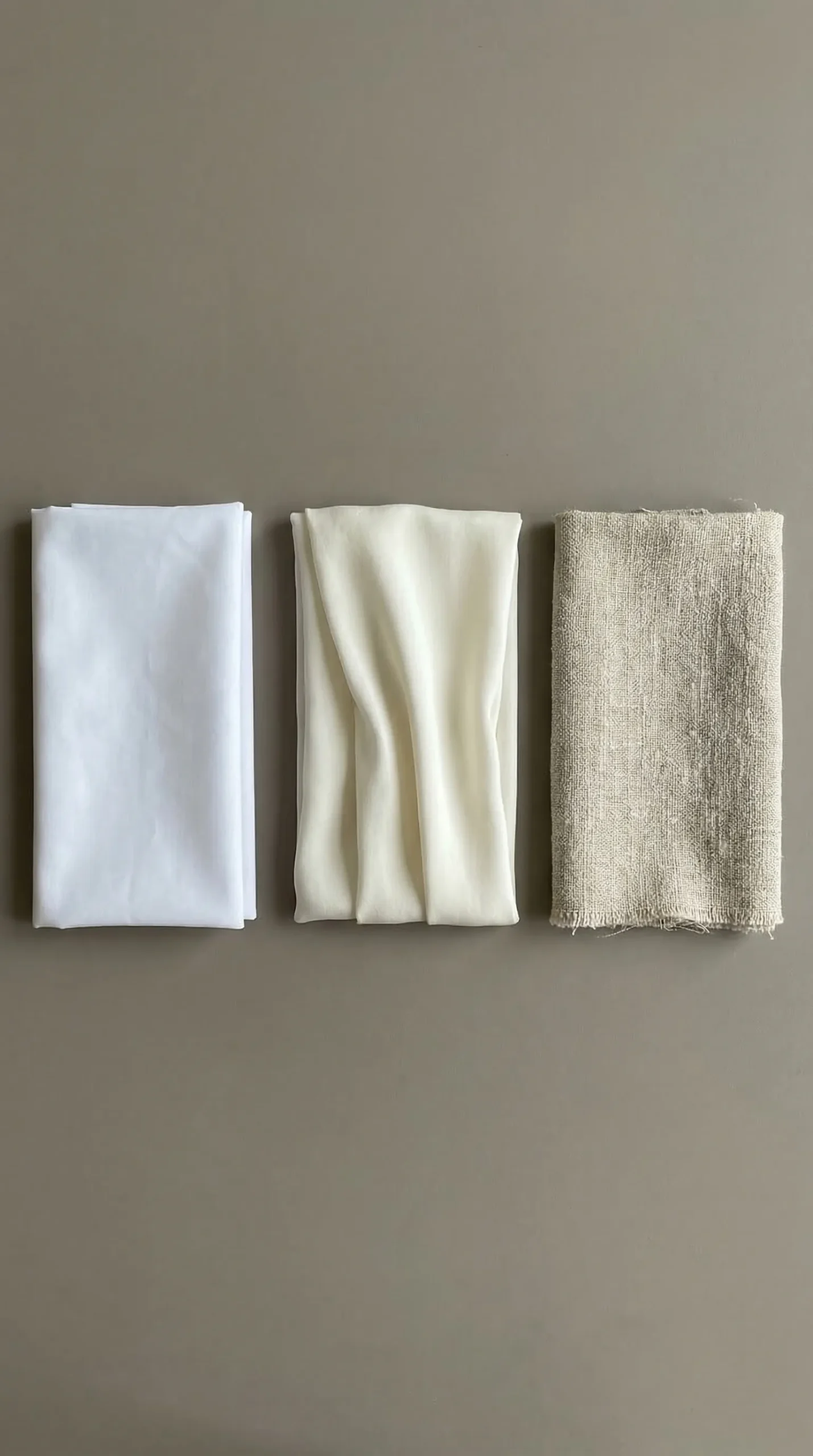
Forget “formal,” “business casual,” and “weekend.” We categorize by fabric surface. Think of three tiers.
Tier 1 is Crisp/Sharp: fabrics with structure, a clear finish, and density. Think fine wool crepe, suiting wool, crisp cotton poplin, thick silk twill. This is the territory of a strict Business Dress Code for Women.
Tier 2 is Soft/Draped: fabrics with fluidity, a soft hand, and medium weight. Think viscose, rayon, fine jersey, modal, light wool knits. This is the essential, ambiguous middle ground explored in any good guide to Business Casual for Women.
Tier 3 is Textured/Casual: fabrics with obvious texture, rustic finishes, or stretchy comfort. Think linen, raw denim, thick cotton jersey, cable knits, fleece.
Mixing tiers has rules. Tier 1 + Tier 2 works beautifully—it’s intentional and modern. Tier 2 + Tier 3 is easy and coherent. Tier 1 + Tier 3 is a visual argument.
It can be a powerful stylistic statement, but it’s hard to pull off without looking messy. Most orphan wardrobes fail because they are piles of Tier 1 and Tier 3 pieces with no Tier 2 translators to bridge the gap.
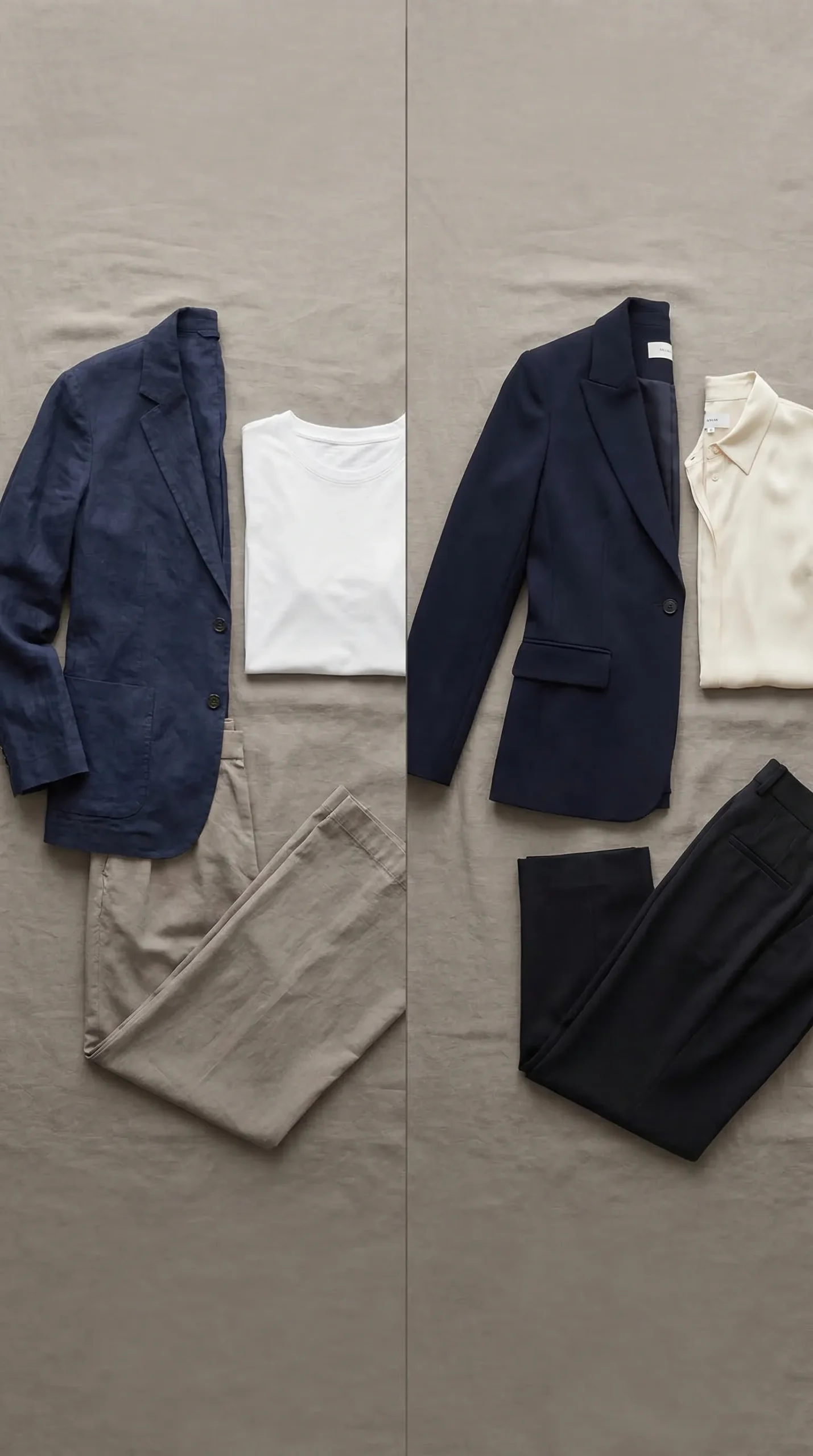
Adopting this system is a choice for cohesion and ease. It means passing on a gorgeous Tier 3 item if you own no Tier 2 pieces to pair it with. That discipline is the price of a functional wardrobe.
A functional wardrobe operates on a three-tier fabric system: Crisp, Soft, and Textured. The secret to effortless dressing is mastering the combinations, primarily using Soft Tier 2 pieces to translate between the extremes. Neglecting Tier 2 is the most common cause of outfit paralysis.
The Execution Plan: Diagnose and Fix Your Wardrobe
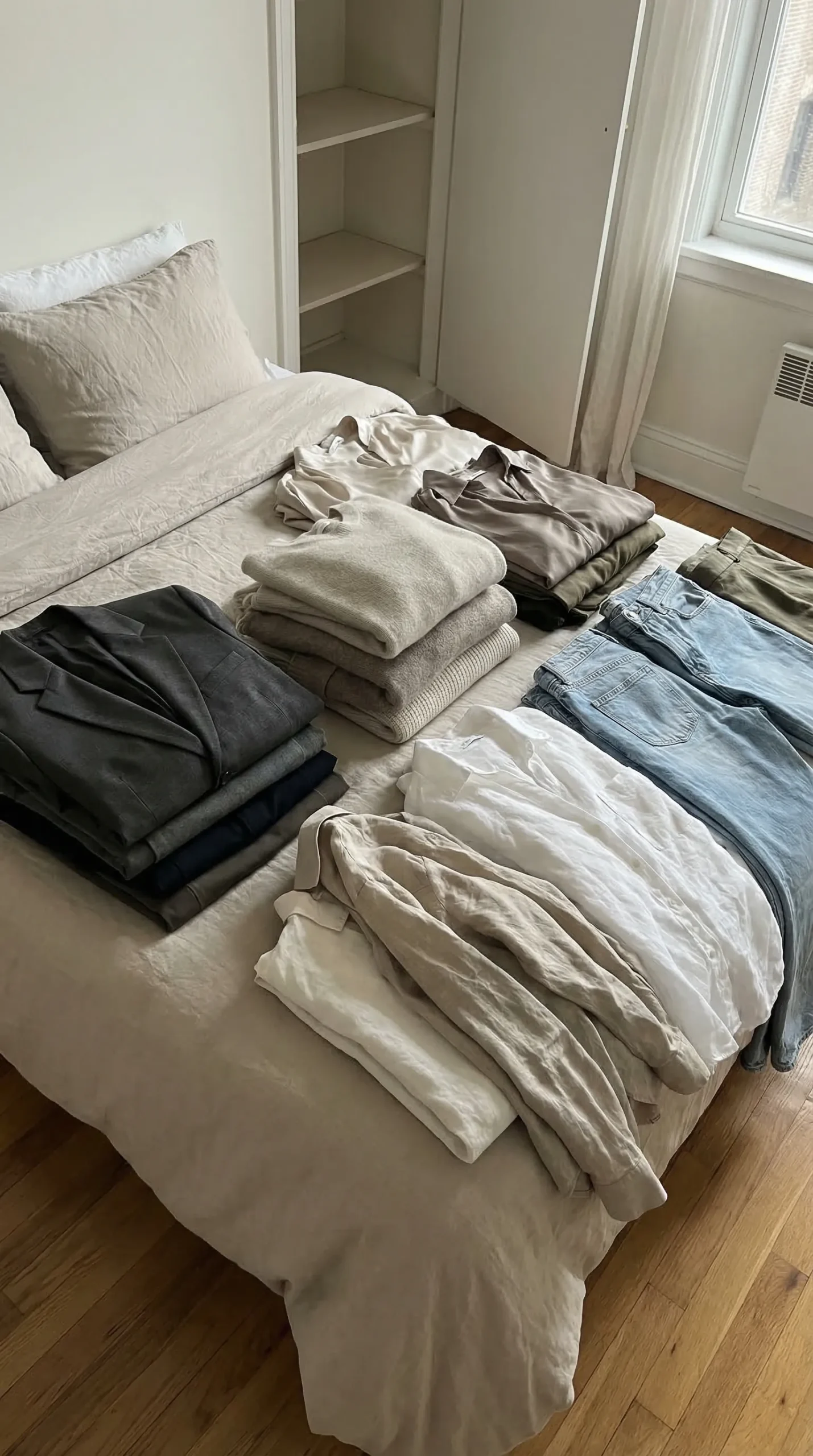
This is not a theoretical clean-out. It’s a forensic audit and a new operating protocol. You will work in three phases: diagnose the current state, document what actually functions, and install a filter for all future decisions. The goal is to stop the bleed of incoming orphans.
You’ll need an hour, your full wardrobe, and your phone’s camera. Empty everything onto your bed. We are not sorting by color or category. We are sorting by texture and feel.
This sounds obvious, but it took me two years to actually understand that a black viscose blouse and black wool trousers were fighting, not cooperating.
Step 1: The Closet Audit (Today)
Create three piles: Crisp (Tier 1), Soft (Tier 2), and Textured (Tier 3). Be ruthless. A “crisp” cotton shirt goes in Tier 1. A “soft” washed-cotton shirt goes in Tier 3. A wool-blend ponte knit? That’s a Tier 2 workhorse.
Now, count. What’s the ratio? Most people find a wasteland in Tier 2. This is your connectivity gap. Next, within each tier, group colors.
Now you’ll see the real problem: you may have ten Tier 1 black items, but only two Tier 2 blacks to pair them with.
Step 2: Document Your Core Combinations (This Week)

Your goal is to build a visual library of what *already works*. Start with the easiest pairings within the same tier. A Tier 2 knit with Tier 2 trousers. Photograph it. Note it.
Then, experiment with one cross-tier combination per day: a Tier 1 blazer over a Tier 2 dress. A Tier 2 sweater with Tier 3 denim. Photograph every successful outfit.
This creates proof and reduces morning decision fatigue. Store these photos in a dedicated album. This documentation phase is critical. It rebuilds your intuition based on evidence, not wishful thinking.
Step 3: The Future Purchase Filter (Before Next Purchase)
Before buying anything, you must answer three questions:
- Which tier does this fabric belong to?
- Do I have at least three items in *adjacent* tiers it can pair with?
- Does it fill a documented gap in my color palette *within that tier*?
If you answer “no” to question two, do not buy it. You are adopting a procurement policy for your personal life. It feels bureaucratic. It is also the only thing that works.
The Anchor Pieces: Your Wardrobe Translators
Certain garments act as diplomatic envoys between tiers. They are not the flashiest items you own. They are the most powerful. You likely own zero or one of them.
Their material properties—weight, finish, fiber—are deliberately ambiguous. This allows them to negotiate peace between a crisp blazer and casual jeans.
Investing in these two anchors will do more for your wardrobe than twenty random purchases. They are the keystones.
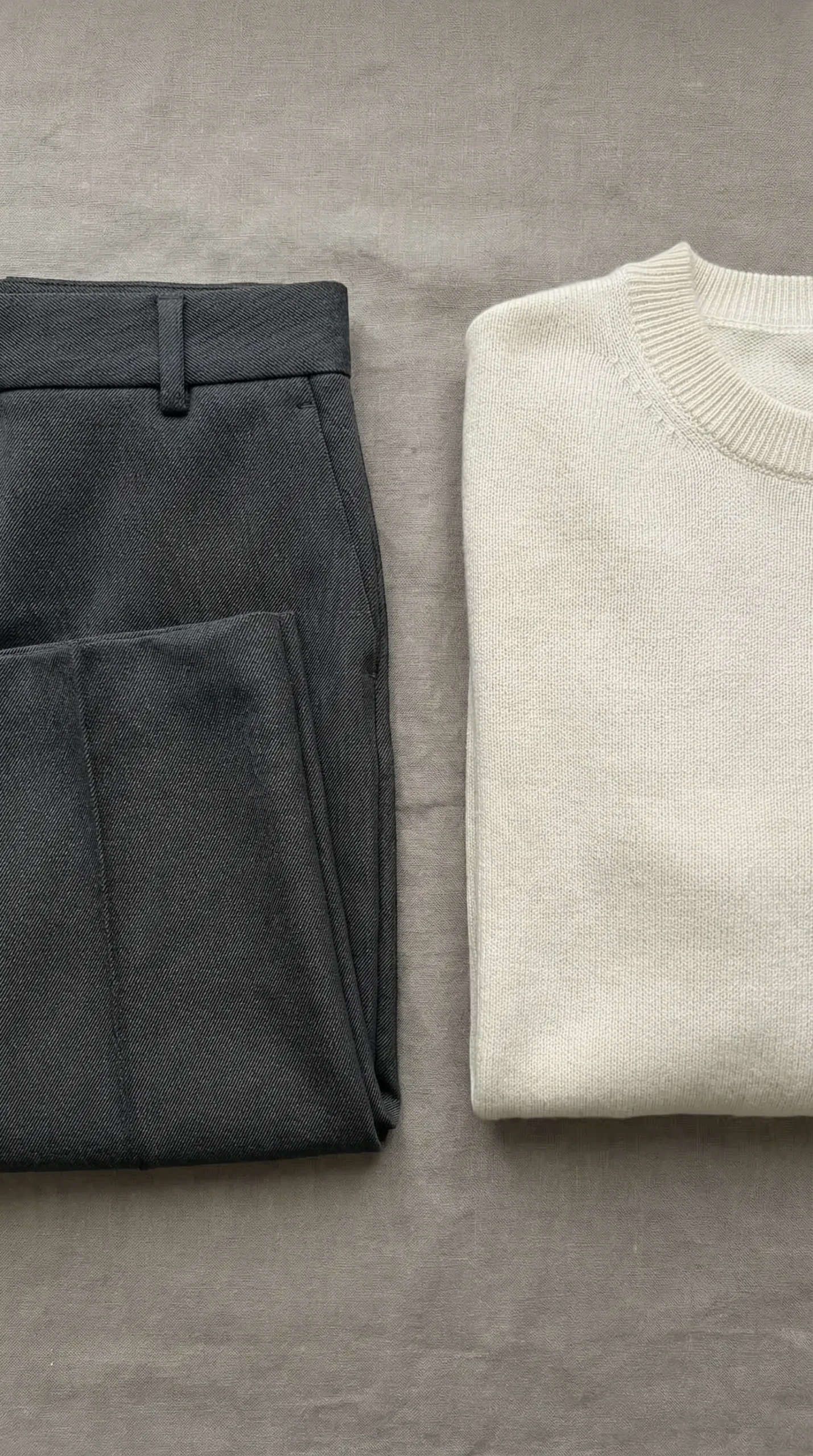
Anchor 01: The Mid-Weight, True Neutral Trouser
This is not a suit trouser. It is not a jean. It is the hybrid. The fabric is key: a wool-blend ponte, a fine twill with minimal sheen, or a heavy, structured viscose blend.
The color must be a true, medium-value neutral—think a charcoal grey, a navy that’s not too black, or a mid-warm grey. The cut is straight or wide-leg.
This trouser has enough structure to stand up to a Tier 1 blazer but a soft enough finish to pair with a Tier 2 sweater or a simple Tier 3 tee. It is the ultimate translator.
A perfect real-world example is something like the COS Wide-Leg Tailored Twill Trousers. The twill fabric provides the necessary in-between character.
Anchor 02: The Flat-Knit Merino Crewneck
Not a chunky sweater. Not a thin, dressy shell. A flat-knit merino crewneck in a medium weight. It should have minimal branding, a classic neckline, and be made of a yarn that lies flat against the body.
Why merino? It looks polished but feels soft. It can layer under a Tier 1 blazer without adding bulk. It can stand alone over Tier 3 trousers without looking too formal.
In black, grey, or cream, it becomes a uniform base. This single top can connect to every bottom and outerwear piece you own. Its texture register is perfectly centered in Tier 2.
Anchor pieces are defined by their ambiguous material properties, not their style. A mid-weight, true-neutral trouser in ponte or twill and a flat-knit merino crewneck are Tier 2 workhorses. They successfully bridge to both more formal and more casual tiers, solving the core connectivity issue.
Common Mistakes
Mistake: Shopping for color first and fabric second.
Fix: Touch the fabric and assess its formality tier before you even look at the color. The handfeel decides everything.
Mistake: Buying a beautiful piece that only works with one other specific item in your closet.
Fix: Institute the “Three Connection Rule.” A new item must work with at least three existing pieces within one tier of itself.
Mistake: Assuming all “neutrals” are created equal and should automatically go together.
Fix: Sort your closet by texture, not color. You will immediately see why your beige linen shirt rejects your beige wool skirt.
Mistake: Over-investing in Tier 1 (Crisp) and Tier 3 (Casual) pieces while neglecting Tier 2 (Soft/Mid).
Fix: Actively seek out Tier 2 fabrics like fine knits, viscose, and fluid crepes. They are the crucial wardrobe bridges you’re missing.
Your Action Checklist
Use this sequential list to implement the system without getting overwhelmed. It turns abstract planning into accountable action.
- Empty your wardrobe and sort every item into three piles by fabric: Crisp (T1), Soft (T2), Textured (T3).
- Identify and count the items in your Tier 2 (Soft) pile. This is your connectivity baseline.
- Within each tier, group items by color to see specific gaps.
- Create at least 5 documented outfit combinations using only items within the same tier. Photograph them.
- Create at least 3 documented outfits that successfully combine Tier 1 + Tier 2 or Tier 2 + Tier 3. Photograph them.
- Before your next purchase, write down which tier the item belongs to and list 3 existing items it can pair with.
Frequently Asked Questions
I love bold colors and prints—does this tier system only work for a neutral wardrobe?
No. The system governs fabric compatibility. A fuchsia Tier 2 silk blouse will pair with a black Tier 1 trouser the same way a black one does. Print and color live *on top of* the fabric tier. Get the tier right first, then add any color you want.
How do I handle statement pieces or heirlooms that don’t seem to fit any tier neatly?
Treat them as the centerpiece and build outward. A beaded top (likely Tier 2 in fabric, but with Tier 1 embellishment) becomes the outfit’s focal point. Pair it with the most simple, tier-appropriate bottoms you own. Let it be the star, and don’t compete with it.
What if my lifestyle requires both very formal (Tier 1) and very casual (Tier 3) clothes—how do I manage two separate “closets”?
You don’t need two closets. You need a robust Tier 2 collection. Tier 2 pieces are the ambassadors. A Tier 2 dress can go formal with a Tier 1 blazer and pumps, or casual with a Tier 3 denim jacket. Invest heavily in Tier 2 to service both ends of your life.
Does footwear follow the same tier rules, and how does it integrate?
Absolutely. Tier 1: polished leather pumps, loafers. Tier 2: sleek ankle boots, simple ballet flats, clean sneakers. Tier 3: running shoes, rugged boots. Match your shoe tier to the dominant tier of your outfit, or go one tier adjacent for intentional styling.
I’ve identified my Tier 2 gap—what are other key Tier 2 pieces besides the merino crewneck?
Look for a fluid viscose wrap dress, drapey wide-leg trousers in a rayon blend, a silk-blend tank with a matte finish, and a lightweight, unconstructed blazer in a wool-silk blend. These are all Tier 2 champions.
How can I apply this logic when shopping for secondhand or vintage clothing, where fabric content isn’t always labeled?
Your hands are your best tool. Learn to feel the difference between a crisp cotton (Tier 1), a soft rayon (Tier 2), and a textured linen (Tier 3). Check the seams and hems—how do they drape? Secondhand shopping sharpens this skill faster than anything.