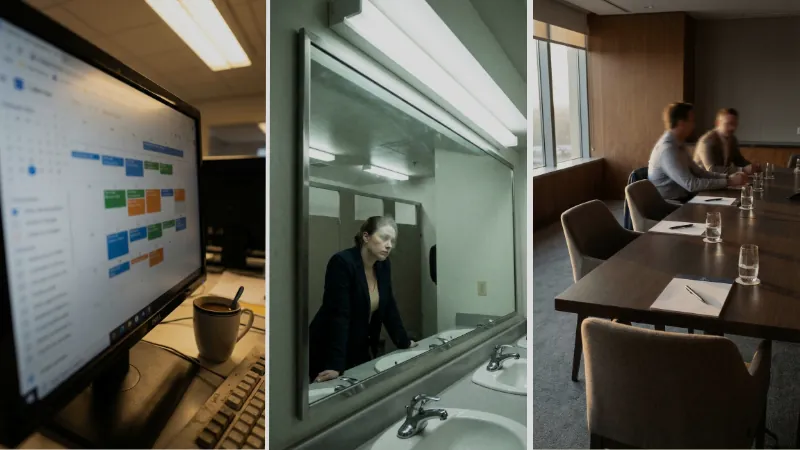
The Meeting Where I Wore the Wrong Thing and Nobody Noticed Except Me

The meeting was at 14:00. I had dressed for a desk day. No external people on the calendar, nothing requiring more than functional.
At 11:30, my manager forwarded a calendar invite. Two names I didn’t recognise had been added. No explanation.
I checked the original invite. It had been internal. Now it had clients in it — people from outside the bank, meeting us for the first time.
I was wearing a grey modal-blend top from Uniqlo. Slightly scooped neck, relaxed fit through the body. I wear it regularly; I own the same one in off-white.
I bought both after spending twenty minutes reading reviews and then deciding in ninety seconds in the store. They are €25 each. They wash well and don’t pill.
The trousers were fine. My Arket pair — mid-grey, straight leg, hemmed slightly because I am 1,65m and full-length trousers bunch at my ankle. The trousers were not the problem.
The top was the problem.
Eleven-thirty to fourteen-hundred
I did not go to the bathroom mirror immediately. I sat at my desk for twenty minutes and decided it was probably fine.
Then I spent fifteen minutes deciding it was not fine. Then I sent two emails. Then I looked up the clients’ company website and decided I was fine again.
The Mango blazer was on my chair — linen-cotton blend, unstructured, a dusty olive I had bought last spring. Not quite a work blazer. Not quite not one, either.
I checked the bathroom mirror at 12:00 with the blazer on. I took it off and put it back on. I was in there for four minutes, which I noticed.
The combination read as someone who dressed for a different day and then added a layer. Because that was what it was. But it was better than the top alone, and there was no other option.
I went back to my desk. I finished the emails. I thought about the top twice more before 14:00.
There is a difference between looking dressed and looking like you considered the room before leaving the house. The modal top is on the wrong side of that line for a client meeting. The fabric is soft and has a slight drape.
On a long desk day, that drape reads as ease. In a room with people meeting you for the first time, it reads as low stakes. Those are not the same thing.
The room
The clients were from a procurement consultancy. Both women. One wore a slim blazer over a fine-knit top; the other, a dark-print shirt dress in what looked like a viscose blend.
Neither outfit was remarkable. They were dressed for a first meeting with people they hadn’t met. My outfit was dressed for my desk — those are different jobs.
The meeting ran forty minutes. I contributed normally. Notes went the next morning; a follow-up was agreed and nothing I’d said was a problem.
But I sat slightly forward the entire time. I noticed this at the twenty-minute mark. I was tracking myself in the room — my posture, the blazer, whether the top was reading the way I feared it would.
In meetings I walk into feeling settled, I don’t do this. My attention stays on the conversation. That Tuesday afternoon, it was split between the conversation and my own collar.
The outcome was fine. The experience of being in the meeting was not quite fine. Those are two different things, and I find it slightly tedious that they can diverge over a €25 top.
What the top is
The Uniqlo modal top is not a meeting piece. It is a good desk piece. It works for days when I know exactly what the day is going to be.
The modal blend doesn’t hold structure the way a woven fabric does. Under pressure — a new client, a room where you’re being assessed — it starts to read as an afterthought.
I knew this when I bought it. I knew it when I put it on that morning. I did not know the day was going to change.
What I don’t have
I don’t keep a backup top at the office. Some people I work with do — a blazer on the coat hook, something neutral folded in a bottom drawer.
I tried this once, about three years ago. The drawer blazer stayed there for four months; I wore it once in a cold room at lunch, not a client situation, then took it home.
I have thought about doing it again. I have not done it.
I find the idea slightly depressing, which I understand is not a rational position. What it implies is a permanent state of being about to be caught out.
What I do instead is check my calendar before getting dressed. Most mornings. I had checked my Thursday calendar on Wednesday evening, and it had looked like a normal Thursday.
By 11:30 the next day, it wasn’t.
Afterwards
I thought about the meeting on the way home. Not the agenda, not the outcome. The top.
Five or six minutes on the U-Bahn. I know how that sounds.
The easy version of this story is: nothing went wrong, so nothing matters. I am not entirely sure that is right. How I was dressed affected how much attention went to monitoring myself versus staying in the conversation.
That is a real effect. Small, but real.
Two weeks after that meeting, I bought a COS shirt in off-white cotton poplin. Clean collar, no detail, fits under my blazers without bunching. I have worn it on three days since, including two I hadn’t expected to need it.
The modal top is still in my wardrobe. I wore it last Tuesday, at my desk, on a day that stayed exactly what it was supposed to be.