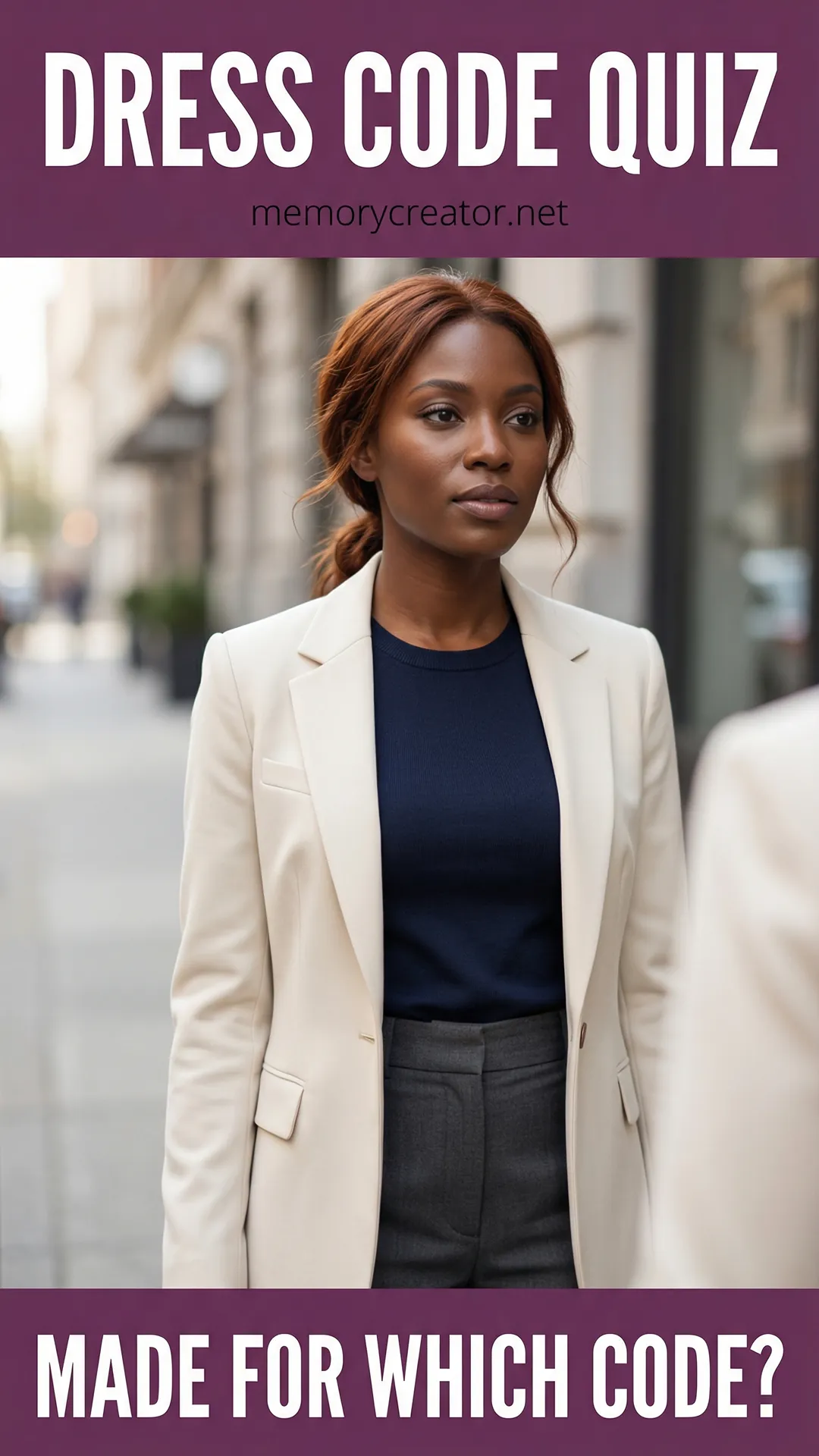
What Dress Code Were You Actually Made For?

In a 2014 study, Professor Karen Pine found that when women are stressed, they neglect 90% of their wardrobe. The main reason women dress up is not to look attractive but to feel confident. Yet many of us spend our working lives in clothes that achieve the opposite. I have a blazer that fits perfectly, from a good brand. I have worn it four times in three years. Every time, I spend the day adjusting my shoulders, feeling like I am playing a part. The research explains this. According to Joy Peluchette and Katherine Karl, how a dress code makes you feel depends heavily on whether it matches your natural preference. Wearing formal attire when you are a natural business casual person has a measurably different psychological effect.
The cost is more than discomfort; it is cognitive. Michael Slepian’s research at Columbia found that formal clothing only promotes abstract, strategic thinking if the wearer feels powerful in it. If the suit feels like a costume, it undercuts the very mechanism that should make it effective. Separately, a well-known study had women complete math problems while wearing a swimsuit. Their performance was worse than those in a sweater, because mental resources were diverted to managing the clothing’s symbolic meaning. This is not about looking wrong. It is about your brain being occupied with something other than your work. The underlying mechanism is described by the Enclothed Cognition framework from Hajo Adam and Adam Galinsky: clothing’s effect requires both symbolic meaning and the physical experience of wearing it.
Peluchette and Karl’s framework maps the trade-offs. Formal business attire creates peak feelings of authority and competence. Business casual creates peak friendliness and, in a follow-up study, peak productivity. Creativity peaks in casual wear. There is no single best dress code. There is only the one that aligns what you need to do with how you need to think. You might be in a formal office but your role requires relentless collaboration, making business casual your functional tool. Or you might need the psychological distance of a blazer to think strategically, making formal wear your advantage. Research by Howlett et al. (2015) adds another layer: women in senior roles often face the harshest judgments for even subtle deviations from expected dress, which can make navigating these choices feel even more fraught.
The quiz below is built from these models. It uses questions based on the research, like your instinct before a high-stakes meeting or how long an ill-fitting outfit occupies your mind. Eight questions. Under two minutes. You might not like the answer.
You have a big meeting with people you’ve never met. Your first instinct is to:
You’re stuck in an outfit that feels wrong all day. How much does it bother you?
When you choose to dress up, what’s the real reason?
You’re in stiff, structured clothes. Does your thinking feel sharper or more scattered?
A peer shows up to a formal event in smart jeans and a great blazer. Your gut reaction is:
Your company announces a strict ‘business formal’ policy starting next month. You think:
When you feel most confident at work, what’s the source?
Be honest: how long does picking a Monday work outfit usually take?
Natural Creative Casual
You operate best when your clothes are a non-issue. Research from Peluchette and Karl shows formality actively hinders creativity and friendliness for you. The cognitive tax is high—you lose mental bandwidth to self-monitoring. To protect your productivity, stick to clothes that feel like you, even in professional settings.
Natural Smart Casual
Structure feels like restriction. You need clothes that signal competence without creating social distance. Studies by Karl et al. find business casual is the sweet spot for trustworthiness and collaboration. To stay in your peak zone, aim for smart trousers and a blouse, or a relaxed blazer with jeans.
Natural Business Casual
You’re the proof of the data. Research consistently finds business casual is the peak for perceived trustworthiness and self-reported productivity. The ‘enclothed cognition’ effect works because your clothes match your internal role—no friction. Keep a wardrobe of tailored separates you can mix and match without thinking.
Natural Business Professional
Formality doesn’t costume you; it focuses you. Columbia University research shows formal wear triggers a sense of power, shifting you into strategic mode. The authority-competence peak outweighs the friendliness trade-off. Invest in high-quality structured pieces that make you feel genuinely powerful, not just compliant.
Natural Formal
You are the exception. Your cognitive performance is tightly linked to formal signalling. Studies show you’d likely feel a drop in perceived friendliness, but for you, the gains in authority and abstract thinking are worth it. Choose formal wear that feels authentically powerful, not just like a uniform.
What Your Result Actually Means
Business Formal. You scored here because clothes are a tool for you, not a source of friction. The research by Slepian et al. on formal clothing and abstract thinking likely applies: you feel the increased psychological distance and power, and it sharpens your focus. The real-world cost of being in the wrong code for you is boredom and a lack of rigour; a casual environment might feel unfocused. If this is your result but not your reality, the mismatch is costly. Peluchette and Karl’s work shows that when personal preference and actual dress mode align, self-perceptions of authority and competence are highest. One concrete thing: if your workplace is casual, establish one formal ritual. Wear a full suit for weekly planning every Monday. Use the enclothed cognition effect to trigger the right mindset for that task.
Business Professional. This result indicates you operate best with clear structure, but value some physical ease. You likely land here because you feel most trustworthy and competent with defined parameters, but find full formalwear occasionally draining. According to the Karl, Hall & Peluchette (2013) study, this zone often represents the peak for perceived trustworthiness and productivity combined. The cost of being forced into full casual wear is a sense of being underestimated; the cost of being forced into strict formal is a drop in perceived friendliness and creativity. One concrete thing: audit your wardrobe for “structured comfort.” Look for pieces like ponte knit blazers, tailored jersey dresses, or high-rise trousers with stretch. Brands like COS and Arket specialise in this. The goal is to keep the symbolic structure while improving the physical experience of wearing it.
Business Casual. This is the productivity sweet spot identified in research. You scored here because you likely prioritise feeling approachable and getting into a state of flow over projecting unimpeachable authority. The Peluchette & Karl (2007) data shows this code maximises friendliness without a significant drop in perceived competence. The cost of being overdressed for you is tangible: you feel distant from colleagues and your thinking can become overly abstract when you need to be detail-oriented. If your office is formal, this mismatch explains why you feel exhausted by Friday. One concrete thing: if you must wear a blazer, choose one in a soft fabric like a wool-cashmere blend or an unstructured linen. Pair it with a turtleneck and straight-leg trousers. This gives the visual cue of a layer without the rigid shoulders that create psychological social distance.
Smart Casual. Your result points to a high sensitivity to the “cognitive tax” of wrong outfits. You likely lose mental bandwidth if your clothes feel restrictive or inauthentic. This aligns with the principles of enclothed cognition, where both symbolic meaning and physical experience must align for optimal effect. The research by Howlett et al. suggests you may also be less harshly judgmental of others’ dress, focusing more on output than code. The cost of being in a formal environment is a constant, low-grade drain on your focus. One concrete thing: focus on fabric and fit intelligence. Seek out “technical” fabrics from brands like Uniqlo or Decathlon that look like ordinary cotton but have four-way stretch and wrinkle resistance. A stretch-modal blend t-shirt under a tailored overshirt can pass in many business casual environments while feeling like weekend wear.
Creative Casual. You are likely in a role, or have a mindset, where creativity and autonomous thinking are primary. The research is clear: formal attire scores lowest on self-perceptions of creativity. If you are forced into it, your sense of authentic self-expression is stifled, which can impact output. The cost is not just personal discomfort; it is a potential reduction in innovative work. Karen Pine’s finding about stressed women using only 10% of their wardrobe is relevant here—your whole wardrobe might feel off-limits. One concrete thing: ignore categories and focus on a uniform. Find one outfit formula that meets the bare minimum of your workplace’s code (e.g., dark jeans, a solid coloured top, a “third piece” like a cardigan or jacket) and buy it in multiple colourways. This minimises decision fatigue and preserves mental energy for your actual work.
How to Wear Your Result
First, diagnose the actual requirement. Is the stated dress code the real one? Look at what the most respected person in your direct role wears, not the company-wide policy. If the head of your department wears smart casual, that is your effective code. This bypasses anxiety about hypothetical formal meetings. The Howlett et al. study showed that senior professional women are the harshest judges of subtle deviations, so aligning with your immediate superiors is a practical move. For a deeper breakdown, our Business Dress Code Guide decodes the common terms.
Build from a core uniform. Pick two bottom halves that work (e.g., tailored trousers, a dark skirt). Pick three tops that layer well (a fine-gauge merino rollneck, a silk-blend shirt, a simple shell). Add two “third pieces” (an unstructured blazer, a long cardigan). Rotate them. This reduces the Monday morning decision time linked to dress-code misalignment. I do this with Uniqlo trousers and Arket knits. It is not exciting, but I have not thought about what to wear on a Tuesday in two years.
Invest in fabric, not trends. Your goal is to align the physical experience of wearing clothes with their symbolic meaning. A stiff, cheap polyester blazer will never feel powerful; it will feel itchy. Look for natural fibres with a small percentage of elastane for movement. Ponte knit, heavy jersey, and wool blends are reliable. I have a pair of Weekday trousers that are viscose-elastane. They look like proper trousers but feel like joggers. I wore them four times in one week, which for me is a lot.
Use enclothed cognition deliberately. If you are a natural business casual person but have a quarterly board presentation, do not wear your full suit for a week to “practise.” Wear it only for the specific task that requires its psychological effect—the presentation rehearsal, the actual meeting, and perhaps the hour of focused preparation beforehand. Change afterwards. This honours the research that the effect is tied to wearing the garment for a specific context. A 2023 meta-analysis confirmed the enclothed cognition effect is real but context-dependent.
Negotiate with accessories. If the code is stricter than your natural preference, your leverage is in details. A formal dress code might require a blazer, but it rarely specifies that the blazer cannot be in a soft knit or corduroy. It might require closed-toe shoes, but not necessarily heels. A 2023 Syndio report on workplace equity notes that inflexible dress codes can disproportionately impact women. Making small, compliant substitutions based on comfort is a form of pragmatic negotiation. Our Business Formal Guide has examples of compliant, comfortable pieces.
Conduct a weekly audit. On Friday afternoon, spend five minutes noting what you wore each day and one word for how you felt in it (“distracted,” “confident,” “neutral”). Do not analyse motivation. After a month, patterns emerge. You will see that the navy COS dress works for client days but makes you impatient on deep-work days. This data is more useful than any style guide. It directly applies the self-perception research from Peluchette and Karl to your specific context.
If your role and your natural dress code are permanently at odds, consider a physical anchor. This is one item you wear that aligns with your natural preference, hidden from view. A creative casual person in a formal office might wear bright socks or a specific bracelet. A formal person in a casual startup might wear tailored underwear or a precise watch. The physical sensation of wearing something that feels like “you” can slightly offset the cognitive friction of the main outfit, a low-stakes application of the enclothed cognition principle.
Understand the productivity gap. Peluchette & Karl’s (2007) research found that employees who wore attire that did not match their personal preference reported significantly lower self-perceptions of productivity, creativity, and friendliness. If you feel your output is suffering, your clothes might be a factor. Track your output for a week in your preferred style versus a week in a mandated style, if possible. The difference can be revealing.
Check your assumptions about others. The Howlett et al. study found that employed women were harsher judges of other women’s competence based on small clothing cues than students were. If you find yourself making snap judgments about a colleague’s outfit, question it. That judgment might be an internalised pressure you’re applying to yourself. Redirect that mental energy to evaluating their work instead.
Sources
Adam, H. & Galinsky, A.D. (2012). “Enclothed cognition.” Journal of Experimental Social Psychology, 48(4), 918-925. https://doi.org/10.1016/j.jesp.2012.02.008
Howlett, N., Pine, K.J., Cahill, N., Orakçıoğlu, I. & Fletcher, B. (2015). “Unbuttoned: The interaction between provocativeness of female work attire and occupational status.” Sex Roles, 72(3-4), 105-116. https://doi.org/10.1007/s11199-015-0450-8
Karl, K.A., Hall, L.M. & Peluchette, J.V. (2013). “City employee perceptions of the impact of dress and appearance: You are what you wear.” Public Personnel Management, 42(3). https://doi.org/10.1177/0091026013495772
Peluchette, J.V. & Karl, K. (2007). “The impact of workplace attire on employee self-perceptions.” Human Resource Development Quarterly, 18(3), 345-360. https://doi.org/10.1002/hrdq.1208
Slepian, M.L., Ferber, S.N., Gold, J.M. & Rutchick, A.M. (2015). “The cognitive consequences of formal clothing.” Social Psychological and Personality Science, 6(6), 661-668. https://www.columbia.edu/~ms4992/Publications/2015_Slepian-Ferber-Gold-Rutchick_Clothing-Formality_SPPS.pdf