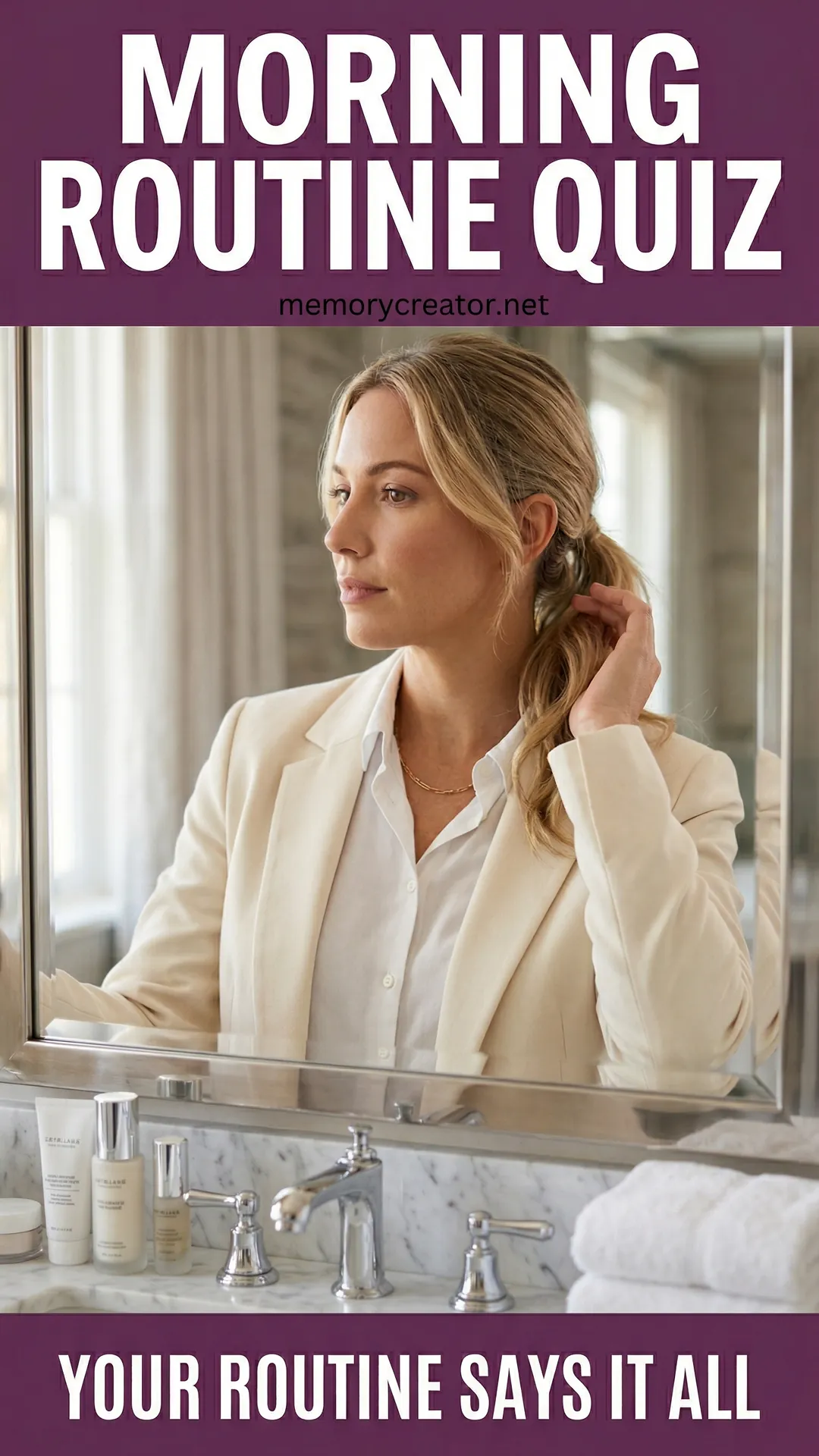
What Does Your Morning Routine Say About Your Style?

A study of over 1,000 parole decisions found that a judge’s likelihood of granting parole starts at around 65% after a meal break and drops to nearly zero just before the next one. The legal facts do not change. The only variable is the judge’s depleted mental resources from making a long sequence of prior decisions. If that is what sequential decision-making does to a trained professional, consider what it does to you at 7:45 a.m. in front of your wardrobe.
Research by psychologist Wendy Wood suggests about 43% of daily behaviour is habitual, performed without conscious thought. Your morning is not a series of choices. It is a series of autopilot routines you may not have designed. When those routines fail, you default to whatever causes the least friction in that moment. The outfit you leave in is not chosen. It is what survived.
The popular idea that building a habit takes 21 days is a myth from a 1960s plastic surgery book. A more rigorous study from University College London found it takes an average of 66 days, with a range of 18 to 254. Simpler actions become automatic faster. Getting dressed is not a simple action. It is a chain of micro-decisions about fit, occasion, and weather. When this process fails, the cost is more than time. One industry survey estimated the average woman spends about 12 minutes a day choosing an outfit. I have personally spent that long staring at a pair of black trousers, trying to decide if they are the right kind of black for the day.
This is not a problem of willpower or a disorganised closet. It is a systems problem. Your morning routine is a diagnostic tool. It shows you exactly where your automatic behaviour breaks down. This quiz maps that breakdown to one of five common patterns.
Eight questions. Under two minutes. You might not love the answer.
You open your closet on a normal Tuesday morning. What happens?
How many times will you wear an outfit you really like before you stop?
You’re running late. What gets sacrificed?
You have a big presentation. How many outfit attempts before you leave?
You buy a new piece to ‘solve’ a morning problem. Does it work?
Describe your closet’s current state in one word.
An outfit feels wrong by lunchtime. How long does that feeling last?
On Sunday evening, what are you thinking about your week’s clothes?
The Last-Minute Gambler
You treat getting dressed as a spontaneous, in-the-moment decision. Research suggests about 43% of daily behaviour is habitual, done without thinking. You’ve pushed this to near 100% for your wardrobe, which costs you time and induces low-grade panic each morning. The fix isn’t more clothes; it’s creating one simple, repeatable cue-routine-reward loop you can default to.
The Repeat Offender
You have a few reliable outfits, but your closet is a museum of past experiments. You default to the same pieces because deciding among the rest is mentally taxing—a classic symptom of decision fatigue. The cost is a wardrobe full of clothes you don’t wear and a nagging sense of wasted potential. The fix is a ruthless edit: reduce choices so your defaults are also your best options.
The Overthinker
You approach your wardrobe as a series of conscious, optimised decisions. This engages your prefrontal cortex for a task that should, by now, be largely habitual. The mental effort depletes willpower you could use for actual work. Studies on ego depletion show this leads to poorer decisions and more impulsivity later. The fix is to move planning out of the morning and make your choices the night before.
The Uniform Builder
You’ve instinctively built a uniform. This is the most efficient habit model: a single, strong cue triggers a reliable routine. The downside can be rigidity—your system might not adapt well to unexpected events or seasons. The data shows simple habits form fastest. Your task is to audit this uniform for genuine satisfaction, not just toleration, and build one or two variations for flexibility.
The Sunday Night Planner
You’ve externalised the decision-making. By planning ahead, you protect your morning cognitive resources. This aligns with the Fogg Behavior Model: you’ve engineered high ability (it’s easy) and a clear prompt (the pre-selected outfit). The potential cost is over-engineering and a lack of spontaneity. The fix is to keep the system but allow one ‘wild card’ day where you choose in the moment, just for practice.


What Your Result Actually Means
The Overthinker scores here because your morning involves active, effortful decision-making when you have the least mental energy for it. You are manually processing variables like formality level, colour coordination, and perceived appropriateness for every meeting. This directly taps into what Roy Baumeister termed ego depletion: each volitional act depletes a finite mental resource. The real-world cost is that you start your workday already fatigued, which research links to increased passivity and a tendency to default to the status quo in later decisions. This week, commit one high-stakes outfit to memory. Write it down: “Grey Arket blazer, black Uniqlo turtleneck, navy trousers.” On that day, you do not open your wardrobe. You put on that uniform.
The Last-Minute Gambler does not have a missing prompt; you have a missing routine. BJ Fogg’s Behaviour Model states that a behaviour requires motivation, ability, and a prompt. Your prompt is the alarm clock, but you lack a pre-designed routine to execute. Your brain defaults to the fastest available option, which is rarely the most appropriate. The cost is a persistent, low-grade anxiety that you are underdressed or mismatched, which can undermine your perceived credibility before you speak. The fix is not more time. It is a simpler first step. Tonight, place one complete, weather-appropriate outfit on a single hanger by your door. Tomorrow, your only task is to put it on.
The Uniform Builder has successfully outsourced decision-making to habit. Wendy Wood’s research indicates people with high self-control scores often just have better habits. Your brain has chunked the routine, likely using Charles Duhigg’s Habit Loop of cue, routine, and reward. The risk is stagnation. A uniform works until it doesn’t—a change in role, climate, or personal style can render it obsolete, and you have no system for adaptation. Your task this week is to audit one piece of your uniform. Is it worn out? Does it fit perfectly? If not, schedule one hour to find a replacement. Do not buy three alternatives. Find one direct successor.
The Repeat Offender has a closet full of clothes you do not wear, anchored to a past version of your life or self. The context-dependent repetition model shows habits form in stable contexts. Your closet context is unstable; it contains too many items that do not fit your current reality. The cost is twofold: wasted money and the daily visual reminder of that waste, which creates background stress. This Saturday, remove five items you have not worn in a year. Do not donate them yet. Place them in a box. If you do not open that box in four weeks, you have your answer.
The Sunday Night Planner uses foresight to bypass morning depletion. This is the most cognitively efficient pattern. You are strategically allocating decision-making to a time of higher resource availability, much like a judge after a break. The potential weakness is rigidity. A perfectly planned week can derail with one unexpected forecast or meeting change, leading to frustration. To build resilience, plan four core outfits for the week, but leave one weekday slot open. Label it “Flex.” On that morning, you have permission to choose from two pre-selected options based on your actual mood and weather.
Redesigning Your Morning, One Habit at a Time
Plan your week on Sunday, but do not plan every detail. Use the weather forecast and your digital calendar to block out basic needs: a formal day, a casual day, days you will be walking more. Then, physically pull those outfits and hang them together. This act of physical retrieval makes the decision concrete. Research on implementation intentions shows that deciding in advance, in a different context, drastically reduces the cognitive load when the time comes. If your workplace dress code is a source of confusion, the Business Casual Guide defines the parameters so you are not guessing.
Build a uniform, not a single outfit. Identify three trousers that fit perfectly and four tops that work with all of them. Two blazers or cardigans complete the set. This creates a modular system, not a rigid costume. As Wendy Wood’s work indicates, this structures your context so the right choice is the only easy choice. You are not deciding between 30 items. You are executing a pre-wired sequence from a curated subset. For more structured outfit formulas, the Corporate Outfits Guide has specific combinations. Shop for this deliberately: look for fabrics like ponte or merino wool that resist wrinkles and can be worn multiple times between washes.
Reduce the number of decisions before you even open the closet. Eliminate broken, uncomfortable, or ill-fitting items. Every piece that does not work is a decision point that will lead to a dead end. This is a direct application of the Fogg Behaviour Model: you are increasing your ability to succeed by removing obstacles. A simple, well-edited wardrobe of maybe 30 core items is more functional than a stuffed closet of 100. I wear a rotation of about 15 items from October to March.
Set a literal timer for five minutes when you start getting dressed. The study on judicial decision fatigue illustrates how prolonged deliberation degrades quality. The timer creates an artificial break and forces a conclusion. If you have not decided in five minutes, you put on your predetermined default outfit. This prevents the spiral. Your default should be your most confident, comfortable combination—something like a Weekday jersey dress and boots.
For high-stakes days, do a full dress rehearsal the night before. Move in the outfit. Sit down. Raise your arms. An outfit that feels fine on a hanger can become a distraction during a presentation if a seam pulls or a sleeve rides up. This practice run eliminates “unknowns,” which are a primary source of morning anxiety. It turns a multi-variable problem into a simple, executable action.
Start with a ‘tiny habit’ to build momentum. According to BJ Fogg’s research, motivation is unreliable. Instead, make the first step so small it’s impossible to fail. Tonight, commit to just laying out your socks. Not the whole outfit. Just the socks. This tiny success wires in a feeling of accomplishment and makes the next step—adding a top—easier tomorrow. The goal is to feel good, not to execute a perfect routine from day one.
Design your environment, don’t rely on discipline. Wendy Wood’s key finding is that people who seem disciplined are usually just better at structuring their surroundings. You can apply this by making your target outfit the most visible thing in your closet. Use a dedicated rack or the front of your rail. If your goal is to wear more colour, fold your black sweaters and put your coloured ones on top of the pile. Your brain will follow the path of least resistance you create. If rules are unclear, a definitive Business Dress Code Guide can remove guesswork.
Sources
Baumeister, R.F., Bratslavsky, E., Muraven, M., & Tice, D.M. (1998). Ego depletion: Is the active self a limited resource? Journal of Personality and Social Psychology, 74(5), 1252–1265. https://doi.org/10.1037/0022-3514.74.5.1252
Danziger, S., Levav, J., & Avnaim-Pesso, L. (2011). Extraneous factors in judicial decisions. Proceedings of the National Academy of Sciences, 108(17), 6889–6892. https://doi.org/10.1073/pnas.1018033108
Fogg, B.J. (2009). A behavior model for persuasive design. Proceedings of the 4th International Conference on Persuasive Technology (Persuasive ’09). https://doi.org/10.1145/1541948.1541999
Lally, P., van Jaarsveld, C.H.M., Potts, H.W.W., & Wardle, J. (2010). How are habits formed: Modelling habit formation in the real world. European Journal of Social Psychology, 40(6), 998–1009. https://doi.org/10.1002/ejsp.674
Wood, W. (2019). Good Habits, Bad Habits: The Science of Making Positive Changes That Stick. Farrar, Straus and Giroux.