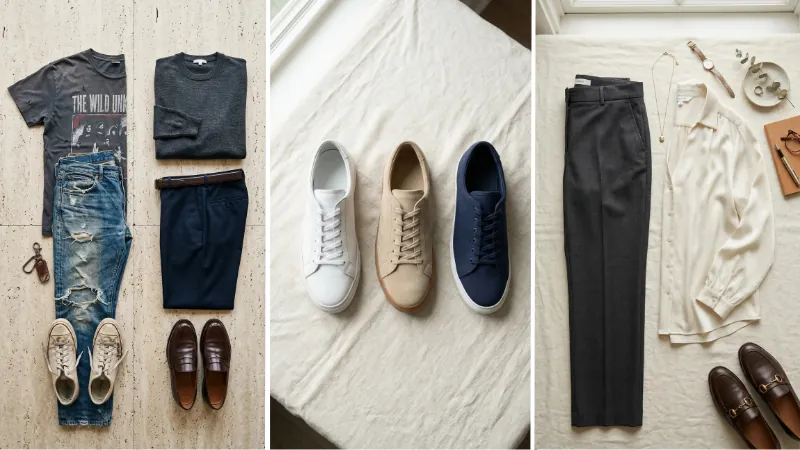
Smart Casual for Women: How to Balance Denim and Tailoring

The dress code “smart casual” usually triggers a bizarre daily panic. Most women default to throwing a rigid boardroom blazer over washed-out weekend denim, creating a completely disjointed silhouette. Spent years decoding this exact gray area for junior analysts who kept showing up to client lunches in inappropriate knitwear.
You do not need an overflowing closet to master this. Just a highly functional capsule and mathematical outfit proportions. Built this definitive reference guide to eliminate the morning guesswork entirely. Broke down the exact formulas to bridge the gap between structured tailoring and relaxed pieces so you are properly dressed for any ambiguous occasion.
What Is Smart Casual for Women?
You have read the words “smart casual” three times. You are standing in front of a full wardrobe. You are genuinely unsure whether the blazer makes it too formal or skipping it makes it too sloppy. The invitation offers no further guidance. Neither does the internet, which will tell you both answers with equal confidence.
This is the actual problem with the smart casual dress code for women. Not that the clothes don’t exist. That the definition doesn’t hold still.
So here is a working one: smart casual sits deliberately between business casual and relaxed casual. Structured, but not stiff. Put-together, but not performing. You look like you made a decision. Not like you are attending a board meeting.
What it is not matters just as much. Smart casual attire for women is not office-formal. It is not weekend-lazy. And it is not “just add a blazer to anything” — that is a myth that has produced a lot of regrettable outfits.
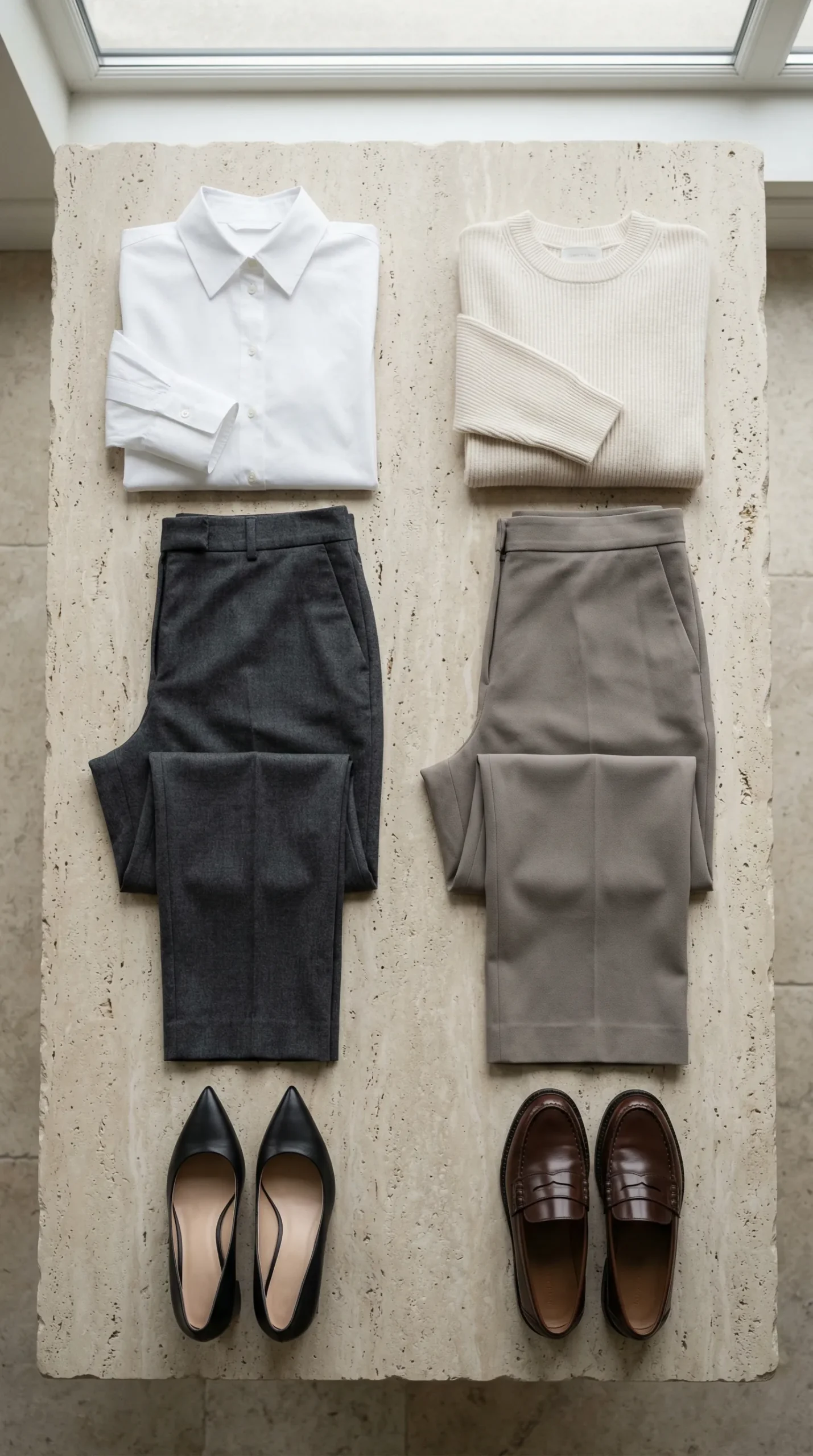
The distinctions are easier to see when you put the codes next to each other. Business casual means tailored trousers and a structured blouse. Smart casual means those same trousers with a relaxed knit instead. One reads as work. The other reads as intentional but human.
| Dress Code | Structure Level | Typical Pieces | Where It Belongs |
|---|---|---|---|
| Business Formal | Highest | Matched suit, structured blazer, closed-toe heels, silk blouse | Board presentations, court, senior client meetings |
| Business Casual | High | Tailored trousers, structured blouse, blazer optional, low heels or clean flats | Most professional offices, internal and external meetings |
| Smart Casual | Medium-High | Dark jeans or chinos, relaxed knit, loafers or ankle boots, one structured piece | Casual Fridays, dinner invitations, creative industries, after-work events |
| Casual | Low | T-shirts, sneakers, lightwash jeans, sweatshirts | Weekends, errands, social plans with no professional dimension |
The table makes it look orderly. In practice, the line between smart casual and business casual is where most women get stuck. And reasonably so. The gap between them is not about the category of clothes. It is about how relaxed the individual pieces are.
One tailored trouser in a stiff wool blend reads business casual. The same silhouette in a softer fabric, worn with a knit top instead of a structured blouse, crosses into smart casual women’s territory. Same shape. Different weight. Different message.
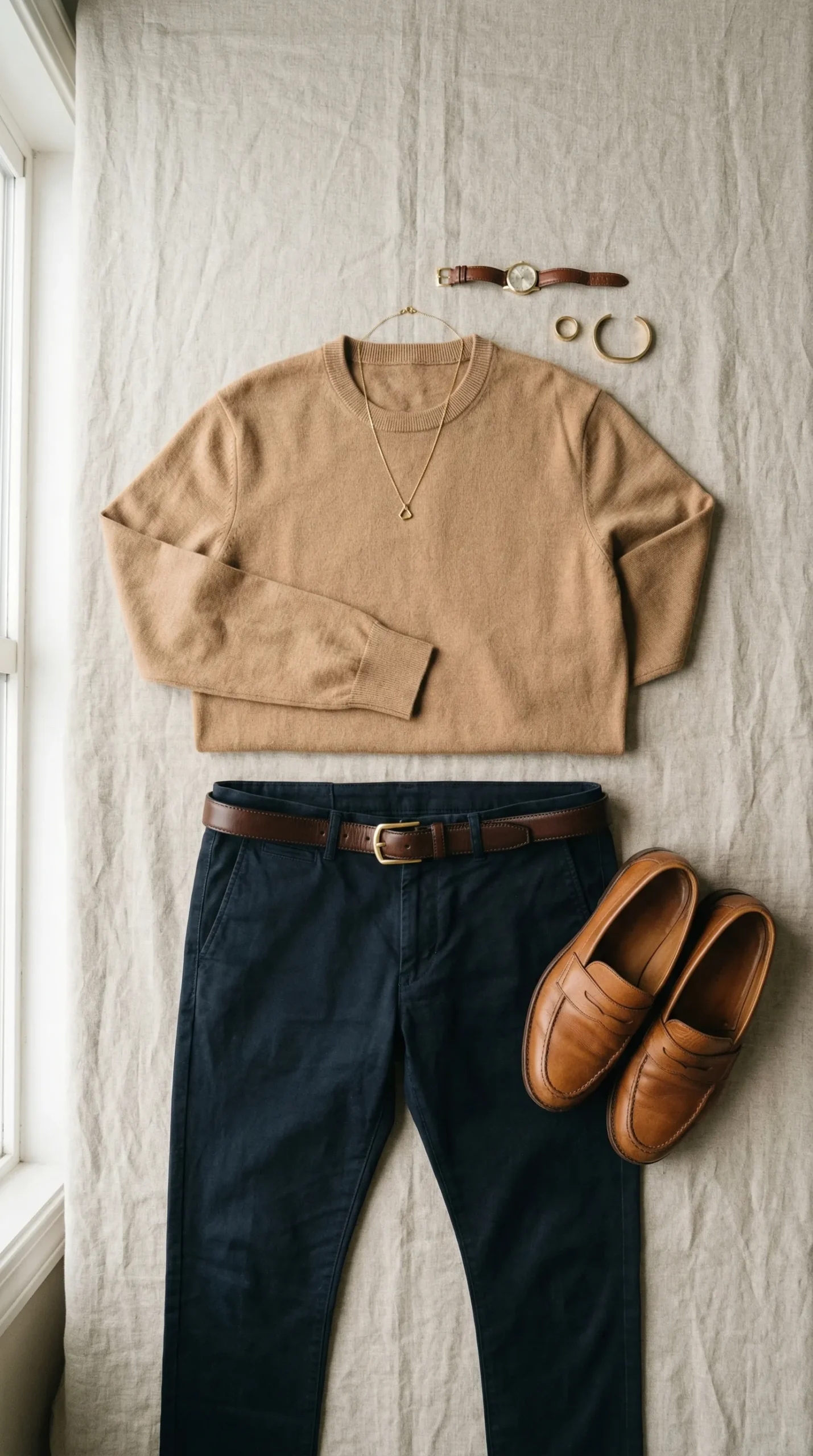
My take: the women smart casual dress code is the most livable dress code on the list, and I think most women would dress better overall if they understood it as a genuine style system rather than a fallback for when the rules run out.
The one principle that holds across every version of smart casual: you need at least one polished piece and at least one relaxed piece in the same outfit. Always. Both ends of that balance matter. All polish and you have drifted into business casual. All relaxed and you have drifted into nothing in particular.
That balance is the actual definition. Everything else is detail.
The Smart Casual Capsule Wardrobe
You know the feeling. An invitation arrives. Smart casual. And suddenly you’re standing in front of a full wardrobe thinking you have nothing to wear. Not because the wardrobe is empty. Because nothing in it was bought with that specific in-between occasion in mind.
That’s the real problem. Most women don’t have a wardrobe gap. They have a planning gap. They’ve accumulated plenty of clothes, but not the right ones — the ones that work equally well for a Friday client lunch, a Saturday gallery visit, and a Sunday dinner that isn’t quite casual but isn’t quite formal either.
Smart casual clothing for women isn’t a dress code. It’s a register. And once you own the right pieces, you stop buying something new before every event that doesn’t fit neatly into “office” or “weekend.”
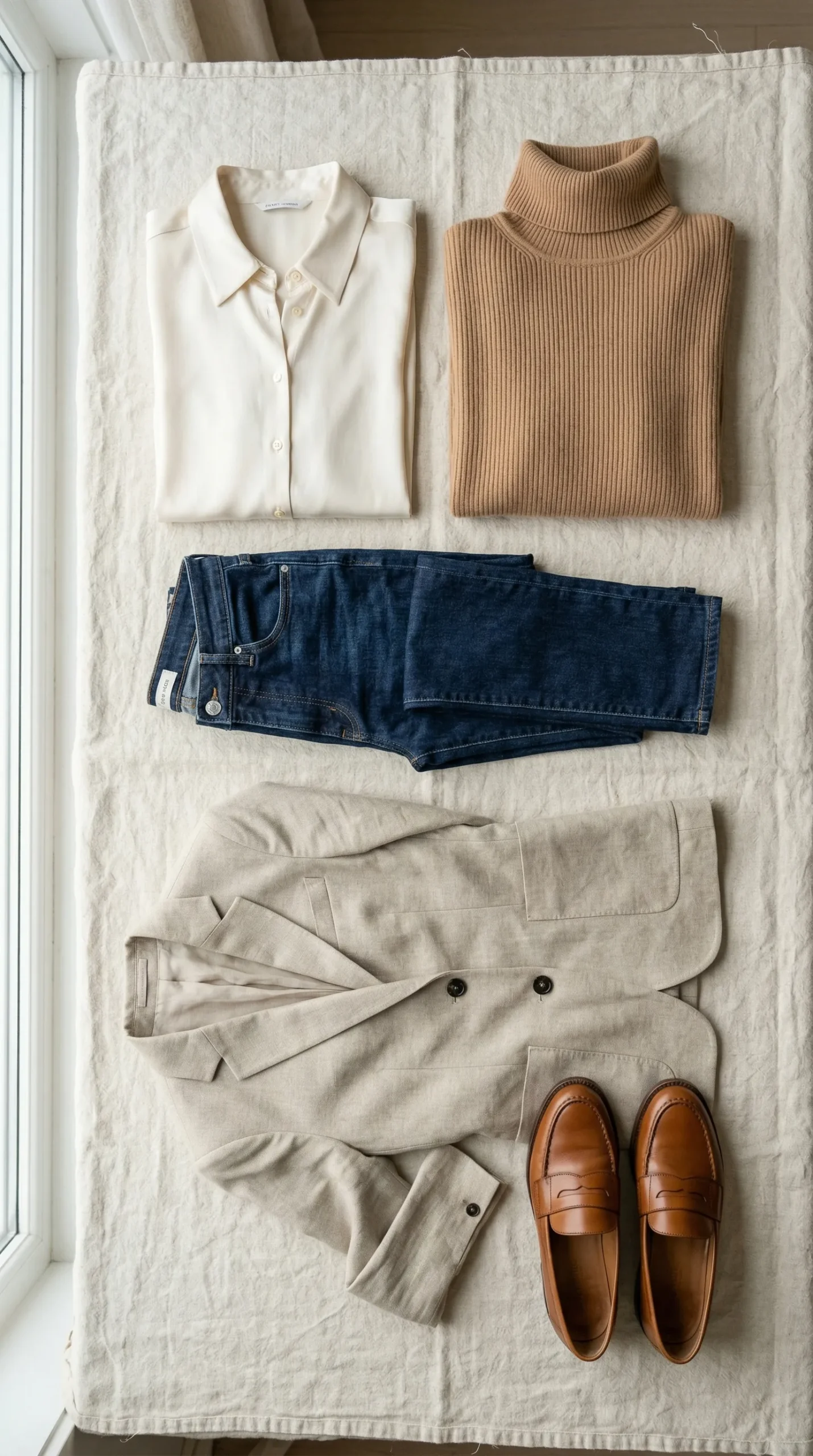
These are the pieces. Buy them once. Wear them everywhere.
| Item Category | Specific Example | Why It Works |
|---|---|---|
| Silk or satin blouse | Ivory or cream, loose tuck | Reads polished without trying. Pairs with trousers and jeans equally well. |
| Tailored trousers | Mid-grey or camel, straight or wide leg | The single most versatile bottom you can own. Dresses up or down depending entirely on what you put on top. |
| Structured blazer | Neutral tone, defined shoulder | Elevates any outfit by one register. Works over a tee, over a blouse, over almost anything. |
| Dark-wash denim | Slim or straight, no distressing | Earns its place in smart casual when paired correctly. More on that below. |
| Ribbed knitwear | Merino rollneck or fine-gauge crewneck | Better texture than a plain tee. Holds its shape. Looks intentional without being stiff. |
| Midi skirt | A-line or straight, muted tone | The hemline does the work. Sits in the sweet spot between casual and formal without effort. |
| Loafers or low-block-heel shoes | Leather or leather-look, neutral | Footwear either confirms or kills a smart casual outfit. These confirm it. |
| Classic coat | Camel or charcoal, knee-length | The first and last thing people see. A good coat makes everything underneath look more considered. |
Tops — Blouses, Knits, and Shirts
Smart casual women’s attire lives or dies at the top. It’s the first thing that reads. And the most common mistake is treating any top as acceptable as long as the bottom is polished. It isn’t.
Three categories earn their place here. Each one comes with a disqualifier.
- Silk or satin blouses. These are the workhorses. They have a natural drape that communicates effort without stiffness. Disqualifier: anything sheer enough to require a camisole layer underneath. That’s lingerie logic, not smart casual logic.
- Structured knitwear. A ribbed merino rollneck or a fine-gauge crewneck reads as polished because the fabric holds its form. Disqualifier: anything that pills after two washes or goes shapeless at the hem. Thin cotton tees fall here. They’re weekend, not smart casual.
- Crisp button-downs. Cotton or linen, properly pressed, properly fitted through the shoulder. Disqualifier: oversized men’s-style shirts with the sleeves rolled to the elbow. That’s casual. Not the smart kind.
Fabric quality matters here for a specific reason. Cheap fabric moves wrong. It clings, it bags, it reflects light in a way that looks synthetic under fluorescent office lighting or in a dim restaurant. A ribbed merino rollneck holds its silhouette across a twelve-hour day. A thin cotton tee does not. That’s not a price argument. It’s a physics one.
My take: A silk blouse in a neutral ivory is the single best investment in this category, and if you only buy one top this year, that’s the one.
Bottoms — Trousers, Skirts, and Jeans
The four options that actually work for smart casual wear for women: tailored trousers, midi skirts, chinos, and dark-wash denim. In that order of reliability.
Tailored trousers are the safest. High waist, straight or wide leg, a fabric with enough weight to hold a clean line when you’re standing. They work in every smart casual room without you having to make a case for them.
Midi skirts earn their place because of hemline geometry. A midi length — roughly mid-calf — sits far enough from both mini and maxi territory that it reads as deliberate. A-line or straight. Avoid anything with too much volume unless the fabric is heavy enough to drape properly.
Chinos are underrated. Slim-fitting, well-pressed chinos in a neutral tone (stone, camel, olive) function almost as well as tailored trousers in most smart casual contexts. The fit is everything. Baggy chinos look like they belong on a building site.
And then: smart casual women’s jeans. Yes. With conditions.
- Dark wash only. The dye makes the fabric read closer to a trouser.
- No distressing. No fading. No rips, raw hems, or whiskering at the thigh.
- The pairing carries the weight. Dark slim jeans with a blazer and loafers qualify. The same jeans with a graphic tee do not.
This won’t work if: the occasion is a wedding reception, a gallery opening, or anything where “smart casual” is being used as a polite way of saying “please dress up.” Jeans can get you to the upper register of casual. They can’t always clear the bar of genuinely formal smart casual.
Blunt truth: Most women own the right jeans already. The issue is the pairing, not the denim itself.
Trade-off: Chinos are more comfortable than tailored trousers for long days. But they wrinkle faster and look noticeably less polished by 4pm. That’s worth knowing before you wear them to something that starts at 6.
Layering — Blazers, Cardigans, and Coats
If you own one piece that earns its cost per wear in smart casual dressing, it’s a blazer. Not because it’s stylish. Because it works mechanically. It adds shoulder definition. It creates a vertical line. It signals that you dressed with intent rather than convenience.
But not all blazers do the same job. There are three distinct versions here, and using the wrong one for the context is a real issue.
- Structured blazer. Defined shoulder seam, firm fabric, fitted through the chest. This is the one that takes a silk blouse into evening territory. A structured blazer over a silk blouse at a dinner reservation is not overdressed. It’s correctly dressed.
- Relaxed blazer-sweater hybrid. Softer construction, often in a knit or ponte fabric. This works for casual smart occasions where a full structured blazer would feel stiff. Think: a creative agency, a lunch that’s technically a meeting, a Sunday afternoon that requires slightly more than jeans and a tee.
- Oversized blazer. This one needs managing. On the right frame with the right bottom, it reads as deliberately relaxed. On the wrong combination, it reads as “I borrowed this.” An unstructured linen blazer over dark slim jeans on a warm Saturday afternoon is weekend-appropriate and looks considered. The same blazer over wide-leg trousers can easily tip into shapeless.
Cardigans play a supporting role. A fine-gauge, fitted cardigan in a neutral can substitute for a blazer in lower-key contexts. But it doesn’t carry the same authority. If you need to walk into a room and look like you belong there immediately, the cardigan is not doing that work.
Coats matter more than most people account for in smart casual for women. The coat is what people see as you arrive. A knee-length coat in camel or charcoal over any of the outfits above instantly confirms that you understood the dress code. A puffer, even an expensive one, does not.
My take: One structured blazer in a neutral tone is worth three “relaxed” ones. Buy the structured one first.
Trade-off: Linen blazers look considered and breathe well in warm weather. They also crease within the first hour of sitting down. That’s not a reason to avoid them. It’s a reason not to wear them to anything where you need to look the same at the end of the evening as you did at the start.
Smart Casual Shoes
You own thirty pairs of shoes. Maybe more. And yet, every morning, you reach for the same white sneakers. Not because they’re right. Because everything else feels like it’s trying too hard, or not hard enough.
That gap, between “too casual” and “too formal,” is exactly where smart casual women’s shoes live. And it’s a narrow gap. Get it wrong and the whole outfit reads off.
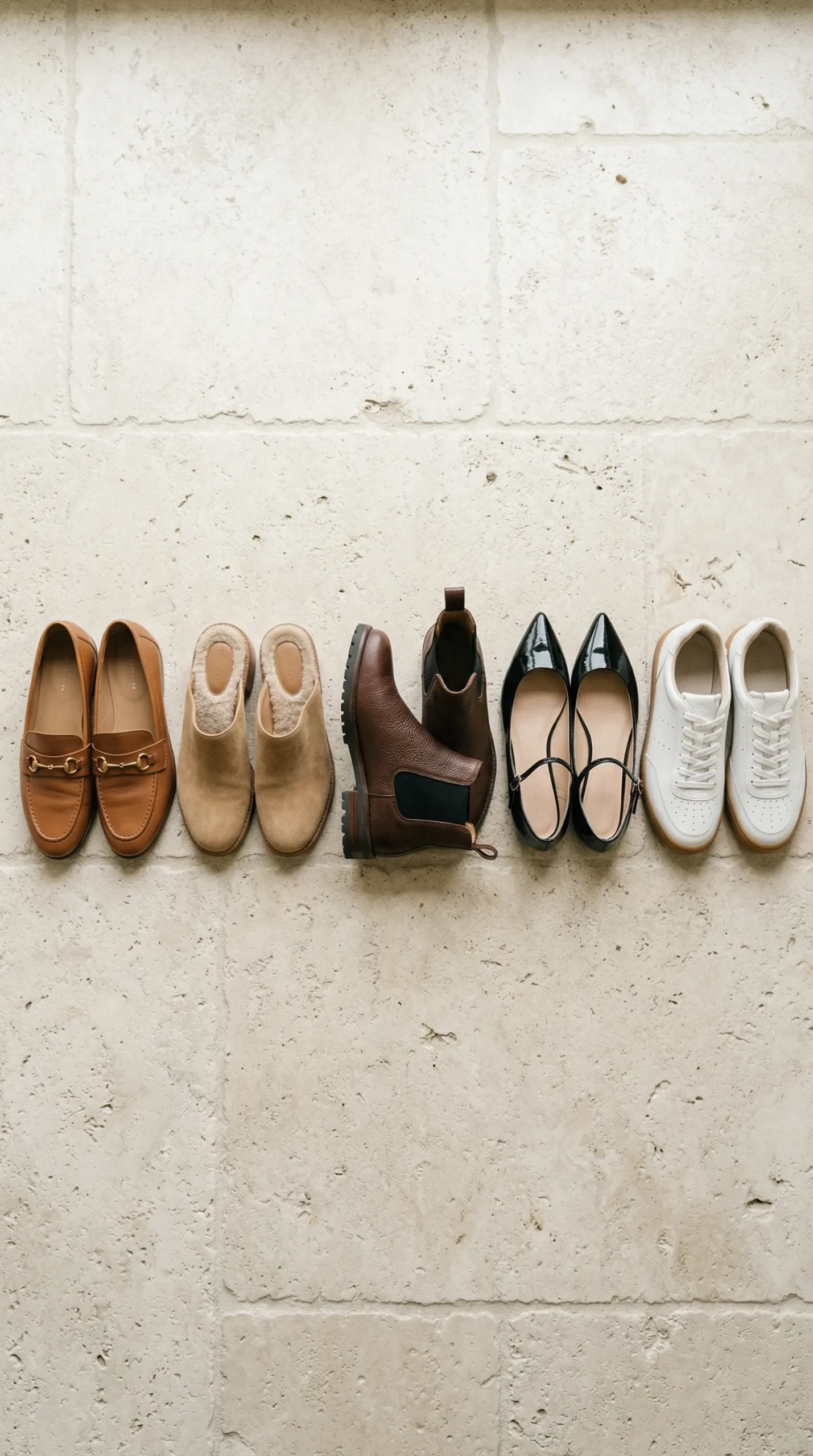
The Five Categories That Actually Work
Not every shoe belongs in a smart casual wardrobe. These five do.
- Loafers. The workhorse. A structured leather loafer, particularly a penny or horsebit style, anchors a creative office environment better than almost anything else. Flat or with a modest block heel. Both work.
- Mules. Backless, yes. Still sharp. A leather or suede mule with a kitten or block heel reads polished without effort. Best anchor: an evening dinner or a Friday that could go either direction.
- Ankle boots. The most versatile option in cold weather. A Chelsea or simple zip boot in a neutral leather elongates the leg and transitions from desk to bar without drama. Best anchor: transitional season dressing when you need one shoe to do everything.
- Ballet flats. Back, and for good reason. A pointed-toe flat in leather or a quality faux leather is no longer just a weekend shoe. It works in smart casual women’s attire when the flat is structured, not slouchy. Best anchor: a daytime meeting where you need to move quickly and look calm doing it.
- Refined leather sneakers. The category with the most caveats. More on this below.
My take: Loafers are the single most reliable smart casual investment in this list, and I would buy one excellent pair before any of the others.
When a Sneaker Qualifies
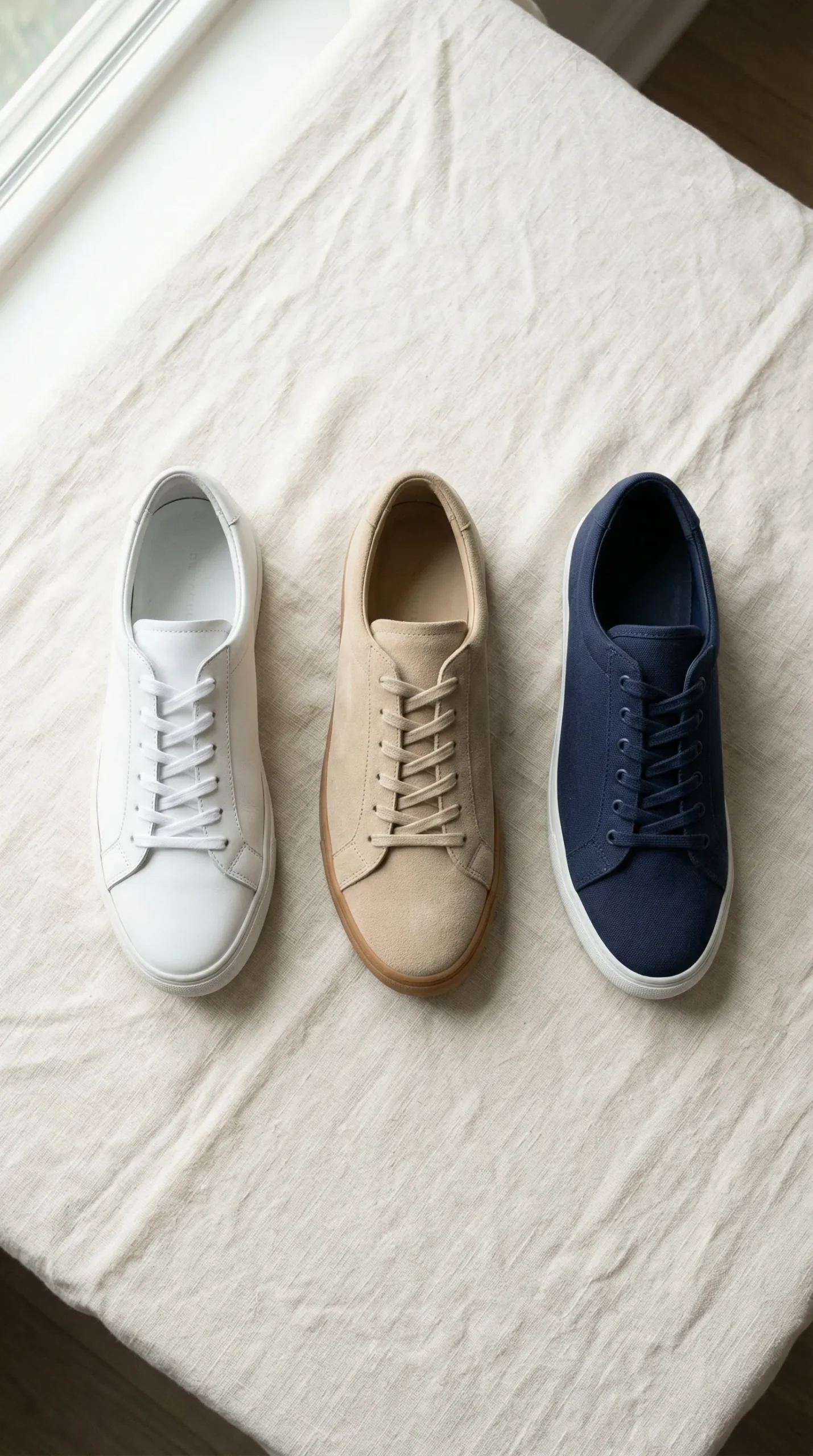
A sneaker earns its place in smart casual women’s shoes under three conditions. One: the upper is leather, or a convincing minimalist material. Two: there is no athletic branding visible anywhere. Three: the sole is clean and low-profile, not a running shoe platform.
That eliminates most of what’s in your closet. It keeps things like a white leather low-top, a simple Stan Smith without the stripes reading too sporty, or a slim court-style shoe in a neutral. The silhouette has to be flat and understated. If it looks like it belongs on a track, it doesn’t belong here.
Trade-off: Even a qualifying leather sneaker slightly lowers the register of any outfit. That’s fine for the right occasion. But if you need the outfit to hold its own in a meeting with someone you’re trying to impress, put on the loafer.
The One Rule Across All Five
Sole thickness matters more than most people think. A thick, chunky sole, even on a loafer, tips into streetwear territory. A thin or moderate sole keeps the shoe in the smart casual range. This is the easiest self-check you can do before leaving the house.
Look down. If the shoe reads “I’m going somewhere,” you’re fine. If it reads “I’m running somewhere,” go back inside.
Accessories — Bags, Jewellery, and Belts
The outfit is fine. Then you grab the bag. The one that fits a laptop, a gym kit, a water bottle, and apparently a small child. You walk into a client meeting and whatever you were trying to communicate with the blazer and the trousers is immediately cancelled out.
Accessories are where business casual falls apart fastest. Not because they’re hard to get right. Because most people don’t think about them until they’re already at the door.
Bags
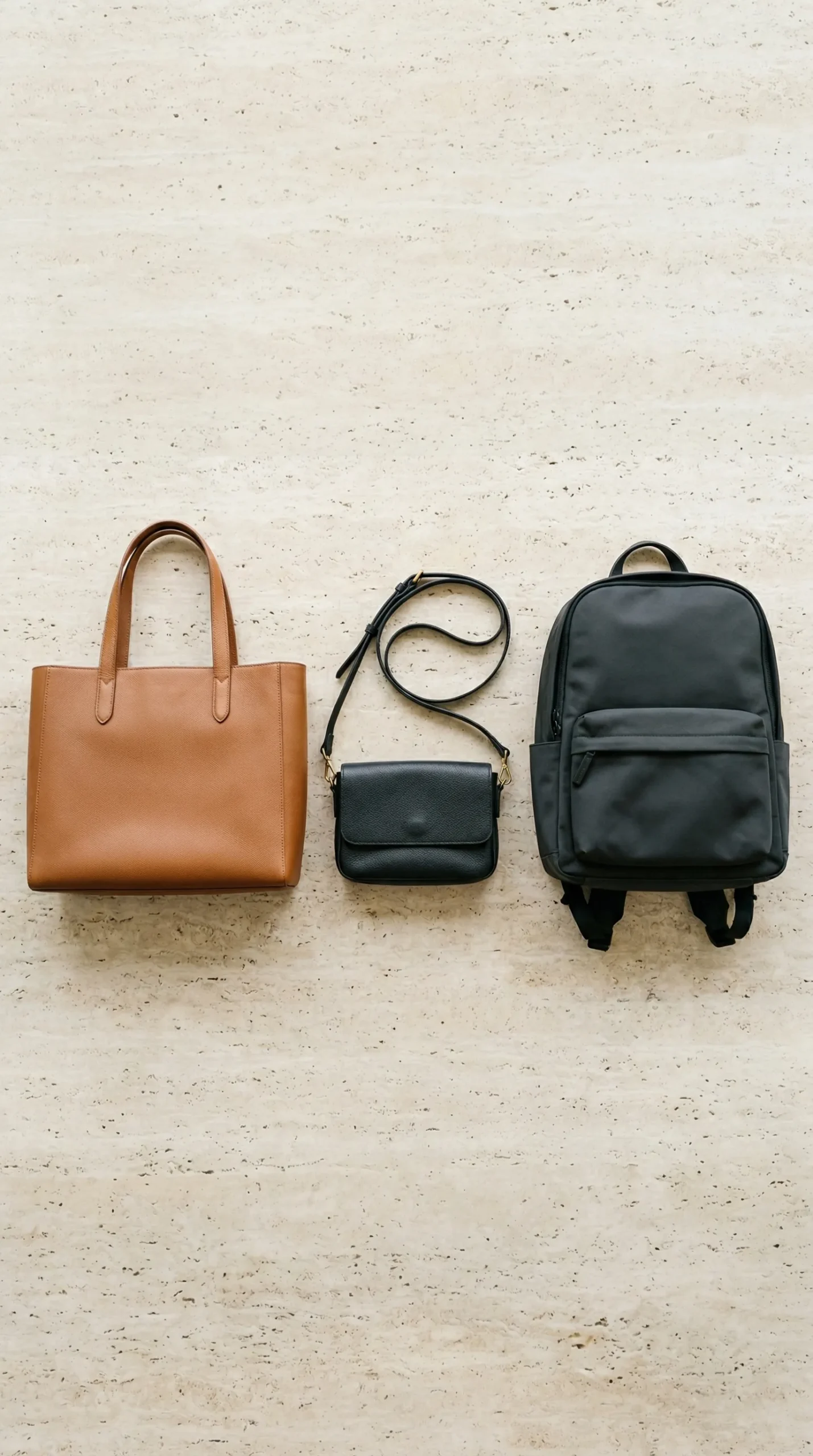
A bag carries stuff. That’s its job. But in a business casual context, it also signals whether you’re there to work or just passing through.
The rule is simple: structure reads as professional. Unstructured reads as casual. A canvas tote that slouches on your shoulder belongs at the farmers market, not in a meeting room. A structured leather tote with clean lines is something else entirely.
- Structured leather tote — works across almost every smart and casual wear for women context. Holds a laptop. Doesn’t collapse on itself. Projects competence.
- Crossbody bag — acceptable for lighter days when you don’t need much. Small, contained, intentional. Not a micro bag the size of a Post-it.
- Canvas tote — leave it for weekends. The material and the sag undermine everything above the waist.
- Backpack — depends entirely on execution. Leather or structured nylon in a minimal design, fine. A hiking pack with external clips, no.
Blunt truth: Most women are carrying bags that are too large for the room they’re walking into. Downsize by one. You’ll feel the difference immediately.
Trade-off: A structured bag with a rigid frame is less comfortable for commuting than a soft tote. That’s real. The answer is a bag that has some structure but isn’t completely rigid — a semi-structured leather tote does the job without punishing your shoulder by 3pm.
Jewellery
Less is more is not a personality trait. It’s a functional strategy. The problem with too much jewellery in a professional setting isn’t that it looks “unprofessional” in some vague, hand-wavy sense. It’s that it splits attention. You want people focused on what you’re saying, not tracking the movement of your chandelier earrings.
The principle: one statement piece. One. Everything else quiet.
- If the outfit is neutral — grey, camel, cream, navy — one bold earring gives you a focal point without noise. A sculptural gold hoop or a single interesting stud. That’s the anchor.
- If the outfit already has pattern or colour — the jewellery steps back. Small gold studs. A thin chain. Nothing that competes.
- Stacking rings and layered necklaces — fine on weekends. In a smart casual women context, layering multiple pieces usually tips into overdressed or visually busy.
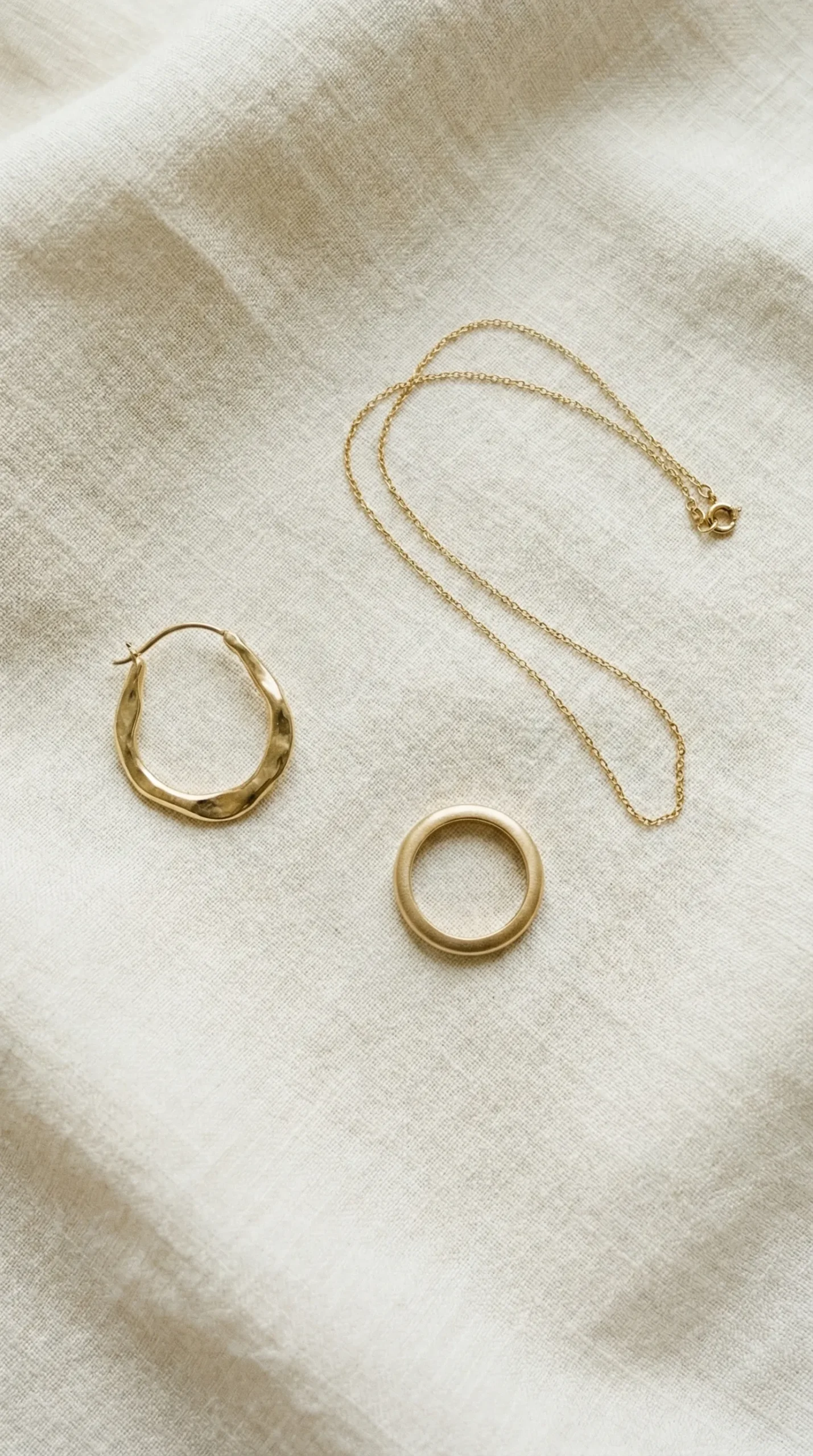
My take: a bold earring does more for a simple outfit than a statement necklace ever will, and it doesn’t make you look like you’re trying.
Belts
A belt has two jobs. Holding trousers up is one. The other is deliberate: defining a waist, anchoring a tucked shirt, adding a material detail to an otherwise flat outfit. Those are not the same job and shouldn’t be treated as such.
Functional belt: thin, black or brown leather, clean hardware. Matches your shoes if possible. You don’t notice it. That’s the point.
Style element: a wider belt in cognac leather over a midi dress, or a structured belt cinching a loose blazer. Here the belt is doing visual work. The outfit would read differently without it. You’re making a choice, not just keeping your trousers in place.
Trade-off: A statement belt over a dress or long top adds definition, but it also locks in the silhouette. If you’re in and out of your jacket all day, or the belt shifts, the whole thing can look undone by afternoon. Know your day before you commit to it as a style element.
Scarves
Transitional weather creates a specific problem: too warm for a coat, too cold for nothing. A scarf solves this, but it also does something else in a business casual context. Worn loosely around the neck or draped over a jacket, a silk or lightweight wool scarf occupies the space that jewellery would otherwise fill.
It’s a practical substitution with a side effect: it reads as considered. Not overdressed. Not trying hard. Just put together.
Keep the print quiet — a subtle geometric or a muted plaid — unless the rest of the outfit is entirely neutral. A bold scarf on a patterned blouse is a decision that requires conviction most people don’t have before 9am.
How to Build a Smart Casual Outfit
You’re standing in front of the mirror in five items that individually pass every test. Nice trousers. A good blouse. Shoes with actual structure. A blazer. A bag that cost more than it should have. And together, somehow, the whole thing looks like you couldn’t decide what event you were dressing for. Not bad, exactly. Just… wrong.
That’s the smart casual trap. It’s not about having the wrong pieces. It’s about having pieces that don’t know what they’re doing next to each other.
The fix is a rule. One you can apply in two minutes, half-awake, before coffee.
One relaxed anchor + one polished anchor. That’s it. Tailored trousers paired with a loose silk blouse. A structured blazer over a soft, draped tee. The tension between the two is what makes the outfit read as intentional rather than accidental. Smart casual womens outfits that work are almost always built on this contrast. Two polished items together tip into boardroom. Two relaxed items together tip into weekend. You want neither.
My take: if you can’t identify one relaxed item and one polished item in your outfit, you haven’t built a smart casual look. You’ve just got dressed.
The 3-3-3 Rule, Applied
The 3-3-3 rule is a dressing framework, not a law. Three items of clothing, three colours maximum, three accessories or equivalent. The number three isn’t magic. What it does is force you to edit.
Most smart casual outfit ideas for women fall apart at exactly this point: too many things competing. A patterned top, printed trousers, two necklaces, a statement bag. Each piece might be fine on its own. Stacked together, they cancel each other out.
- 3 items of clothing: Think in layers — a base, a bottom, a top layer. Blouse, trousers, blazer. That’s your outfit. Adding a fourth garment usually adds volume and complication without adding polish.
- 3 colours maximum: One neutral doing most of the work. A second neutral or near-neutral. One accent, if you want it. Camel, cream, and a burgundy bag. Navy, white, and tan shoes. This is a formula, not a restriction.
- 3 accessories or equivalent: Shoes count. Bag counts. Belt counts. A watch counts. Earrings count as one unit. By the time you’ve reached three, you’re done.
This isn’t about minimalism as an aesthetic. It’s about reducing the number of decisions your eye has to make when it scans the outfit. The fewer decisions, the more put-together the result.
Colour Strategy
Neutrals are the foundation. Always. Black, white, grey, navy, camel, cream, stone — these are not boring. They are the reason your one interesting piece looks interesting instead of overwhelming.
The mistake I see constantly: treating every item as an opportunity to introduce a colour. It isn’t. One accent per outfit. One. If the blouse is dusty rose, the trousers are neutral. If the trousers are a warm cognac, the blouse is white or cream. The accent earns its place by having nothing fighting it.
Blunt truth: a monochrome outfit in a single neutral will always look more intentional than a multi-colour outfit that wasn’t carefully considered. When in doubt, go monochrome. It reads as a choice, not an accident.
Proportion Logic
Smart casual outfit ideas work on one axis of proportion at a time. Fitted top, relaxed bottom. Or relaxed top, tailored bottom. Pick one direction and commit.
Two fitted items together: office-formal. Requires deliberate softening to stay in smart casual territory.
Two loose items together: the look collapses. Volume on volume reads as unplanned, even if both pieces are expensive. This is the physics of it — a wide-leg trouser and an oversized blouse means neither piece has anything to anchor it. The eye can’t find a line to follow.
Trade-off: the fitted-top-plus-relaxed-bottom combination is the more versatile formula for most body types, but it puts more pressure on the top half of the outfit. A blouse that’s slightly loose around the torso will read as relaxed from a distance. That’s fine. But a blouse that gapes at the buttons because of fit issues won’t recover, no matter how good the trousers are.
Check the silhouette, not the individual items. That’s the step most people skip. Step back. Squint. If the outline reads clean and intentional from across a room, it works.
Adapting Smart Casual for Winter
Cold weather is where smart casual goes wrong for most people. The instinct is reasonable: it’s freezing, so you add bulk. And then the outfit that was working in September stops working in November and you’re not sure why.
Why it happens: warmth and structure are often in direct conflict. A chunky knit adds warmth. It also disrupts the proportion logic you built. A puffer jacket is warm. It eliminates the silhouette entirely. Smart casual women’s winter dressing is essentially a problem of layering without losing the line.
Layering Without Disrupting the Balance
The rule here is thin and structured beats thick and shapeless. Every time.
A fine-knit turtleneck under a blazer adds a full layer of insulation without changing the silhouette. The blazer’s shoulder still reads. The waist definition still reads. You’re warmer and the outfit still makes sense. A bulky ribbed knit under the same blazer? The blazer can no longer close properly. The shoulder looks wrong. The whole thing reads as improvised.
- Fine-gauge merino turtleneck: The most useful winter layer in smart casual dressing. Goes under a blazer, under a tailored shirt, under almost anything. Merino specifically because it’s thin enough to layer and doesn’t trap body odour the way synthetics do after a full workday.
- Thermal base layer under trousers: Invisible, practical, doesn’t change the fit. Use a thin one. The moment the trouser leg starts pulling or bunching, the thermal is too thick.
- A knit in place of a blouse: Swap the blouse for a fine-knit in the same colour family. The proportion stays the same. You’re warmer. This is the simplest swap.
A full winter outfit that holds the smart casual balance: wide-leg trousers in charcoal, ribbed turtleneck in oatmeal, longline wool coat, ankle boots with a low block heel. That works. Nothing is fighting anything else. The coat lengthens the line instead of breaking it.
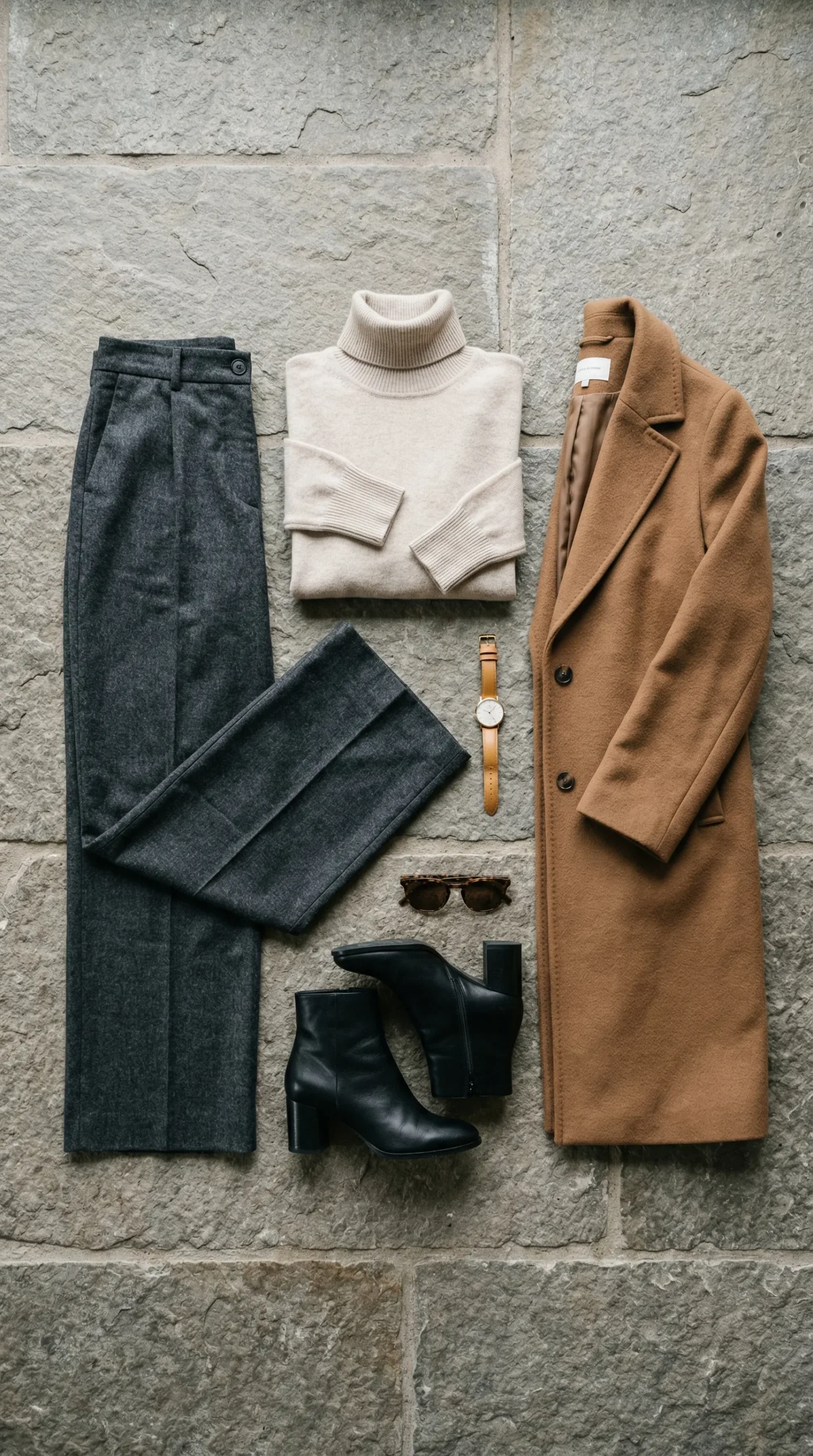
Coat Choices
The coat is doing everything in winter. It’s the first and last thing anyone sees. Get it wrong and it doesn’t matter what’s underneath.
A wool tailored coat preserves the smart casual silhouette because it has structure. The shoulder is defined. The hem falls at a deliberate length. It functions like an oversized blazer, which means it fits into the same proportion logic you already built. Longline is better for smart casual than cropped — a cropped coat over wide-leg trousers shortens the visual line and tends to look more casual than intended.
A puffer jacket does not belong in a smart casual outfit. This is not a snob opinion. It’s a structural one. Puffer jackets are designed to trap air, which means volume. That volume eliminates every proportion decision you made underneath. The outfit disappears.
| Coat Style | Smart Casual Verdict | Why |
|---|---|---|
| Longline wool tailored coat | Yes | Structured shoulder, defined hem, extends the silhouette |
| Belted wool coat (mid-length) | Yes | Belt creates waist definition; adds polish without rigidity |
| Camel wrap coat | Yes, with conditions | Works if belted; without the belt it loses structure quickly |
| Cropped wool jacket | Marginal | Shortens the line; works only with high-waisted, narrow-leg trousers |
| Quilted / puffer jacket | No | Volume eliminates proportion; outfit disappears underneath |
| Parka (relaxed fit) | No | Casual by design; the silhouette doesn’t recover |
This won’t work if it’s genuinely, aggressively cold. Below -10°C, a wool coat is not enough. That’s honest. At that point, the warmest coat that still qualifies is a structured wool-cashmere blend with a high wool content (70% and above) and a down inner lining. Some coats are built this way — a tailored shell with a removable quilted liner. The outer silhouette stays intact. The warmth is handled inside. It costs more. But it solves the problem without sacrificing the look.
My take: most people are not dressing for -15°C. They’re dressing for 3°C with wind. A good wool coat and a fine-knit layer underneath handles that without any compromise.
Smart Casual by Occasion
You can get the dress code right and still show up wrong. That specific feeling of standing at a rooftop dinner in an outfit that was clearly assembled for a desk at 9am — structured, sensible, completely off — is its own kind of embarrassing. Smart casual women’s attire doesn’t change by item. It changes by context.
The formula stays the same. The calibration shifts. Here’s how to read the room before you get there.
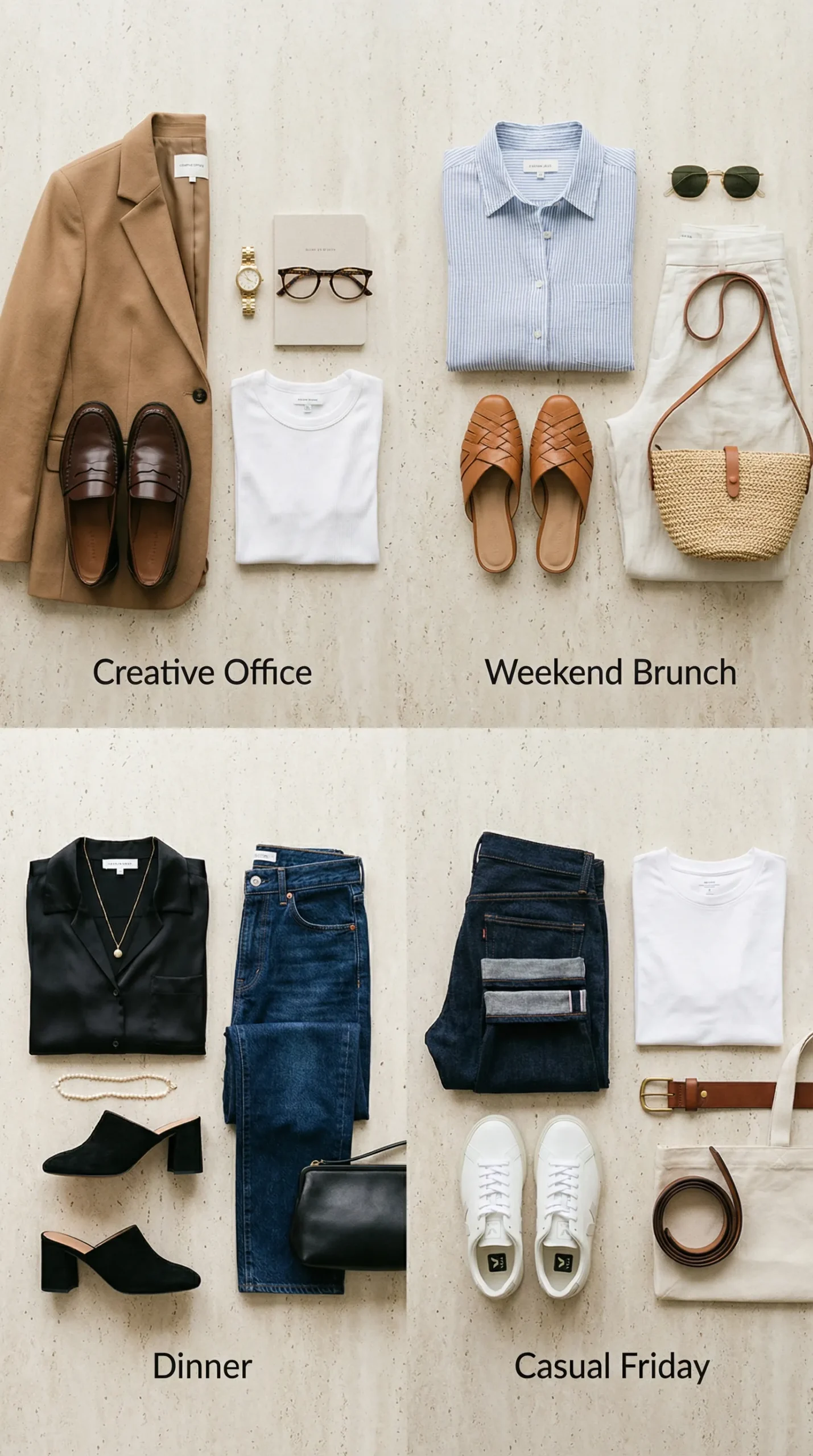
| Occasion | Top | Bottom | Layer | Footwear | Accessories |
|---|---|---|---|---|---|
| Creative Office | Relaxed blouse or fitted knit | Wide-leg trousers or midi skirt | Unstructured blazer or oversized cardigan | Loafers or clean white trainers | Minimal. One interesting piece. |
| Weekend Brunch | Linen shirt or soft tee | Straight-leg jeans or casual midi | Denim jacket or lightweight knit | Mules or flat sandals | Relaxed tote, simple earrings |
| Dinner Date | Silk or satin blouse | Tailored trousers or wrap skirt | Fitted blazer or nothing | Block heel or pointed mule | One statement piece. Not two. |
| Casual Friday | Fitted ribbed top or chambray shirt | Dark slim jeans or chinos | Blazer optional. Cardigan works. | Clean leather sneakers or loafers | Keep it low. It’s Friday. |
Smart Casual for Work
Workplace smart casual wear for women is not the same animal as weekend smart casual. The silhouette is the same. The tolerance for casualness is not.
The gap depends entirely on your industry. A creative studio and a law firm both say “smart casual.” They do not mean the same thing. In a corporate office, smart casual skews toward the polished end: tailored trousers, structured knits, closed-toe shoes. In a creative environment, you have more room — unstructured layers, interesting textures, the occasional sneaker that actually looks intentional.
- Creative office: midi skirt + tucked blouse + loafers. Relaxed enough to signal you’re not a suit person. Pulled together enough that no one questions your presence in a client meeting.
- Corporate office: same midi skirt, but the blouse is crisper, the loafer has a slight heel, and the blazer is non-negotiable.
The piece that does the most work here is fit. A slightly oversized blouse reads artistic in a design agency and sloppy in a bank. Same blouse. Different room.
My take: if you’re unsure which side of the line your workplace sits on, watch what the senior women wear on a Thursday. Not Monday — everyone tries on Monday. Thursday is honest.
Smart Casual for Dinner and Evening Events
The problem with smart casual women’s dinner dressing is the range. Some people show up in a blazer and jeans. Others arrive in a cocktail dress. Both technically qualify. Neither is wrong. But one of them is going to feel underdressed by the second course, and it is usually the one who left the office and didn’t change.
Three things shift at dinner: fabric, heel height, and accessories. That’s it. You don’t need a different wardrobe. You need the evening version of what you already own.
- Fabric: silk, satin, fine knit, or anything with a subtle sheen moves the outfit out of daytime. Matte cotton and linen stay there.
- Heel height: even a 4cm block heel changes the register of an outfit. Flat loafers that worked at 2pm start reading as office leftovers at 8pm.
- One elevated accessory: a statement earring, a small evening bag, a silk scarf worn properly. One. Not three.
The formula that works almost every time: tailored trousers + silk blouse + mules + one statement earring. Done. You are not overdressed. You are not underdressed. You’re the person who understood the assignment without making it a whole thing.
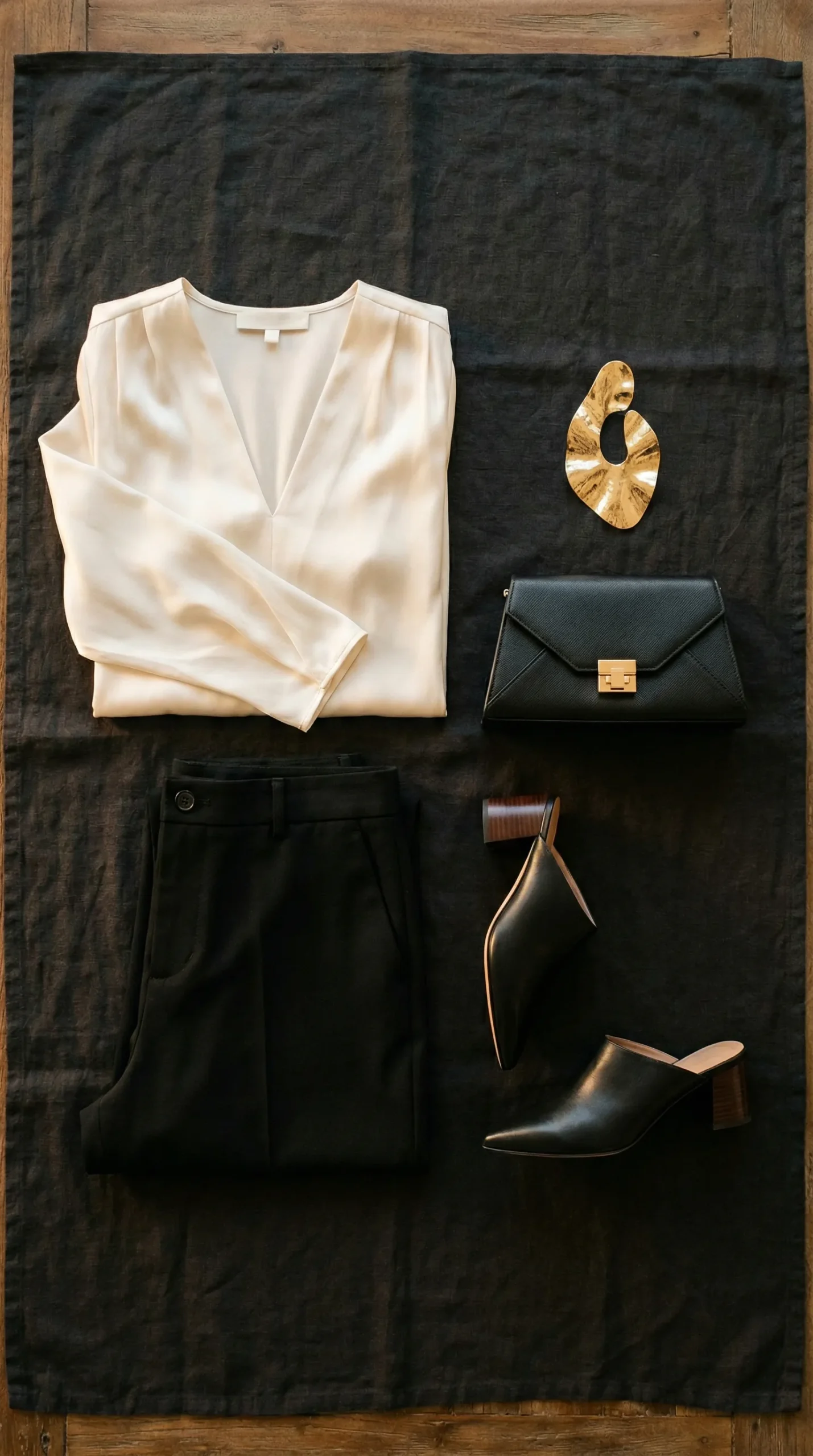
Trade-off: silk blouses look exactly right for dinner and are genuinely annoying to care for. Hand wash, lay flat, iron on low. If that sounds like too much for a Wednesday night, a good quality satin polyester does most of the visual work with less of the ritual.
Smart Casual for Weddings and Parties
Wedding smart casual is not regular smart casual. It sits a full level above. The host wrote “smart casual” on the invitation because they didn’t want to write “cocktail” and scare people off — but they still expect you to look like you understood the occasion.
The gap to close: add one formally elevated element to what you’d normally wear. A midi wrap dress in a quality fabric (crepe, silk blend, structured jersey) with a block heel and a structured clutch covers almost every smart casual wedding without tipping into overdressed. The dress does the work. The accessories confirm the decision.
- What reads right: midi wrap dress + block heel + structured clutch. Print or solid, both work. Avoid anything that competes with what the bridal party is wearing.
- Seasonal parties (Christmas, work events): the dress code allows slightly more embellishment than usual. Velvet, metallic thread, deep jewel tones — these read festive without being fancy dress. A fitted midi in deep burgundy or forest green does more work than a sequin situation.
This won’t work if the invitation says “smart casual” but the venue is a country estate with a seated dinner for 200 people. That is not smart casual. That is quiet cocktail. Escalate accordingly: a more formal midi dress or tailored wide-leg trousers with a dressy top, proper heels, and evening accessories.
Blunt truth: most women underestimate the wedding dress code, not overestimate it. Showing up slightly overdressed at a wedding is recoverable. Showing up in your Thursday work outfit is not something the photos will forgive.
What to Avoid — Smart Casual Dos and Don’ts
You’ve seen the photos. Maybe it was a work event, maybe a dinner, maybe something that required exactly one step up from your normal Friday. And there you are in the background, technically dressed correctly for the smart casual women dress code, technically not in sweatpants. But something is off. The outfit reads like a decision made in defeat.
That’s the failure mode no one talks about. Not “too casual.” Just unclear. And unclear is its own kind of wrong.
So let’s be direct about what doesn’t qualify.
- Hoodies. Any hoodie. The fabric category disqualifies them before you’ve even looked in the mirror.
- Graphic tees with logos, slogans, or anything that requires reading.
- Sweatpants. Including the expensive ones.
- Worn sneakers. If they’ve been on a run, they’ve been on their last public outing.
- Heavily distressed denim. A small fade, fine. Pre-torn knees on smart casual attire for women? No.
- Athletic slides or shower shoes. No context makes this acceptable.
That’s the obvious tier. The harder failures are the ones that look almost right.
The Five Ways Smart Casual Goes Wrong
Poor fit is the most common. A blazer in the correct fabric, correct colour, correct occasion — and it’s swallowing you whole. Fit isn’t a finishing touch. It’s the whole thing.
Wrong fabric is subtler. Polyester jersey that looked structured on the hanger goes soft under office lighting. Fabrics with visible sheen read as either too formal or too cheap depending on the cut. Neither is where you want to land.
No balance means everything is working in the same register. All relaxed, or all polished. Smart casual women need exactly one elevated element and one relaxed one. That tension is the point. Remove it and you’re just dressed.
Inappropriate footwear dismantles an otherwise functional outfit. Not because shoes are the most important thing, but because they’re the last thing people see before they form an impression. A good trouser ruined by a gym shoe is a choice that speaks louder than the trouser.
Over-accessorising is easy to diagnose: if you’re putting on a fourth thing, take off two. Accessories should reinforce a look, not compensate for one.
| Element | Do | Don’t |
|---|---|---|
| Fit | Tailor or hem anything that doesn’t land correctly. One well-fitted piece carries the whole outfit. | Wear anything that bunches, gaps, or adds visual bulk you didn’t plan for. “It’ll do” is not a fit decision. |
| Fabric | Choose structured knits, ponte, cotton-modal blends, wool blends. Fabrics that hold their shape by mid-afternoon. | Reach for anything with visible jersey stretch, shiny polyester, or fabric that pills after two wears. |
| Balance | Pair one relaxed element with one structured one. Tailored trouser with a simple knit. A crisp shirt with straight-leg jeans. | Combine multiple relaxed pieces and call it smart casual. Casual + casual is just casual. |
| Footwear | Clean leather loafers, block-heeled mules, white leather sneakers (unscuffed), ankle boots with a low heel. | Athletic sneakers (the ones you actually run in), worn slides, heavily platform shoes that shift the outfit’s tone entirely. |
| Accessories | One or two considered pieces. A watch, a simple chain, a structured bag. Things that were chosen, not grabbed. | Stack everything at once. If you can hear yourself walking, you’ve made a decision you might want to revisit. |
The Other Direction: Over-Dressing Also Disqualifies You
This gets ignored. People worry about being underdressed, so they correct too hard. A floor-length gown, a heavily embellished blazer, full cocktail-event jewellery — that’s not smart casual women attire. That’s a different event.
Smart casual sits in a specific register. It’s not a floor. It’s a range. Go too far above it and you’ve broken the code just as badly as the person who showed up in sweatpants. You just feel worse about being corrected for it.
Blunt truth: over-dressing for smart casual is usually about anxiety, not aesthetics. The fix isn’t more. It’s better.
Fit Is Not One Factor Among Many. It’s the Factor.
One well-fitted item outperforms three technically correct ones that don’t sit right. That is not an opinion. You can test it. Wear a perfectly tailored pair of trousers with a simple cotton tee and clean shoes. Then wear a full smart casual ensemble — blazer, printed blouse, structured trousers — in the wrong size. Compare the photos.
My take: most women have enough clothes to dress well for smart casual occasions. What they don’t have is enough items that fit. That’s the actual problem, and buying more doesn’t solve it.
Fit is also the one variable you can control regardless of budget. Tailoring a €40 trouser costs €15 and makes it look like it cost €120. The maths are not complicated.
FAQ — Smart Casual for Women
What is smart casual attire for women?
Smart casual sits between polished and relaxed. Neat, intentional clothes that don’t read as formal. For the full breakdown, see What Is Smart Casual for Women? above.
What is not allowed for smart casual?
Athletic wear, flip-flops, graphic tees, anything distressed or visibly worn. The smart casual dress code for women draws a clear line at clothes that read as gym, beach, or weekend-errand territory. Everything else is covered in What to Avoid.
Are jeans OK for smart casual?
Yes. Under specific conditions. Dark wash, no distressing, no stretch fabric that’s gone baggy at the knee. Pair them with something structured on top and you’re fine. See Bottoms — Trousers, Skirts, and Jeans for the full criteria.
What is the 3-3-3 rule for clothing?
Three colours, three textures, three pieces. It’s a self-editing framework that stops an outfit from looking either too plain or too busy. The full application is in How to Build a Smart Casual Outfit.