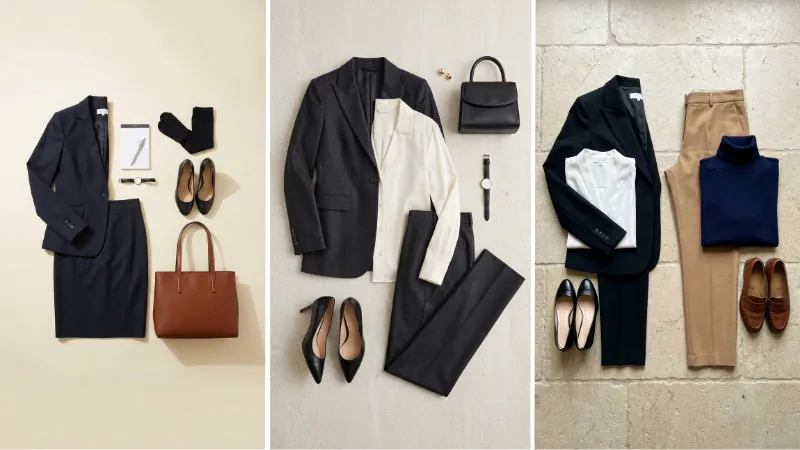
Business Formal for Women: The Boardroom Standard

Seeing “Business Formal” on an itinerary usually triggers pure panic. Most women immediately default to a stiff, poorly cut polyester suit that wrinkles the second they sit down. Absolute amateur mistake for a high-stakes environment. Spent a decade in strict German banking boardrooms watching brilliant women undermine their own authority with gaping blouses and unhemmed trousers.
True business formal isn’t just about throwing on a matching jacket. It requires a clinical understanding of fabric weight, exact tailoring, and a rigid garment hierarchy. Stripped out all the vague fashion magazine advice to build this definitive ruleset. Broke down every single garment category to eliminate the guesswork entirely. This is the exact, actionable framework to ensure you dress flawlessly and project absolute competence at your next high-stakes professional occasion.
What Is Business Formal?
The meeting invitation lands in your inbox. It says “Business Formal.” And you stop.
Not because you don’t own nice clothes. Because you suddenly aren’t sure what “nice enough” means in this context. Full suit? Heels mandatory? Is a blazer over trousers going to look underdressed next to someone in a pencil skirt and structured jacket? That moment of freezing — that’s what this section is for.
Business formal is the strictest dress code you’ll encounter in a regular office setting. Not black-tie. That’s a different conversation entirely, and it involves floor-length gowns and event venues, not conference rooms. Business formal sits one rung below that.
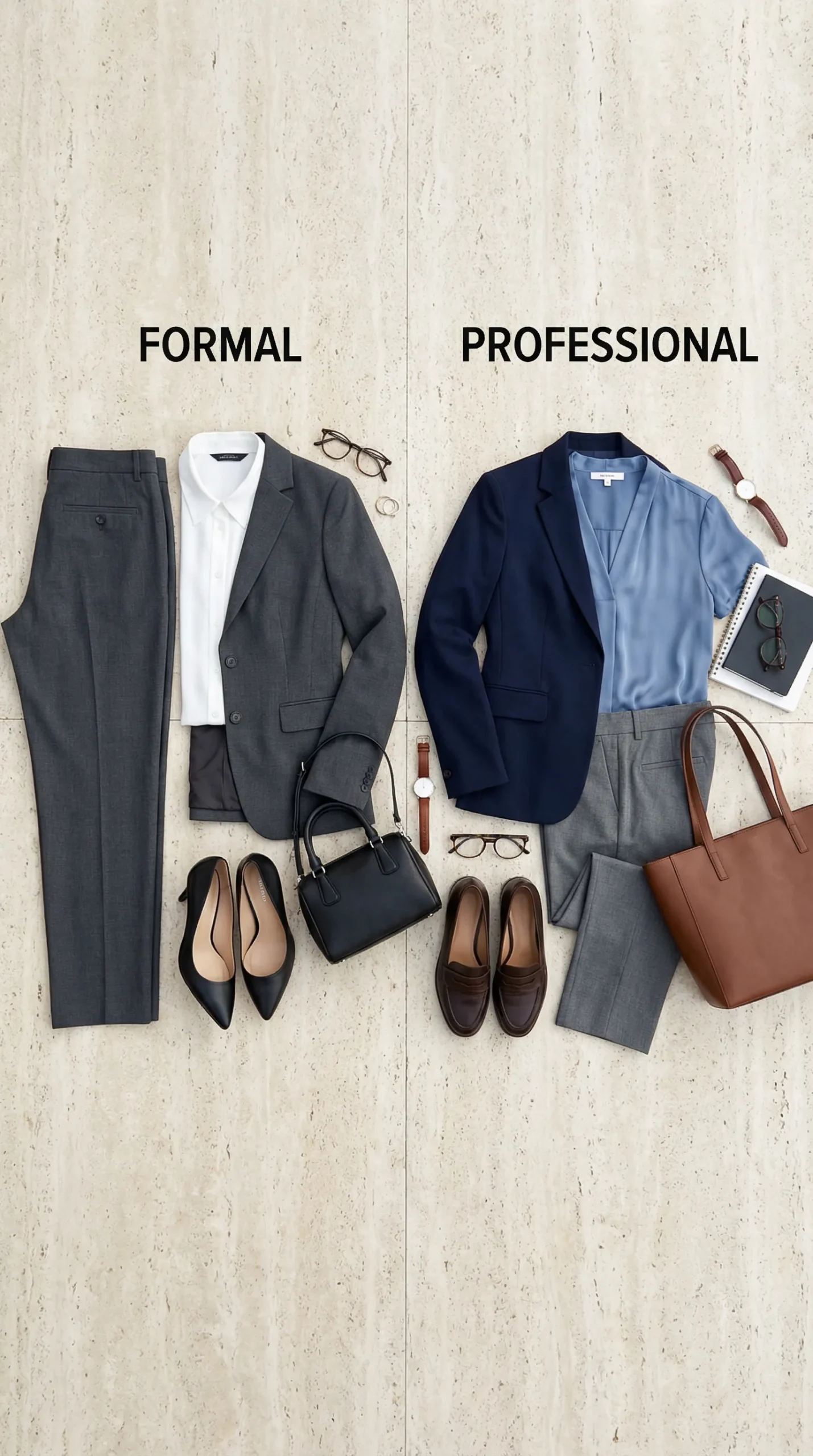
Here’s the hierarchy, plainest terms possible:
- Black-tie / White-tie — galas, awards ceremonies, formal evening events
- Business formal — the top of the corporate dress code ladder
- Business professional — polished, but with more flexibility
- Business casual — the broad middle ground most offices now occupy
- Smart casual / Casual — everything below that
Business formal attire means a tailored suit or a matching skirt suit. Full stop. The pieces coordinate. The fabric has weight. Nothing is wrinkled, sheer, or decorative in a way that reads as informal.
It does not mean “no sneakers.” That’s a much lower bar.
Business Formal vs. Business Professional: The Distinction That Actually Matters
People use these interchangeably. They aren’t the same thing, and the difference matters when you’re deciding whether to add a blazer or bring the full suit.
Business professional allows slightly more range. A blouse with tailored trousers and a blazer qualifies. Separates that don’t perfectly match can work if the overall look is polished and structured. The rules exist, but there’s interpretive space.
The business formal dress code removes most of that interpretive space. The expectation is a matching suit — jacket and trouser, or jacket and skirt — in a neutral or dark colour. A coordinated sheath dress with a structured blazer also clears the bar. What doesn’t: mixing a blazer from one suit with trousers from another and hoping it reads as intentional.
My take: Business professional is what most people mean when they say business formal. But if the invitation actually says “business formal,” don’t gamble on that assumption.
The fabric matters here too, in a way it doesn’t at the business professional level. Formal attire for business calls for structured materials — wool, wool crepe, ponte, or a quality suiting blend. Anything that wrinkles easily, stretches visibly, or has a casual texture (cotton jersey, linen, denim-adjacent fabrics) belongs in a different context.
Trade-off: A proper suiting fabric holds its shape through a long day better than most alternatives. It also costs more and usually needs professional cleaning. That’s the reality of dressing at this level.
When Business Formal Actually Applies
It’s more specific than people assume. Most offices don’t require it day-to-day.
- Board meetings and executive presentations
- Job interviews in law, finance, consulting, or government
- Career fairs at professional or graduate level
- Client-facing presentations in conservative industries
- Court appearances or legal proceedings
- Formal internal reviews or promotion panels
The common thread: someone is evaluating you, the stakes are real, and the environment signals authority. Business formal attire is what you wear when you cannot afford for your clothes to be the thing someone notices.
That’s its entire purpose. Invisible competence.
Business Formal vs. Business Casual
Two invitations. Same week. One says business formal. One says business casual. And suddenly you’re standing in front of your wardrobe at 7am wondering if you can get away with the same outfit or if you need to rethink the whole bag.
This is not a small confusion. The gap between these two dress codes is wider than most people assume — and the cost of reading it wrong is not just aesthetic.
| Category | Business Formal | Business Casual |
|---|---|---|
| Suit | Required. Matched jacket and trouser or skirt, or a structured sheath dress with a blazer. | Optional. A blazer over tailored trousers works. A full matched suit is acceptable but not expected. |
| Footwear | Closed-toe heels or structured flats in leather or leather-look. No open toes. No mules. | Loafers, block heels, clean pointed flats. Some workplaces allow neat ankle boots. Read the room. |
| Acceptable Fabrics | Wool, wool crepe, silk, structured ponte. Fabric must hold its shape through a full day. No stretch blends that relax. | Cotton blends, jersey-twill, ponte, linen (in warmer months). Some texture and softness is acceptable. |
| Colour Palette | Navy, black, charcoal, deep grey. Neutrals only. A single accent is acceptable in accessories. | Wider range. Muted tones, soft patterns, colour blocking in professional shades. Still no neons. |
| Dress Options | Sheath dress, midi length minimum, with structured blazer or jacket. Standalone dresses only if the fabric and cut read as suiting. | Shirt dresses, A-line dresses, wrap dresses in non-casual fabrics. Knee length or longer is the safer call. |
| Accessories | Minimal. A watch, small earrings, a structured bag. Nothing that makes noise or moves visibly when you walk. | More flexibility. A statement earring is fine. Patterned scarves, interesting bags. Keep it coherent, not costumed. |
Signals People Consistently Misread
A blazer over jeans is business casual. It is not business formal. Not even dark jeans. Not even very good dark jeans. The denim disqualifies it.
A wrap dress on its own sits in business casual territory. In a formal context, it needs a structured layer over it — and the fabric has to do real work. Jersey wraps that cling or move too softly don’t make the cut for formal business clothes.
Heels do not automatically make an outfit more formal. A stiletto over a knit midi dress is still casual. The formality lives in the fabric and silhouette first. The heel is secondary.
My take: most women underdress for business formal and overdress for business casual, and both errors come from the same mistake — focusing on individual pieces instead of the overall silhouette.
Where Business Formal and Business Professional Overlap
When people search business formal vs business professional, they usually expect two completely different things. The honest answer: the categories overlap significantly.
Business professional is the term most commonly used in corporate environments — law firms, finance, consulting. It means a matched suit or suiting-weight separates, conservative colours, closed-toe shoes. That description is nearly identical to business formal. The practical difference is context. Business formal tends to appear on event invitations (galas, formal dinners, award ceremonies). Business professional describes a standing daily dress code.
If an invitation says business formal and you wear what you’d wear to a serious client meeting, you are almost certainly fine. The overlap is real.
Trade-off: erring toward business formal when the code is unclear protects you in most rooms. But in a creative or tech-adjacent environment, it can read as tone-deaf. There is no universal safe choice. You are always making a judgment call.
Women’s Business Formal Attire
Twelve dresses. One blazer. And still, standing in front of the wardrobe at 7am, no clear answer on whether any of it actually clears the business formal bar.
That is a specific kind of frustrating. Because business formal is not vague in principle. It has rules. The problem is that nobody hands you the list.
Business formal attire for women means a defined set of garments, in a defined range of colours, worn in a specific way. Not approximated. Not interpreted loosely. Here is the full picture.
| Garment | Key Points |
|---|---|
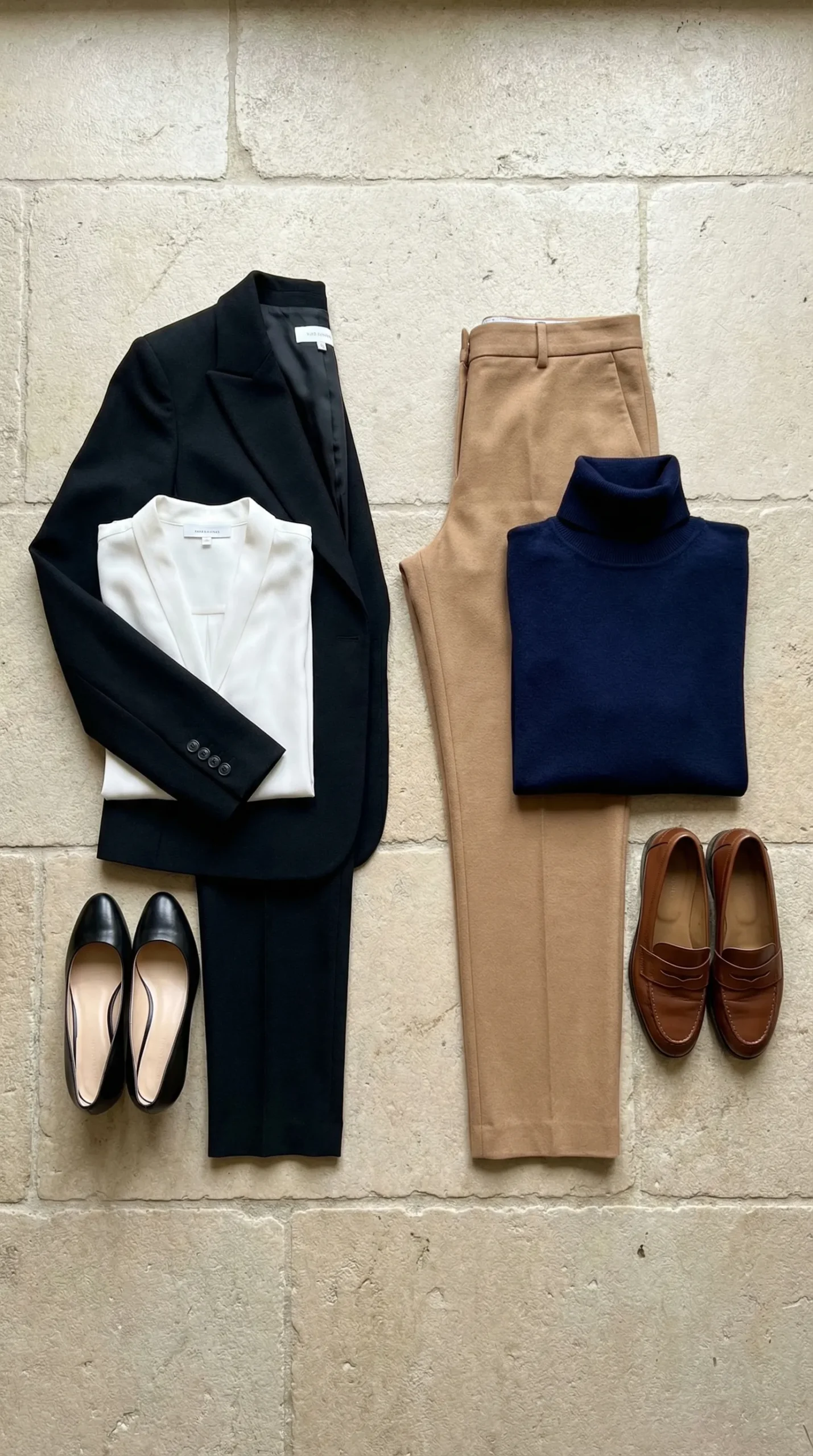
| Trouser Suit | Matching jacket and trousers in the same fabric and colour. Wool or wool-blend only at this level. Charcoal, navy, or black. |
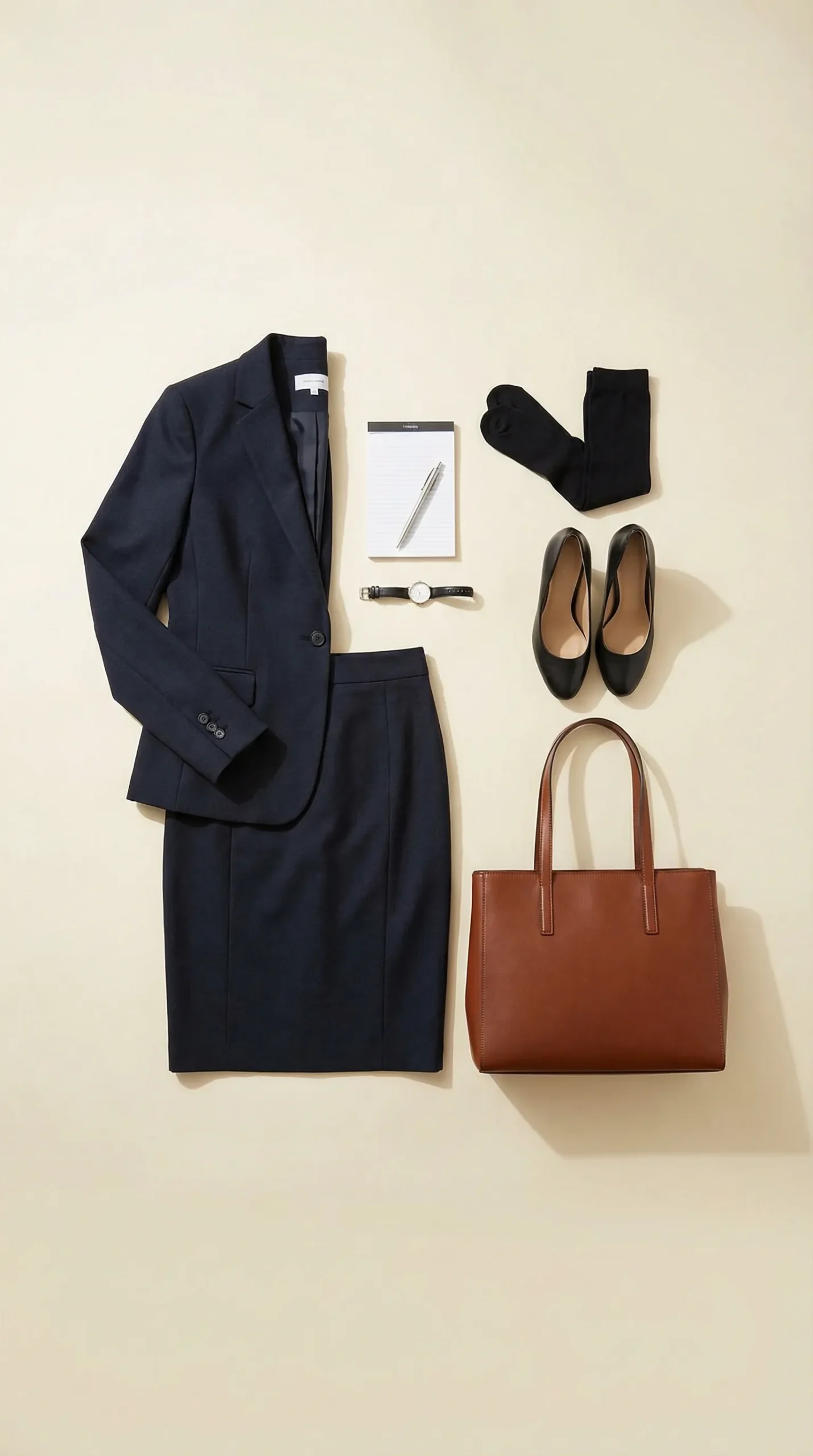
| Skirt Suit | Structured jacket paired with a matching pencil or A-line skirt. Hem at or below the knee. No unmatched separates. |
| Blouse | Silk, silk-blend, or quality woven fabric. White, ivory, pale grey, or soft blush. No visible patterns. Fully tucked. |
| Sheath Dress | Structured, knee-length or longer. Worn with a matching or coordinating blazer. Fabric with body — not jersey or drape-heavy knit. |
| Hosiery | Sheer, skin-tone or neutral. Worn with skirts, dresses, and in more conservative environments, expected. Not optional in traditional finance or law. |
| Footwear | Closed-toe leather pump or block heel. Heel height 5–8cm is the reliable range. Nude, black, navy, or cognac. |
| Bag | Structured leather or faux-leather in a neutral. Fits documents or a small laptop. No visible branding unless extremely understated. |
| Jewellery | Small stud earrings, a simple watch, or a single delicate necklace. Nothing that moves loudly or reflects light across a boardroom. |
That is the full inventory. Everything else is either business casual or evening wear that wandered into the wrong room.
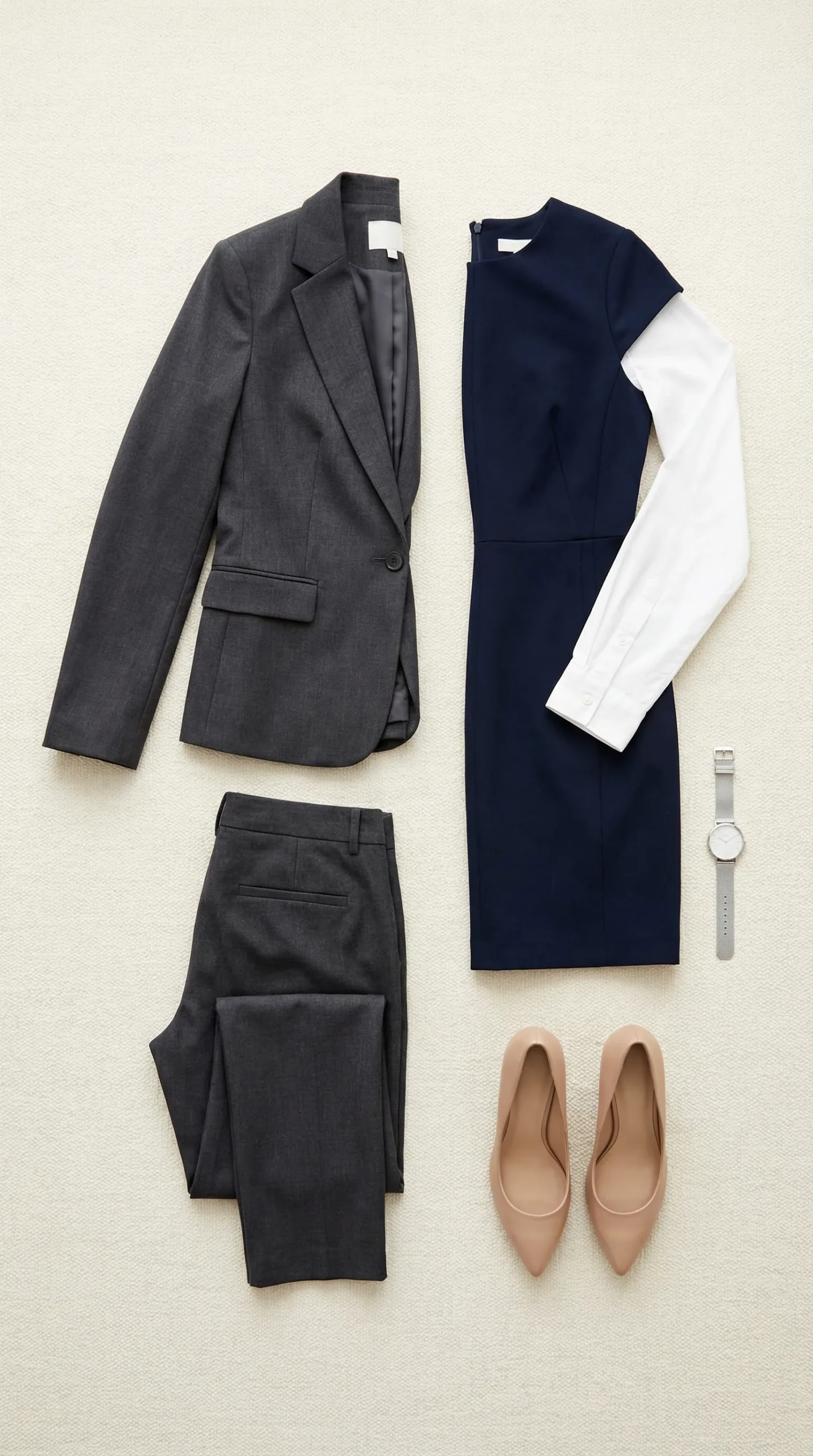
Suits, Skirt Suits & Trouser Suits
The trouser suit and the skirt suit are not interchangeable. They have different weight in different rooms.
A trouser suit reads as more authoritative in most contexts — interviews, first client meetings, anything where you need to walk in and not have your clothing be the first thing someone evaluates. The skirt suit has more polish in presentation settings, formal events, and industries where traditional still carries meaning (think law, private banking, certain areas of government).
Fabric is not a detail here. It is the whole point.
Wool and wool-blend fabrics hold their structure across a full day. They drape without collapsing. A suit in 70% wool will still look like a suit at 6pm. Linen will not. Polyester-heavy blends will not. Crepe can work if it has enough body, but wool is the benchmark for genuine business formal women’s attire.
- Charcoal, navy, and black: correct
- Camel and light grey: acceptable in some contexts, not all
- Bold prints, bright colours, or anything with obvious texture variation: not this environment
On fit. Four places to check, in order.
- Shoulder seam: sits at the edge of the shoulder, not sliding down the arm, not pulled toward the neck
- Jacket length: covers the hip. Cropped blazers are not formal business clothes
- Trouser break: slight — meaning the fabric grazes the top of the shoe. Not pooling. Not floating at mid-shin
- Skirt hem: at the knee or below. This is not negotiable. Above the knee removes the suit from business formal entirely
An unstructured jacket — the kind that folds softly in the hand without any resistance — does not work here. Business formal requires a jacket that holds its shape on its own. If you can crumple the lapels easily, the jacket is not doing the job.
My take: if you are buying one suit for business formal situations, buy the trouser suit in charcoal. It covers more ground than the skirt suit and does not require the hosiery calculation every morning.
Trade-off: wool-blend suits require dry cleaning. If you are wearing one twice a week, that is a real maintenance cost. Price that in before you buy.
Business Formal Dresses for Women
Yes, you can wear a dress to a business formal event. But the answer is conditional. Not every dress gets in.
The silhouette has to earn its place. A structured sheath
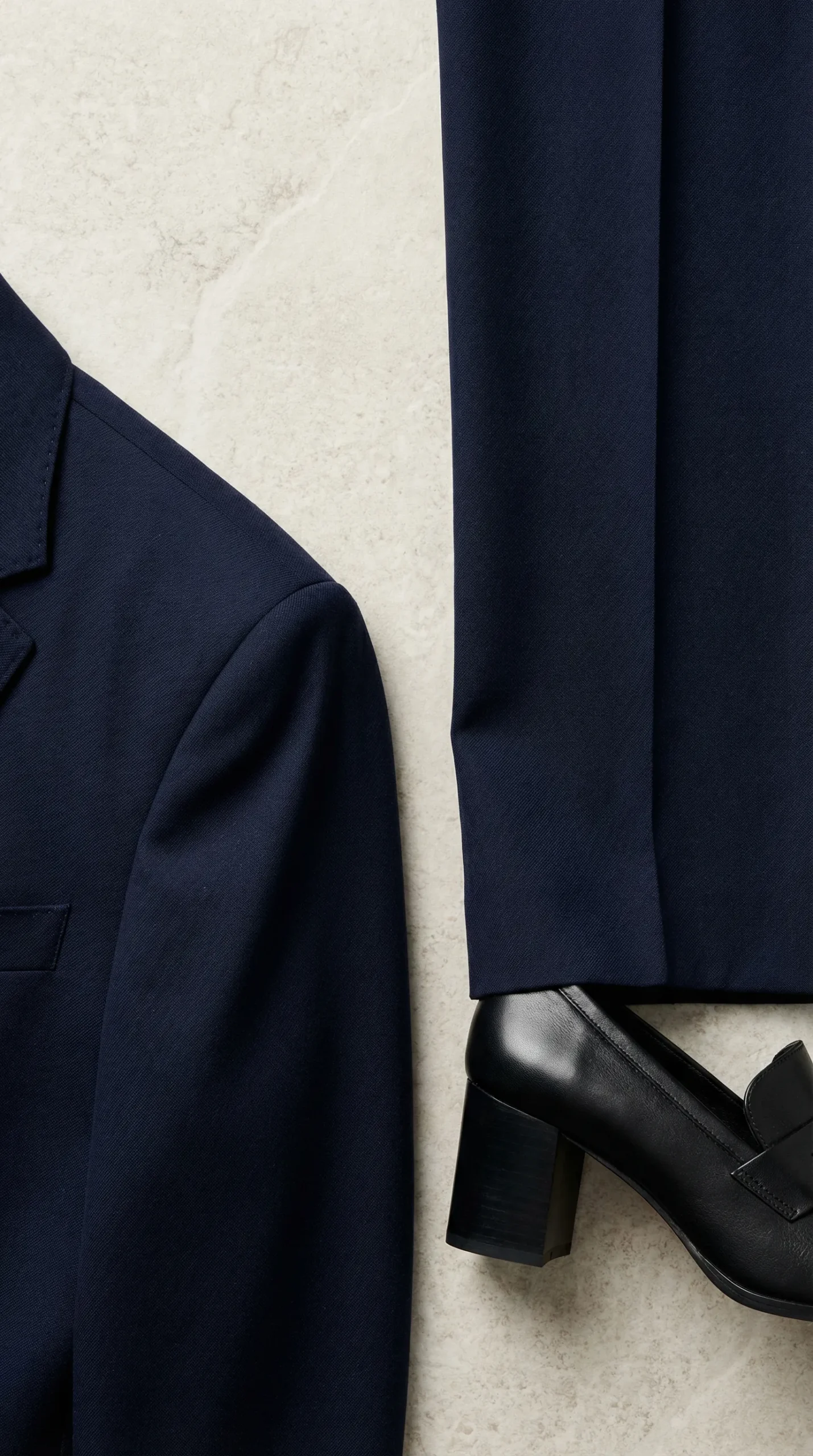
Business Formal Dos, Don’ts & the 3-3-3 Rule
You walk into the room and you know within three seconds. Someone got it wrong. Not badly wrong. Just slightly off. Maybe the fabric is too matte, or the silhouette too relaxed, or there’s a logo where there shouldn’t be one. The room noticed before she did.
That moment is what the business formal dress code is designed to prevent. It’s not about looking expensive. It’s about removing doubt.
| Category | Do | Don’t |
|---|---|---|
| Colour | Navy, charcoal, black, ivory, camel, burgundy | Neons, pastels worn head-to-toe, anything that competes with itself |
| Fit | Tailored to your actual body; clean lines with no pulling or bunching | Oversized silhouettes, anything that reads as borrowed, anything stiff with newness |
| Fabric | Wool, wool-blend, ponte, structured crepe, matte silk for blouses | Denim, jersey, linen (in high-volume meetings), anything with visible pilling |
| Footwear | Polished leather or leather-look; block heels, kitten heels, or clean pointed-toe flats | Scuffed soles, platform sneakers, strappy sandals with no structure, athletic shoes of any kind |
| Jewellery | One or two restrained pieces; gold or silver, not both at once | Statement earrings and a statement necklace simultaneously; anything that moves loudly when you do |
| Grooming | Clean, intentional, finished; hair off the face for high-stakes rooms if that suits you | Visibly chipped nails, roots that are growing out unevenly, anything half-done |
| Fragrance | Light application; one spritz at most before a closed-room meeting | Anything that announces you before you walk in; anything reapplied mid-day at your desk |
The table above covers the non-negotiables. But a list of rules only gets you so far. What actually keeps an outfit coherent is a framework you can apply in under a minute.
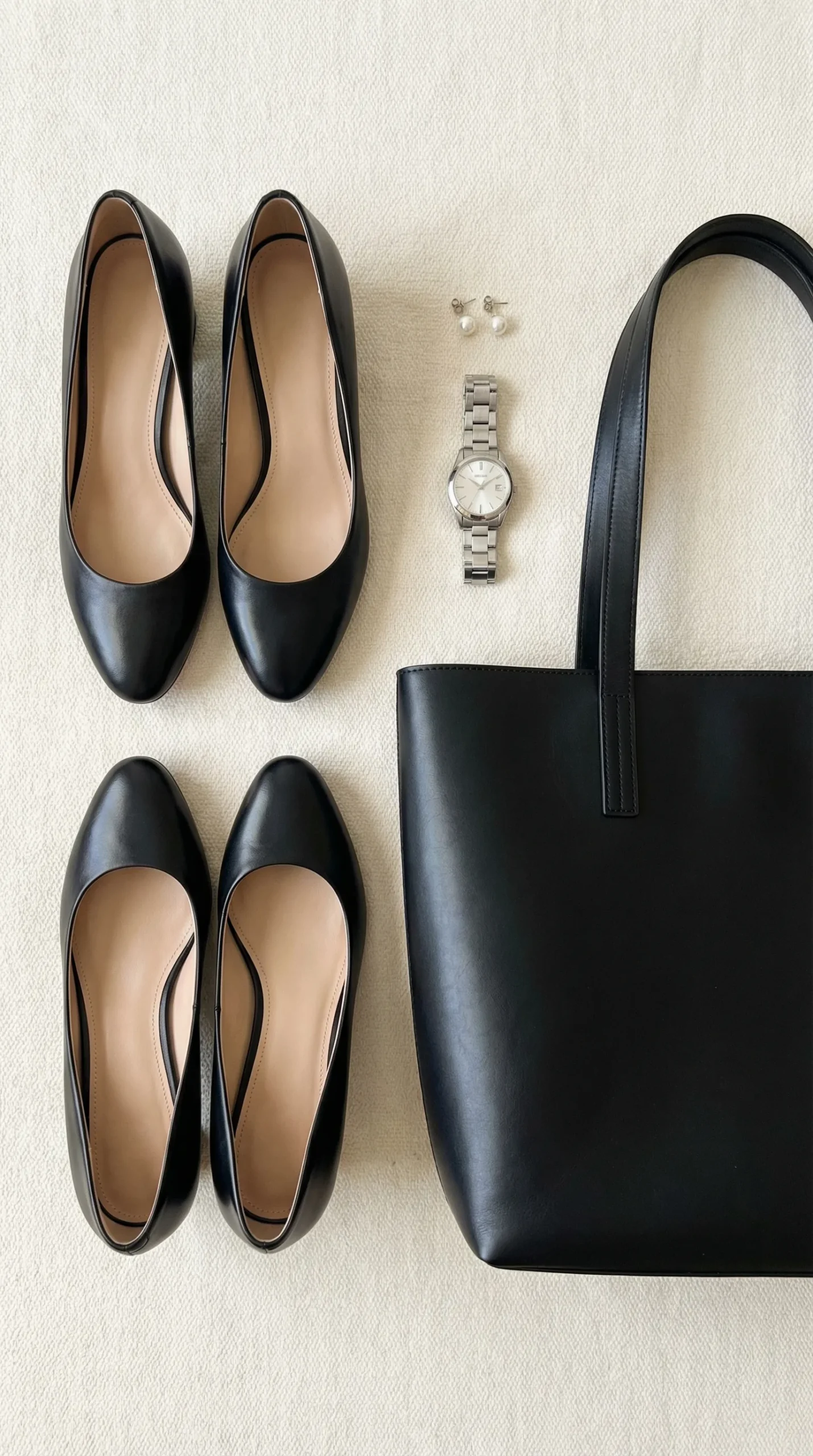
The 3-3-3 Rule: What It Is and How to Use It
The 3-3-3 rule is a styling principle built around restraint. No more than 3 colours, no more than 3 accessories, no more than 3 visible patterns in a single outfit.
That’s it. The whole rule.
It exists because the human eye can only process so much information at once before an outfit starts reading as noisy instead of composed. In formal attire for business, noise is a problem. You want the person across the table focused on what you’re saying, not trying to make sense of what you’re wearing.
Applied to a business formal outfit, it works like this:
- Charcoal trousers + ivory blouse + black blazer. That’s 3 colours. Stop there.
- One ring + one pair of stud earrings + a structured bag. That’s 3 accessories. Done.
- A fine houndstooth blazer + a solid blouse + solid trousers. One pattern, two solids. Well within the rule.
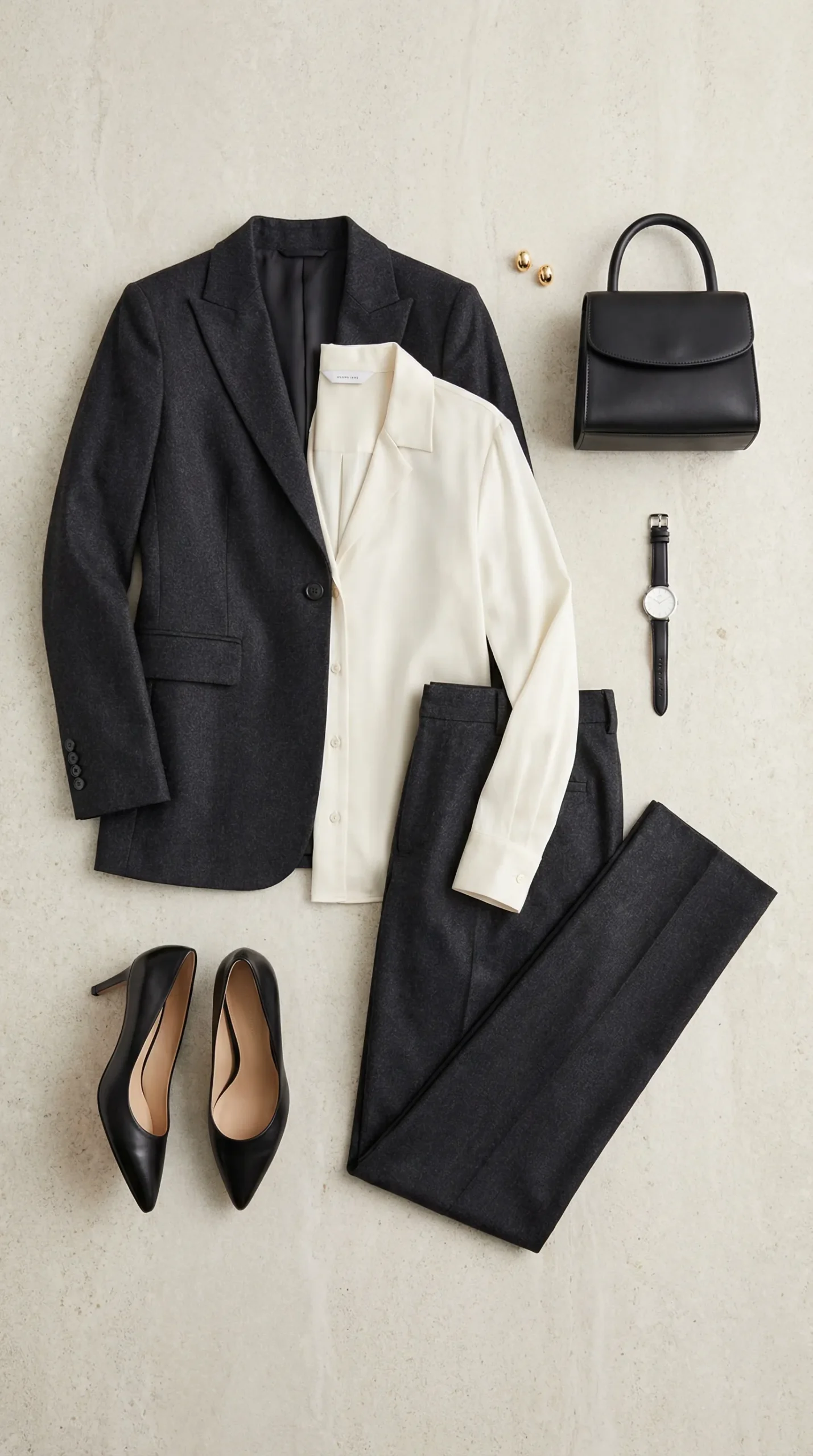
Where people go wrong: they add a printed blouse, a patterned scarf, and a textured bag and wonder why the outfit feels off. It’s not any single piece. It’s the accumulation.
My take: the 3-3-3 rule is most useful when you’re already running late and don’t have time to think. It’s a stopping rule, not a creative one.
Trade-off: following it rigidly can make an outfit feel safe to the point of forgettable. One deliberate break — a single strong colour, one piece of jewellery that actually means something — is fine. Just one.
What Not to Wear for Business Formal
These are the highest-impact offenders. Not a complete list. Just the ones that actually cost you credibility in the room.
- Visible logos. On anything. Bag, belt, shoes. Formal attire doesn’t advertise.
- Sheer fabric without a layer underneath. If it reads as lingerie under fluorescent light, it doesn’t belong in a board room.
- Casual textures in formal silhouettes. A blazer-cut top in jersey fabric still reads as casual. The structure has to come from the material, not just the shape.
- Poor fit worn confidently. Confidence doesn’t fix a jacket that pulls across the shoulders. Tailoring does.
- Too many competing focal points. Bold colour, strong pattern, statement accessory. Pick one. The rest should recede.
- Anything that requires adjustment. If you’re pulling at the hem, tugging the neckline, or pushing up a sleeve every twenty minutes, the garment isn’t working for you.
The core principle behind all of it: business formal attire is not the place to solve an outfit problem in real time. If it needs fixing before you leave the house, it needs replacing before the next event.
Fit, Tailoring & Expressing Personal Style
You have worn it twice and it still doesn’t feel right. The jacket cost more than your last three tops combined. And yet something is off. Not obviously wrong. Just quietly, persistently off.
It’s the shoulders. One centimetre. That’s usually all it is.
The shoulder seam is the first thing a tailor looks at and the last thing most women check when they’re shopping. When it sits even a centimetre past the edge of your actual shoulder, the whole jacket slumps. The lapels lose their line. The sleeves hang wrong. And no amount of steaming fixes it.
This is the core argument for fit over price. A tailored mid-range suit reads more polished than an ill-fitting designer one. Full stop. Business formal attire lives or dies on structure, and structure lives or dies on how the fabric sits on your specific body.
My take: I would rather own two well-fitted pieces than six expensive ones I have to brace myself to wear.
The Four Checkpoints
You don’t need to audit every seam. You need four checkpoints. These are the ones that actually move the needle.
- Shoulder seam: Should sit exactly at the edge of your shoulder bone. Not past it.
- Jacket length: Should end at the hip, not mid-thigh. Mid-thigh cuts the leg. Hip-length lengthens it.
- Trouser break: A half-break (fabric barely grazes the shoe) reads cleaner than a full break for most business formal outfits. A full break can look heavy unless the trouser is slim.
- Skirt hem: The knee is not a strict rule. But one to two centimetres above or below it is the range where professional and polished overlap without any negotiation required.
These four points cover roughly 80% of what reads as “fitted” to the eye. The rest is adjustment at the waist, which a tailor handles in twenty minutes for less than you think.
Blunt truth: Hemming and waist-taking are not luxury services. They’re maintenance. Budget for them the way you budget for dry cleaning.
Where Your Personality Actually Lives
Here is the mistake. Women try to express identity through cut. Wide leg instead of straight. Oversized instead of structured. And then it doesn’t work in the room, and they blame the outfit.
Cut is not where personality lives in business formal outfits for women. Silhouette is load-bearing. It carries the professional signal. You don’t move that.
What you do move:
- Blouse texture: Silk, crepe, a subtle jacquard. Same silhouette. Completely different feeling.
- Colour within range: Dusty rose instead of white. Deep teal instead of navy. The framework allows this.
- Watch strap: A tan leather strap on a simple watch does more than most people realise.
- Lapel pin: One. Small. Intentional. This is the difference between a uniform and a point of view.
These are the details that make formal business clothes feel like yours without softening the professional read.
Quality Signals Worth Knowing
You can’t always touch the fabric before you buy. But you can know what to look for.
| Signal | What It Tells You | Worth It? |
|---|---|---|
| Natural fibre content (wool, cotton, silk) | Breathes, drapes well, holds its shape over time | Yes |
| Clean interior finish (no exposed serging) | The manufacturer didn’t cut corners on the inside | Yes |
| Visible synthetic sheen under fluorescent light | High polyester content; will look cheaper in the office than in the store | No |
| Pilling at cuffs or inner arms on the hanger | The fabric has already started to degrade before you’ve worn it once | No |
| Pattern matching at side seams | Careful construction; someone thought about the details | Yes |
The synthetic sheen problem is worth dwelling on. A fabric that looks fine in warm store lighting can read as cheap under the harsh overhead light of most offices. This is not a theoretical concern. It happens constantly.
Trade-off: Natural fibres require more care. Wool needs proper hanging and occasional steaming. Silk is dry-clean only. That’s the cost of fabric that actually behaves.
Fit is the foundation of everything that follows in how business formal outfits read in a room. The shoulder seam is where that conversation starts, and for most women, it’s also where years of quiet frustration with expensive clothes finally makes sense.
Frequently Asked Questions
What is considered business formal?
Business formal is the most structured tier of professional dress. Think tailored suits, conservative silhouettes, closed-toe heels, and no visible skin below the collarbone. The full breakdown is in the opening chapter.
What is the 3-3-3 rule for clothing?
The 3-3-3 rule is a dressing framework: three colors maximum, three garment pieces, three accessories. It keeps an outfit coherent without overthinking it. Full context lives in the Dos, Don’ts & the 3-3-3 Rule section.
Can I wear a dress to a business formal event?
Yes. But the structure has to hold up. That means a tailored cut, appropriate coverage, and fabric with enough weight to read as intentional rather than casual. See H3: Business Formal Dresses for Women for specifics.
What not to wear for business formal?
The three highest-impact offenders: visible logos, open-toe shoes, and anything with stretch fabric trying to pass as tailored. The full list is in the Dos & Don’ts table.
Is a suit mandatory for business formal attire?
No. A structured dress in a dark, solid color with appropriate coverage meets the business formal dress code. The suit is the default. It is not the only option.
What is the difference between business formal vs business casual?
Business formal requires a complete tailored look with no casual elements. Business casual allows more flexibility — separates, softer fabrics, flats. The dress code comparison table in the introduction maps it out clearly.