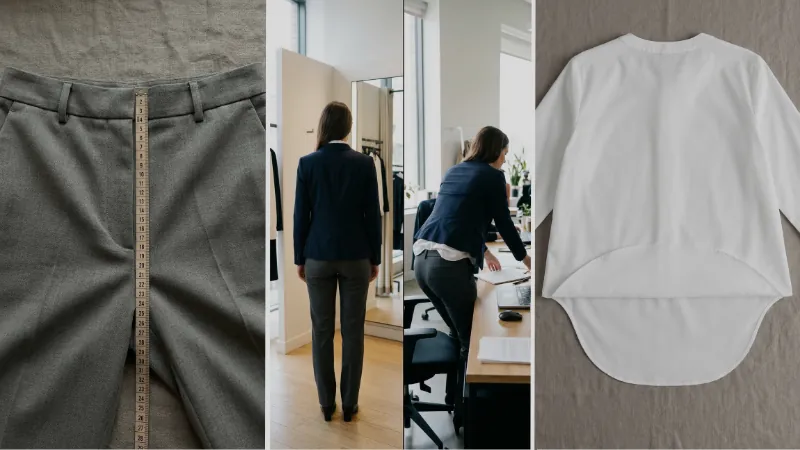
The Sitting-to-Standing Problem: Why Your Outfit Only Works at Your Desk

We spend hours seated, yet we judge our work outfits standing up. This creates a universal blind spot. An outfit can be perfectly fitted in the mirror but self-destructs the moment you rise from your chair in a meeting. You have felt this. You just didn’t have the framework for it.
My advice is rooted in clothing mechanics, but I’ll be direct. If your job is highly active or your workplace is genuinely casual, prioritizing ‘sit-proofing’ above all else might not be your primary concern. For the rest of us in desk-bound roles, it’s everything.
Quick Answer
- Use the sit-test: check shirt hems, trouser pressure, and jacket vents while seated.
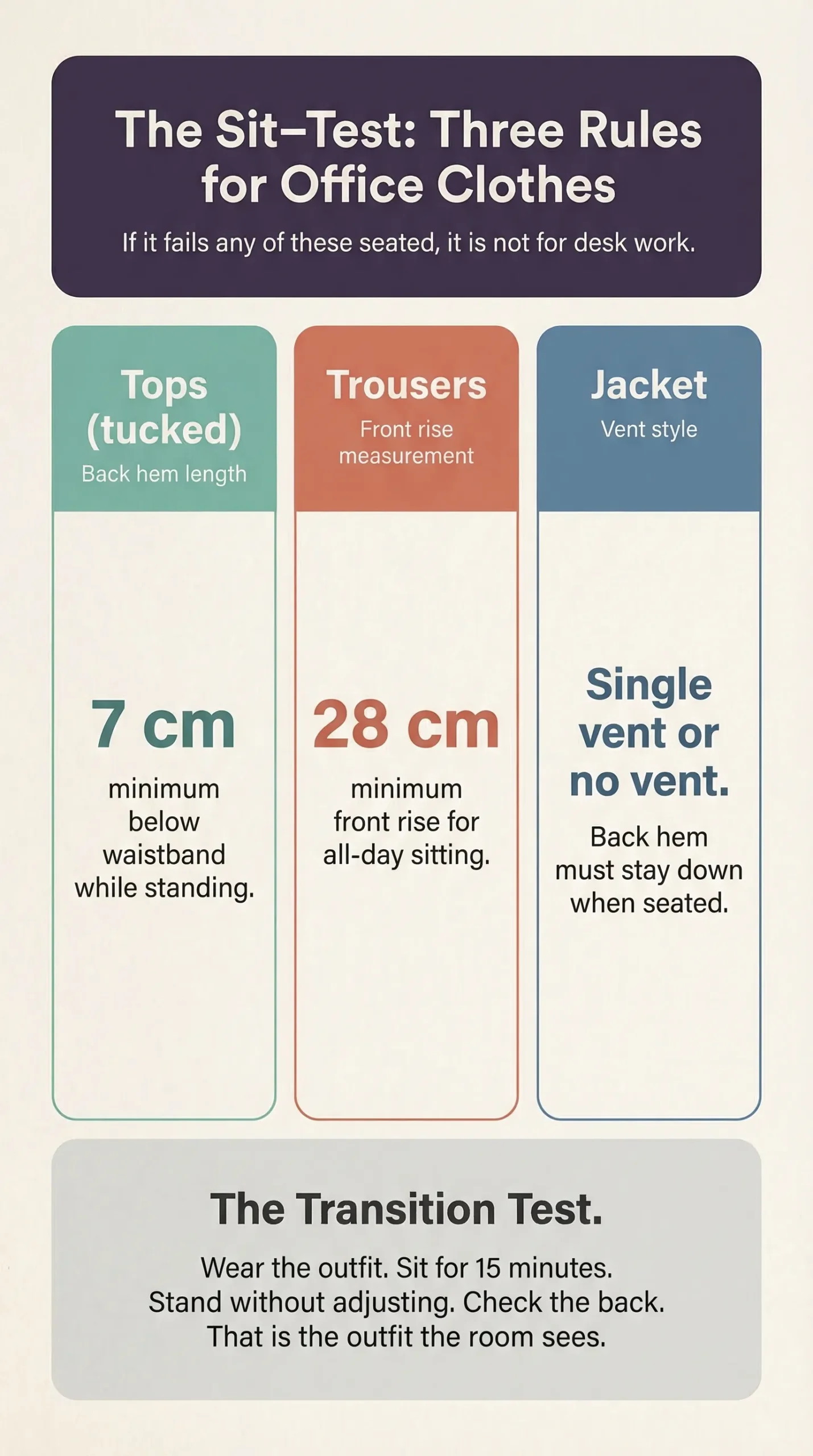
- Any top to tuck needs a back hem at least 7cm below your waistband.
- For all-day sitting, choose trousers with a front rise of at least 28cm.
- Office clothes have two different fits—standing and seated. Most only account for one.
- The solution isn’t buying clothes that fit, but fitting for your most demanding posture.
If you only do one thing: Wear your go-to work outfit, sit for 15 minutes, then stand and check the back without adjusting.
The Problem You Only See When You Stand Up

It’s the feeling of your blouse pulling out of your waistband as you stand to greet someone. You look fine standing still. The failure happens in the transition. An impromptu meeting is called. You sit for thirty minutes, your body settles, fabric shifts. When you stand, your outfit is no longer the one you walked in with.
The back of your shirt has ridden up, creating a puff of fabric above your trousers. Your jacket, fine while seated, now pulls awkwardly across the shoulders. The back hem is caught. You are suddenly, subtly, disheveled. This moment is uniquely professional. It’s not about comfort alone; it’s about maintained appearance.
The problem is invisible in a fitting room and in your hallway mirror. It only reveals itself in the cycle of sitting and standing that defines office life. You can’t readjust your tuck in the middle of a conference room. The outfit betrays you precisely when you need to look most composed.
It’s a failure of design, not of your body. Clothes are cut for a standing silhouette. When you sit, your torso lengthens, your hips pivot, and the geometry of every seam changes. We buy for the static pose, not for the dynamic reality. So you are left performing a silent, frantic audit every time you get up.
The sitting-to-standing transition is the most reliable predictor of a work outfit’s failure. If a garment cannot maintain its silhouette and placement through this basic movement, it is functionally unfit for a professional environment. This isn’t about style—it’s about mechanics.
Why “Buy Clothes That Fit” is Incomplete Advice
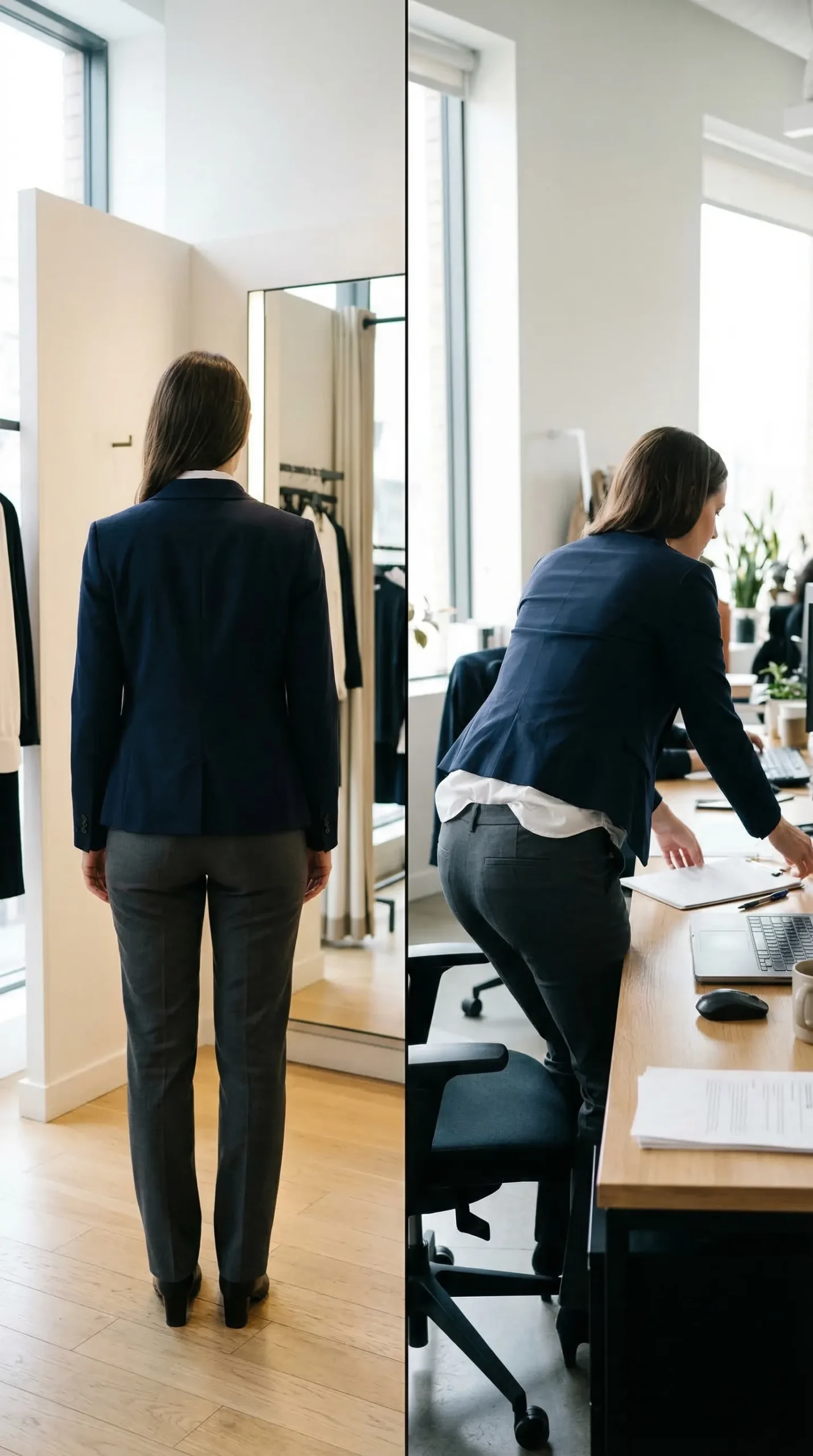
“Buy clothes that fit” is technically correct and completely useless. It assumes a single, static state of ‘fit.’ For the office, there are two fits: the standing fit and the seated fit. They are different. A garment that fits perfectly while you stand will undergo significant stress when you sit.
Your spine curves, adding roughly 8-12cm to your torso length from collar to waist. Your waistband, which rested at your natural waist, is now pressed into the softer part of your abdomen. The standard retail fitting room is a trap. You stand, you turn, you maybe bend forward. But you don’t sit for ten minutes. You don’t simulate the pressure of a meeting.
So you buy the blazer that lies flat when your arms are at your sides, not realizing how the back pulls when you’re reaching for a notepad. You buy trousers that feel fine for a moment, not understanding how the waistband will feel after two hours of pressure. The fitting room offers a snapshot, not the full movie of your workday.
This sounds obvious, but it took me ruining a good silk blouse to understand it. I had it tailored to a perfect standing fit. In my first long sit, the back hem tension was so great it ripped a seam. The tailor was not wrong. The context was. We must fit for the most demanding posture, which for office work is seated.
The standing fit then becomes a pleasant consequence, not the primary goal. This inversion is the core of the solution.
Traditional fitting targets a neutral, standing body. Office work demands a garment accommodate a 10% increase in torso length and shifted pressure points from sitting. A piece that only fits the first state is engineered for the wrong environment, guaranteeing failure in the real one.
The Sit-Test Framework: Your New Fitting Standard

Forget the mirror test. Your new non-negotiable is the sit-test. Before anything else—color, trend, fabric—a work garment must pass it. The rule is simple: assess everything seated first. The standing opinion is secondary. This flips the entire shopping and dressing process. You are no longer buying a look. You are buying a system that performs under specific conditions.
The test has three universal checkpoints. First, the back hem of any top meant to be tucked. Second, the waistband and rise of your trousers or skirt. Third, the back hem and vents of a jacket. If any of these areas fail while you are seated, the garment is a liability in a meeting setting, regardless of how good it looks standing.
This is the direct trade-off: you might sacrifice a razor-sharp standing silhouette for one that holds its integrity. I’ve found the latter is what actually projects competence. This framework is liberating. It gives you a clear, physical criteria to replace vague feelings of something being “off.” It turns subjective style into objective engineering.
When you try on a blazer, you don’t just look at the front. You sit down, lean forward slightly, and feel what happens across your shoulders and back. You check if the hem rides up. That’s the test. It removes doubt and saves money on pieces that were doomed from the start.
The sit-test framework establishes seated functionality as the primary filter for professional clothing. Any item failing on three key checkpoints—back shirt hem, trouser waistband pressure, and jacket back coverage—is unsuitable for desk-based work, making standing aesthetics a secondary concern.
How to Execute Your Own Sit-Test Audit
Start with what you already own. Wear your most-worn work outfit—the one you default to on busy days. Sit at a table for fifteen minutes. Work. Then, without adjusting anything, stand up and have someone photograph your back or use a full-length mirror set up behind you. This is your “real” outfit. Not the one you left the house in, but the one the world sees after you’ve been at your desk. The results are often startling.
This neutral audit shows your personal failure patterns. From there, you test by category. The goal isn’t to throw everything out. It’s to diagnose, so you know what to look for when you replace items. Be systematic. A quick emotional try-on in your bedroom won’t work. You need to simulate the posture and duration of your workday.
The Diagnostic Starting Point
Your first audit requires zero new purchases. The point is to gather data on your current wardrobe’s behavior. Put on the outfit. Sit in a real chair (not your bed) at a table or desk. Do some work for a solid 15-20 minutes. Let your body settle. Then stand, without a single tug or adjustment, and assess the damage. The shirt bunching? The jacket strained? Note it. This shows you which garment categories are your weakest links and guides your future spending.
Testing Tops: The Tuck Rule
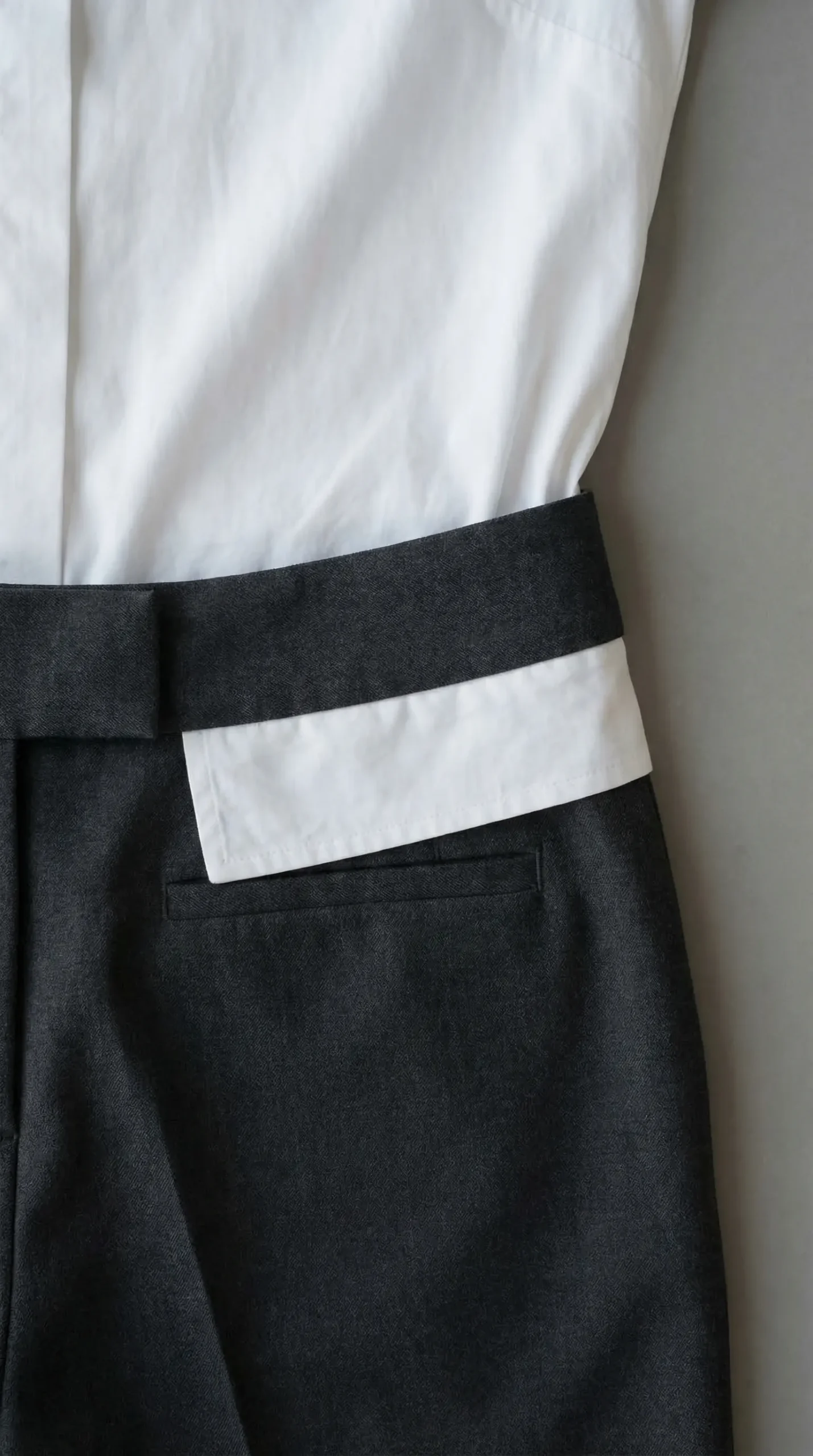
For any top designed to be tucked, length is the only thing that matters. The rule is 7cm minimum. The back hem must extend at least 7cm below your natural waistband when standing. This creates a fabric reserve for when you sit and your torso lengthens. Then, perform the movement test.
Sit, and slowly raise both arms as if reaching for a high shelf or gesturing. If the back hem pulls out from the waistband, it’s too short. The alternative is to abandon the tuck altogether and choose tops with a hem designed to be worn out.
Testing Trousers: The Rise & Pressure Test
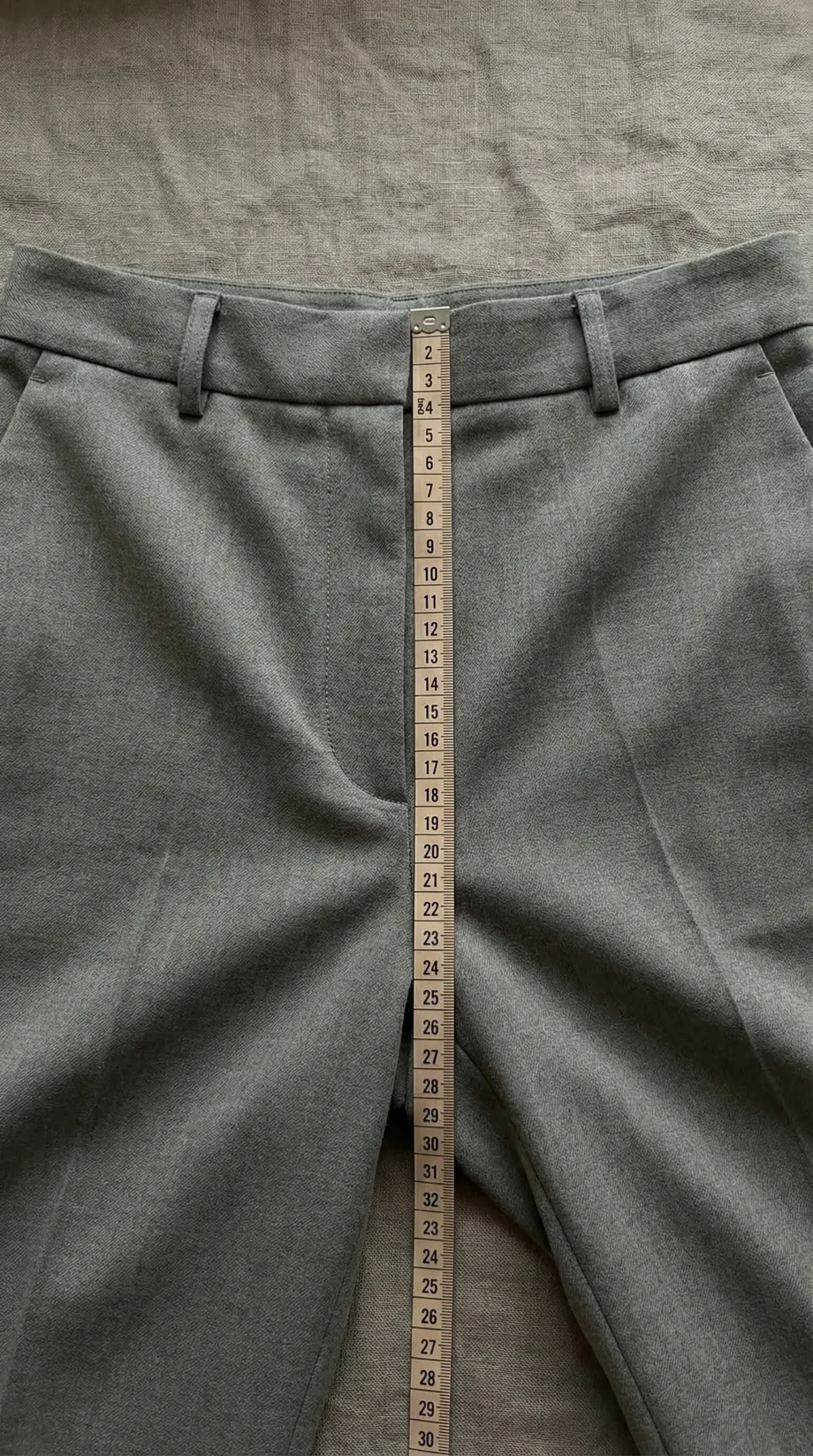
The critical measurement is the front rise—the distance from the crotch seam to the top of the waistband. For all-day sitting, I won’t buy anything with a front rise under 28cm. You need that height to distribute pressure across a wider area of your torso, not dig into a single crease.
Sit. Then, cross your legs. Does the waistband cut in painfully? Does the fabric across your thighs pull so tight it creates a “muffin” effect? That’s a fail. The material should have enough ease and the rise enough height to accommodate this basic seated movement.
Testing Jackets: The Vent & Back Hem Check
Sit down in your blazer. Lean slightly forward as if reviewing a document. Two things will happen with a poorly designed jacket. The back hem will ride up toward your neck, exposing a gap of shirt at your lower back. And the vent, if it’s a double vent, will splay open and create a gap at your seat. A single long vent is far more forgiving in the seated position than a double vent. It opens on one side only and maintains coverage. A vent-less jacket is the most structured option but can pull across the hips for curvier body types when seated.
Foundational Pieces Built for the Sit-Test
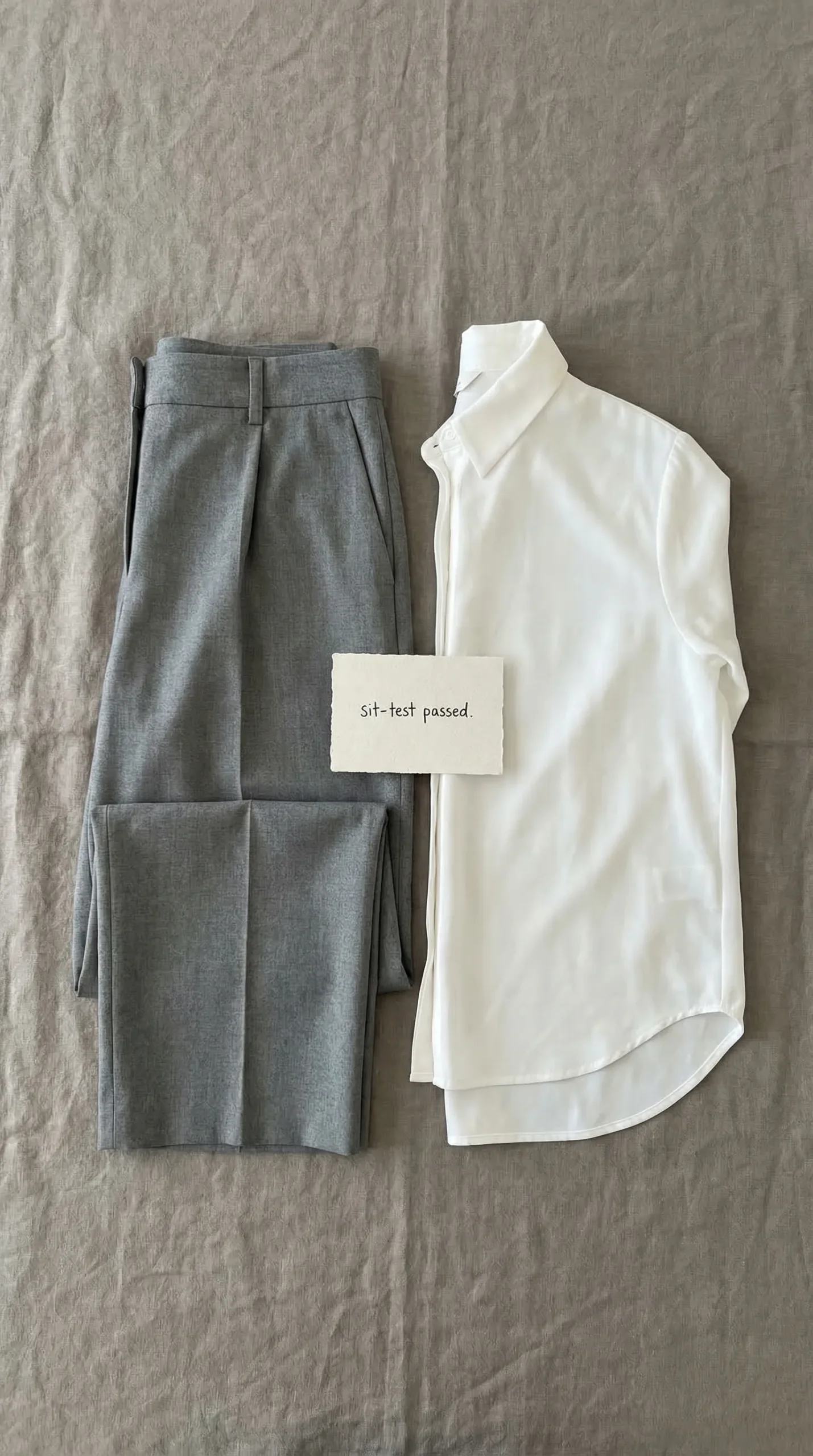
Once you’ve audited, you rebuild with purpose. Start with two anchor categories engineered to pass the test by design. These are your wardrobe workhorses. Get these right, and you’ve solved 80% of the problem. They aren’t the most exciting purchases, but they are the most important. You’ll wear them constantly because they simply function, eliminating daily friction.
Look for pieces where the design specs acknowledge the seated body. This is often found in brands with a focus on tailoring or practical design, not fast fashion. The details are subtle but mechanical: a slightly curved hem, a specific rise measurement, a vent choice. These features are your friends.
Anchor 01: The Mid-Rise Trouser with a Longer Inseam
High-rise trousers dig into your soft abdomen when seated. Low-rise slips down and requires constant adjustment. The sweet spot is a true mid-rise—hitting several centimetres below your natural waist. This band sits on a more stable part of your torso, distributing pressure evenly between sitting and standing.
Pair this with a longer-than-usual inseam. Why? When you sit, the fabric pulls up from your calf. Extra length ensures the hem still grazes your shoe when you stand, maintaining the silhouette. It’s a direct application of geometry.
For a perfect example of this principle in action, the COS Wide-Leg Tailored Twill Trousers are cut with this precise intent.
Anchor 02: The Longer-Back Hem Blouse
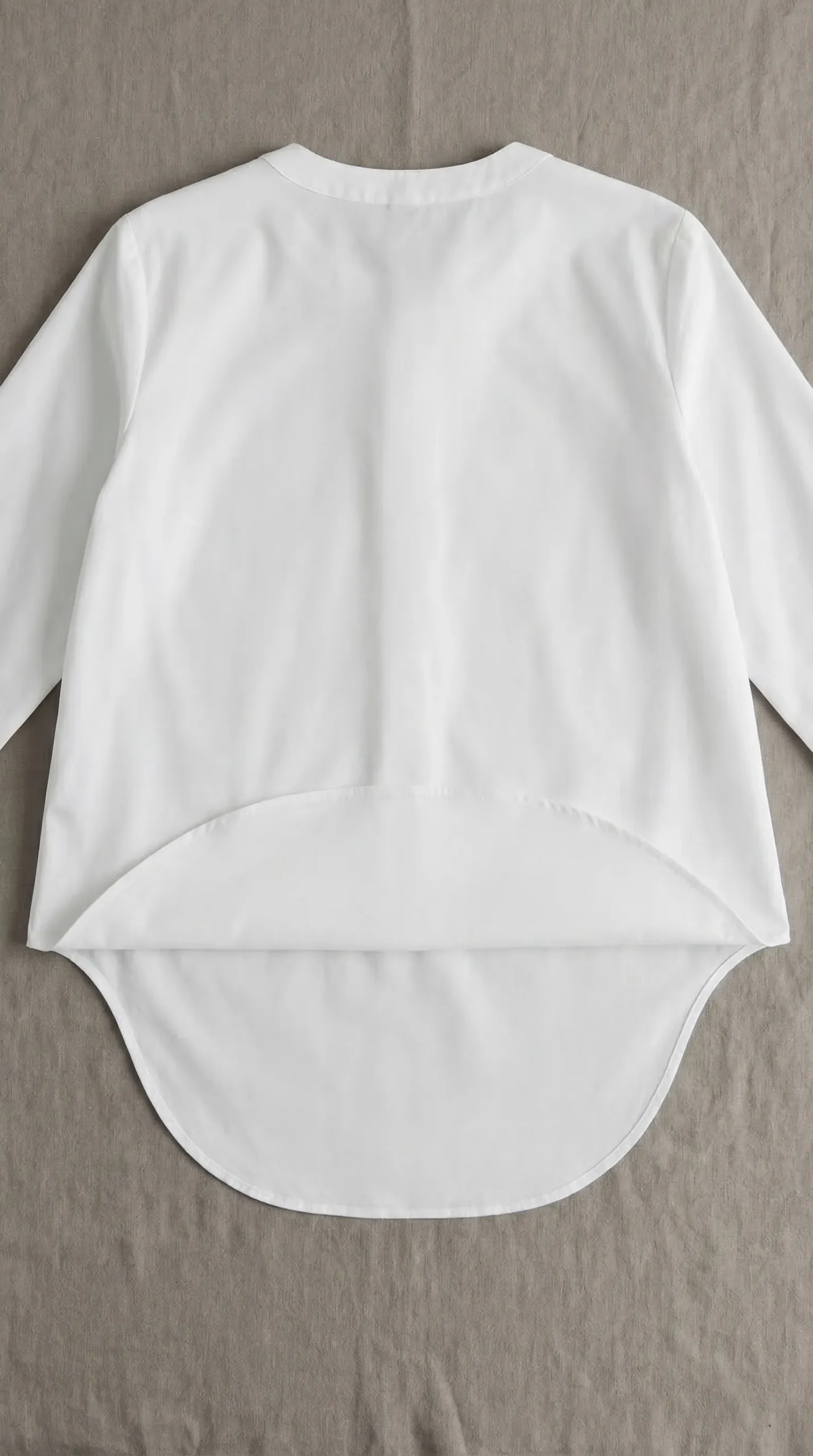
This is a specific design feature, not just a long shirt. Look for blouses where the back hem is visibly longer than the front, or is cut on a curve. This extra 4-6cm of fabric in the back is your seated reserve. When you sit and your torso lengthens, this fabric is released from the tuck.
This prevents the main body of the blouse from pulling out. It’s a simple, brilliant bit of engineering. You find it by checking product photos from the side or back, or by feeling for a distinct dip in the hemline.
Rebuilding a work wardrobe starts with two engineered anchors: a mid-rise trouser to distribute seated pressure evenly, and a blouse with a longer back hem to provide fabric reserve for the seated torso. These pieces solve core mechanical failures, making everything else easier.
Common Mistakes & Fixes
- Mistake: Choosing a blouse that just touches the top of your trousers when standing. Fix: Opt for tops with at least 7cm of length below your natural waistband to survive the seated position.
- Mistake: Assuming high-rise trousers are more professional and therefore better for all-day wear. Fix: Select a true mid-rise to avoid the waistband cutting into your torso when seated for long periods.
- Mistake: Tucking a standard-length top into a skirt and hoping a “little pull” will keep it in place. Fix: If it’s not long enough to pass the sit-test, wear it fully untucked and choose a silhouette designed to be worn that way.
- Mistake: Prioritizing the clean look of a double-vented blazer without considering your seated reality. Fix: For a primary work blazer, choose a single, long vent or a vent-less style to maintain coverage.
Your Sit-Test Checklist
Use this to audit current items or evaluate new purchases. If it fails any point, it’s not for desk work.
- TOP (to tuck): Does the back hem extend 7cm+ below my waistband? Can I raise my arms while seated without it pulling out?
- TROUSERS: Is the front rise at least 28cm? Can I sit and cross my legs without the waistband digging or the fabric pulling tight across my thighs?
- JACKET: Does it have a single long vent or no vent? When I sit and lean forward slightly, does the back hem stay down and not ride up my neck?
- THE TRANSITION: Have I worn it, sat for 15 minutes, then stood and checked the back without adjusting?
FAQ
Why does a shirt that stays tucked when I bend over come untucked when I sit down?
Bending over is a forward hinge from the hips. Sitting is a posterior rotation of the pelvis that lengthens the spine and rounds the lower back. This uses more fabric from the back of the shirt. A bend tests length; a sit tests back-length and fabric tension.
How can I find my true front rise measurement for trousers, and why isn’t it on the label?
Measure a pair of trousers that fit you well: run a tape measure from the crotch seam intersection straight up to the top of the waistband. Brands often omit it because it varies more with style than inseam does, and a higher number can be misperceived as “less trendy.” It’s the most important number for comfort.
What if my preferred style is high-waisted trousers—is there any way to make them work for all-day sitting?
Look for a high-rise made in a stretch woven fabric (like a wool-elastane blend) with a wide, soft waistband. Avoid rigid denim or non-stretch tweed. The stretch gives at the pressure point. It’s a compromise, but it can work.
Can a tailor alter my existing shirts and blazers to make them pass the sit-test, or do I need to buy new ones?
For shirts, a tailor can often add a curved hem or lengthen the back if there’s enough seam allowance. For blazers, altering the back length or vents is complex and expensive, often costing more than a new garment. It’s usually more economical to apply the test to future purchases.
How do I apply the sit-test principle to dresses and jumpsuits?
The checkpoints are the same. For a dress, sit down: does the back ride up uncomfortably? Does the waistline hit in a different, unflattering place? For jumpsuits, the critical test is the torso length when seated—does it pull at the crotch or shoulders? If yes, the proportions are wrong for you.
Does fabric choice impact how an outfit performs in the sitting-to-standing transition?
Absolutely. Natural fibers like wool and high-quality cotton have better recovery, meaning they return to shape after stretching. Stiff, non-woven synthetics can hold a crease or bulge permanently. A small amount of elastane (2-4%) in woven fabrics is your friend for seated ease.