The Dress Code Said Smart Casual and I Nearly Cancelled

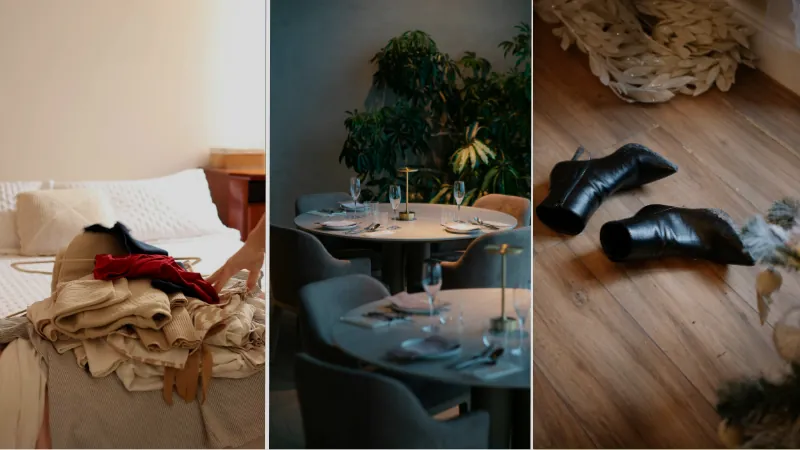
The invitation said smart casual. I read it on a Thursday evening and set my phone down. By Saturday morning I had tried on eleven combinations and was seriously considering inventing a work commitment.
The event was a leaving dinner for a colleague who was moving to Munich. She had been at the bank for twelve years. Not a client situation, not a conference — a restaurant, about fifteen people, a work occasion that was also supposed to feel like an evening.
I looked the restaurant up: moderate lighting in the photos, the kind of place where a blazer would work but was not required. That did not help. Smart casual is the dress code that sounds specific and is not.
I own work clothes and I own weekend clothes. The overlap, I discovered that Saturday, is smaller than I had assumed. What I do not own is a reliable middle register.
What I actually have
My work wardrobe is structured: COS trousers in charcoal and dark grey, two blazers from Arket, blouses that press. My weekend wardrobe is soft — Uniqlo jersey, a Decathlon half-zip for walking, jeans in two washes. I immediately understood the problem, which was not enough.
The obvious starting point was blazer over dark jeans — the charcoal Arket blazer, straight-leg jeans in a dark wash. This combination is in every smart casual article that has ever been published. On me, that morning, it looked like I was going to a meeting and had decided at the last minute to pretend otherwise.
I put the blazer away. I tried a midi skirt in rust-coloured ponte — structured, intentional. Too dressed for a restaurant I did not know, and for a colleague I had never seen outside the bank.
A muted olive shirt from Zara, bought eight months ago and worn almost never. Every time I take it out I remember the fabric does not move well. The collar sits slightly wrong.
The blazer again, this time with wide dark navy trousers. Too formal. The blazer with the jeans, a different top — still wrong.
It was 11am. The dinner was at seven. I made coffee and tried two more things that were also wrong.
The thing I landed on
I bought wide-leg trousers from Mango in a dark camel on sale last spring and wore them twice. They do not read as a work trouser or a weekend trouser — somewhere between, which I had treated as a flaw. The fabric is a cotton-blend, lighter than it looks, and it drapes.
I paired them with a dark chocolate modal-blend top from COS. Not a blouse, not a T-shirt — slightly loose through the body, with a subtle centre seam at the front that stops it reading as sleepwear. I bought it for long office days because the fabric does not wrinkle, and until that afternoon I had always worn it under a blazer.
Together they worked. Not in a planned way — in the way where you look in the mirror and feel no need to keep going. Dark brown block-heel boots, COS, three years old and resoled once — nothing I put on that afternoon was bought for this occasion.
I checked the mirror twice. Then I left.
What I found annoying
I spent four hours on this. The dinner lasted two and a half hours. I am aware.
When I arrived, the table had found six different interpretations of smart casual. Half the group was in blazer and dark jeans — the exact combination I had put back. One person was in a printed wrap dress, two had come from the office in full work clothes, and nobody appeared bothered.
The person who had spent four hours on it was me.
I did wonder, once, around the main course, whether the camel trousers were reading as too casual against the blazer group. I looked at the table and decided they were not — that took two seconds. I do not know what I spent the other three hours and fifty-eight minutes on.
What the problem was
I sort my wardrobe into two categories: work and not work. That made sense when I organised it.
The camel trousers went into not-work because they are not formal. The modal top went into work, subcategorised in my head as only-under-something. Neither decision was wrong.
Smart casual just does not recognise either category. I had nothing filed as the third option.
A leaving dinner is a work occasion but not an office one. I was also dressing for twelve years of working alongside someone, which is different from dressing for the office. I had not thought about it that way before.
The trousers and the top had both been in my wardrobe for months. They just needed to be in the same place.
I wore the outfit three weeks later, to a Saturday lunch with people I do not see often. Then to an internal team day where the dress code says business casual but means: wear trousers. Both times it was right.
The trousers are in the rotation now, and the top gets worn without a blazer — where both should have been already. I spent most of a Saturday and bought nothing new to figure that out.
The annoyance and the relief were approximately equal.
The dinner was fine and the food was good. My colleague looked happy about Munich. I do not remember what anyone was wearing.