My Colleague Asked If I Was “Going Somewhere” Today. I Was Not.

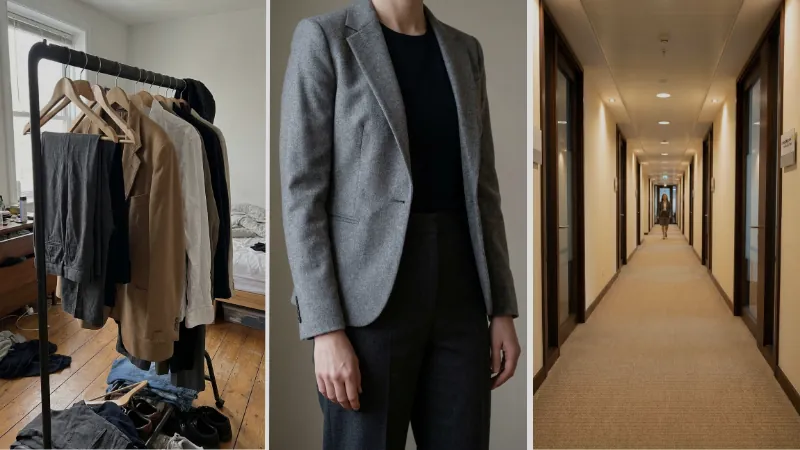
It was a Tuesday in February. I was wearing dark trousers, a white shirt, and a blazer. My colleague Petra stopped in the hallway and said, “Are you going somewhere today?”
I said no. She said, “Oh, you just look nice.” Then she walked away.
I thought about that for the rest of the morning.
The problem was not the comment. Petra was not being rude. The problem was what the comment implied: that I did not usually look like that. That this was a departure from something. I had worn that combination before, I was fairly certain. I could not immediately prove it.
That afternoon I spent time I did not have scrolling through my phone photos. Not selfies — I do not take those — but background appearances. Reflections in windows. The edge of my arm in a photo someone sent from the office Christmas event. I was trying to reconstruct what I had actually been wearing on regular days.
What I found was not reassuring.
I had, without deciding to, sorted my wardrobe into two categories. Things I wore to important things, and things I wore the rest of the time. I had not named these categories. I had not planned them. But they existed.
The important-things category: the COS trousers, the good blazer, the structured shirts. The rest-of-the-time category: the Arket jersey-twill pair, the soft-collar tops, the slightly more relaxed everything. Both categories were work clothes. Both were appropriate. But they were not the same.
Petra had noticed the difference because there was a difference.
I work in Frankfurt. The dress code in my building is not creative, but it is also not a uniform. There is a range. I had been operating at the lower end of that range most of the time and the upper end occasionally, and I had thought of this as normal variation. It is normal variation. But I had not asked myself whether the lower end was actually working for me.
That is a different question.
I thought about the internal meetings where I had worn the soft trousers and a modal blend top and felt comfortable. Comfortable is good. Comfortable means I am not adjusting things or thinking about what I am wearing. But I had also been in those meetings and felt, at certain moments, slightly underprepared. Not for the content. For the room.
I do not know if those two things are connected. I could not prove it. But I noticed I had felt that way more than once.
The blazer situation was its own problem. I own two. One is a structured wool-mix from COS that I bought three years ago and that still looks like I just picked it up. The other is a softer Mango one in camel that I bought because it seemed more wearable, meaning I thought I would reach for it more. I reach for it less. It is too casual for the days when I need structure and slightly off for the days when I do not need structure at all. It exists in a gap.
I wore it maybe four times last year. That is not nothing, but it is not much.
After the Petra comment I started paying attention to what I was wearing when I felt like things were going well at work. Not just the days with good outcomes — outcomes depend on too many things. Specifically the days when I walked into a room and did not have to spend any thought on myself. When I was just there.
On most of those days I was wearing the COS trousers. Or the grey Arket pair with a proper shirt, not a soft top. Or a dress — I have one, a ponte knit in dark green from Weekday, that I bought thinking it was too simple and have worn more than anything else this winter.
The soft tops were not the problem. I have a few that work. The problem was that I had been wearing them with the softer trousers, and soft plus soft was reading as a different register than I intended. Not inappropriate. Just lower.
A jersey top with structured trousers is different from a jersey top with jersey-twill trousers. The difference is small. It apparently shows.
I did not buy anything after this. I did not need to. I had the pieces. I had just been combining them badly, or rather, I had not been thinking about the combinations at all. I was picking things that felt comfortable together, which is not the same as picking things that work together.
Comfort and function are usually the same thing for me. In this case they were not, and I had not noticed for long enough that a colleague commented on it.
I moved the Mango blazer to a different part of the wardrobe. Not out, but further back. I stopped combining the Arket trousers with the modal blend tops for days when I had anything significant before noon. Those two changes took about a week to become automatic.
Nobody has commented again. I do not know if that means anything.
The COS trousers are still the ones I reach for when I need to be sure. I have accepted that about myself. I spent six weeks looking for work trousers once and bought the pair I had seen on day one. The trousers were fine. I find this pattern less annoying now than I used to.
The Arket pair gets worn on Fridays and on long days when I know the afternoon will go sideways and I want one fewer thing to manage. That still works. It just does not work on Tuesdays in February when I am walking past Petra.