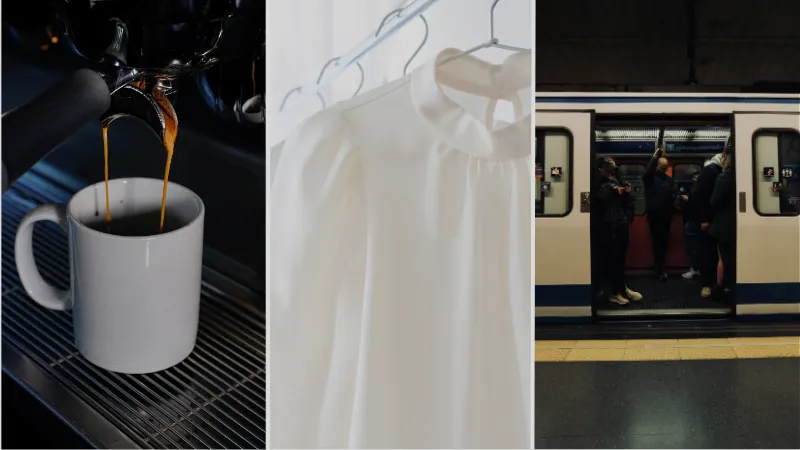
I Wore White to the Office and Spent Eight Hours Protecting It with My Life

The blouse was white. Not cream, not ivory — white. I had owned it for two years without incident, because I had never worn it on a full working day.
I wore it on a Tuesday in March because everything else I considered that morning felt wrong. I was tired. The day was long. The blouse is well-cut — it is from COS, a relaxed fit in a modal blend, and it manages to look more deliberate than it is. I pulled it on and thought: fine.
By 8:15, standing at the coffee machine, I had already begun to regret this.
The coffee
I drink two coffees in the morning at the office. This is not normally a situation that requires management. That Tuesday I held both cups slightly further from my body than I usually do. My colleague Petra asked if something was wrong with my arm. I said no. She accepted this.
I do not know when the distance-from-body strategy began. I was doing it before I had consciously decided to. That is a bad sign, and I knew it by the second cup.
There were pastries at the nine o’clock meeting. The kind with a powdered sugar coating that migrates onto other surfaces. I did not take one immediately. I sat across from a colleague who had taken three and watched him eat them without visible concern. He was wearing a dark navy jacket. This detail stayed with me for longer than it should have.
I work in Frankfurt. The culture around food at meetings leans toward participation. Declining once is fine. Declining twice is mostly fine. Declining three times becomes something people notice. At 9:22 I ate a pastry with my elbows on the table, handling it as though it needed to stay level. Nothing landed on me. I considered this a partial success.
The pen
At around half past ten I reached into my jacket pocket and found something wet. A pen had leaked. The jacket is dark grey, so I had not noticed until I had already touched my collar twice while thinking about something unrelated. The stain itself was small and could have been worse.
I went to the bathroom and applied water and hand soap, which produced a damp patch considerably larger than the original mark. This is always the outcome of that approach. I have done it before and I did it again, apparently on principle.
The patch dried over the following forty minutes. The collar was fine. I washed my hands, looked at myself in the bathroom mirror for longer than necessary, and walked back to my desk. A colleague in the corridor said the blouse was nice. I said thank you and kept moving.
Lunch
I had lunch with a colleague at the restaurant we use when we are not eating at our desks. I ordered a salad. The dressing arrived on the side, which I had not specifically requested but was relieved about. I ate the salad with the dressing kept entirely separate from the salad, all the way through.
She ordered bolognese and ate it without incident. I found this difficult to watch in a way I could not entirely justify.
I got back to my desk at 1:50 with nothing on the blouse. This felt like a genuine achievement. I was annoyed that it felt that way.
The afternoon
The three o’clock was in the main conference room. Someone had left an uncapped whiteboard marker on the table near my end. I noticed it early and moved it to the ledge of the board without making it obvious that this was what I was doing. Not because I am organised. Because I saw it, understood it, and acted.
By four I was tired of thinking about the blouse. Not in any way that showed — just the background process that had been running since the coffee machine. When I leaned forward to type I thought about the desk edge. When someone walked past with a cup I registered it and adjusted slightly. When a colleague dropped a folder I had a small, fast reaction that I covered immediately.
It is a small thing. It is also continuous, and by the time I left the office it had been continuous for about eight hours without a real break.
At 5:40 I looked down and the blouse was still white. I took the U-Bahn home and stood the whole journey because the seats had something on them I could not identify from where I was standing. At home I took the blouse off immediately and hung it up. It was fine.
What the blouse is
The COS modal blend washes well and keeps its shape. The fit is relaxed through the shoulder and tapers at the hem, so it does not come untucked and does not look shapeless on me. The fabric has real weight to it. Those are the reasons I bought it.
What I had not considered carefully enough was that white at the office is not a colour in the way dark grey is a colour. It is an additional responsibility that runs alongside whatever you are already doing that day, without stopping, without being something you can put down. I found this out over approximately eight hours on a Tuesday.
After
I wore the blouse again the following weekend, to meet a friend for lunch. I spilled nothing. I thought about nothing. I ate pasta without managing it.
I have worn it to the office once more since March — a short day, no external meetings, no catered anything. I held my coffee at a normal distance. Nothing happened and I was only mildly aware of what I was wearing, which is how clothes are supposed to work.
I think white at work requires a version of the day that does not have much else in it. I am sometimes in that position. The blouse is still in my wardrobe. I do not reach for it on Tuesdays that already look complicated before they start.