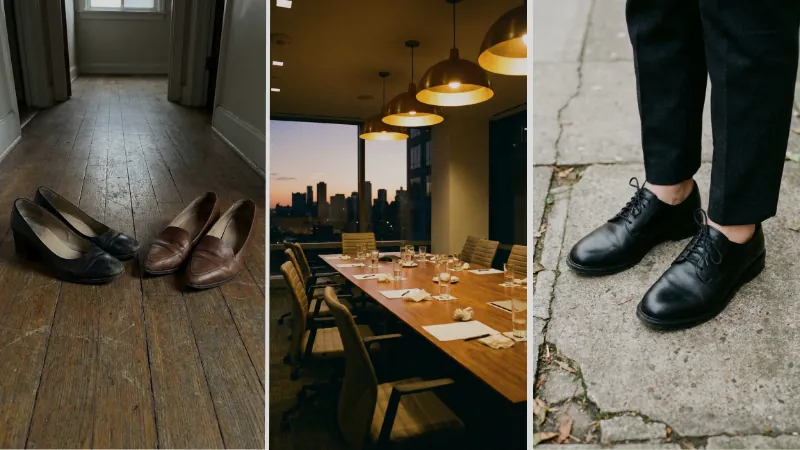
I Bought the Comfortable Shoes and I’m Not Apologizing

My feet hurt for about eighteen months before I did anything about it.
Not constantly. Not dramatically. Just the specific, low-grade kind of hurt that starts around 3pm and gets worse on the U-Bahn home. I had two pairs of shoes I wore to the office. Both were leather, both looked correct, and by the end of a long day both felt like a minor punishment.
One pair was black court shoes with a small block heel. They did look correct. They also required plasters on my heels for the first three months and then developed a creak I was convinced was audible in quiet meetings.
The other pair were flat pointed-toe loafers in dark tan. Better. But the sole was thin and I work in a building with marble floors and a lot of walking between floors. By Wednesday of any given week I could feel every step.
I kept wearing them. I bought gel insoles. I tried the plasters-on-the-back-of-the-heel thing again even though the shoes were already broken in. I told myself it was fine.
It was not fine. I was just not paying attention to what fine was supposed to feel like.
Hamburg
I had a conference in Hamburg. Two days, a lot of standing, dinner in the evening, a breakfast meeting the following morning. I packed both pairs and spent longer than I want to admit deciding which was less bad.
I wore the loafers. By the end of the first day my lower back hurt in a way it did not usually hurt. I sat through the dinner thinking about my feet instead of the conversation. I took the shoes off under the table, which I found embarrassing, and then found the embarrassment mildly annoying.
On the train home I looked up shoes for about forty minutes on my phone. I was not looking for anything in particular. I just knew I was done with both pairs.
The Research, Which Took Longer Than It Should Have
I spent about two weeks looking before I bought anything. This is not unusual for me. I read a lot of reviews. I have opinions about reviews — whether the person writing them seems to actually wear the shoes to work, or whether they wore them once to a wedding and then wrote eight hundred words.
I looked at several brands I already knew. COS has done simple leather shoes that I had considered before and rejected for reasons I can no longer reconstruct. Arket had a Derby style I liked the look of, but several reviews mentioned the sole was harder than expected. Zara’s leather shoes have not, in my experience, held up past a year.
I looked at Ecco for the first time with any real attention. I had walked past their shops for years. The shoes always looked slightly too practical, slightly adjacent to something medical, in a way that felt like a category I was not in. That was the thought I had. I held it for two weeks and then let it go.
What I Actually Bought
I went in-store. I try on shoes in person now because I have returned enough pairs to know that photographs and my feet have a complicated relationship.
I tried three pairs. The one I bought was a simple leather Derby — black, low heel, clean toe. Not trendy. Not particularly interesting to look at. The kind of shoe that reads as a shoe and not much else. The sole had real cushioning. The leather was soft from the first day.
They cost €189. That felt like a lot for something I was mainly hoping would stop hurting me. I bought them anyway and took the U-Bahn home, carrying them in the bag, and walked to my flat in the loafers for the last time.
The First Week
I wore them on a Tuesday. I walked to the station, into the office, to three different floors for meetings, to a lunch place two streets away, back to my desk, home. At no point did I think about my feet.
I had not realised that thinking about my feet had become a background condition of my working day until it stopped. That is not dramatic. It is just what happened.
By Thursday I had worn them three times. I noticed I was walking slightly differently — not better exactly, but without the small compensations I had apparently been making. The lower back thing from Hamburg did not come back.
My colleague asked where I had got them. I told her. She said she had been considering Ecco for a while but kept deciding against it. I said I had done the same thing for two years, which was true.
The Part I Had Resisted
There is a version of work dressing where shoes are the item that signals effort. I had absorbed this from somewhere — a decade of reading things I can no longer locate. The idea that practical shoes read as not trying.
I wore my new Derbies with a dark wool trouser and a tucked silk blouse to a client meeting three weeks after buying them. No one looked at my feet. One client complimented my blouse. I was home by 6:15 and my back was fine.
The shoes looked like shoes. They worked in that room. I had no reason to think they wouldn’t have, and yet I had spent two years wearing things that hurt me to avoid finding out.
Where I Am Now
I still have the court shoes. I keep meaning to take them to a cobbler about the creak. I have not done this.
The loafers I have returned to rotation for summer, when I am less likely to walk long distances and more likely to want something lighter. The insoles help. They are fine for that use.
The Eccos I have worn consistently since October. No plasters. No 3pm calculation about whether I can hold out until the end of the day. I resoled them in February, which surprised me — I did not expect to wear them enough to need it that quickly.
My opinion, stated plainly: I should have done this much earlier. But I spent the time I spent.