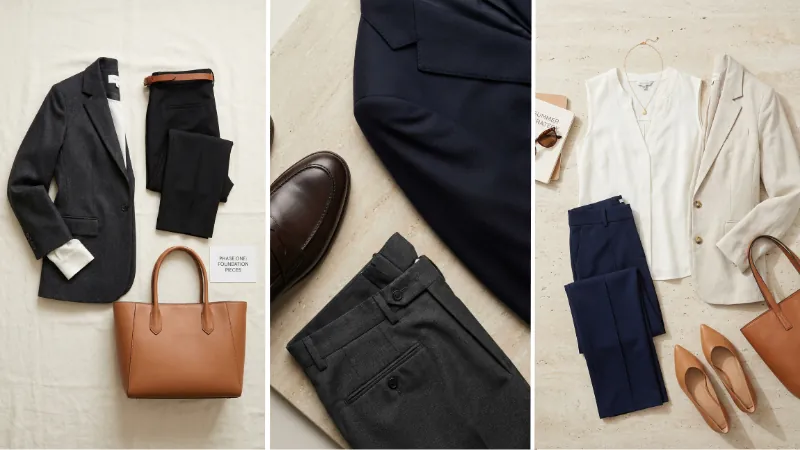
Corporate Outfits for Women: The No-Think Morning Formula

Most corporate style guides are fundamentally useless. They preach about “power dressing” but completely ignore the physical reality of sitting through a four-hour strategy meeting in a synthetic blazer that traps heat. Staring at a disorganized closet at 7 AM trying to decode cryptic HR dress codes is a massive drain on your daily energy. Built this definitive framework after years of navigating rigid banking environments. Looking undeniably competent doesn’t require a massive budget or chasing seasonal trends.
It requires a clinical, systematic approach to tailoring, fabric weights, and proportions. Stripped away all the editorial fashion fluff to give you the exact blueprint. From translating vague office dress codes to dressing for your specific build, the shifting seasons, and a realistic budget. This is the practical manual for building a corporate wardrobe that actually does its job.
Understanding Corporate Dress Codes
You get a calendar invite. The dress code field says “business professional.” You stare at it for a moment. Then you spend ten minutes on your phone Googling whether your blazer counts. This is not a you problem. The terminology is genuinely inconsistent, and nobody explains it properly.
Here is what the spectrum actually looks like, in plain language.
Business Formal is a full suit or a tailored dress with a structured jacket. Matched pieces. Closed-toe shoes with a heel or a clean flat. Nothing relaxed. This is courtroom attire, board presentations, formal client events.
Business Dress (sometimes called Business Professional) is where most corporate attire for women sits. Structured trousers or a pencil skirt, a blouse, a blazer. Not necessarily a matched set. But everything should look intentional. Fabrics matter here.
Business Casual is the one that confuses everyone. Dark jeans plus a blazer is business casual. A midi dress in a solid color is business casual. A clean knit top with tailored trousers is business casual. The operative word is tailored. Fit is doing the work that formality used to do.
Smart Casual is not the same as “casual.” It just means the effort is visible. Neat, put-together, but relaxed. Loafers instead of heels. A shirt tucked loosely rather than precisely. It reads intentional, not dressed-up.
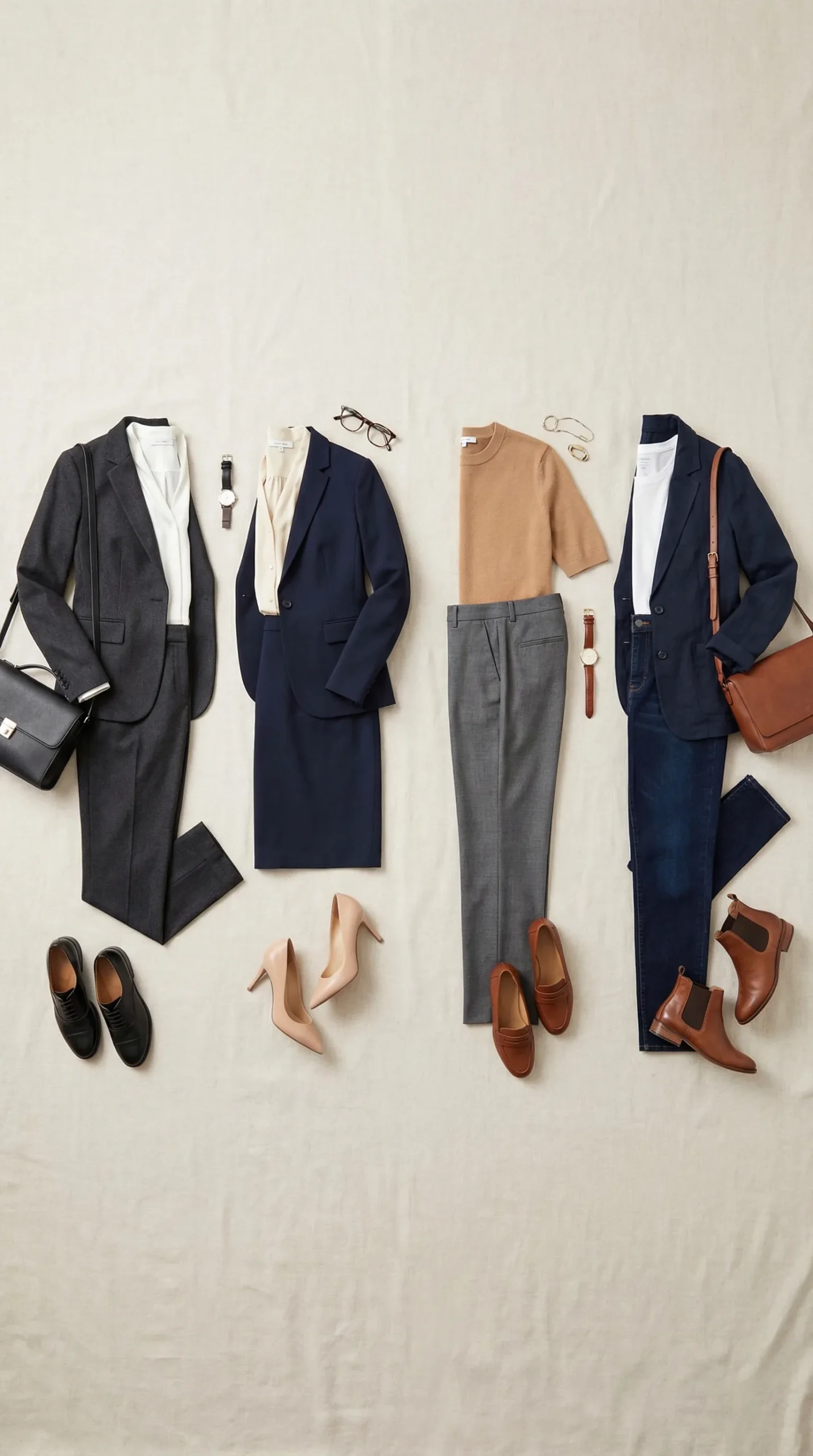
| Dress Code | Plain Definition | Key Garments |
|---|---|---|
| Business Formal | Matched, structured, zero ambiguity. Everything is deliberate. | Matched trouser suit or skirt suit, structured blazer, closed-toe heels or polished flats |
| Business Dress | Professional and polished. Separates are fine. Fabric and fit carry the formality. | Tailored trousers, structured blouse, blazer or structured jacket, midi dress in a solid or subtle print |
| Business Casual | Relaxed but intentional. Fit replaces formality. Still office-appropriate in a conservative room. | Dark tailored jeans, knit blazer, clean blouse or fitted sweater, ankle trousers |
| Smart Casual | Effort is visible, formality is not. Neat, cohesive, but relaxed in silhouette and fabric. | Tailored chinos, loafers, linen shirt or clean crew-neck, unstructured jacket |
Where your office lands on this spectrum depends entirely on industry. Finance and law default to Business Dress as a baseline. Creative agencies tend to sit at Business Casual. Tech startups often slide past Smart Casual into something closer to “whatever the founder is wearing.” None of these are judgments. They are just calibrations.
The problem with modern professional work outfits is that the rules have shifted but nobody sent a memo. What passed as business outfits for women in a traditional corporate environment ten years ago can read as overdressed in a hybrid tech office today. Context reads the outfit. Not the other way around.
My take: “Business Casual” has become a catch-all term that means different things in different buildings, and the safest move is always to observe what the senior women in your office actually wear on a Tuesday, not what the employee handbook says.
The single most practical rule in corporate clothes for women is this: for any job interview, dress one level above the company’s everyday standard. If they are Business Casual on a normal day, you come in at Business Dress. Not because you are trying to impress. Because it is much easier to relax your look after you are hired than to recover from looking underprepared at the beginning.
Trade-off: Going one level up for an interview can occasionally make you feel stiff in a very casual office environment. Worth it anyway. First impressions are set in the first few minutes, and you cannot go back and re-dress for them.
The other confusion point worth naming directly: modern business attire for women is not the same as formal attire. Structured trousers and a clean blouse without a jacket is business dress in most offices. It is not underdressed. It is correctly dressed. The blazer is an add-on for formality, not a requirement for professionalism.
Your Core Corporate Wardrobe
Sunday night. You’re standing in front of your wardrobe. Again. And you have nothing to wear.
Not because the wardrobe is empty. It’s full. You bought a new top last week. And the week before that. But nothing connects to anything else, so you keep buying stopgaps instead of building something that actually works.
That’s the problem. Not a shortage of clothes. A shortage of structure.
Corporate outfits for women fall apart at this exact point. Lots of individual items. No system underneath them. The fix isn’t buying more — it’s buying fewer, better, and in the right order.
The Non-Negotiables First
Before anything else, you need foundation pieces. These are the items that make everything around them work. Get these wrong and the rest of the wardrobe fights you every morning.
A tailored blazer. Neutral trousers in at least two weights. One structured bag that is professional without trying too hard. A flat or low heel that you can actually walk in by 4pm.
That’s it. That’s the floor. Everything else is optional.
Blunt truth: Most women buy the accessories before they’ve sorted the foundation, and then wonder why their outfits look expensive from the rack and slightly off in the office.
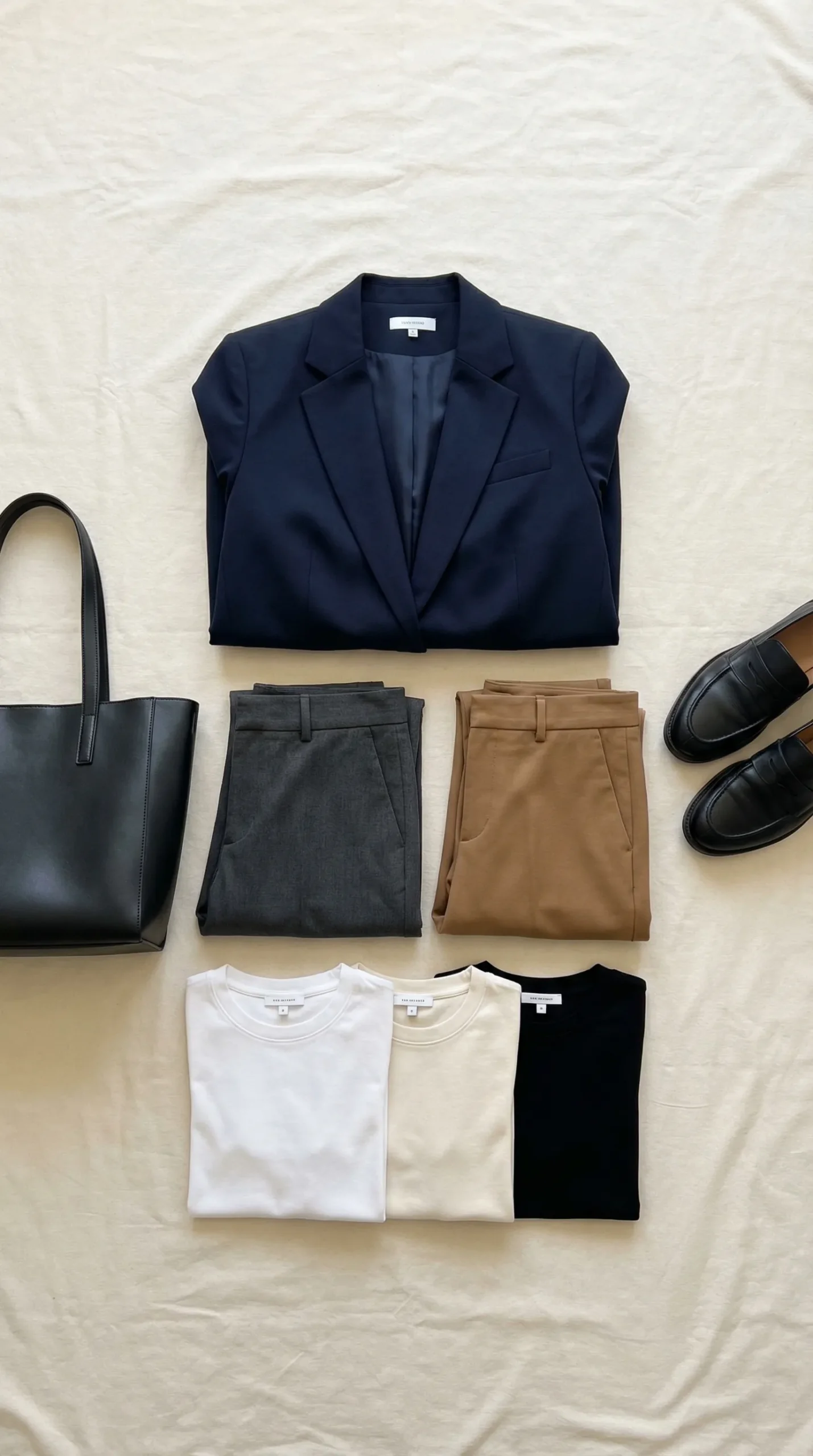
| Item | Why It’s Essential | Key Buying Note |
|---|---|---|
| Tailored blazer | Instantly sharpens any outfit underneath it. A clean blazer over a simple top reads as intentional rather than underdressed. | The shoulder seam must sit exactly at your shoulder. Not close. Exactly. Everything else can be adjusted. That can’t. |
| Neutral trousers (x2) | The backbone of classy work outfits for ladies. One pair in a heavier wool blend for structure. One in a lighter fabric for warmer months or longer days. | Get them hemmed. Off-the-rack trouser lengths are a guess. The right hem length changes the entire silhouette. |
| Fitted, plain-neck top (x3) | The item that does the quiet work. Sits under blazers, under cardigans, on its own with tailored trousers. Needs to fit cleanly through the shoulder and torso. | Buy in black, white, and one neutral close to your skin tone. Avoid anything with stretch that goes thin across the chest after two washes. |
| Structured work bag | A bag that holds its shape when set down reads as more professional than one that slumps. It’s a small detail. It registers anyway. | Needs to fit a laptop or full A4 documents without straining the zip. Tone should be neutral: black, tan, or dark brown. |
| Flat or low-heel shoe | A heel you stop wearing by noon because your feet hurt is not a work shoe. It’s a problem you’re paying for. | Loafers in leather or a leather-look finish work in almost every corporate environment. They don’t need to be expensive. They need to look like they cost more than they do. |
| Midi or knee-length skirt | Gives you an alternative to trousers without leaving the register of corporate women outfits. Useful when trousers feel too heavy or you need a slight change of pace. | Avoid bodycon. The cut should skim, not grip. A-line or straight-cut in a heavier fabric holds its shape through a full day. |
Why a Small Wardrobe Outperforms a Large One
The capsule logic is simple. Six foundation pieces in the same tonal family will combine into roughly four to five distinct outfits without you having to think about it. Add two more pieces and the combinations multiply again.
That’s not theory. That’s how proportion works. Fewer decisions means fewer mistakes. And fewer mistakes means you stop buying panic tops on Sunday night.
The key is tonal range, not colour variety. If your neutrals are all in the same family — cool greys and navies, or warm camel and cream — they will pair without effort. Mix warm and cool tones across your foundation pieces and nothing quite works together, even when each piece is individually fine.
My take: Ten pieces you actually reach for will always outperform thirty pieces you’re not sure about. Volume is not the same as range.
What Has Actually Changed in the Corporate Wardrobe
The boxy power suit is not the default anymore. It hasn’t been for a while. What replaced it is harder to name precisely, but the shift is real.
Tailored wide-leg trousers have taken the place that pencil skirts used to hold as the neutral legwear option in trendy professional clothes. They are not casual. In the right fabric — a wool blend with enough weight — they read as more formal than a slim-cut trouser in a cheaper fabric. The silhouette is wider, but the structure carries the formality.
The matching two-piece has also shifted. Instead of a matched jacket-and-trouser in the same fabric, the modern corporate wardrobe tends toward a blazer that coordinates without matching exactly. Same tonal register. Different texture or weight. That’s the current read on corporate women outfits in most professional environments.
Trade-off: Wide-leg trousers require the right shoe height to land correctly. In a flat shoe, a wide leg can shorten your silhouette if the hem is too long. That’s not a reason to avoid them. It’s a reason to get the hem right before you wear them anywhere important.
Modern female business attire has also moved away from exclusively skirt-and-heel combinations as the default “formal” look. Trousers are fully neutral now in most industries. The formality comes from fabric quality and fit, not from the category of garment.
That’s the actual shift. Not trends. Not seasonal edits. The structural logic of what reads as professional has quietly moved, and a wardrobe built on the old assumptions will keep feeling slightly off without being obviously wrong.
Outfit Formulas for Every Occasion
It is 7am. You have three blazers. All of them are technically “professional.” And you have absolutely no idea which one is correct for the client pitch today versus the internal team debrief tomorrow.
That’s not a wardrobe problem. That’s a system problem.
A formula fixes this. The logic is simple: base layer + structured layer + footwear = a complete outfit. Every variable has a defined range. You’re not starting from scratch every morning. You’re filling in blanks.
The table below maps the formula to five real scenarios. Use it as a decision tree, not a mood board.
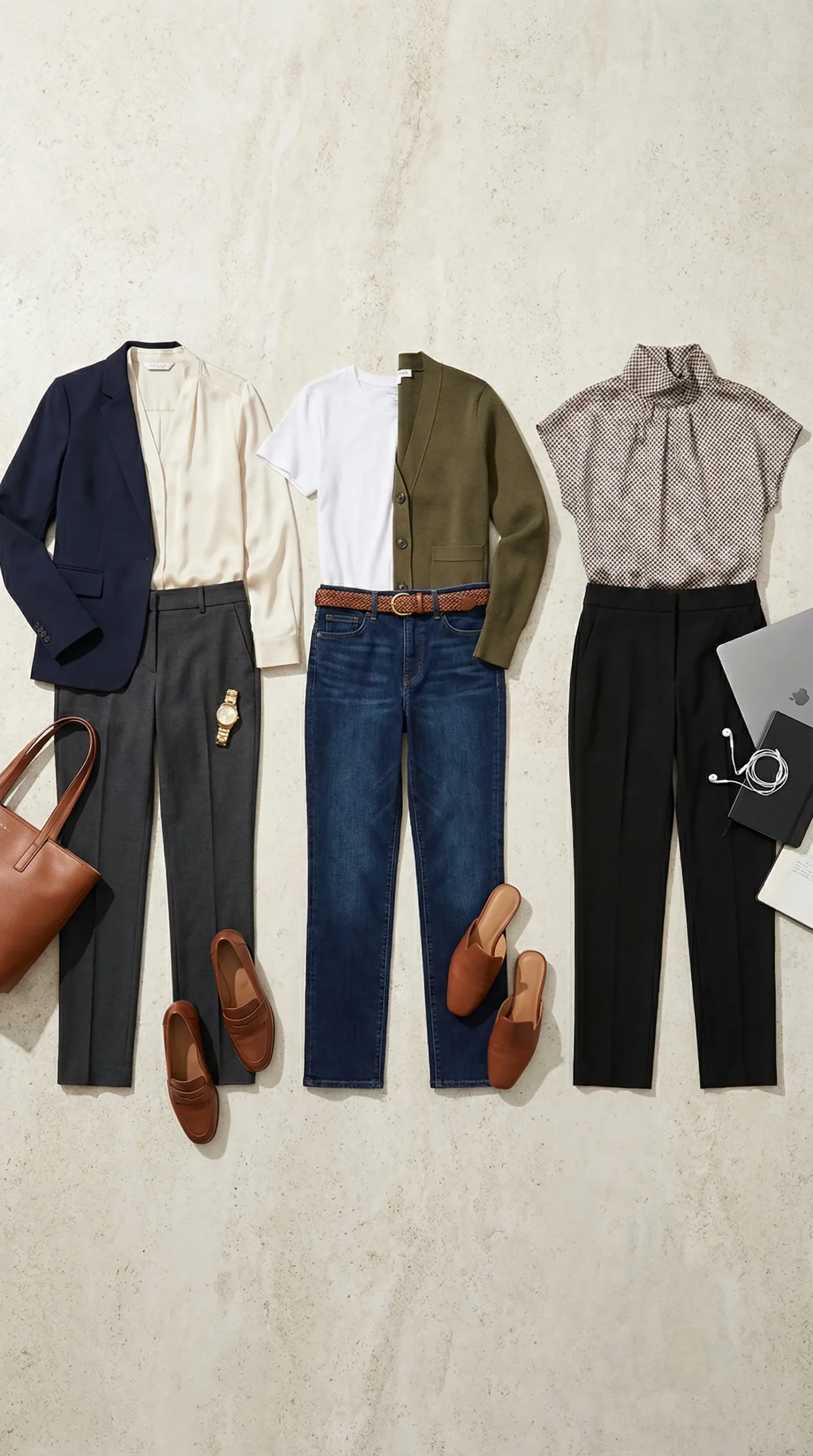
| Occasion | Formula | Key Pieces | Dress Code Level |
|---|---|---|---|
| Client Meeting | Tailored blouse + structured blazer + trousers + closed-toe heel or loafer | Wool-blend blazer, pressed trousers, silk or woven blouse | Business Formal / Business Casual |
| Presentation Day | Tailored set (matching jacket + trousers or skirt) + simple top + low heel | Matching blazer and bottom in the same fabric, neutral or single-colour base | Business Formal |
| Casual Friday | Dark straight-leg jeans + knit or woven top + structured third layer + loafer or clean flat | Dark denim (no distressing), fitted knit or button-down, blazer or tailored cardigan | Smart Casual |
| Video Call | Structured top or blouse + blazer or cardigan with visible lapel or collar | Solid or subtle-pattern top, no logos, no casual jersey fabrics on camera | Business Casual (top half only) |
| Job Interview | Tailored suit or blazer + matching or tonal bottom + closed-toe heel or clean loafer | Single-colour or tonal palette, no pattern mixing, minimal accessories | One level above company norm |
Business Formal and Business Dress Formulas
For high-stakes corporate office outfits, women consistently make the same mistake. They treat a blazer as a blazer and trousers as trousers. They don’t think in complete systems.
The formula that works in formal settings: tailored suit jacket + matching trousers + silk or woven blouse + closed-toe heel or leather loafer. Every piece earns its place. Nothing is decorative.
Colour strategy matters here more than anywhere else. A neutral palette — navy, charcoal, stone, black — is non-negotiable in high-authority rooms. A single accent works. One burgundy blouse under an all-navy suit reads intentional. Cobalt jacket with burgundy trousers reads chaotic.
The rule: one colour decision per outfit. Make it deliberate.
My take: for the best corporate outfits for women in formal environments, a matching set does more work than any blazer-and-separate combination. The visual coherence reads as competence before you say a word.
For interviews specifically: default one dress code level above what you can see on the company’s website or social media. If their team photos show business casual, you show up in a structured suit. Not because it’s required. Because it removes a variable.
- Research the company’s visible culture before deciding
- When uncertain, choose the more formal option
- A blazer can be removed; an underdressed outfit cannot be upgraded on the spot
This won’t work if the company runs a flat-hierarchy, open-plan office where the founders are in trainers. Overdressing in that environment doesn’t signal authority. It signals that you didn’t do your research. Read the room before you pack the suit.
Trade-off: formal suiting limits your range of motion and can feel excessive in a casual office culture. That’s a real cost. Decide whether looking authoritative that day is worth it.
Business Casual and Smart Casual Formulas
Most women get this wrong in one direction. They start with a casual piece they like and try to “dress it up.” That’s backwards.
Start with the structured piece. Build down from there.
Business casual formula: tailored trousers or a midi skirt + fitted top + structured blazer or jacket + loafer or block heel. Smart casual formula: dark straight-leg jeans + woven or knit top + blazer or longline cardigan + clean leather flat or loafer.
The difference between these two is mostly the bottom half. And the footwear. Those two variables do a lot of lifting.
What actually elevates a casual piece into something corporate-appropriate is not magic. It’s three things:
- Fit: nothing too loose, nothing that pulls. The fabric should lie flat.
- Fabric quality: woven, structured, or fine-gauge knit. Not jersey. Not anything that pills after two washes.
- Footwear: a loafer or a low heel changes the register of the whole outfit. A clean leather flat works. A chunky sneaker does not, unless Smart Casual is explicit company policy.
On the jeans question. Dark denim — no distressing, no fading, no stretch panels that shine under office lighting — is acceptable in casual corporate outfits for women when the rest of the outfit is structured. That means a blazer. That means proper footwear. The jeans are not the statement. They are the background.
Blunt truth: medium-wash jeans with a graphic tee is not Smart Casual. It is weekend casual. In a corporate context, it communicates that you don’t know the difference. That matters more than anyone admits.
For young professionals building their first corporate wardrobe: the instinct is to underdress because overdressing feels performative. Resist it. For casual work outfits, female professionals early in their career are disproportionately judged on this. It is not fair. It is also not changing fast enough to be worth ignoring.
Trade-off: defaulting to structured pieces every day is effortful and expensive to maintain. Dark jeans done correctly are genuinely easier. But they require the rest of the outfit to compensate. Every time.
Modern Trends Worth Adopting Now
Not micro-trends. Not what appeared on a runway last season. What has actually shifted in how professional women dress for work — and stayed shifted.
Three changes are worth paying attention to for corporate outfits and women’s wardrobes specifically.
1. Tailored sets have replaced the mismatched blazer-and-separate. A matching jacket and trouser in the same fabric reads more intentional than a cobbled-together combination, even if both pieces are technically good. The set does the coordination work for you. That’s the functional argument. And it photographs better on video calls, which is now relevant every week.
2. The wide-leg tailored trouser has replaced the pencil skirt as the default neutral bottom. Wide-leg trousers in wool or a wool blend move well, pack better, and work across a wider range of shoe shapes. The pencil skirt requires specific footwear and limits stride. Wide-leg does not. It is simply more versatile.
My take: if you’re looking at trendy professional clothes and wondering what’s actually worth buying versus what will look dated in eighteen months — a wide-leg trouser in navy or charcoal is the answer. It’s not trend-driven at this point. It’s replaced something older.
3. Clean, minimal sneakers have entered Smart Casual — but with conditions. A low-profile leather or leather-look sneaker in white, cream, or grey now works in companies where Smart Casual is the stated dress code. The condition is that the rest of the outfit has to be structured. Tailored trousers or a midi skirt. A blazer or a knit with clear shape. The sneaker is not licence to relax everything.
If your company is Business Casual or above, the sneaker is not there yet. Boundaries on trendy work clothes on a budget are real: a fashion-forward piece worn in the wrong environment costs credibility, and credibility takes longer to rebuild than an outfit takes to change.
Corporate outfits for women ideas that come from trend cycles are worth filtering through one question before buying: will this still be appropriate in two years? If the honest answer is probably not, the purchase requires more justification than novelty.
Corporate Outfits by Season
You have sweated through a blazer in July. You have shivered through a December board meeting in a pencil skirt because the alternative was a chunky knit that made you look like you were heading to a ski lodge. Both situations are stupid. Both are avoidable.
The fix is not a new wardrobe. The core pieces covered in the capsule chapter stay constant. What changes by season: the fabric weight, the layering logic, and two or three specific swaps that make the difference between functional and miserable.
Winter Corporate Outfits
Winter has one real problem in a corporate context. Not the cold outside. The cold outside is manageable. The problem is the 40-minute gap between leaving the house and sitting at your desk — when you are either freezing on a platform or overheating in a packed commuter train.
The answer is not to dress for the train. Dress for the office, then solve the commute separately with outerwear.
For layering that stays office-appropriate, the fabric under a blazer matters more than most people think. A fine-knit merino turtleneck works because merino regulates temperature — it traps warmth without trapping moisture, which is why you can wear it for eight hours without feeling clammy. A thick cotton crew-neck does not work. It adds bulk at the shoulder and collar, and the blazer starts to look strained.
Fabrics that provide warmth without visual heaviness:
- Ponte — structured, holds its shape in cold, does not go limp when you’re layered under a coat
- Wool-blend — anything above 40% wool content will give you real warmth; below that, you’re paying for the label
- Merino knit — fine gauge only; bulky merino reads casual and the shoulder line collapses under a blazer
- Flannel — underused in women’s workwear, but a well-cut flannel trouser in charcoal or mid-grey is one of the most winter-appropriate things you can wear to a corporate office
Blunt truth: Thermal underlayers exist and they work. A thin merino base layer under a silk blouse adds warmth you cannot see. Nobody needs to know.
Two formulas for the two distinct winter realities:
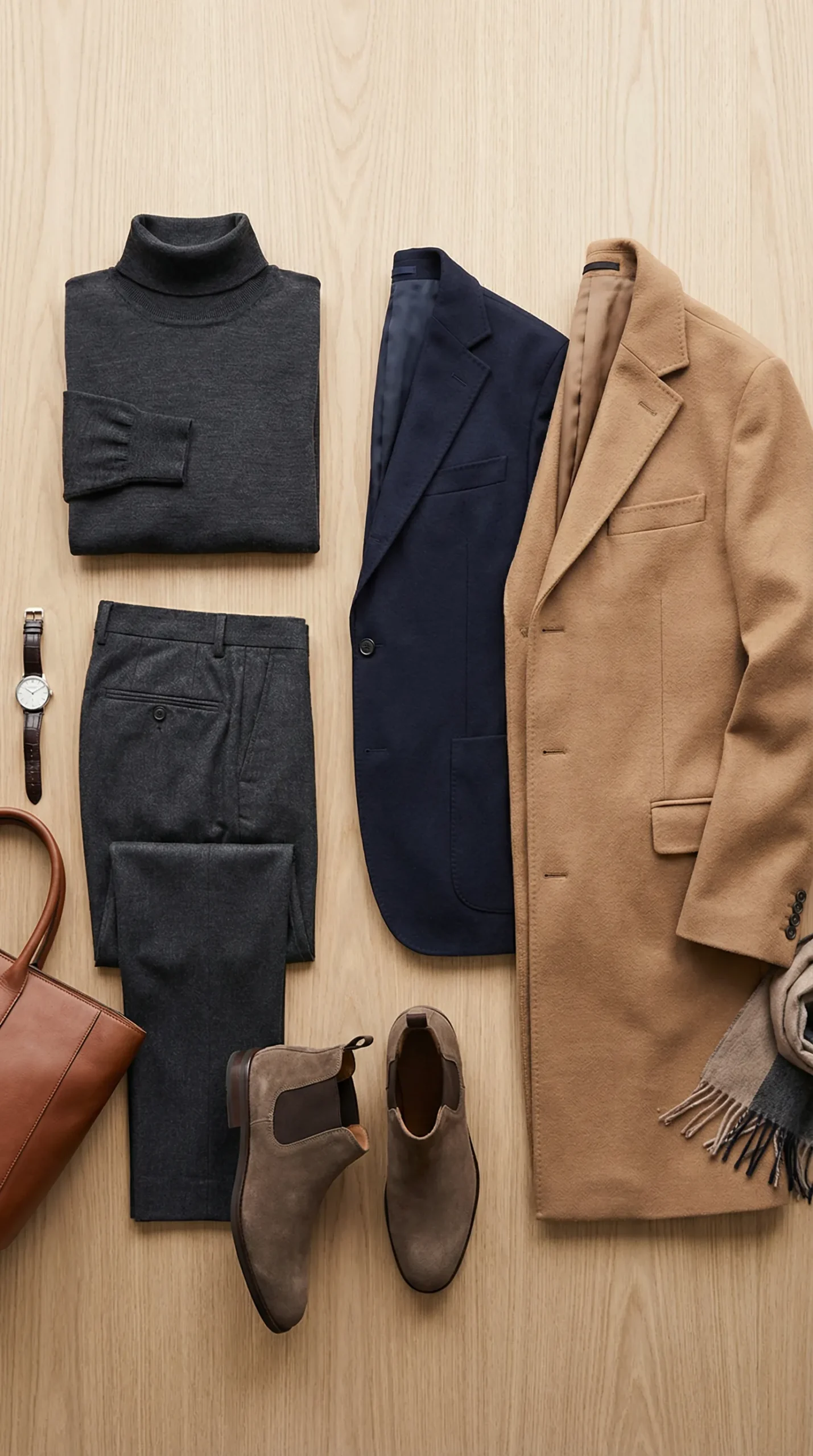
| Context | Outfit Formula | Why It Works |
|---|---|---|
| Cold commute, client-facing day | Fine-knit merino turtleneck + tailored wool-blend trousers + structured blazer + wool overcoat | The turtleneck replaces the blouse entirely. No open collar means no cold air at the neck. The overcoat comes off at the door and the rest of the outfit is already meeting-ready. |
| Overheated open-plan office, internal day | Lightweight ponte straight-leg trousers + fitted long-sleeve blouse + blazer kept on chair | The ponte is warm enough to feel like winter dressing but light enough that you are not dying at 2pm. The blazer is there when you need it. It is not attached to you. |
On outerwear: the coat you wear over a corporate outfit should not make the outfit invisible. A long wool coat in camel, charcoal, or black works because it reads as part of the same register. Puffer jackets are a practical choice for corporate outfits women wear through winter — but only if they stop at the hip. A floor-length puffer over tailored trousers looks like you changed your mind halfway through getting dressed.
Trade-off: A beautiful wool overcoat requires actual care. Dry cleaning, proper hanging, storage in summer. If you are not going to do that, a high-quality recycled-fill short puffer in a neutral colour is the more honest choice for fall corporate outfits women navigate in rain and wind every day.
My take: The turtleneck-under-blazer combination is genuinely one of the most underrated moves in winter workwear. It looks deliberate. It is warm. I would wear it four days a week if I could get away with it.
Summer Corporate Outfits
Summer in a corporate office is a two-environment problem. The street is 32 degrees. The conference room is 19. You have approximately fifteen minutes between both, and you need to look the same in each.
Nobody has cracked this perfectly. But some fabrics get closer than others.
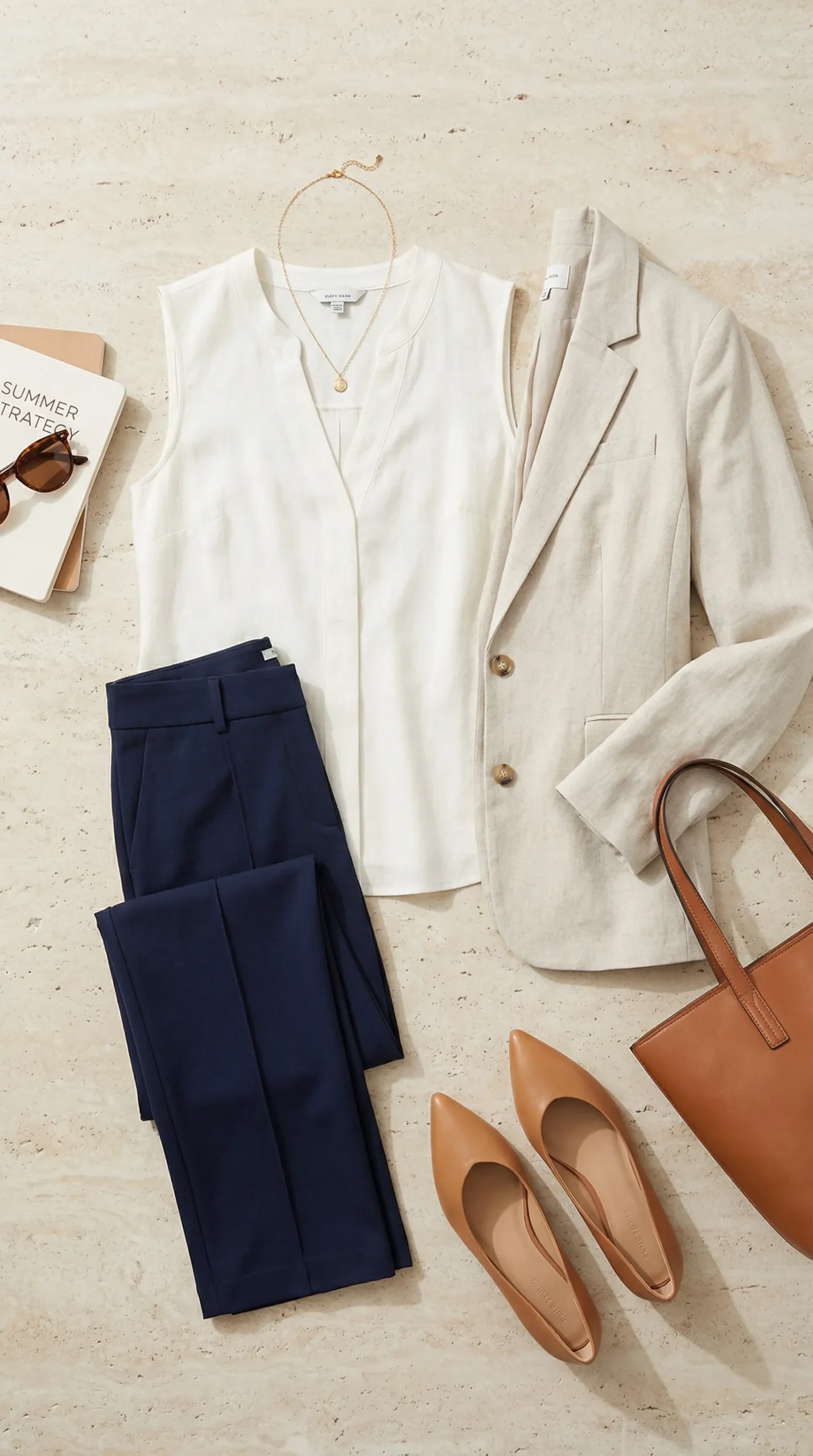
What works in heat and still reads professional:
- Linen — breathable, lets air move, looks intentional; the wrinkle issue is real but manageable if you choose a structured cut rather than a relaxed one
- Lightweight ponte — holds its shape better than linen in transit, less prone to showing the outline of whatever you are wearing underneath
- Cotton-linen blend — splits the difference; some structure, some breathability, less wrinkling than pure linen
- Lightweight wool-blend — counterintuitive, but a fine summer wool actually regulates temperature better than cotton; it is also less likely to show sweat marks, which is the real concern
What does not work: anything synthetic that traps heat, anything light-coloured that turns translucent when you get warm, and anything with a high polyester content that you are relying on to look crisp by noon. It will not.
Blunt truth: The fabric category that shows sweat the fastest is 100% cotton in a fitted cut. Useful to know before you commit to a white cotton blouse for a summer client meeting with no air conditioning.
The outfit formula that solves the air-conditioning problem is simple. Not revolutionary. Just practical.
Sleeveless structured blouse (linen or ponte) + straight-leg linen trousers + light blazer or unlined jacket that you carry or remove. The blazer is the variable. Outside, off. Inside, on. The rest of the outfit stays exactly the same and looks deliberate in both contexts.
Trade-off: Linen looks correct and composed for the first hour of a summer workday. After that, if you are commuting or moving between buildings, it will crease. That is the trade-off. You can reduce it by choosing a linen blend or a heavier linen weight, but you cannot eliminate it.
On hemlines and sleeves: summer is not an invitation to redefine what corporate outfits women wear. The line sits at the same place it does in October. Skirts and dresses at the knee. Sleeveless is fine — a structured, fitted sleeveless top reads professional; a spaghetti strap does not, regardless of how hot it is. Shoulders can be visible. The fit and structure of the garment still need to do their job.
My take: The sleeveless structured blouse is one of the most useful summer work pieces you can own, and most people do not own one that actually fits properly through the armhole. That is usually where the problem is.
For corporate outfits women summer dressing that functions across the full day, the simplest test is this: if you can remove one layer and the outfit still reads as intentional, it works. If removing that layer leaves something that looks unfinished, you are one blazer away from a problem.
Corporate Outfits for Every Body Type
You find a blazer. The shoulders sit perfectly — seam exactly where it should be, no pulling, no overhang. Then you button it and the fabric across the hips does something you can’t fix without a tailor. You stand in the fitting room and decide which problem to live with.
Most people pick the shoulders and hope the hips sort themselves out. They don’t.
Here is the only principle that actually matters: fit overrides formula. A well-fitted pair of dark jeans reads more professional than a poorly fitted “correct” trouser. The outfit hierarchy most style guides sell you is a lie if nothing actually fits your body. Fit is the formula.
What follows is practical guidance by frame. Not colour. Not fabric. Just the structural decisions that make professional work outfits look intentional rather than assembled in the dark.
- Broader shoulders: Look for raglan or dolman sleeves on tops — they distribute the shoulder line rather than emphasising it. V-necklines pull the eye down and inward. Avoid cap sleeves entirely; they sit at the widest point and make it wider.
- Fuller hips: The straight-leg trouser is your baseline. Not wide-leg (adds volume), not slim-fit (creates tension lines). Straight. A longer blazer that skims past the hip works structurally because it creates a vertical line rather than a horizontal break at the widest point.
My take: The fitting room is not the place to be optimistic. If it pulls now, it pulls in the meeting.
Plus Size Corporate Outfits
The problem with plus size corporate dressing isn’t availability. Extended sizing exists now in a way it didn’t ten years ago. The actual problem is finding pieces that hold their structure through a full working day — not just pieces that look right on a hanger at 9am and go soft by lunch.
Structure requires a certain fabric weight. And construction. A ponte blazer in a size 18 will hold its shape through eight hours in a way that a woven-cotton blazer with no interfacing will not. That’s not opinion. That’s what interfacing does.
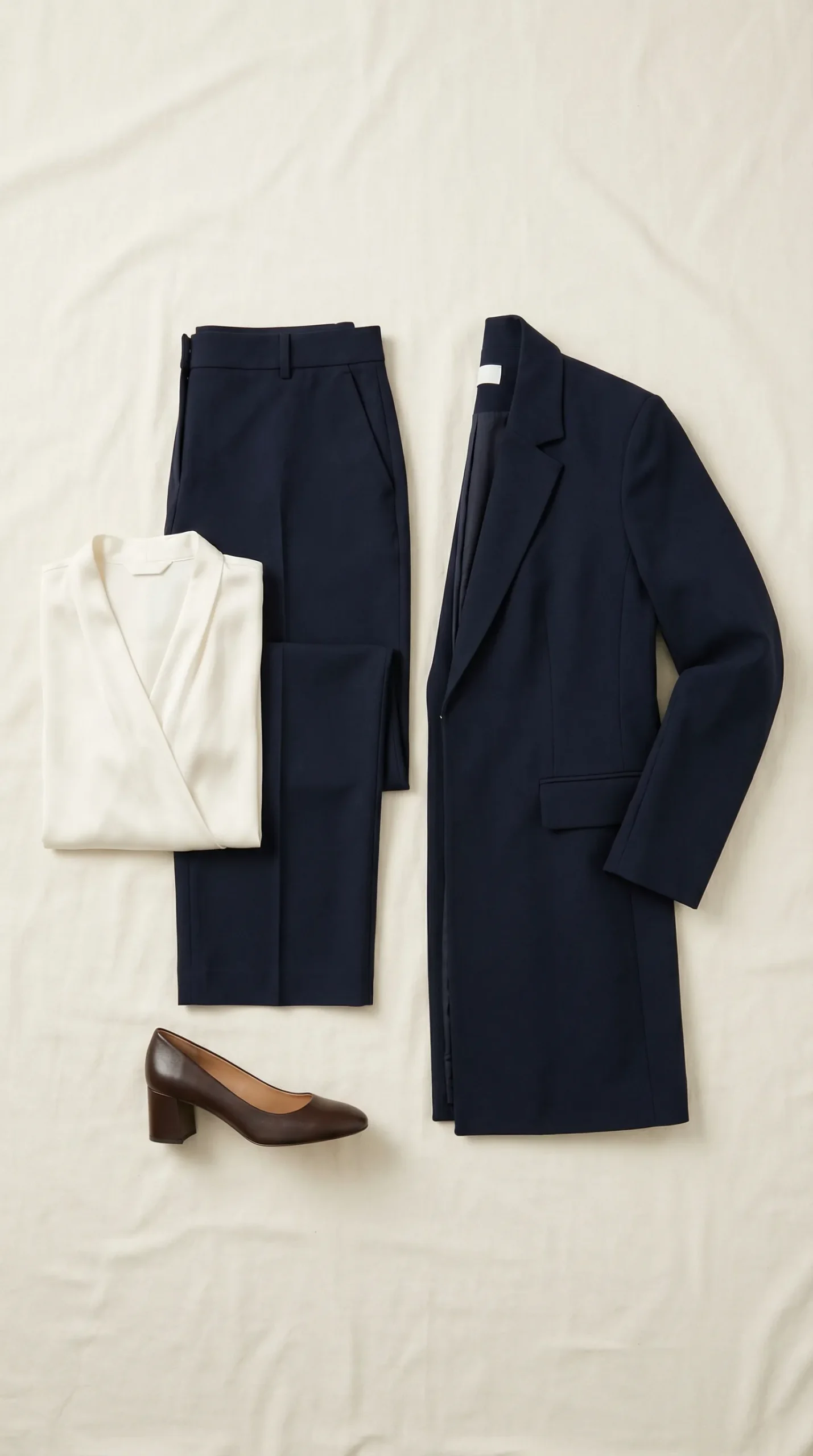
The silhouettes that consistently work for corporate outfits women plus size are:
- Straight-leg trousers: They create a clean vertical line from hip to hem. No gathering. No tapered ankle that pulls attention to proportion.
- Wrap-style dresses: The wrap creates a diagonal line across the torso, which is structurally more flattering than a horizontal seam. It also adjusts at the waist, which means it actually fits rather than approximating a fit.
- Longline blazers: Anything that ends below the hip extends the torso line. Short blazers cut across the widest point of the hip and create a visual break where you don’t want one.
The most common mistake? Sizing up across the board to avoid tightness. Understandable logic. Wrong result. A size too large adds volume where there isn’t a fit problem and creates a shapeless silhouette that reads casual. Not comfortable-professional. Just casual.
Blunt truth: You can buy the right silhouette and still need alterations. Alterations are the most underused tool in plus size professional dressing, and they cost less than a new outfit.
A tailor taking in the waist of a wrap dress by two centimetres is the difference between “this fits” and “this looks expensive.” It’s a forty-euro alteration. It changes everything about how a piece reads in a fluorescent-lit conference room.
Trade-off: Structured fabrics (ponte, heavy crepe, bonded jersey) hold their shape all day. They also retain heat. If your office runs warm, that matters.
Petite and Tall Corporate Dressing
Proportion is physics. A cropped blazer on a petite frame extends the visual leg line. The same blazer on a tall frame ends mid-torso and makes the jacket look like it shrank in the wash. Same garment. Opposite results. Neither person did anything wrong. The cut just doesn’t work for both.
For petite frames:
- Cropped blazer: Ends at or just above the natural waist. Creates the illusion of more leg. Works with high-rise trousers specifically — the two together form one unbroken vertical line.
- Monochrome dressing: Top-to-toe in one colour removes the horizontal break at the waist. The eye travels the full length of the body rather than stopping mid-frame.
- Heeled footwear: Not for height. For line. A block heel or a low kitten heel extends the leg line cleanly without compromising stability on a long day.
Petite outfit formula: High-rise straight-leg trouser in a mid-to-dark tone, tucked-in blouse in the same tonal family, cropped blazer. One unbroken line. Done.
For tall frames:
- Midi-length skirts and dresses: The hemline hitting mid-calf is proportionally balanced on a taller frame. Anything shorter looks shorter than it is. Midi fills the space correctly.
- Wide-leg trousers at full length: Do not hem them to standard length. Let them sit at the ankle or just above. The full length on a taller frame looks intentional. Hemmed to average-height standard, it just looks cropped.
- Avoid cropped blazers: They end too high on the torso and create a silhouette that reads unfinished rather than tailored.
Tall outfit formula: Wide-leg tailored trouser at full length, longline blazer that hits at the hip, fitted top underneath. The length of the blazer breaks the frame into two even halves rather than leaving the legs as the dominant visual element.
My take: Tall women are often told to embrace their height and “own it.” That’s fine advice. It still doesn’t tell you which hemline actually works. Midi-length skirts are the most reliable answer I’ve found, and I haven’t changed that position in years.
The common thread across every frame category: professional work outfits fail at the proportion level before they fail anywhere else. Get the line right. Then worry about everything else.
Corporate Dos and Don’ts
You wear what feels completely professional. You get to the office. And then, somewhere around 10am under the fluorescent lights, you start wondering. Is the skirt slightly too short when you sit down? Is the blouse slightly too sheer? You can’t tell anymore. You spend the rest of the day half-distracted by it.
That quiet uncertainty is its own kind of exhausting. And it’s almost always avoidable.
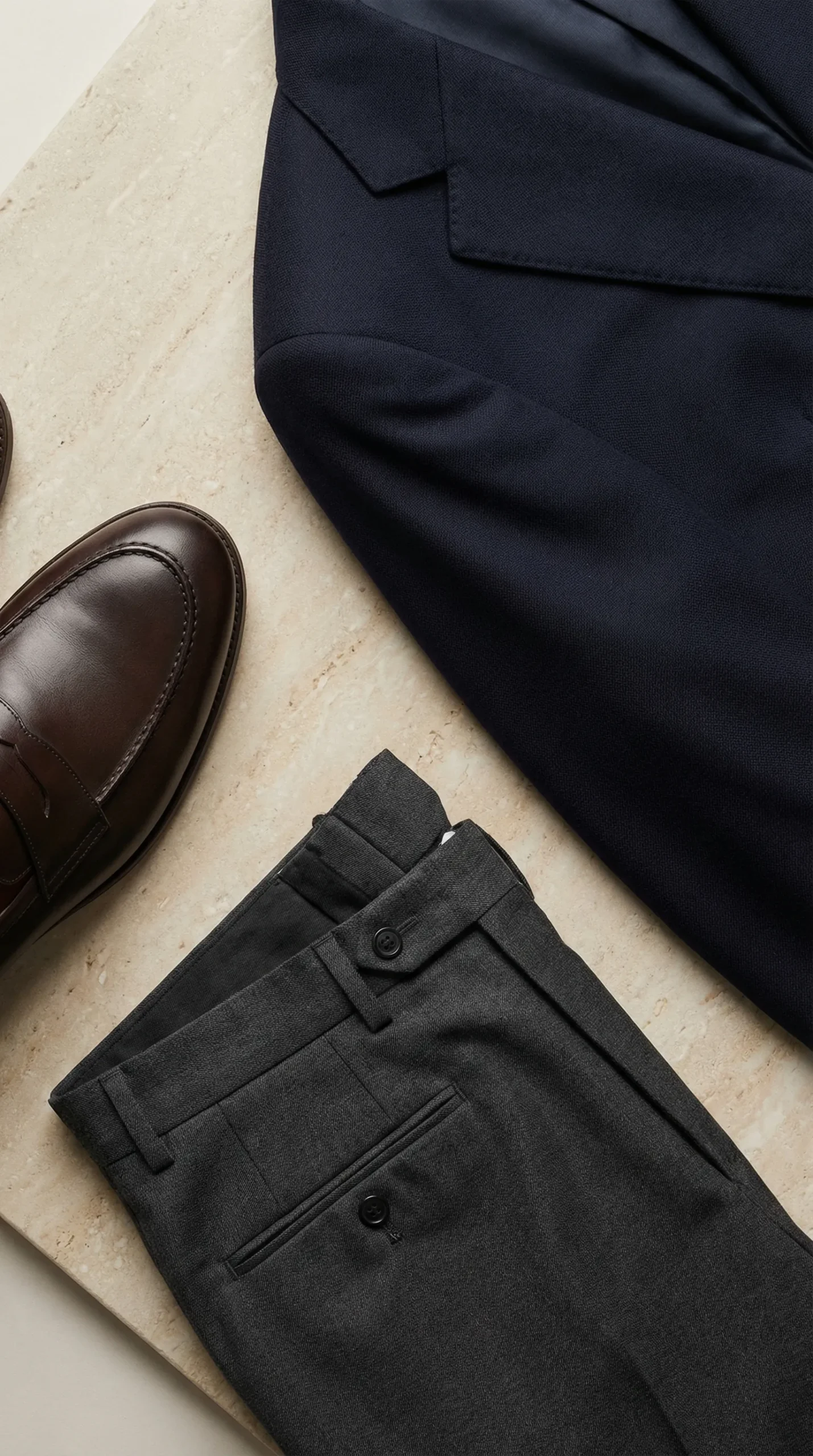
| DO | DON’T |
|---|---|
| Fit: Have anything you wear regularly tailored. Shoulders sit on your shoulders, waistbands sit at your waist, hems are intentional. | Fit: Buy “close enough” and assume it will look fine. It won’t. Pulling across the bust or gaping at the back reads as unprepared, not just casual. |
| Formality: Match your baseline to the room you spend the most time in, then dress one level above it. | Formality: Dress for the average day and hope the client meeting is relaxed. It usually isn’t. |
| Fabric: Choose structured fabrics with some weight — wool blends, ponte, dense jersey. They hold their shape through a full day. | Fabric: Wear lightweight rayon or thin cotton to work. Both wrinkle fast and go limp under office heat. They look fine at 8am. Not at 3pm. |
| Colour: Build around neutrals — charcoal, navy, camel, stone. Add one non-neutral per outfit, maximum. | Colour: Mix more than two patterns or more than three distinct colours in corporate outfits for women. The eye doesn’t know where to settle. Neither does the person interviewing you. |
| Accessories: Keep them small and intentional. One quality piece per zone — wrist, neck, ears. Not all three simultaneously. | Accessories: Stack every piece you own because “more is more.” In most corporate environments, it isn’t. |
The Three Mistakes That Actually Keep Happening
Fit is the last thing women check. Because corporate sizing is wildly inconsistent across brands. A 38 in one store is a 40 in the next. So women find something that mostly fits and move on. But “mostly fits” is visible. Especially across the back and through the shoulders.
Sheer fabrics get misjudged in store lighting. Retail light is warm and flattering. Office light is cold and unforgiving. A blouse that looked opaque in the changing room can read completely differently under overhead fluorescents. The fix is boring but it works: hold the fabric up to the brightest light source before you buy it.
Work outfits for women get planned as tops and bottoms, not as a full silhouette. The pieces look fine individually. Together, they don’t quite cohere. Usually because the proportions haven’t been considered. A voluminous top needs a slim bottom. A wide leg needs a fitted layer on top. That’s it. That’s the whole rule.
My take: fit problems account for at least half of all “this outfit isn’t working” moments, and most of them would be solved by one appointment with a tailor.
Shoes and Accessories: The Layer Most Women Rush
Here is what happens. You spend twenty minutes on the outfit. Forty seconds on the shoes. The shoes undo it.
Footwear is where corporate dressing loses women, because the comfort versus formality trade-off is genuinely difficult and no one talks about it plainly. Heavily cushioned sneakers worn with work outfits don’t read as fashion-forward in most offices. They read as casual. Whether that matters depends entirely on your workplace. But you should make that call deliberately, not by accident.
- A structured heel (even a low block heel at 4–5cm) adds immediate formality to any outfit without requiring effort elsewhere.
- Loafers are the most reliable flat option for corporate women’s outfits. They work under trousers, midi skirts, and tailored dresses. They require no maintenance decision in the morning.
- Ballet flats are fine. But thin-soled ones with no structure tend to look worn quickly. If you wear them, buy a quality pair and replace them before they start to look tired.
- Bags follow the same logic as shoes. One structured bag in a neutral leather (or convincing alternative) does more for a work outfit than three interesting accessories combined.
Trade-off: heels are more formal, but if you’re on your feet for six hours or moving between buildings, they will cost you. That’s a real consideration, not a style failure. Choose accordingly.
Where to Shop Without Blowing Your Budget
You find it. The blazer. The exact cut, the right weight, the colour that actually works under office lighting. You click through to buy it. £280. For one piece. That you will wear, if you are disciplined about rotation, three times a week.
And then you close the tab.
This is the actual problem with building corporate outfits for women: the pieces that genuinely work tend to cost real money, and the pieces that don’t cost real money tend to fall apart or look cheap by February. Neither outcome is acceptable.
But the solution is not “buy cheap” or “spend more.” It’s knowing which category each piece belongs to before you open your wallet.
The Logic of Where to Spend
Not everything in your wardrobe needs to be an investment. Some pieces earn that treatment. Others don’t.
Spend more on pieces that:
- Are visible in every professional setting (a structured blazer, tailored trousers, a quality bag)
- Are load-bearing — meaning the whole outfit falls apart if they look wrong
- Need to hold their structure through repeated wear and dry cleaning
Save on pieces that:
- Sit underneath something else (a plain shell, a basic fitted top)
- Are seasonal or trend-driven and won’t be in rotation next year
- Are replaceable without grief if they wear out quickly
Blunt truth: The items closest to your face and furthest from your waist get the most scrutiny in a room. That’s where quality shows.
Cost-Per-Wear: The Only Budget Framework That Actually Works
Here is a number most people ignore when shopping: cost per wear.
It’s simple. Divide the price of a garment by the number of times you will realistically wear it. A £180 blazer worn 100 times over three years costs £1.80 per wear. A £40 blazer that pills after 10 wears costs £4.00 per wear. The cheap option cost more.
This is not a justification to overspend. It’s a filter. Apply it like this: if I won’t wear this at least 30 times, I should not be paying investment-tier prices for it. If I will wear it constantly, the higher price usually earns itself back.
My take: The cost-per-wear calculation only works if you’re honest about how often you’ll actually reach for something. Most of us overestimate.
What to Expect at Each Price Tier
| Tier | Price Range (Per Piece) | What You’re Getting | What to Prioritise | Honest Limitation |
|---|---|---|---|---|
| Budget | Under £60 | Trend-driven pieces, synthetic fabrics, faster production cycles | Fit first. Fabric second. Brand is irrelevant. If a £28 top fits well and doesn’t pill, it works. | Construction shortcuts are common. Check seam allowances and stitching before buying. |
| Mid-Range | £60 – £180 | Better fabric blends, more considered cuts, longer wear cycles | Look for natural fibre content (even partial — 40% wool in a blend behaves better than 0%). Check that seams lie flat and that the garment holds its shape when hung. | Quality is inconsistent across categories. A mid-range blazer may be excellent; mid-range knitwear often is not. |
| Investment | £180 and above | Natural fibres, structured interlinings, hand-finishing on key seams | Construction quality and fibre content, not label. A well-cut blazer in 90% wool with a proper interlining will outlast anything without one, regardless of price. | Price does not guarantee quality at this tier. You are also paying for brand. Learn to read garment construction so you’re paying for the right thing. |
How to Build a Professional Wardrobe from Scratch When the Budget Is Tight
Start with what touches the room first. Not in a poetic sense. Literally: what do people see when you walk in?
The answer is your outer layer and your silhouette. So that’s where the money goes first.
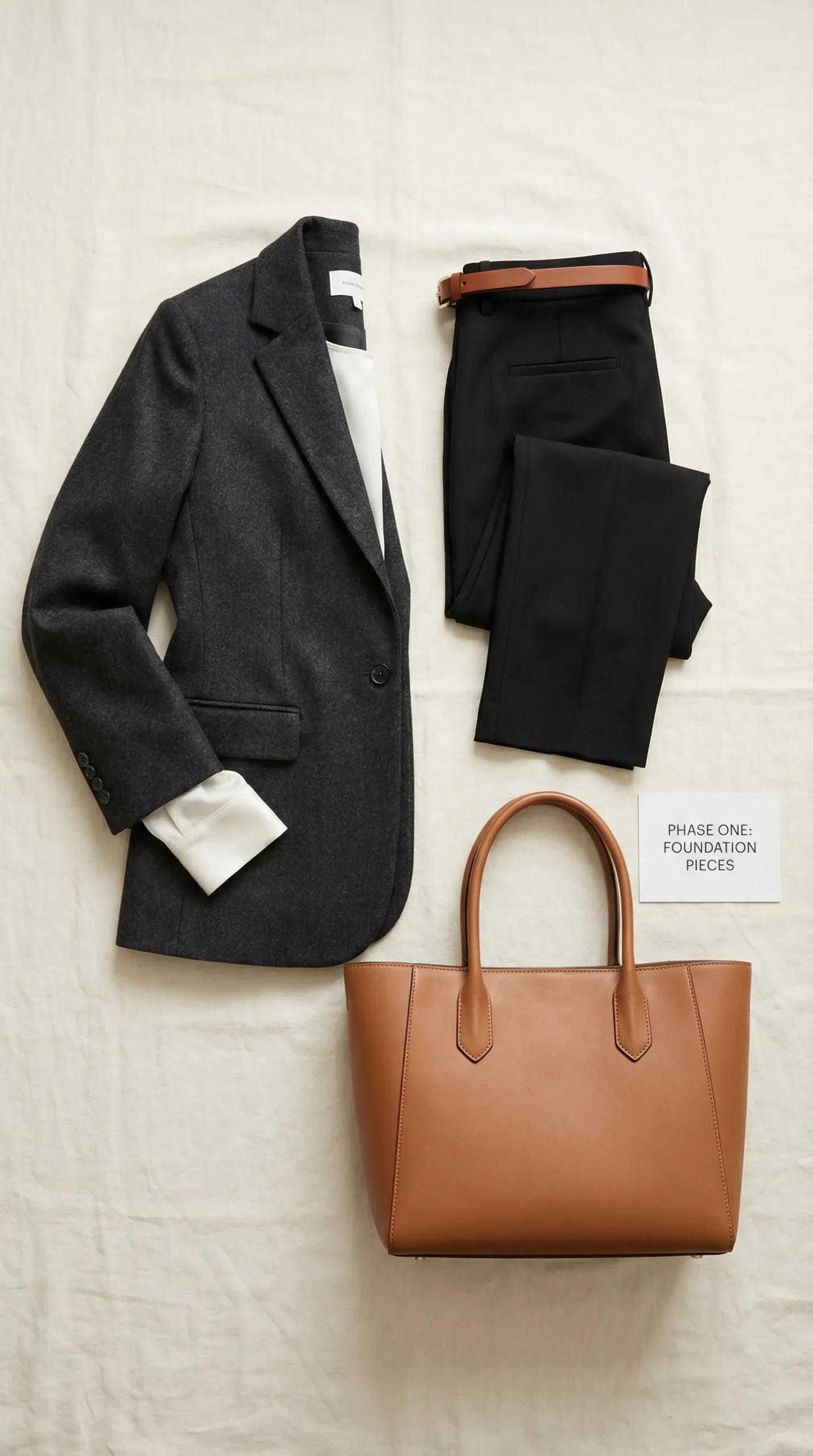
Phase 1 — Buy these first:
- One structured blazer in a neutral. This is the piece that makes everything else look intentional. It’s also the piece where spending more pays off most visibly. Do not cut corners here.
- One pair of well-fitting tailored trousers. The fit matters more than the fabric at this stage. Get them hemmed properly if needed. Bunching at the ankle reads as careless, not casual.
- One quality bag. Not a fashion bag. A structured, professional bag in a dark neutral that holds its shape. This is the second thing people notice.
Phase 2 — Add these second:
- Two to three basic shells or blouses in neutral tones. These sit under the blazer and don’t need to be expensive. They need to fit cleanly through the shoulders and not wrinkle aggressively by 11am.
- A second trouser in a different weight or colour. Once you have the first pair dialled in, a second gives you rotation without having to rethink your system.
- One pair of clean, simple heels or low block-heeled shoes. Not fashion shoes. Functional professional shoes that hold up across a full day.
Phase 3 — Add over time:
- Seasonal pieces (a lighter blazer for summer, a warmer layer for winter)
- A second bag if the first gets heavy use
- Anything trend-adjacent that earns its place through specific use, not aspiration
Trade-off: Building this way means you’ll wear the same core pieces on heavy rotation for the first several months. That is not a flaw in the system. That is the system working.
If you’re building work outfits for women on a real budget, the answer is almost always: buy fewer pieces and buy the right ones. Five things that work reliably beats twelve things that almost work.
The internet will tell you that you can assemble trendy work clothes on a budget with the right sale timing and enough patience. That’s partially true. But trends are the last category to add, not the first. Build the foundation in neutrals. Trends can come later, when you actually have the base to attach them to.
A £40 blazer that gaps at the button and loses its shape after six months is not a budget win. It’s a £40 lesson you’ll repeat until you stop repeating it.
FAQ — Corporate Outfits for Women
What is the difference between business formal and business casual for women?
Business formal means a suit, or a tailored dress with a blazer, in dark neutrals. Business casual is the same level of polish with more room — trousers without a matching jacket, a blouse without a blazer, a midi dress that doesn’t require a second layer. The silhouette still matters in both. The rigidity doesn’t.
Can women wear jeans to a corporate office?
Depends entirely on your office. Dark, straight-cut denim with no distressing can pass in some environments. Not in finance. Not in law. If you have to ask whether your specific workplace allows it, that uncertainty is your answer.
What should a woman wear to a corporate job interview?
A tailored blazer, well-fitted trousers or a knee-length skirt, and closed-toe shoes. Keep the color palette dark or neutral. The goal is to remove clothing as a variable entirely — they should be thinking about your answers, not your outfit. The full breakdown on interview dressing is covered in the interview section above.
What are the best corporate outfits for plus size women?
The same rules apply: structure, fit, and fabric quality. A well-tailored wide-leg trouser in a medium-weight fabric is not a compromise — it is genuinely one of the strongest silhouettes for most body types. What changes for plus-size dressing is fit priority: off-the-rack often needs alteration at the waist, and that alteration is worth the cost every single time.
How do I dress corporate in summer without overheating?
Linen-blend trousers, cotton-silk blouses, and breathable knit blazers in pale neutrals. Avoid anything with a polyester lining in August. The seasonal dressing section covers fabric choices and weight by temperature range in more detail.
What shoes are appropriate for a corporate office?
A low block heel, a loafer, a leather flat, or a clean pointed-toe flat. The heel height is less important than the finish — scuffed or worn soles read as careless regardless of the shoe. Shoe guidance by outfit type is in the capsule wardrobe section.
Are sneakers ever acceptable in a corporate environment?
Clean leather sneakers (think minimal, white or black, no branding) can work in creative or tech-adjacent offices on casual Fridays. Classic athletic sneakers stay home. Blunt truth: if you work in a traditional corporate environment and you’re still debating this, the answer is no.
What corporate outfits work for young women starting their first job?
Start with three pairs of trousers, two blazers, and five tops that rotate. That covers two weeks with minimal repetition. Prioritize fit over quantity — two pairs of well-fitted trousers beat five that need adjusting. The capsule wardrobe section maps this out in full.
How many work outfits do I actually need?
Ten complete outfits is a functional starting point for a five-day work week. That’s not ten of everything — it’s ten combinations you’ve already tested and know work. Business outfits for women don’t need volume. They need reliability. Most people rewear more than they admit, and that’s fine.